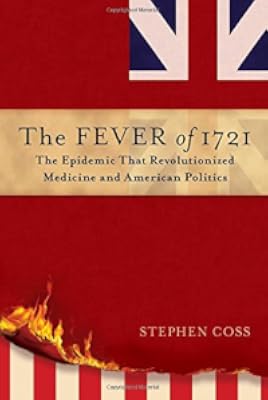
The Fever of 1721: The Epidemic That Revolutionized Medicine and American Politics
by Stephen Coss
On This Page
Description
"More than fifty years before the American Revolution, Boston was in revolt against the tyrannies of the Crown, Puritan Authority, and Superstition. This is the story of a fateful year that prefigured the events of 1776. In The Fever of 1721, Stephen Coss brings to life an amazing cast of characters in a year that changed the course of medical history, American journalism, and colonial revolution, including Cotton Mather, the great Puritan preacher, son of the president of Harvard College; show more Zabdiel Boylston, a doctor whose name is on one of Boston's grand avenues; James and his younger brother Benjamin Franklin; and Elisha Cooke and his protege; Samuel Adams. During the worst smallpox epidemic in Boston history Mather convinced Doctor Boylston to try a procedure that he believed would prevent death--by making an incision in the arm of a healthy person and implanting it with smallpox. "Inoculation" led to vaccination, one of the most profound medical discoveries in history. Public outrage forced Boylston into hiding, and Mather's house was firebombed. A political fever also raged. Elisha Cooke was challenging the Crown for control of the colony and finally forced Royal Governor Samuel Shute to flee Massachusetts. Samuel Adams and the Patriots would build on this to resist the British in the run-up to the American Revolution. And a bold young printer James Franklin (who was on the wrong side of the controversy on inoculation), launched America's first independent newspaper and landed in jail. His teenage brother and apprentice, Benjamin Franklin, however, learned his trade in James's shop and became a father of the Independence movement. One by one, the atmosphere in Boston in 1721 simmered and ultimately boiled over, leading to the full drama of the American Revolution"-- show lessTags
Recommendations


Member Recommendations


themulhern Benjamin Franklin plays a significant role in both.
Member Reviews
In general, I felt like Coss was writing two different books which only barely intersected and did not have the cause and effect aspect he proposes. The revolutionary aspect of this smallpox epidemic was that inoculation was used and there was a large battle about whether it was safe or efficacious. The practice was banned despite more success than failure. The idea for inoculation came from African and Asian sources, and the doctor practicing it mostly succeeded (those who died after inoculation were generally the elderly, the weak, and those who had already contracted smallpox prior to being inoculated).
The politics come in due to the battles between the Boston city council and British crown representatives, and the changing of the show more giving way of the Puritan powers. Also, Benjamin Franklin was working in his brother's printing shop in Boston in this period and had some anonymous editorials published. Coss states that the American Revolution started here, and that Boston was in revolt against the tyrannies of the crown, but I feel this is a pretty big stretch.
Stating that this epidemic radicalized Franklin also seems semi-ridiculous to me. His involvement with the inoculation battle came in his brother printing anti-inoculation articles (and other political items subject to censorship and arrest) solely because Cotton Mather (yes, that one) was a force in suggesting and supporting inoculation. So Franklin was radicalized by his brother unfairly vilifying someone based on personal feelings? Okay...
The two stories are interesting, but tacking them together and attempting to turn them into something extra sensational didn't serve either story well. The history of inoculation is really interesting on its own and doesn't need to be dressed up. Likewise the history of early pushbacks against Crown power in the US is plenty interesting (but since it's mostly about personal gains and losses of a few leading figures I think it's unfair to say the Boston city council was revolutionary).
Not recommended. show less
The politics come in due to the battles between the Boston city council and British crown representatives, and the changing of the show more giving way of the Puritan powers. Also, Benjamin Franklin was working in his brother's printing shop in Boston in this period and had some anonymous editorials published. Coss states that the American Revolution started here, and that Boston was in revolt against the tyrannies of the crown, but I feel this is a pretty big stretch.
Stating that this epidemic radicalized Franklin also seems semi-ridiculous to me. His involvement with the inoculation battle came in his brother printing anti-inoculation articles (and other political items subject to censorship and arrest) solely because Cotton Mather (yes, that one) was a force in suggesting and supporting inoculation. So Franklin was radicalized by his brother unfairly vilifying someone based on personal feelings? Okay...
The two stories are interesting, but tacking them together and attempting to turn them into something extra sensational didn't serve either story well. The history of inoculation is really interesting on its own and doesn't need to be dressed up. Likewise the history of early pushbacks against Crown power in the US is plenty interesting (but since it's mostly about personal gains and losses of a few leading figures I think it's unfair to say the Boston city council was revolutionary).
Not recommended. show less
 This review was written for LibraryThing Early Reviewers.
Health is always political
The Fever of 1721: The Epidemic That Revolutionized Medicine and American Politics by Stephen Coss (Simon & Schuster, $28).
If you think vaccinations cause controversy now, you should have seen how wigged out people got over inoculations in the Colonial Period—when they still wore wigs—in this new history of the 1721 smallpox outbreak in Boston.
While the conclusions are a bit forced–he doesn’t make the case for “revolution,” but given the time period under consideration, it was probably hard to resist using that word–Stephen Coss’s The Fever of 1721: The Epidemic That Revolutionized Medicine and American Politics is a fascinating story.
Imagine the sort of superstitious panic that cable news can show more make from something like Ebola or Zika, and then quadruple it. If anything, this narrative is proof positive that while technology changes, people don’t: infected passengers escaped quarantine and spread the disease they were trying to avoid; public controversy over the use of inoculation as a preventative measure caused disruption to the community; and media mogul James Franklin (Benjamin’s big brother) made outrageous use of public angst to increase circulation of his newspaper.
All one needs to do is remember the parade of proud science-deniers and their unvaccinated children in the California statehouse a year ago to understand that the more we change, the more we stay the same.
Reviewed on Lit/Rant: www.litrant.tumblr.com show less
The Fever of 1721: The Epidemic That Revolutionized Medicine and American Politics by Stephen Coss (Simon & Schuster, $28).
If you think vaccinations cause controversy now, you should have seen how wigged out people got over inoculations in the Colonial Period—when they still wore wigs—in this new history of the 1721 smallpox outbreak in Boston.
While the conclusions are a bit forced–he doesn’t make the case for “revolution,” but given the time period under consideration, it was probably hard to resist using that word–Stephen Coss’s The Fever of 1721: The Epidemic That Revolutionized Medicine and American Politics is a fascinating story.
Imagine the sort of superstitious panic that cable news can show more make from something like Ebola or Zika, and then quadruple it. If anything, this narrative is proof positive that while technology changes, people don’t: infected passengers escaped quarantine and spread the disease they were trying to avoid; public controversy over the use of inoculation as a preventative measure caused disruption to the community; and media mogul James Franklin (Benjamin’s big brother) made outrageous use of public angst to increase circulation of his newspaper.
All one needs to do is remember the parade of proud science-deniers and their unvaccinated children in the California statehouse a year ago to understand that the more we change, the more we stay the same.
Reviewed on Lit/Rant: www.litrant.tumblr.com show less
This is a fascinating snapshot of New England society during the early 1700s. While the book's central point is the smallpox epidemic and eventual inoculation, the focus is not at all that narrow. Within and surrounding this topic, we explore relationships, politics, medical care, and religion.
The writing is clear and concise, and the content exceptionally well researched. I found the author's style thoroughly engaging. It's not at all a dry, textbook kind of read. Instead, I felt like I was immersed in the era, meeting the people, experiencing the terror of the epidemic and the fear of the unknown. Having grown up minutes from where much of this took place, I was surprised at how little detail I knew. We learn a bunch of dates and show more facts in history classes, but rarely the full, human story. And this is a remarkable, human story.
*I received an advance ebook copy from the publisher, via NetGalley, in exchange for my honest review.* show less
The writing is clear and concise, and the content exceptionally well researched. I found the author's style thoroughly engaging. It's not at all a dry, textbook kind of read. Instead, I felt like I was immersed in the era, meeting the people, experiencing the terror of the epidemic and the fear of the unknown. Having grown up minutes from where much of this took place, I was surprised at how little detail I knew. We learn a bunch of dates and show more facts in history classes, but rarely the full, human story. And this is a remarkable, human story.
*I received an advance ebook copy from the publisher, via NetGalley, in exchange for my honest review.* show less
I went back and listened to the introduction and the prologue after I finished the book and it brought it together for me as I felt this book was interesting but the author tended to go off on tangents.
I have a theory of why this may have happened. It sounded to me that the author did extensive research of the newspapers of the period for his story. It seemed that when he did he got interested in other stories in the paper and wanted to fit them all in even though many didn't really tie coherently into his story lines. The lines being the politics of the time, the development of the smallpox inoculation, and rise of independent newspapers. It sometimes seemed like he was reading you the daily papers.
I rank the information covered show more very high but my ranking also reflects the poor transitions and extraneous information included that didn't hold my attention. It was definitely an interesting time in history and I think the story could have been told in a way that would better hold one's interest. show less
I have a theory of why this may have happened. It sounded to me that the author did extensive research of the newspapers of the period for his story. It seemed that when he did he got interested in other stories in the paper and wanted to fit them all in even though many didn't really tie coherently into his story lines. The lines being the politics of the time, the development of the smallpox inoculation, and rise of independent newspapers. It sometimes seemed like he was reading you the daily papers.
I rank the information covered show more very high but my ranking also reflects the poor transitions and extraneous information included that didn't hold my attention. It was definitely an interesting time in history and I think the story could have been told in a way that would better hold one's interest. show less
This review was written for LibraryThing Early Reviewers.A lively tale of the 1721 smallpox epidemic in Boston. During this epidemic Ben Franklin got his start as a newspaperman and Cotton Mather pursued the cause of science and becomes a member of the Royal Society. A useful reminder that Boston was an uppity pain to Great Britain a good 50 years before the Tea Party and Massacre. The story also reminds us that nutters were attacking people because of what they had read about them then as now.
A lengthy epilogue probably exaggerates the importance of some of the events, but is nonetheless interesting.
Probably the most important character in the book is not Boylston, the doctor who inoculated roughly 100 Bostonians, or the governor of Massachusetts, but James Franklin, the publisher of the show more newspaper "The Boston Courant", and Ben Franklin's older and more alcoholic brother.
James Franklin's anti-Harvard diatribes (he called just about everybody associated with Harvard a bunch of stuck-up plagiarists) are kind of on the ball today.
The Puritan vs. Anglican battle was pretty funny.
It is alway nice to be reminded that a good many Protestants considered the celebration of Christmas to be a form of idolatry.
The reader went in for a few mispronunciations, the most irritating being reading "ye" as "ye" instead of "the". show less
A lengthy epilogue probably exaggerates the importance of some of the events, but is nonetheless interesting.
Probably the most important character in the book is not Boylston, the doctor who inoculated roughly 100 Bostonians, or the governor of Massachusetts, but James Franklin, the publisher of the show more newspaper "The Boston Courant", and Ben Franklin's older and more alcoholic brother.
James Franklin's anti-Harvard diatribes (he called just about everybody associated with Harvard a bunch of stuck-up plagiarists) are kind of on the ball today.
The Puritan vs. Anglican battle was pretty funny.
It is alway nice to be reminded that a good many Protestants considered the celebration of Christmas to be a form of idolatry.
The reader went in for a few mispronunciations, the most irritating being reading "ye" as "ye" instead of "the". show less
This review was written for LibraryThing Early Reviewers.I received a free advanced readers copy of this audiobook through the Library Thing Early Reviewers program in exchange for an honest review.
1721 is a pivotal year in Boston history. Coss details how a popular party of elected representatives challenge the rule of the Royal Governor establishing the ideology and some of the organizations that would be used by the Revolutionary generation 50 years later. At the same time, The New England Courant is launched as the first colonial newspaper completely independent of the government's imprimatur and challenges the political and religious leaders of the time. Tying them together is an epidemic of smallpox and the effort of some learned people in the town to try to fight it using a new idea, show more inoculation.
There are five pivotal figures in this book:
While I was familiar with a lot of the aspects of this history, I found it fascinating how Coss tied them together and showed how they influenced one another and lasting impact on Boston and Colonial America. It's a fascinating and engaging historical work. show less
1721 is a pivotal year in Boston history. Coss details how a popular party of elected representatives challenge the rule of the Royal Governor establishing the ideology and some of the organizations that would be used by the Revolutionary generation 50 years later. At the same time, The New England Courant is launched as the first colonial newspaper completely independent of the government's imprimatur and challenges the political and religious leaders of the time. Tying them together is an epidemic of smallpox and the effort of some learned people in the town to try to fight it using a new idea, show more inoculation.
There are five pivotal figures in this book:
- Elisha Cooke, Jr., the popular party politician whose election as Speaker of the Massachusetts House of Representative leads to a showdown with Royal Governor Samuel Shute, who dissolves the House and calls for new elections.
- James Franklin, publisher of The New England Courant, who publishes opinions that scandalize the established elites and religious leaders of the colony, while also aiming for a more entertaining and literary journalism than offered by the two existing newspapers. While generally on the side of reason against tradition and superstition, Franklin's Courant comes out strongly against inoculation.
- Benjamin Franklin, James' much younger brother and apprentice who educates himself with materials at the print shop and makes his first impression by anonymously submitting the Courant's most popular opinion pieces under the pseudonym of Silence Dogood. Franklin, of course, is a direct connection to the Revolutionary period of the 1760s & 1770s.
- Cotton Mather, the conservative Puritan preacher and theologian, seeking redemption for his part in the Salem Witch hysteria. Surprisingly he is also a man of science who initiates the call to attempt inoculation against small pox which he learns of from his African slave Onesimus and the writings of physicians in Europe.
- Dr. Zabdiel Boylston, a middling physician who answers the call to attempt inoculation and continues to do so despite strong opposition in the town and threats to his life. Boylston ends up successfully inoculating nearly 250 people for smallpox despite being a provincial doctor with no formal training and doing so before anyone in Britain had attempted to do so.
While I was familiar with a lot of the aspects of this history, I found it fascinating how Coss tied them together and showed how they influenced one another and lasting impact on Boston and Colonial America. It's a fascinating and engaging historical work. show less
This review was written for LibraryThing Early Reviewers.The Fever of 1721 should be about the smallpox epidemic of 1721, and it is, but it also draws on other subjects such as freedom of the press when newspapers were just starting out, piracy, colonial politics with the crown, early biography of Ben Franklin and the printing press, Cotton Mather. It's not what I expected, but it's hard to complain when I kept learning new things. Coss brings it alive through the judicial use of period language. This is a Club Sandwich of a book, however if you already know many of the incidents it may not hold together as a whole.
Members
- Recently Added By
Published Reviews
ThingScore 75
The history of a year can be revealing, if the right 12 months somehow encapsulate a crucial historical moment or trend. For his momentous year, Coss focuses on a small place, Boston. The Bay Colony’s capital had been founded in 1630 as a “city upon a hill,” built to beam a purified Christian faith to a fallen world. Not all settlers shared that goal, however, and the native peoples of show more the region routinely opposed it. And yet a later generation of Massachusetts men would help lead the struggle that culminated in American independence. It is easy to assume that the fierce Puritan flock of yore had somehow gestated the fiery patriots of 1776.
In Coss’s telling, the troubles of 1721 represent a shift away from a colony of faith and toward the modern politics of representative government. So does the emergence of the first independent American newspaper, James Franklin’s New-England Courant, unsanctioned by the government and a training ground for the editor’s little brother, Benjamin. Coss’s story is a Whig version of history, in which past events helpfully point toward an enlightened present. All the scene needed was a touch of modern science and, voilà, the dark ages recede. Enter smallpox.... show less
In Coss’s telling, the troubles of 1721 represent a shift away from a colony of faith and toward the modern politics of representative government. So does the emergence of the first independent American newspaper, James Franklin’s New-England Courant, unsanctioned by the government and a training ground for the editor’s little brother, Benjamin. Coss’s story is a Whig version of history, in which past events helpfully point toward an enlightened present. All the scene needed was a touch of modern science and, voilà, the dark ages recede. Enter smallpox.... show less
added by rybie2
Lists

Books Read in 2017
4,249 works; 130 members

Books We Discovered On LibraryThing
530 works; 130 members
Author Information

Some Editions
Awards and Honors
Awards
Common Knowledge
- Original publication date
- 2016
- People/Characters
- Oliver Noyes; William Clark; Elisha Cooke; Christopher Taylor; John Campbell; James Franklin (show all 20); Benjamin Franklin; William Brooker; Royal Governor Samuel Shute; Philip Musgrave; Cotton Mather; Judge Samuel Sewall; Charles Paxton; William Hutchinson; Jonathan Belcher; Lieutenant Governor William Dummer; Dr. William Douglass; Zabdiel Boylston; Thomas Walter; Samuel Mather
- Important places
- Boston, Massachusetts Bay Colony; Barbados, West Indies; Spectacle Island, Boston Harbor, Massachusetts Bay Colony
- Important events
- Boston Smallpox Epidemic (1721); South Sea Bubble (1720)
- Epigraph
- Part One: Trouble Near
The common people of this Province are so perverse, that when I remove any person from the Council, for not behaving himself with duty towards H.M. or His orders, or for treating me H. M. Govr. i... (show all)ll, that he becomes their favourite, and is chose a Representative.
- Samuel Shute, royal governor of Massachusetts, letter to the Council of Trade and Plantations, London, June 1, 1720
Part Two: Grievous Calamity
I in the burying place may see
Graves shorter there than i;
From Death's Arrest no Age is free
Young Children too may die;
My God, may such an awful Sight
... (show all)Awakening be to me!
Oh! That by early Grace I might
For Death prepared be.
- From "The New-England Primer" (required reading for every Boston schoolchild in the eighteenth century)
That disease...was then the most terrible of all the ministers of death...filling the churchyards with corpses, tormenting with constant fears all whom it had not yet stricken, leaving on those whose lives it spared the hideous traces of its power, turning the babe into a changeling at which the mother shuddered, and making the eyes and cheeks of the betrothed maiden objects of horror to the lover. - Thomas Babington Macaulay, "History of England", Chapter 20, "William and Mary", 1859
Part Three: American Monsters
Could unrepentance have kept to this courtly tone (learned out of imported periodicals), respectability might have been confounded, but James Franklin was an American and therefore an angr... (show all)y man.
- Perry Miller, The New England Mind: From Colony to Province, 1953 - Dedication
- For Judy, and for my sons: Dylan, Kevin, Brett, and Stephen
- First words
- Seventeen twenty-one might be the most important anonymous year in the evolution of both modern medicine and American liberty.
- Last words
- (Click to show. Warning: May contain spoilers.)He was with the patriots, where he had always belonged.
Classifications
Statistics
- Members
- 201
- Popularity
- 162,867
- Reviews
- 18
- Rating
- (3.83)
- Languages
- English
- Media
- Paper, Audiobook, Ebook
- ISBNs
- 9
- ASINs
- 2