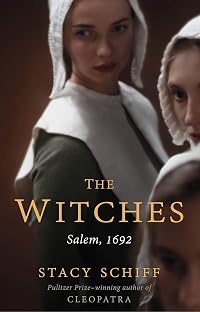
The Witches: Salem, 1692
by Stacy Schiff
On This Page
Description
It began in 1692, over an exceptionally raw Massachusetts winter, when a minister's daughter began to scream and convulse. It ended less than a year later, but not before 19 men and women had been hanged and an 80-year-old man crushed to death. The panic spread quickly, involving the most educated men and prominent politicians in the colony. Neighbors accused neighbors, parents and children each other. Aside from suffrage, the Salem Witch Trials represent the only moment when women played show more the central role in American history. In curious ways, the trials would shape the future republic.As psychologically thrilling as it is historically seminal, THE WITCHES is Stacy Schiff's account of this fantastical story-the first great American mystery unveiled fully for the first time by one of our most acclaimed historians. show lessTags
Recommendations










Member Recommendations
Member Reviews
Ms. Eliza Foss' narration enhanced Ms. Stacy Schiff's excellent The Witches : Salem, 1692. Time didn't hang while listening to its fifteen compact discs. It's not as if I haven't read about the Salem Witchcraft trials before in books I own. In fact, that's why I checked this book out from my local library.
I very much enjoyed the more recent information Ms. Schiff provided, although I wish she had checked out the Miss Gulch footage posted on YouTube in 2010 or watched a copy of the MGM 'The Wizard of Oz' movie before she wrote what she did about Aunt Em and Miss Gulch. As shown here, it's not Miss Gulch's wealth that prevents Aunt Em from telling her what she thinks of her. Aunt Em is held in check by her Christianity -- either because show more her opinion would be best expressed in foul language or that opinion is too far from the principle of Christian love. https://www.youtube.com/watch?v=AldxVQ8z5FQ
The section on the questioning and death of Giles Corey was particularly interesting because it contradicted something I had believed about him.
If you suffer from hypertension, be sure to take your blood pressure medication before listening. The behavior of the 'justices' (I get a bad taste in my mouth just typing that word for those men) is absolutely appalling! I found myself indulging in a fantasy of letting them know what their future reputations would be based upon their judicial murders of 19 persons. Another fantasy was if I had the telepathic and telekinetic powers of Jean Grey of the X-Men, I would have used them to make the girls accuse the justices, particularly, their chief, William Stoughton. I wonder how long the trials would have gone on then.
It was frightening how even being a person of good reputation couldn't save one from accusation. George Burroughs was a minister and he still hanged. This was definitely a situation where one was presumed guilty and left in a disgusting jail, manacled, for months while awaiting trial -- not to mention having to pay the costs of your imprisonment. You could also expect to have your possessions confiscated if you were convicted -- even if that left your children to starve.
The extent to which Salem tried to cover up their evil hysteria afterward made me angry, too.
To repeat, this is absorbing history, but you might want to watch some comedy every few CDs to calm you down. There's also a lesson to be taken from what learned and intelligent persons 'prove' using logic because their logic is influenced by their beliefs. (That cuts both ways, theists and atheists.)
I heartily recommend this book to persons interested in the Salem Witch Trials, American history, or examples of miscarriages of justice. show less
I very much enjoyed the more recent information Ms. Schiff provided, although I wish she had checked out the Miss Gulch footage posted on YouTube in 2010 or watched a copy of the MGM 'The Wizard of Oz' movie before she wrote what she did about Aunt Em and Miss Gulch. As shown here, it's not Miss Gulch's wealth that prevents Aunt Em from telling her what she thinks of her. Aunt Em is held in check by her Christianity -- either because show more her opinion would be best expressed in foul language or that opinion is too far from the principle of Christian love. https://www.youtube.com/watch?v=AldxVQ8z5FQ
The section on the questioning and death of Giles Corey was particularly interesting because it contradicted something I had believed about him.
If you suffer from hypertension, be sure to take your blood pressure medication before listening. The behavior of the 'justices' (I get a bad taste in my mouth just typing that word for those men) is absolutely appalling! I found myself indulging in a fantasy of letting them know what their future reputations would be based upon their judicial murders of 19 persons. Another fantasy was if I had the telepathic and telekinetic powers of Jean Grey of the X-Men, I would have used them to make the girls accuse the justices, particularly, their chief, William Stoughton. I wonder how long the trials would have gone on then.
It was frightening how even being a person of good reputation couldn't save one from accusation. George Burroughs was a minister and he still hanged. This was definitely a situation where one was presumed guilty and left in a disgusting jail, manacled, for months while awaiting trial -- not to mention having to pay the costs of your imprisonment. You could also expect to have your possessions confiscated if you were convicted -- even if that left your children to starve.
The extent to which Salem tried to cover up their evil hysteria afterward made me angry, too.
To repeat, this is absorbing history, but you might want to watch some comedy every few CDs to calm you down. There's also a lesson to be taken from what learned and intelligent persons 'prove' using logic because their logic is influenced by their beliefs. (That cuts both ways, theists and atheists.)
I heartily recommend this book to persons interested in the Salem Witch Trials, American history, or examples of miscarriages of justice. show less
Stacy Schiff attempts to set the record straight on the witch hysteria of 1692, something that has been defined for modern people by how it is depicted in movies, plays, and books. This is partially due to the efforts of those who lived through the crisis to erase the witch madness from the collective memory (for example, noted diarists of the period have blank spaces for the 9 months of the trials). Schiff relies on the official court transcripts for much of her narrative providing a relentless account of accusations, denials, questionable judicial practices, confessions, and further accusations. The repetition of the process would be tedious if it weren't so terrifying. The psychological effects of the hysteria are laid clear in show more written accounts of the accused who actually came to believe that they may in fact be witches. Over the course of time the crisis spirals out of Salem Village to Andover and Boston and threatens to undermine the economy and government of New England.
Schiff does a great job of establishing the context of the witch trials, with the understanding of witchcraft and previous crises including a dramatically large one in Sweden in 1675. Other events of the time that had an effect on the New Englander's psyche was the recent King Phillip's War (and continuing scuffles with natives and French settlers on the frontiers) and the revolt against New England royal governor Edmund Andros in 1689. The adoption of a new charter for the province and the arrival of a new governor for Massachusetts are events happening concurrently with the witch trials. Closer to home, Schiff examines the relationships of the residents of Salem Village. It's pretty clear that if you lived in Salem Village in 1692, you had some asshole neighbors, and the resentments informed the underlying tensions related to the witchcraft accusations. In the final chapters, Schiff also examines some theories behind why the witchcraft hysteria occurred, especially the psychology of the "afflicted" girls who's accusations were the tipping point. It's an interesting and accessible history of a horrendous atrocity and miscarriage of justice in American history. show less
Schiff does a great job of establishing the context of the witch trials, with the understanding of witchcraft and previous crises including a dramatically large one in Sweden in 1675. Other events of the time that had an effect on the New Englander's psyche was the recent King Phillip's War (and continuing scuffles with natives and French settlers on the frontiers) and the revolt against New England royal governor Edmund Andros in 1689. The adoption of a new charter for the province and the arrival of a new governor for Massachusetts are events happening concurrently with the witch trials. Closer to home, Schiff examines the relationships of the residents of Salem Village. It's pretty clear that if you lived in Salem Village in 1692, you had some asshole neighbors, and the resentments informed the underlying tensions related to the witchcraft accusations. In the final chapters, Schiff also examines some theories behind why the witchcraft hysteria occurred, especially the psychology of the "afflicted" girls who's accusations were the tipping point. It's an interesting and accessible history of a horrendous atrocity and miscarriage of justice in American history. show less
While there's a lot out there about the Salem witch trials, so much of it has been layered over with myth and confusion. As the author herself points out, there's very little by way of first-person eyewitness accounts of 1692 in Salem, as if the whole town collectively decided to erase the history. This thoroughly researched account takes you through 1692 from January when the strange behavior of a couple of girls and accusations first began, through the summer of trials and hangings, and the fall when the tide began to turn once again.
Schiff's account is detailed and evenhanded. By turns fascinating and tragic - especially stories my like own relative, Rebecca Nurse, who was an old woman and mostly deaf and so pious that most likely show more her excommunication was the most difficult part of the whole proceedings - most of the time the pages turn quickly, though there are a few times when the narrative gets bogged down by the very fact of how complicated piecing together what happened in chronological order can get and introducing all the main players. I had to look back at the list at the beginning more than once to remember who was who, accuser or accusee, and how one person was related to another. The bulk of the narrative simply takes you through the chronology of events, only at the end trying to make sense of what may have caused the girls to behave or accuse the way they did. I learned a lot and would love to learn more. show less
Schiff's account is detailed and evenhanded. By turns fascinating and tragic - especially stories my like own relative, Rebecca Nurse, who was an old woman and mostly deaf and so pious that most likely show more her excommunication was the most difficult part of the whole proceedings - most of the time the pages turn quickly, though there are a few times when the narrative gets bogged down by the very fact of how complicated piecing together what happened in chronological order can get and introducing all the main players. I had to look back at the list at the beginning more than once to remember who was who, accuser or accusee, and how one person was related to another. The bulk of the narrative simply takes you through the chronology of events, only at the end trying to make sense of what may have caused the girls to behave or accuse the way they did. I learned a lot and would love to learn more. show less
Author Stacy Schiff digs deep into the historical records to provide a detailed account of the 1692 Salem witchcraft trials. This book explains what led a community to execute 14 women, 5 men, and 2 dogs. Schiff’s account is thorough. She follows each person, in chronological order, from being accused through indictment, trial, and punishment.
Schiff intermixes facts with the fabrications of the participants. For the majority of the book, she focuses more on what happened than why. These last few chapters cover the causes of the mass hysteria, including superstitions, lack of modern legal procedures, a judge abusing power, and children (and others) taking the opportunity to be the center of attention. It is lengthy, and sometimes show more feels repetitive, as many of the accusations against the so-called “witches” are similar.
I listened to the audiobook, competently read by Eliza Foss. I appreciated the inclusion of the footnotes in the narration. As may be expected, some content is quite disturbing. The reader feels for these people so unjustly convicted and killed. show less
Schiff intermixes facts with the fabrications of the participants. For the majority of the book, she focuses more on what happened than why. These last few chapters cover the causes of the mass hysteria, including superstitions, lack of modern legal procedures, a judge abusing power, and children (and others) taking the opportunity to be the center of attention. It is lengthy, and sometimes show more feels repetitive, as many of the accusations against the so-called “witches” are similar.
I listened to the audiobook, competently read by Eliza Foss. I appreciated the inclusion of the footnotes in the narration. As may be expected, some content is quite disturbing. The reader feels for these people so unjustly convicted and killed. show less
I couldn’t put this one down. Not like a typical scholarly work. Informative, yes. But you feel as though you’re being told the story as if you’re there, not just reading an account of what transpired all those years ago.
Now, I knew people had some crazy views back then, but putting yourself into the contextual setting of these people really made me take a step back and try to empathize with them. Why would young women say they were possessed or were witches doing satan’s bidding? Why would you confess, even when you know it means prison and/or death? One entry hit the nail on the head I think, stating that “if I denied a thousand times, he would never believe me, if I confess once, he will stop the trial”. And the fact that show more Cotton Mathers moved on to inoculation. I don’t know how I never read (or maybe I did and just didn’t retain it) that.
Overall, my favorite historical account so far due to how immersive it was. What an absolutely insane, hysteria, terror filled time in our history. show less
Now, I knew people had some crazy views back then, but putting yourself into the contextual setting of these people really made me take a step back and try to empathize with them. Why would young women say they were possessed or were witches doing satan’s bidding? Why would you confess, even when you know it means prison and/or death? One entry hit the nail on the head I think, stating that “if I denied a thousand times, he would never believe me, if I confess once, he will stop the trial”. And the fact that show more Cotton Mathers moved on to inoculation. I don’t know how I never read (or maybe I did and just didn’t retain it) that.
Overall, my favorite historical account so far due to how immersive it was. What an absolutely insane, hysteria, terror filled time in our history. show less
I’ve reviewed a couple of books on the Salem witch outbreak before: Salem Possessed and Wonders of the Invisible World. I approached Stacy Schiff’s The Witches with some diffidence, since Ms. Schiff is a bestselling “popular” historian and my prejudice suggested a possible lack of rigor; I was disabused – this is an excellent, well written book. I wish I had read it as my first Salem history as the other books gloss over some of the aspects.
The Witches is mostly a straightforward chronological history of the witch outbreak: there’s some background, details of the years 1692 and 1693, and some summing-up. There are a lot of side trips Schiff could have taken but she sticks to the history; it’s already a long book. I’ll show more take some side trips myself in the review.
The Basics
Adolescent girls in Pastor Samuel Parris’ household did some sort of superstitious ritual; the results frightened them, and they began behaving strangely. They began accusing other people in the Salem area of bewitching them. A special court – Oyer and Terminer – was set up, and suspects were apprehended, jailed, tried, convicted and some were eventually executed. The accusations began to expand until a great many people from Salem and the surrounding area were imprisoned or under suspicion. Prisoners began to confess to pacts with Satan and flying to Satanic meetings – the confessions increased greatly when prisoners noticed that confessed Satanists weren’t executed (although some worried that would eventually come). The Mather family - father and son, Increase and Cotton - got involved. Eventually the hysteria seemed to die down more or less of its own accord, nobody else was tried, and all the prisoners were released. The trials became an embarrassment to the area simultaneously with becoming a national symbol for miscarriage of justice.
The Record
Schiff notes that records of the time are sparse. The official court proceedings are lost; it’s suspected they were destroyed in Stamp Act riots years later (1765), when the governor’s mansion was sacked and state papers thrown into the street. When Salem records were transcribed, everything relating to the trials was expunged from the new copies. Many contemporaries seem to have destroyed or expurgated letters, diaries, and other personal written records. This may account for inconsistencies in the reports I’ve read. For example, in Salem Possessed the girls have their initial encounter with the forces of evil when they do a ritual involving dropping an egg white into water and looking at the resulting shape; in The Witches the ritual involves making a “witch cake”. In Salem Possessed, part of the evidence against George Burroughs was he was able to pick up a heavy gun by the barrel; in The Witches, there are two incidents; once Burroughs picks up a barrel and sometime later he fires a heavy gun one-handed (since Burroughs was a “puny” man according to contemporaries, it was a given that he would need Satanic assistance to perform these feats, regardless of exactly what they were). In many of the accounts the slave girl Tituba - one of the accusers and a confessor to witchcraft - is portrayed as black; Schiff notes there’s no evidence for this and suggests she was Native American.
The Accusers
According to Schiff, the average age of the bewitched girls was 18; the average age of the executed witches was 56 (the ages of two of the 19 people executed are unknown). She doesn’t accuse the girls of deliberate malice, instead suggesting they were bored and started the whole thing as entertainment. The girls saw things; the accused witches had yellow or blue birds about them that only the girls could see; the witches could fly up to the rafters in the church or courtroom and dance on them, again only visible to the girls; the witches stuck pins into the girls and bit them (at least one of courtroom spectators saw a girl pull a pin out of her clothes and stick it into herself, but the report was apparently ignored). The witches could cause the girls to have fits by looking at them or gesturing (so sometimes the witches were blindfolded and tied during the proceedings). Schiff notes there must have been collusion and advance choreography. In one case, a girl’s hands were “tied” such that it took strong men to force them apart; Schiff takes this to mean there was a physical rope involved (and therefore collusion) while I think (based on the statement that “strong men forced them apart” rather than cut or untied a rope) that it was a “spectral” rope.
The Accused
The first witch to hang (and the only one hanged alone, rather than in a group) was Bridget Bishop. Bishop fits the pattern suggested in Salem Possessed – that the accused witches tended to be unpopular with their neighbors; she ran a tavern and was rather notorious in Salem for lying and “bad behavior” – like wearing brightly colored clothes. Some of the other executed witches don’t fit this template, though (although it must be conceded that records are so sparse there may have been “bad blood” that was never written down). A particularly grim case was Rebecca Nurse; she was well-respected in the community and many signed a petition asking for her acquittal. She was initially found not guilty, but the magistrates ordered the jury to reconsider and she was pronounced guilty when they returned after a second deliberation. The governor of Massachusetts, William Phips, granted Nurse a reprieve but when he left the state to fight Indians and Frenchmen, his lieutenant governor, William Stoughton (who was also one of the Salem judges), rescinded the reprieve and confirmed the death sentence.
The Evidence
I came across “spectral evidence” before, in other accounts of the trials and in Mather’s book, but I didn’t quite understand what it implied until Schiff explained it. A “specter” has the appearance of a living person; a ghost has the appearance of a dead one. Both were important at the trials – but only the girls could see either specters or ghosts. Spectral evidence had been presented at trials before – not only in Massachusetts but all over Europe - and there had been debates over its validity. The Salem judges took the hard-line position – not only was spectral evidence valid, but an innocent person could not appear as specter; if your specter appeared somewhere – even if it were only visible to teenage girls – it was conclusive evidence of your deal with Satan. Nobody, even the accused, suggested the girls were lying; when the accused were asked why they thought the girls were behaving the way they were, the answers were “They are bewitched – but not by me” or “They are possessed”. (You were “bewitched” by somebody else but “possession” was strictly between you and Satan). There had been earlier cases in Massachusetts where people behaving like the girls were judged as possessed rather than bewitched, but nobody took that route at Salem. It was not just an article of faith but an article of law that witches existed; denying the existence of witches was both blasphemy and a criminal offense. There are some cases where people who expressed any skepticism were accused of being witches themselves.
The Arrests
The sheriff picked up the accused, often to their considerable surprise. In a few cases, people received warnings and were able to flee; however, that allowed the sheriff to confiscate their property. Prison conditions were grim; the accused were chained and were charged for their food; four died in prison. As time went on the Salem jail became overcrowded and the accused had to be housed in Boston. One suspect, Giles Corey, refused to plead; he was staked out in the prison yard and increasingly heavy weights were piled on him until he died (Corey has become sort of a folk hero; supposedly his last words were “Pile on more, you sons of bitches”. There’s actually no evidence he said that, and he had earlier accused his own wife – who ended up hanging).
The Trials
Seventeenth century Massachusetts was a very litigious society; almost everybody had been to court at one time or another, either for lawsuits with neighbors over stray cattle or land titles, or if you did something the authorities didn’t like, such as fail to attend church. Nevertheless, there was nobody with formal legal training; instead the trials were conducted by a tribunal of magistrates who acted as prosecutors and judges (there was a jury, but the magistrates acted as judges in the sense that they ran the proceedings). The accused had no defense lawyer and didn’t know the evidence against her until she appeared in court. Although English law held you were innocent until proven guilty, the magistrates didn’t act that way. What trial records exist seem to describe a pretty chaotic scene; the magistrates flinging rapid-fire accusations at the accused and the girls going into fits or seeing specters as the mood struck them. In at least one case, the girls had accused someone they had never met but knew only by name; in court they flew into fits when the wrong person arrived. As far as we know, there was only one “Not guilty” verdict in the initial round of trials, and that was overturned when the magistrates ordered the jury to go back and redeliberate.
The Executions
The guilty were taken by cart to improvised gallows; they had to mount a ladder – probably a difficult accomplishment when tied and hooded – and then “turned off”; there was no drop and the victims slowly strangled. George Burroughs made an impassioned speech, including a perfect recitation of the Lord’s Prayer. This caused some murmuring among the spectators, since witches were supposedly unable to do so; however, they were assured that Satan was invisibly prompting him and he hung anyway. There was a single execution on June 10, 1692; five (all women) on July 19; five (four men) on August 19; and eight (two men) on September 22.
The Confessions
Prisoners eventually realized if they confessed they were spared immediate execution – although perhaps believing they would be executed eventually, at least it gave them some time. Soon everybody still in prison was confessing – and implicating more and more others as they did so. The confessions are very similar – Satan appeared as a “black” or “dark” man in a high-crowned hat. He offered you a book to sign, sometimes promising benefits if you did and sometimes making threats if you didn’t. Once enrolled, you flew on a pole (no brooms involved) to Reverend Parris’ pasture where you hobnobbed with your fellow witches and wizards. The Satanic benefits are surprisingly prosaic; no eternal life or sexual pleasure; instead recruits were promised colorful clothes and picture books. Hmm, books. I wonder… No, never mind. Schiff notes that colorful things figure prominently in many of the narratives – the girls often saw spectral yellow or blue birds associating with the accused witches, and the confessions mention colorful things as Satanic rewards; she speculates Massachusetts in the late 1600s was so drab color was the most luxurious thing people could imagine.
The End
Governor Phips returned from his military expedition; he dissolved the Court of Oyer and Terminer and directed trials continue in the regular courts; he also forbade consideration of spectral evidence. (One of the magistrates, Stoughton, resigned in protest, but eventually returned). There were no further convictions and everybody, including all the confessed witches, was released.
The Aftermath
Everybody had accused everybody else of Satanism; they all just hung their heads and went about their business. Salem Village eventually changed its name to Danvers (Salem Town remains Salem and eventually began profiting from the notoriety, doing a lot of tourist business on Halloween). John Hathorne was one of the “Hanging Judges”; out of embarrassment his family changed their name to Hawthorne (Nathaniel Hawthorne was a descendant). Formal apologies were issued to some of the families, and there was some financial restitution (although it took years to come through). Since the word “Puritan” was tainted, history books began calling the initial Massachusetts settlers “Pilgrims” instead of “Puritans”. The witch trials were even used as a slur on the North by the South during the Civil War.
The Implications
This is an area where Schiff seems deficient. She attributes the girls’ behavior to “hysteria” and cites Freud as an authority, apparently not realizing that neither the term “hysteria” nor the authority of Freud carry much weight any more. There’s one mention of the recent “satanic day care abuse” cases, where day care center operators were accused of a variety of seemingly unlikely things (and often convicted and imprisoned) based on the testimony of preschoolers. Schiff doesn’t mention the hypothesis of political conflict between Salem Village and Salem Town developed in Salem Possessed; however, she discusses at some length the coup carried out against Governor Edmund Andros in 1689; Andros was accused of plotting to betray Massachusetts to the French and of supplying Indians with weapons. The Mathers and some of the other figures involved in the witch trials were prime movers in the action against Andros; Schiff notes it’s more likely that Andros was actually deposed for promoting the Church of England and enforcing anti-smuggling laws rather than any imaginary efforts on behalf of French and Indians.
Long but an easy read; footnotes, endnotes, and an excellent bibliography. Photographs of paintings of some of the participants. I’ll have to read more and take on some of Schiff’s other books. show less
The Witches is mostly a straightforward chronological history of the witch outbreak: there’s some background, details of the years 1692 and 1693, and some summing-up. There are a lot of side trips Schiff could have taken but she sticks to the history; it’s already a long book. I’ll show more take some side trips myself in the review.
The Basics
Adolescent girls in Pastor Samuel Parris’ household did some sort of superstitious ritual; the results frightened them, and they began behaving strangely. They began accusing other people in the Salem area of bewitching them. A special court – Oyer and Terminer – was set up, and suspects were apprehended, jailed, tried, convicted and some were eventually executed. The accusations began to expand until a great many people from Salem and the surrounding area were imprisoned or under suspicion. Prisoners began to confess to pacts with Satan and flying to Satanic meetings – the confessions increased greatly when prisoners noticed that confessed Satanists weren’t executed (although some worried that would eventually come). The Mather family - father and son, Increase and Cotton - got involved. Eventually the hysteria seemed to die down more or less of its own accord, nobody else was tried, and all the prisoners were released. The trials became an embarrassment to the area simultaneously with becoming a national symbol for miscarriage of justice.
The Record
Schiff notes that records of the time are sparse. The official court proceedings are lost; it’s suspected they were destroyed in Stamp Act riots years later (1765), when the governor’s mansion was sacked and state papers thrown into the street. When Salem records were transcribed, everything relating to the trials was expunged from the new copies. Many contemporaries seem to have destroyed or expurgated letters, diaries, and other personal written records. This may account for inconsistencies in the reports I’ve read. For example, in Salem Possessed the girls have their initial encounter with the forces of evil when they do a ritual involving dropping an egg white into water and looking at the resulting shape; in The Witches the ritual involves making a “witch cake”. In Salem Possessed, part of the evidence against George Burroughs was he was able to pick up a heavy gun by the barrel; in The Witches, there are two incidents; once Burroughs picks up a barrel and sometime later he fires a heavy gun one-handed (since Burroughs was a “puny” man according to contemporaries, it was a given that he would need Satanic assistance to perform these feats, regardless of exactly what they were). In many of the accounts the slave girl Tituba - one of the accusers and a confessor to witchcraft - is portrayed as black; Schiff notes there’s no evidence for this and suggests she was Native American.
The Accusers
According to Schiff, the average age of the bewitched girls was 18; the average age of the executed witches was 56 (the ages of two of the 19 people executed are unknown). She doesn’t accuse the girls of deliberate malice, instead suggesting they were bored and started the whole thing as entertainment. The girls saw things; the accused witches had yellow or blue birds about them that only the girls could see; the witches could fly up to the rafters in the church or courtroom and dance on them, again only visible to the girls; the witches stuck pins into the girls and bit them (at least one of courtroom spectators saw a girl pull a pin out of her clothes and stick it into herself, but the report was apparently ignored). The witches could cause the girls to have fits by looking at them or gesturing (so sometimes the witches were blindfolded and tied during the proceedings). Schiff notes there must have been collusion and advance choreography. In one case, a girl’s hands were “tied” such that it took strong men to force them apart; Schiff takes this to mean there was a physical rope involved (and therefore collusion) while I think (based on the statement that “strong men forced them apart” rather than cut or untied a rope) that it was a “spectral” rope.
The Accused
The first witch to hang (and the only one hanged alone, rather than in a group) was Bridget Bishop. Bishop fits the pattern suggested in Salem Possessed – that the accused witches tended to be unpopular with their neighbors; she ran a tavern and was rather notorious in Salem for lying and “bad behavior” – like wearing brightly colored clothes. Some of the other executed witches don’t fit this template, though (although it must be conceded that records are so sparse there may have been “bad blood” that was never written down). A particularly grim case was Rebecca Nurse; she was well-respected in the community and many signed a petition asking for her acquittal. She was initially found not guilty, but the magistrates ordered the jury to reconsider and she was pronounced guilty when they returned after a second deliberation. The governor of Massachusetts, William Phips, granted Nurse a reprieve but when he left the state to fight Indians and Frenchmen, his lieutenant governor, William Stoughton (who was also one of the Salem judges), rescinded the reprieve and confirmed the death sentence.
The Evidence
I came across “spectral evidence” before, in other accounts of the trials and in Mather’s book, but I didn’t quite understand what it implied until Schiff explained it. A “specter” has the appearance of a living person; a ghost has the appearance of a dead one. Both were important at the trials – but only the girls could see either specters or ghosts. Spectral evidence had been presented at trials before – not only in Massachusetts but all over Europe - and there had been debates over its validity. The Salem judges took the hard-line position – not only was spectral evidence valid, but an innocent person could not appear as specter; if your specter appeared somewhere – even if it were only visible to teenage girls – it was conclusive evidence of your deal with Satan. Nobody, even the accused, suggested the girls were lying; when the accused were asked why they thought the girls were behaving the way they were, the answers were “They are bewitched – but not by me” or “They are possessed”. (You were “bewitched” by somebody else but “possession” was strictly between you and Satan). There had been earlier cases in Massachusetts where people behaving like the girls were judged as possessed rather than bewitched, but nobody took that route at Salem. It was not just an article of faith but an article of law that witches existed; denying the existence of witches was both blasphemy and a criminal offense. There are some cases where people who expressed any skepticism were accused of being witches themselves.
The Arrests
The sheriff picked up the accused, often to their considerable surprise. In a few cases, people received warnings and were able to flee; however, that allowed the sheriff to confiscate their property. Prison conditions were grim; the accused were chained and were charged for their food; four died in prison. As time went on the Salem jail became overcrowded and the accused had to be housed in Boston. One suspect, Giles Corey, refused to plead; he was staked out in the prison yard and increasingly heavy weights were piled on him until he died (Corey has become sort of a folk hero; supposedly his last words were “Pile on more, you sons of bitches”. There’s actually no evidence he said that, and he had earlier accused his own wife – who ended up hanging).
The Trials
Seventeenth century Massachusetts was a very litigious society; almost everybody had been to court at one time or another, either for lawsuits with neighbors over stray cattle or land titles, or if you did something the authorities didn’t like, such as fail to attend church. Nevertheless, there was nobody with formal legal training; instead the trials were conducted by a tribunal of magistrates who acted as prosecutors and judges (there was a jury, but the magistrates acted as judges in the sense that they ran the proceedings). The accused had no defense lawyer and didn’t know the evidence against her until she appeared in court. Although English law held you were innocent until proven guilty, the magistrates didn’t act that way. What trial records exist seem to describe a pretty chaotic scene; the magistrates flinging rapid-fire accusations at the accused and the girls going into fits or seeing specters as the mood struck them. In at least one case, the girls had accused someone they had never met but knew only by name; in court they flew into fits when the wrong person arrived. As far as we know, there was only one “Not guilty” verdict in the initial round of trials, and that was overturned when the magistrates ordered the jury to go back and redeliberate.
The Executions
The guilty were taken by cart to improvised gallows; they had to mount a ladder – probably a difficult accomplishment when tied and hooded – and then “turned off”; there was no drop and the victims slowly strangled. George Burroughs made an impassioned speech, including a perfect recitation of the Lord’s Prayer. This caused some murmuring among the spectators, since witches were supposedly unable to do so; however, they were assured that Satan was invisibly prompting him and he hung anyway. There was a single execution on June 10, 1692; five (all women) on July 19; five (four men) on August 19; and eight (two men) on September 22.
The Confessions
Prisoners eventually realized if they confessed they were spared immediate execution – although perhaps believing they would be executed eventually, at least it gave them some time. Soon everybody still in prison was confessing – and implicating more and more others as they did so. The confessions are very similar – Satan appeared as a “black” or “dark” man in a high-crowned hat. He offered you a book to sign, sometimes promising benefits if you did and sometimes making threats if you didn’t. Once enrolled, you flew on a pole (no brooms involved) to Reverend Parris’ pasture where you hobnobbed with your fellow witches and wizards. The Satanic benefits are surprisingly prosaic; no eternal life or sexual pleasure; instead recruits were promised colorful clothes and picture books. Hmm, books. I wonder… No, never mind. Schiff notes that colorful things figure prominently in many of the narratives – the girls often saw spectral yellow or blue birds associating with the accused witches, and the confessions mention colorful things as Satanic rewards; she speculates Massachusetts in the late 1600s was so drab color was the most luxurious thing people could imagine.
The End
Governor Phips returned from his military expedition; he dissolved the Court of Oyer and Terminer and directed trials continue in the regular courts; he also forbade consideration of spectral evidence. (One of the magistrates, Stoughton, resigned in protest, but eventually returned). There were no further convictions and everybody, including all the confessed witches, was released.
The Aftermath
Everybody had accused everybody else of Satanism; they all just hung their heads and went about their business. Salem Village eventually changed its name to Danvers (Salem Town remains Salem and eventually began profiting from the notoriety, doing a lot of tourist business on Halloween). John Hathorne was one of the “Hanging Judges”; out of embarrassment his family changed their name to Hawthorne (Nathaniel Hawthorne was a descendant). Formal apologies were issued to some of the families, and there was some financial restitution (although it took years to come through). Since the word “Puritan” was tainted, history books began calling the initial Massachusetts settlers “Pilgrims” instead of “Puritans”. The witch trials were even used as a slur on the North by the South during the Civil War.
The Implications
This is an area where Schiff seems deficient. She attributes the girls’ behavior to “hysteria” and cites Freud as an authority, apparently not realizing that neither the term “hysteria” nor the authority of Freud carry much weight any more. There’s one mention of the recent “satanic day care abuse” cases, where day care center operators were accused of a variety of seemingly unlikely things (and often convicted and imprisoned) based on the testimony of preschoolers. Schiff doesn’t mention the hypothesis of political conflict between Salem Village and Salem Town developed in Salem Possessed; however, she discusses at some length the coup carried out against Governor Edmund Andros in 1689; Andros was accused of plotting to betray Massachusetts to the French and of supplying Indians with weapons. The Mathers and some of the other figures involved in the witch trials were prime movers in the action against Andros; Schiff notes it’s more likely that Andros was actually deposed for promoting the Church of England and enforcing anti-smuggling laws rather than any imaginary efforts on behalf of French and Indians.
Long but an easy read; footnotes, endnotes, and an excellent bibliography. Photographs of paintings of some of the participants. I’ll have to read more and take on some of Schiff’s other books. show less
A story of superstition, of piety, of unanswerable questions, the Salem witch trials of 1692 have long enthralled us. It may be difficult to believe that anything original could be published regarding these events over three hundred years after they took place, however, Schiff easily refutes this in her comprehensive dissection of one of the darkest periods of American history. Concerning not just the infamous witch trials and subsequent hangings but also the basic tenets of Puritanism, the politics of colonial Massachusetts, and the hardships of life in rural New England, The Witches is a substantial historical narrative. Not recommended for the casual reader, a narrative of this magnitude is intimidating at times with its sheer volume show more of details and footnotes, but is well worth the investment. Chock full of captivating anecdotes, Schiff's text is as witty as it is informative, deconstructing with finesse the courtroom blunders, neighborhood grudges and betrayals, and supernatural and folkloric conspiracies that plagued the trials of 1692. Split into "acts", the narrative progresses from a systematic introduction of characters and background on the political and social climate early in the year, leading to a turning point in the trials in early summer when outside authority is brought in and the situation escalates, the jails filled to bursting with the accused. The final act is marked by a culmination of the witch trials as the summer progressed into fall and the fine line of Puritanism between religious entreaty through prayer and witchcraft grew even more convoluted and skeptics of the debacle became the easiest targets. The gravity lies not only in the deaths of the accused by hanging, but also those who perished in prison and families destroyed by the shame of witchcraft accusations. Schiff's asides and village tales can be lengthy and difficult to follow at times, meandering as they are, yet for readers seeking the complete picture they are essential and do not detract from the overall impact of the text. In closing, The Witches offers a succinct explanation of what the author believes truly ailed the bewitched girls of Salem and why a mere year of distant American history continues to haunt and fascinate. show less
Members
- Recently Added By
Published Reviews
ThingScore 91
added by DoctorDebt
added by DoctorDebt
These are upsetting tales and Schiff writes movingly as well as wittily; this is a work of riveting storytelling as well as an authoritative history. Schiff’s explanations for the events are convincing. She identifies the symptoms of the supposedly bewitched with those neurologist Jean-Martin Charcot listed in his studies of hysteria (twitching, stammering and grimacing) and she suggests show more that in a repressed, puritanical society, people found this an easy outlet both for boredom and for an uneasy conscience. There were also questions of power at stake: land disputes; sexual and professional rivalries. “Vengeance is walking Salem,” cries Miller’s John Proctor; “the little crazy children are jangling the keys of the kingdom, and common vengeance writes the law!” show less
added by DoctorDebt — edited by souloftherose
Lists

Chronological 2022
3 works; 1 member

History and Biography Read in 2016
20 works; 3 members

Feminism
167 works; 4 members

Books Read in 2016
4,666 works; 199 members

Books You Couldn't Finish
202 works; 32 members

Witchy Fiction
253 works; 126 members

Reading Glasses Podcast
410 works; 3 members

In Our Time books
4,934 works; 2 members
Author Information

10+ Works 10,962 Members
Stacy Schiff was born on October 26, 1961 in Adams, Massachusetts. She received a B.A. degree from Williams College in 1982. She was a Senior Editor at Simon and Schuster until 1990. She is the author of several nonfiction books including Saint-Exupéry: A Biography about Antoine de Saint Exupéry, Cleopatra: A Life, and The Witches: Salem 1692. show more She won the Pulitzer Prize for biography for Véra: Mrs. Vladimir Nabokov in 2000. (Bowker Author Biography) show less
Some Editions
Awards and Honors
Awards
Distinctions
The Guardian Book of the Day (2015-11-02)
Common Knowledge
- Original title
- The Witches: Salem, 1692
- Original publication date
- 2015-10-27
- People/Characters
- Ann Foster; Martha Carrier; Sarah Osborne; Samuel Parris; Abigail Williams; Betty Parris (show all 80); John Hale; Mary Sibley; Nathaniel Putnam; Cotton Mather; Sarah Good; William Good; Tituba; John Hathorne; Edward Putnam; Ezekiel Cheever; Martha Corey; Deodat Lawson; Mary Wacott; Rebecca Nurse; Bathshua Pope; Nicholas Noyes; Elizabeth Hubbard; Dorothy Good; Sarah Cloyce; Mercy Lewis; Elizabeth Proctor; Edmund Andros; John Higginson; Thomas Danforth; Benjamin Hutchinson; Sarah Wilds; Deliverance Hobbs; John Proctor; Bridget Bishop; Mary Warren; Abigail Hobbs; George Burroughs; Shubael Dummer; George Jacobs; Sarah Churchill; John Willard; Bray Wilkins; Daniel Wilkins; Samuel Sewall; Betty Sewall; Samuel Willard; Dorcas Hoar; Susannah Sheldon; Susannah Martin; William Phips; Mary Esty; Nathaniel Cary; Elizabeth Cary; Bartholomew Gedney; Thomas Newton; John Alden; John Louder; Ann Dolliver; Sarah Bibber; Nathaniel Saltonstall; Elizabeth How; Ephraim Wilds; William Stoughton; Mary Lacey; Mary Lacey Jr.; Andrew Camer; Richard Camer; Joshua Moody; Elizabeth Colson; Martha Tyler; Philip English; Mary English; Mary Toothaker; Samuel Wardwell; Robert Pike; Rebecca Eames; Sarah Cloyce; Ann Winthrop; John Richards
- Important places
- Salem, Massachusetts, USA; Andover, Massachusetts, USA; Ipswich, Massachusetts, USA; Boston, Massachusetts, USA; Casco Bay, Maine, USA; York, Maine, USA (show all 9); Wells, Maine, USA; Billerica, Massachusetts, USA; Danvers, Massachusetts, USA
- Important events
- Salem witch trials (1692); King Philip's War (1675 | 1676); Wells Massacre (1692-06-11); 17th century
- Dedication
- For Wendy Belzberg
- First words
- I
The Diseases of Astonishment
We will declare frankly that nothing is clear in this world. Only fools and charlatans know and understand everything.
—Anton Chekhov
In 1692 The Massachusetts Bay Colon... (show all)y executed fourteen women, five men, and two dogs for witchcraft. The sorcery materialized in January. The first hanging took place in June, the last in September, a stark, stunned silence followed. What discomfited those who survived the ordeal was not the cunning practice of witchcraft but the clumsy administration of justice. Innocents indeed appeared to have hanged. But guilty parties had escaped. There was no vow never to forget; consigning nine months to obliviion seemed a more appropriate response. It worked, for a generation. We have been conjuring with Salem—our national nightmare, the undercooked, overripe tabloid episode, the dystopian chapter in our past—ever since. It crackles, flickers, and jolts its way through American history and literature. - Quotations
- "A witch is one who can do or seems to do strange things, beyond the known power of art and ordinary nature, by virtue of a confederacy with evil spirits." - Joseph Glanvill
"Salem is in part the story of what happens when a set of unanswerable questions meets a set of unquestioned answers."
In the anxious murk, religion sometimes seemed a kind of halfway house between reason and superstition.
I observe the law to be very much like a lottery - great charge, little benefit.
Oh! You are liars, and God will stop the mouth of liars...I will speak the truth as long as I live. - Dorcas Hoar
If you are not for Christ and his works, you are against him. - Samuel Parris (show all 10)
You are not what you think you are...you are what we think you are.
And if you take away my life, God will give you blood to drink. - Sarah Good
To see a man taking his last steps, and going to the place of execution (though worthily) moves everyone whose heart is not harder than adamant. - Parris
Just as everyone had known a victim of King Philip's War, everyone now knew an accused witch. - Last words
- (Click to show. Warning: May contain spoilers.)"I do not think they are."
- Blurbers
- Ellis, Joseph J.; Harrison, Kathryn; Massie, Robert K.; Cornwell, Patricia; Rosenthal, Bernard; Marshall, Megan (show all 7); Hall, David D.
- Original language
- English US
- Canonical DDC/MDS
- 364.18809744
- Canonical LCC
- KFM2478.8.W5
Classifications
- Genres
- History, General Nonfiction, Nonfiction, Religion & Spirituality
- DDC/MDS
- 364.18809744 — Society, government, & culture Social problems and social services Crime Criminal offenses Other offenses Offenses against religion Standard subdivisions History, geographic treatment, biography North America Northeastern United States (New England and Middle Atlantic states) Massachusetts
- LCC
- KFM2478.8 .W5 — Law Law of Maine Law of Maine
- BISAC
Statistics
- Members
- 3,318
- Popularity
- 5,131
- Reviews
- 77
- Rating
- (3.45)
- Languages
- English, Polish, Spanish, Portuguese (Portugal)
- Media
- Paper, Audiobook, Ebook
- ISBNs
- 23
- ASINs
- 7