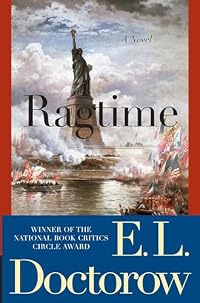
Ragtime
by E. L. Doctorow
On This Page
Description
Selected by the Modern Library as one of the 100 best novels of all timePublished in 1975, Ragtime changed our very concept of what a novel could be. An extraordinary tapestry, Ragtime captures the spirit of America in the era between the turn of the century and the First World War.
The story opens in 1906 in New Rochelle, New York, at the home of an affluent American family. One lazy Sunday afternoon, the famous escape artist Harry Houdini swerves his car into a telephone pole outside show more their house. And almost magically, the line between fantasy and historical fact, between real and imaginary characters, disappears. Henry Ford, Emma Goldman, J. P. Morgan, Evelyn Nesbit, Sigmund Freud, and Emiliano Zapata slip in and out of the tale, crossing paths with Doctorow's imagined family and other fictional characters, including an immigrant peddler and a ragtime musician from Harlem whose insistence on a point of justice drives him to revolutionary violence.
From the Trade Paperback edition.
. show less
Tags
Recommendations

















Member Recommendations

Member Reviews
Situado num período sobre o qual eu li muito pouco, mas que parece ser a vibe dos Bioshocks (especialmente o Infinite), Ragtime se passa no começo do crescimento dos EUA, entre 1900 e o começo da Grande Guerra. O livro fala muito sobre a questão racial e migratória, com as hordas de pobres nas beiras do sistema americano lutando para sobreviver, enquanto os EUA se segmentavam como potência econômica, bem nessa época dos grandes burgueses e da decadência final da aristocracia européia. É nessa época que surgem grandes como Carnegie, Morgan (do JP Morgan) e afins, enquanto também surgem movimentos anarquistas e socialistas a rodo dentro dos próprios EUA, lutando pela dignidade dos trabalhadores, que comiam o pão que o diabo show more amassou, vivendo enfurnados em bairros sujos. Isso sem falar da questão racial, que só foi avançar realmente DÉCADAS depois, mas já fica exposta na atitude dos personagens e no que sofre o Coalhouse, que, por ser alvo de fortes perseguições raciais de bombeiros decide buscar Justiça a todo custo, tornando-se um revolucionário, e para isso convertendo o fio condutor da narrativa, onipresente, o Irmão Mais Novo. Coalhouse vai de músico educado, tentando casar-se com a humilde lavadeira que engravidou, para incendiário e assassino, obcecado em ter seu carro reparado. O livro faz algo que, ao que consta, era inédito na época, misturando figuras históricas, como Morgan, Houdini, Emma Goldman, dentre outros, com a narrativa ficcional da família de New Rochelle. O resultado é um livro deveras interessante, que me apresentou uma série de coisas sobre o período, como o começo do movimento sindical nos EUA, a existência de outro presidente americano assassinado (achava que era somente JFK), e é um livro delicioso de se ler. Uma jóia. show less
I got a blister on my thumb, thanks for asking. Wrong music, though, wrong era. It only occurred to me to cue up some ragtime tunes on Youtube while writing this, a bit of an oversight given that this was very much composed as an ode to that music, going hand in hand with jittery, speeded-up black and white stock footage. An old era is ending and a new one beginning. Mass consumption, mass production, mass entertainment and mass destruction are all a-borning, and Ragtime is an almost jolly ode to the death/birth pangs of the new American Century. It reminded me of One Hundred Years of Solitude, but also Catch-22. Magical realism in high-density storytelling that swoops through time and place and social strata, skipping from person to show more person, tell-don't-show with more than a touch of satire as the horrific social injustices are set beside awesome wealth and power. Ragtime should be played slow, according to the epigraph, but Ragtime was read fast. show less
E.L. Doctorow used to be an author I had never read but was quite certain I would not like. I’m not even sure what the reason for that was – I saw the movie Daniel and disliked it, and maybe transferred that dislike to the author of the novel (The Book of Daniel) the film was based on (and yes, I’m aware I should have known better, but we’re talking about my ca. twenty year old self here who was a lot quicker to judge than I am today), or maybe I considered him to conventional during my hardcore modernist / postmodernist phase, or maybe it was something else altogether I cannot now remember.
Somewhat less vague is the reason why I got interested in him again after all, namely me stumbling across various mentions of Ragtime as a show more novel important for the development of the historical novel in the 20th century. As I have always had a soft spot for historical novels, and an interest in how a genre that belongs so distinctly to the 19th century and its unshaken belief in the capability of fiction to represent the real has managed to not only survive into the 20th and 21st centuries but also has re-invented itself several times over to remain alive and relevant. While that had me teetering on the brink of reading a novel by him, it was his recent death that pushed me over, with its rather uncomfortable reminder that I am slowly but steadily running out of time to read and so had better get to it.
Ragtime was named, as Wikipedia informs me, for “its syncopated, or ‘ragged’, rhythm” and one can see after reading just a few pages how this fits the book, in particular its language. It is written mostly in short, simple sentences, in a very matter-of-fact style; and several references to an anonymous “we” that is collecting and presenting evidence made me think of a chronicle or some kind of report. But again and again there are interspersed between the plain statements longer sentences, where language takes off and becomes fanciful, lyrical even, disrupting the steady flow of facts, or – to stay in the metaphor – syncopating them, introducing an off-beat element. And also pretty quickly it becomes obvious how this fits the content of the novel as well when on the unblemished white of the petit-bourgeois world there are more and more outbreaks of colour, immigrants and negroes disrupting the orderly world of the Anglo-Saxon middle classes.
There seems to me to be a certain double entendre in the novel’s title – “ragtime” not only as the musical genre of that name, but also literally as a time of rags; very early in the novel one of its many protagonists (if one wants to call them that, more on that later) sees a “rag ship” coming into harbour filled with dark-skinned immigrants just as he leaves on an expedition for the white wastes of the North Pole. It’s maybe a bit too blatant, but one cannot deny that the irony that Doctorow has arranged here is quite exquisite. Rags, then, are everything that is outside of the orderly (and always immaculately dressed) white middle classes, the immigrants, the negroes, the working classes (one also can’t but thing of the Lumpenproletariat which actually might be translated literally as “rag proletariat”). Doctorow sets his novel at the start of the 20th century, at a time when all kinds of social unrest were fermenting, when Unions and socialists (actual socialists, that is, not what passes for it these days in the muddled minds of most Republicans) still had a public voice in the USA, and where in fact many people were expecting the US to be the first country to have a Communist revolution (a much more likely candidate than Russia).
I think what Doctorow tried here is to write an anti-Bourgeois novel – quite an ambitious project considering how much the bourgeoisie has made the novel form its own during the 18th and 19th centuries. And his formally most audacious move in achieving this is to remove the individual protagonist; Ragtime is very far from being the Bildungsroman of a single consciousness rising from immaturity to becoming a responsible citizen, but instead presents a whole host of protagonists (I did not bother to count, but it is an astonishing number for such a comparatively short novel) without favouring any of them but instead jumping from character to character gradually coalescing the threads into some kind of whole by letting them criss-cross each other again and again.
Which might not appear all that dissimilar from what Dos Passos did in Manhattan Transfer, but Doctorow goes a step father – while Dos Passos has a multitude of protagonists they still are individuals with their own, distinct personalities. The fictional protagonists in Ragtime, on the other and, do for the most part not even have names but are family archetypes, Father, Mother, Younger Brother etc. Only very few fictional characters have names, and they without exception are non-white, non-middle class like the Jew Tateh or the negro Coalhouse Walker jr. “Coalhouse” by the way being very close to how an English speaker would pronounce “Kohlhaas,” the titular protagonist of a novella by German 19th century writer Heinrich von Kleist which apparently was the original inspiration for Doctorow’s novel (and there are some interesting connections to be made between the two, not just the – very obvious – similarities in plot). Coalhouse’s identity is borrowed, then, and he remains (just like Kleist’s creation) a very ambivalent character – it never becomes quite clear whether he is confident in his identity as a person of colour or simply imitating the white man.
While Doctorow keeps his fictional characters for the most part anonymous archetypes, there still is a huge amount of name-dropping in Ragtime, as he introduces a large cast of non-fictional, historical figures. The list includes people like Sigmund Freud, Pierpoint Morgan, Emma Goldman, Harry Houdini. By turning them into characters in a novel, Doctorow of course fictionalises them, but at the same time he also short-circuits his novel with history. He is of course not the first to have historical characters mix with his fictional ones, that tradition goes as far back as to the very beginning of the genre, to Walter Scott. But I don’t think any other writer has done it with quite the enthusiastic abandon of Ragtime, where we get a veritable parade of them, marching to the novel’s ragged, syncopated rhythm.
The best description of Ragtime is actually to be found in the novel itself, and as it not only precisely captures its feeling and structure but also is beautifully written, I’m going to deviate from my usual habits and quote a bit in closing this review:
Somewhat less vague is the reason why I got interested in him again after all, namely me stumbling across various mentions of Ragtime as a show more novel important for the development of the historical novel in the 20th century. As I have always had a soft spot for historical novels, and an interest in how a genre that belongs so distinctly to the 19th century and its unshaken belief in the capability of fiction to represent the real has managed to not only survive into the 20th and 21st centuries but also has re-invented itself several times over to remain alive and relevant. While that had me teetering on the brink of reading a novel by him, it was his recent death that pushed me over, with its rather uncomfortable reminder that I am slowly but steadily running out of time to read and so had better get to it.
Ragtime was named, as Wikipedia informs me, for “its syncopated, or ‘ragged’, rhythm” and one can see after reading just a few pages how this fits the book, in particular its language. It is written mostly in short, simple sentences, in a very matter-of-fact style; and several references to an anonymous “we” that is collecting and presenting evidence made me think of a chronicle or some kind of report. But again and again there are interspersed between the plain statements longer sentences, where language takes off and becomes fanciful, lyrical even, disrupting the steady flow of facts, or – to stay in the metaphor – syncopating them, introducing an off-beat element. And also pretty quickly it becomes obvious how this fits the content of the novel as well when on the unblemished white of the petit-bourgeois world there are more and more outbreaks of colour, immigrants and negroes disrupting the orderly world of the Anglo-Saxon middle classes.
There seems to me to be a certain double entendre in the novel’s title – “ragtime” not only as the musical genre of that name, but also literally as a time of rags; very early in the novel one of its many protagonists (if one wants to call them that, more on that later) sees a “rag ship” coming into harbour filled with dark-skinned immigrants just as he leaves on an expedition for the white wastes of the North Pole. It’s maybe a bit too blatant, but one cannot deny that the irony that Doctorow has arranged here is quite exquisite. Rags, then, are everything that is outside of the orderly (and always immaculately dressed) white middle classes, the immigrants, the negroes, the working classes (one also can’t but thing of the Lumpenproletariat which actually might be translated literally as “rag proletariat”). Doctorow sets his novel at the start of the 20th century, at a time when all kinds of social unrest were fermenting, when Unions and socialists (actual socialists, that is, not what passes for it these days in the muddled minds of most Republicans) still had a public voice in the USA, and where in fact many people were expecting the US to be the first country to have a Communist revolution (a much more likely candidate than Russia).
I think what Doctorow tried here is to write an anti-Bourgeois novel – quite an ambitious project considering how much the bourgeoisie has made the novel form its own during the 18th and 19th centuries. And his formally most audacious move in achieving this is to remove the individual protagonist; Ragtime is very far from being the Bildungsroman of a single consciousness rising from immaturity to becoming a responsible citizen, but instead presents a whole host of protagonists (I did not bother to count, but it is an astonishing number for such a comparatively short novel) without favouring any of them but instead jumping from character to character gradually coalescing the threads into some kind of whole by letting them criss-cross each other again and again.
Which might not appear all that dissimilar from what Dos Passos did in Manhattan Transfer, but Doctorow goes a step father – while Dos Passos has a multitude of protagonists they still are individuals with their own, distinct personalities. The fictional protagonists in Ragtime, on the other and, do for the most part not even have names but are family archetypes, Father, Mother, Younger Brother etc. Only very few fictional characters have names, and they without exception are non-white, non-middle class like the Jew Tateh or the negro Coalhouse Walker jr. “Coalhouse” by the way being very close to how an English speaker would pronounce “Kohlhaas,” the titular protagonist of a novella by German 19th century writer Heinrich von Kleist which apparently was the original inspiration for Doctorow’s novel (and there are some interesting connections to be made between the two, not just the – very obvious – similarities in plot). Coalhouse’s identity is borrowed, then, and he remains (just like Kleist’s creation) a very ambivalent character – it never becomes quite clear whether he is confident in his identity as a person of colour or simply imitating the white man.
While Doctorow keeps his fictional characters for the most part anonymous archetypes, there still is a huge amount of name-dropping in Ragtime, as he introduces a large cast of non-fictional, historical figures. The list includes people like Sigmund Freud, Pierpoint Morgan, Emma Goldman, Harry Houdini. By turning them into characters in a novel, Doctorow of course fictionalises them, but at the same time he also short-circuits his novel with history. He is of course not the first to have historical characters mix with his fictional ones, that tradition goes as far back as to the very beginning of the genre, to Walter Scott. But I don’t think any other writer has done it with quite the enthusiastic abandon of Ragtime, where we get a veritable parade of them, marching to the novel’s ragged, syncopated rhythm.
The best description of Ragtime is actually to be found in the novel itself, and as it not only precisely captures its feeling and structure but also is beautifully written, I’m going to deviate from my usual habits and quote a bit in closing this review:
“Coalhouse Walker Jr. turned back to the piano and said ‘The Maple Leaf.’ Composed by the great Scott Joplin. The most famous rag of all rang through the air. The pianist sat stiffly at the keyboard, his long dark hands with their pink nails seemingly with no effort producing the clusters of syncopating chords and the thumping octaves. This was a most robust composition, a vigorous music that roused the senses and never stood still a moment. The boy perceived it as light touching various places in space, accumulating in intricate patterns until the entire room was made to glow with its own being.”show less
Novela apasionante de Doctorow en la que nos traslada a los primeros años del siglo XX, previos a la Gran Guerra. Se trata de una historia coral, en cuyo centro se encuentra una familia de clase media, y a su alrededor van desfilando los más variopintos personajes. La acción se sitúa en un Nueva York convulso y lleno de vida, que casi puedes sentir, en una época marcada por la llegada de los inmigrantes y las primeras huelgas de trabajadores, destacando también la lucha de las clases oprimidas, negros y mujeres, por salir de esta situación discriminatoria.
Padre, el cabeza de la familia protagonista, tiene un negocio de fabricación de banderas y otros símbolos patrióticos y fuegos artificiales. Un hecho marcará la vida de esta show more familia, el encuentro sorprendente con Sarah y su bebé, de raza negra. De esta manera también conoceremos a uno de los personajes más memorables que ha dado la literatura, Coalhouse Walker Jr., pianista profesional e igualmente negro. Pero la lista de personajes no para aquí. Con una maestría inigualable, Doctorow va saltando por hechos y personajes históricos, todos ellos relacionados de alguna manera con esta familia: Houdini, Freud, el magnate J.P. Morgan, la anarquista Emma Goldman, Henry Ford, Emiliano Zapata, etcétera.
Doctorow conjuga a la perfección la ficción con los hechos reales. Lo que podrían parecer fragmentos de historia, Doctorow nos los cuenta de forma novelada, quedando todo ensamblado de manera natural y genial. Si un capítulo termina con un hecho o personaje, el siguiente capítulo recoge el testigo y continúa la trama por otra vertiente curiosamente afín a la historia general que nos está narrando. Sencillamente magnífico.
Curiosamente, la primera vez que entré en contacto con 'Ragtime' fue a través de su versión para teatro musical, 'Ragtime. The Musical', con música de Stephen Flaherty, estrenado primero en Toronto y después en Broadway, y que también es muy bueno. show less
Padre, el cabeza de la familia protagonista, tiene un negocio de fabricación de banderas y otros símbolos patrióticos y fuegos artificiales. Un hecho marcará la vida de esta show more familia, el encuentro sorprendente con Sarah y su bebé, de raza negra. De esta manera también conoceremos a uno de los personajes más memorables que ha dado la literatura, Coalhouse Walker Jr., pianista profesional e igualmente negro. Pero la lista de personajes no para aquí. Con una maestría inigualable, Doctorow va saltando por hechos y personajes históricos, todos ellos relacionados de alguna manera con esta familia: Houdini, Freud, el magnate J.P. Morgan, la anarquista Emma Goldman, Henry Ford, Emiliano Zapata, etcétera.
Doctorow conjuga a la perfección la ficción con los hechos reales. Lo que podrían parecer fragmentos de historia, Doctorow nos los cuenta de forma novelada, quedando todo ensamblado de manera natural y genial. Si un capítulo termina con un hecho o personaje, el siguiente capítulo recoge el testigo y continúa la trama por otra vertiente curiosamente afín a la historia general que nos está narrando. Sencillamente magnífico.
Curiosamente, la primera vez que entré en contacto con 'Ragtime' fue a través de su versión para teatro musical, 'Ragtime. The Musical', con música de Stephen Flaherty, estrenado primero en Toronto y después en Broadway, y que también es muy bueno. show less
Como assim só dei três estrelas para um livro que tem Emma Goldman e outros revolucionários como personagens, faz crítica social aos brancos capitalistas e coloca Freud e Jung no barco do amor de Coney Island? Pois é, também não sei, esse livro tem todos os elementos para que eu me apaixonasse por ele, incluindo basear seu ritmo na síncope do ragtime, mas isso não ocorreu, infelizmente.
I'll say this is one of the better books I've read in a while. It's a novel about U.S. people in the early 20th century, before World War I. The writing is brilliant. The story depicted many social problems/phenomena with very clever use of cynicism. Here's an example from chapter 1 describing the early 1900's that cracked me up:
" Patriotism was a reliable sentiment in the early 1900's. Teddy Roosevelt was President. The population customarily gathered in great numbers either out of doors for parades, public concerts, fish fries, political picnics, social outings, or indoors in meeting halls, vaudeville theatres, operas, ballrooms. There seemed to be no entertainment that did not involve great swarms of people. Trains and steamers and show more trolleys moved them from one place to another. That was the style, that was the way people lived. Women were stouter then. They visited the fleet carrying white parasols. Everyone wore white in summer. Tennis racquets were hefty and the racquet faces elliptical. There was a lot of sexual fainting. There were no Negroes. There were no immigrants."
There are a lot more where that came from, and the author often used real-life historical figures of the 1900's as actors of these cynical scenes. And of course, Negroes and immigrants played a heavy part in the story :P The novel focused on the injustice faced by the former, and the poverty experienced by the latter. A well-to-do White family crossed paths with the people experiencing the injustice and poverty, and members of this family reacted differently. Another favorite excerpt from the book, depicting two family members discussing the injustice they witnessed:
"Father said I hope I misunderstand you. Would you defend this savage? Does he have anyone but himself to blame for Sarah's death? Anything but his damnable nigger pride? Nothing under heaven can excuse the killing of men and the destruction of property in this manner! Brother stood so abruptly that his chair fell over. The baby started and began to cry. Brother was pale and trembling. i did not hear such a eulogy at Sarah's funeral, he said. I did not hear you say then that death and the destruction of property was inexcusable."
The story arc on the injustice faced by the Negro man Coalhouse Walker, and the way the arc ended, made me cry the way I haven't cried over fiction in a long time. show less
" Patriotism was a reliable sentiment in the early 1900's. Teddy Roosevelt was President. The population customarily gathered in great numbers either out of doors for parades, public concerts, fish fries, political picnics, social outings, or indoors in meeting halls, vaudeville theatres, operas, ballrooms. There seemed to be no entertainment that did not involve great swarms of people. Trains and steamers and show more trolleys moved them from one place to another. That was the style, that was the way people lived. Women were stouter then. They visited the fleet carrying white parasols. Everyone wore white in summer. Tennis racquets were hefty and the racquet faces elliptical. There was a lot of sexual fainting. There were no Negroes. There were no immigrants."
There are a lot more where that came from, and the author often used real-life historical figures of the 1900's as actors of these cynical scenes. And of course, Negroes and immigrants played a heavy part in the story :P The novel focused on the injustice faced by the former, and the poverty experienced by the latter. A well-to-do White family crossed paths with the people experiencing the injustice and poverty, and members of this family reacted differently. Another favorite excerpt from the book, depicting two family members discussing the injustice they witnessed:
"Father said I hope I misunderstand you. Would you defend this savage? Does he have anyone but himself to blame for Sarah's death? Anything but his damnable nigger pride? Nothing under heaven can excuse the killing of men and the destruction of property in this manner! Brother stood so abruptly that his chair fell over. The baby started and began to cry. Brother was pale and trembling. i did not hear such a eulogy at Sarah's funeral, he said. I did not hear you say then that death and the destruction of property was inexcusable."
The story arc on the injustice faced by the Negro man Coalhouse Walker, and the way the arc ended, made me cry the way I haven't cried over fiction in a long time. show less
A funny little book, written almost entirely in expostional narrative. There are many small (and sometimes dirty) pleasures available in this book, but what particularly won me over was the character of Coalhouse Walker, a man so proud and stubborn, with such an inflexible sense of justice that it's impossible not to all in love with him. One thing that puzzled me: there's a lot in this book about anarchism and socialism, and I feel like it's doing more than merely "giving a sense of the period". But I'm not quite sure what.
Members
- Recently Added By
Lists

1001 Books You Must Read Before You Die
1,448 works; 1,131 members

Novels from The Guardian's Great American Novelist Tournament
148 works; 24 members

Best Historical Fiction
620 works; 261 members

Great American Novels
158 works; 42 members

Historical Fiction
889 works; 91 members

Read the book and saw the movie
1,170 works; 192 members
Time Magazine's "All-Time 100"
113 works; 15 members

1970s
657 works; 23 members

20th Century Literature
1,161 works; 55 members
Books Set in New York City
127 works; 21 members
The American Experience
173 works; 18 members

Canon de la narrativa universal del siglo XX
254 works; 6 members
Time's All-Time 100 Novels
100 works; 27 members
TML 200 Best Books 1950-1999
202 works; 10 members
1,001 BYMRBYD Concensus
723 works; 27 members

A Novel Cure
742 works; 23 members
Best of American Literature
146 works; 9 members
The Modern Library's 100 Best Novels: The Board's List
85 works; 6 members

2022 books
7 works; 1 member

Publisher's Weekly Bestsellers - Part II - 1940 - 1979
355 works; 5 members

Books To Get From The Library
115 works; 5 members

Llibres que he llegit el 2008
33 works; 1 member

The Torchlight List
95 works; 1 member
Canon de la narrativa universal del s. XX (cicutadry)
499 works; 3 members
Modern Library's 100 Best Novels
100 works; 2 members

living room bookshelf
150 works; 1 member

The Modern Library (The Two Hundred Best Novels....
202 works; 1 member

Mustich's 1000 Books to Read Before You Die: A Life Changing List
1,001 works; 18 members

AP Lit
363 works; 6 members

Books by Jewish Authors
68 works; 5 members
My TBR
371 works; 3 members

Blue Pyramid 1,276 Best Books of All Time
1,248 works; 32 members

Swinging Seventies
255 works; 16 members

Unread books
1,063 works; 87 members
Author Information

57+ Works 25,114 Members
E. L. (Edgar Lawrence) Doctorow was born on January 6, 1931, in the Bronx, New York. He received an A.B. in philosophy in 1952 from Kenyon College and did graduate work at Columbia University. He served in the U.S. Army Signal Corps from 1953-1955. He began his career as a script reader for CBS Television and Columbia Pictures and as a senior show more editor for the New American Library. He was editor-in-chief for Dial Press from 1964 to 1969, where he also served as vice president and publisher in his last year on staff. It was at this time that he decided to write full time. He wrote novels, short stories, essays, and a play. His debut novel, Welcome to Hard Times, was published in 1960 and was adapted into a film in 1967. His other works include, Loon Lake, The Waterworks, The March, Homer and Langley, and Andrew's Brain. He won the National Book Award for Fiction in 1986 for World's Fair and the National Book Critics Circle Award for fiction in 1976 for Ragtime, which was adapted into a film in 1981 and a Broadway musical in 1998. Billy Bathgate received the PEN/Faulkner Award, the National Book Critics Circle Award, and the William Dean Howells Medal in 1990. The Book of Daniel and Billy Bathgate were also adapted into films. He received the 2013 Medal for Distinguished Contribution to American Letters for his outstanding achievement in fiction writing. He died of complications from lung cancer on July 21, 2015 at the age of 84. (Bowker Author Biography) show less
Some Editions
Awards and Honors
Series
Belongs to Publisher Series
Work Relationships
Is contained in
Has the adaptation
Has as a commentary on the text
Common Knowledge
- Canonical title
- Ragtime
- Original title
- Ragtime
- Alternate titles*
- Рэгтайм
- Original publication date
- 1975
- People/Characters
- Booker T. Washington; Harry Houdini; J. Pierpont Morgan; Evelyn Nesbit; Emma Goldman; Robert Peary (show all 21); Matthew Henson; Henry Ford; Stanford White; Harry Kendall Thaw; Archduke Franz Ferdinand of Austria; Sophie, Duchess of Hohenberg; Sigmund Freud; Carl Jung; Sigmund Freud; Theodore Dreiser; Jacob Riis; Emiliano Zapata; Charles Seymour Whitman; Rhinelander Waldo; Coalhouse Walker Jr.
- Important places
- New Rochelle, New York, USA; New York, New York, USA; New York, USA
- Important events
- 1900s; 1910s
- Related movies
- Ragtime (1981 | IMDb)
- Epigraph
- Do not play this piece fast. It is never right to play Ragtime fast ...
Scott Joplin - Dedication
- The author thanks the John Simon Guggenheim Memorial Foundation and the Creative Artists Program Service for fellowships awarded during the period in which this novel was written
Respectfully dedicated to
Rose Doctorow Buck - First words
- In 1902 Father built a house at the crest of the Broadview Avenue hill in New Rochelle, New York.
- Last words
- (Click to show. Warning: May contain spoilers.)And Harry K. Thaw, having obtained his release from the insane asylum, marched annually at Newport in the Armistice Day parade.
- Original language
- English
*Some information comes from Common Knowledge in other languages. Click "Edit" for more information.
Classifications
Statistics
- Members
- 6,845
- Popularity
- 1,736
- Reviews
- 138
- Rating
- (3.86)
- Languages
- 18 — Catalan, Czech, Danish, Dutch, English, Estonian, Finnish, French, German, Hungarian, Italian, Norwegian (Bokmål), Polish, Portuguese, Romanian, Spanish, Swedish, Turkish
- Media
- Paper, Audiobook, Ebook
- ISBNs
- 103
- UPCs
- 1
- ASINs
- 42