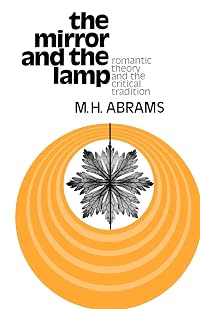
The Mirror and the Lamp: Romantic Theory and the Critical Tradition
by Meyer H. Abrams
On This Page
Description
Traces the evolution of the Romantic approach to literary criticism and compares it to the other methods which prevailed in the early nineteenth century.Tags
Recommendations










Member Reviews
This book was a challenging read. No doubt this is because it is a doctoral dissertation outside of my field. But not outside of my interest, so I stuck with it. Abrams draws out what was new in Romantic literary criticism by situating it in the long tradition stretching back to Plato and Aristotle. The title is shorthand for controlling metaphors of what literature should aim at, whether to be a mirror of the real world (that is, nature) or whether it should illuminate it. That seems reasonable, yet it turns out to be not so simple. There were other aims throughout history, including moral improvement (an aim not all Romantic critics disavowed, even though they foreswore being didactic) and turning the mirror from the outside world to show more the author.
Along the way, there are many names (thankfully most familiar to me), quotations, and endnotes. I had to reread sentences more than once after realizing I had lost the thread. Nevertheless, I’m glad I stuck with it. Not only for the general reason that it’s always good to read something that stretches you from time to time but also for the many things I learned that can help me make better sense of the poetry not only of the Romantic period but also of the neo-classical age that preceded it (I’ve always had a hard time understanding, much less enjoying, Pope, for instance).
When this book appeared, its primary audience would have been grad students starting out. Of course, that was seventy years ago, and while I’m sure it was compulsory reading for at least a generation, I wouldn’t be surprised if it has slipped out of the curriculum since. Too bad. And don’t be scared off because it was a dissertation: it’s much better written than most. show less
Along the way, there are many names (thankfully most familiar to me), quotations, and endnotes. I had to reread sentences more than once after realizing I had lost the thread. Nevertheless, I’m glad I stuck with it. Not only for the general reason that it’s always good to read something that stretches you from time to time but also for the many things I learned that can help me make better sense of the poetry not only of the Romantic period but also of the neo-classical age that preceded it (I’ve always had a hard time understanding, much less enjoying, Pope, for instance).
When this book appeared, its primary audience would have been grad students starting out. Of course, that was seventy years ago, and while I’m sure it was compulsory reading for at least a generation, I wouldn’t be surprised if it has slipped out of the curriculum since. Too bad. And don’t be scared off because it was a dissertation: it’s much better written than most. show less
I've read snatches from this book before for undergraduate essays, but never the whole text. And, I must say, I now feel very foolish for not having read the whole thing cover-to-cover previously. M.H. Abrams, the well-known critic and editor of various Norton Anthologies and Literary Glossaries, attempts in this book to convey the tenets of Romantic theory and how these were shaped by the critical western tradition from Plato up to the nineteenth century. His prose is always succinct and calculated, with little extraneous emotionalism or attempts at bravura criticism. Although I do not really have a problem with more 'subjective' criticism (and I use that term advisedly, as Abrams has a whole section in which he delineates the show more ascendancy of the terms 'subjective' and 'objective' in the critical lexicon) I did find Abrams's restraint refreshing.
Most of the book is not, in fact, Abrams's own criticism, but rather an exposition of the various streams of literary criticism during the Romantic period, and how these evolved from ancient times. Abrams obviously did extensive (and by extensive, I mean panoptic) research during the writing of this book. He often quotes the usual proponents of Romantic critical theory, such as Coleridge, Hazlitt, De Quincey, etc., but he also digs up critics that have fallen through the cracks of history. If there is anything bravura about Abrams's approach, it is this bringing to light of unknown and forgotten literary theorists and commentators.
I did feel that Abrams held back on his own opinions a little too much in the book, which makes it a bit bloodless. I'm not, however, saying that he should have made it a personal document, or a panegyric to any one critic or school of criticism. God knows we have enough of those. I'm just saying that it would not have hurt to add some more personal appraisals, perhaps as a coda or so. Obviously, Abrams does find some joy in Romanticism and the critical tradition, or he would not have written the book.
I'll end with one of my favourite quotations from the book. It is from the last subsection of the book, The Use of Romantic Poetry, in the chapter, Science and Poetry in Romantic Criticism. Here is Percy Bysshe Shelley giving what Abrams calls a 'classic indictment of our technological, material, and acquisitive society.' It is from Shelley's 'Defence of Poetry':
The cultivation of those sciences which have enlarged the limits of the empire of man over the external world, has, for want of the poetical faculty, proportionally circumscribed those of the internal world; and man, having enslaved the elements, remains himself a slave... The cultivation of poetry is never more to be desired than at periods when, from an excess of the selfish and calculating principle, the accumulation of the materials of external life exceed the quantity of the power of assimilating them to the internal laws of human nature.
Whether one agrees with Shelley's sad indictment of modern material man, one can surely not deny that it is cogently, even beautifully, expressed. For me, it is a motto that I have transcribed deep in my own heart. show less
Most of the book is not, in fact, Abrams's own criticism, but rather an exposition of the various streams of literary criticism during the Romantic period, and how these evolved from ancient times. Abrams obviously did extensive (and by extensive, I mean panoptic) research during the writing of this book. He often quotes the usual proponents of Romantic critical theory, such as Coleridge, Hazlitt, De Quincey, etc., but he also digs up critics that have fallen through the cracks of history. If there is anything bravura about Abrams's approach, it is this bringing to light of unknown and forgotten literary theorists and commentators.
I did feel that Abrams held back on his own opinions a little too much in the book, which makes it a bit bloodless. I'm not, however, saying that he should have made it a personal document, or a panegyric to any one critic or school of criticism. God knows we have enough of those. I'm just saying that it would not have hurt to add some more personal appraisals, perhaps as a coda or so. Obviously, Abrams does find some joy in Romanticism and the critical tradition, or he would not have written the book.
I'll end with one of my favourite quotations from the book. It is from the last subsection of the book, The Use of Romantic Poetry, in the chapter, Science and Poetry in Romantic Criticism. Here is Percy Bysshe Shelley giving what Abrams calls a 'classic indictment of our technological, material, and acquisitive society.' It is from Shelley's 'Defence of Poetry':
The cultivation of those sciences which have enlarged the limits of the empire of man over the external world, has, for want of the poetical faculty, proportionally circumscribed those of the internal world; and man, having enslaved the elements, remains himself a slave... The cultivation of poetry is never more to be desired than at periods when, from an excess of the selfish and calculating principle, the accumulation of the materials of external life exceed the quantity of the power of assimilating them to the internal laws of human nature.
Whether one agrees with Shelley's sad indictment of modern material man, one can surely not deny that it is cogently, even beautifully, expressed. For me, it is a motto that I have transcribed deep in my own heart. show less
A tough one to rate on the star system, unfortunately, since it's very uneven. The early chapters, up to his precis of Wordsworth and especially Coleridge are excellent- he explains how and why Romantic criticism came to be what it is, by putting it into the context of earlier critics. The second half, though, isn't nearly as impressive. It's good intellectual history, I guess, in the 'x thought y' mode. But there's much less convincing analysis of the 'x thought y because of z' mode, and really, that's much more important.
I was also hoping for something a bit less dense when I started, which might have biased me a bit, and there's nothing more fatuous than the psychology of art, from the earliest writers through to the show more neuro-aestheticians of our time. So that didn't help the middle two chapters. On the other hand, better this than the books that were being written twenty years later, since Abrams was still under the impression that you have to know about something before writing theory about that thing, so this book will help you learn about the Romantics and not about, say, a deconstructivist post-feminist anti-Marxist stance with some vague connection to Shelley. Thumbs up for that. show less
I was also hoping for something a bit less dense when I started, which might have biased me a bit, and there's nothing more fatuous than the psychology of art, from the earliest writers through to the show more neuro-aestheticians of our time. So that didn't help the middle two chapters. On the other hand, better this than the books that were being written twenty years later, since Abrams was still under the impression that you have to know about something before writing theory about that thing, so this book will help you learn about the Romantics and not about, say, a deconstructivist post-feminist anti-Marxist stance with some vague connection to Shelley. Thumbs up for that. show less
"El espejo y la lámpara" de M. H. Abrams es un estudio sobre la evolución de la teoría literaria, centrándose en el romanticismo y su impacto en la crítica moderna. La obra analiza cómo la literatura pasó de ser vista como un reflejo de la realidad (espejo) a una expresión creativa del pensamiento (lámpara).
Meyer (Mike) Howard Abrams (born July 23, 1912) is an American literary critic, known for works on Romanticism, in particular his book The Mirror and the Lamp. Under Abrams' editorship, the Norton Anthology of English Literature became the standard text for undergraduate survey courses across the U.S. and a major trendsetter in literary canon formation.
http://en.wikipedia.org/wiki/M._H._Abrams
http://en.wikipedia.org/wiki/M._H._Abrams
Apr 4, 2010Swedish
Ratings
Members
- Recently Added By
Lists

Modern Library 100 Best Nonfiction Books
100 works; 8 members
Author Information

140+ Works 12,757 Members
M. H. Abrams, 1912 - 2015 Meyer Howard Abrams was born in Long Branch, New Jersey on July 23, 1912. He received a B.A. in English from Harvard University in 1934. He won a Henry fellowship to Cambridge University in 1935. He returned to Harvard University, where he received a Masters' degree in 1937 and a Ph. D. in 1940. He joined the Cornell show more University faculty in 1945 and taught a popular introductory survey class. While at Cornell in the 1950s, he was asked by publisher W. W. Norton to lead a team of editors compiling excerpts of vital English works. The first edition of the Norton Anthology came out in 1962. Abrams stayed on through seven editions. He was also the author of a popular Glossary of Literary Terms, The Mirror and the Lamp: Romantic Theory and the Critical Tradition, Natural Supernaturalism, The Milk of Paradise, and the essay collection The Fourth Dimension of a Poem. In 2014, he received a National Arts Medal for "expanding our perceptions of the Romantic tradition and broadening the study of literature." He died on April 21, 2015 at the age of 102. (Bowker Author Biography) show less
Some Editions
Awards and Honors
Awards
Notable Lists
Series
Belongs to Publisher Series
Common Knowledge
- Canonical title
- The Mirror and the Lamp: Romantic Theory and the Critical Tradition
- Original title
- The Mirror and the Lamp: Romantic Theory and the Critical Tradition
- Original publication date
- 1953
Classifications
Statistics
- Members
- 641
- Popularity
- 45,482
- Reviews
- 6
- Rating
- (4.01)
- Languages
- 6 — Czech, English, German, Polish, Portuguese, Spanish
- Media
- Paper
- ISBNs
- 7
- ASINs
- 8