
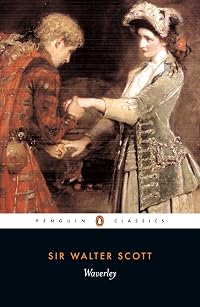
Waverley; or 'Tis Sixty Years Since
by Walter Scott
Waverley Novels, publication (1814), Waverley Novels (1745)
On This Page
Description
Waverley by Sir Walter Scott is an enthralling tale of love, war and divided loyalties. Taking place during the Jacobite Rebellion of 1745, the novel tells the story of proud English officer Edward Waverley. After being posted to Dundee, Edward eventually befriends chieftain of the Highland Clan Mac-Ivor, and falls in love with his beautiful sister Flora. He then renounces his former loyalties in order actively to support Scotland in open rebellion against the Union with England. The book show more depicts stunning, romantic panoramas of the Highlands, and is famous for being one of the first historical novels. Its influence extended to many authors, including Dickens, Dumas, Gogol, Stevenson, Thackeray and Tolstoy. show lessTags
Recommendations



















Member Recommendations
Cecrow By contrast, a modern romance set at the same time and place.
themulhern Two historical novels. "Waverly" was published something like 70 years after the events it recounts, 1815 - 1745, while "The Adventures of Huckleberry Finn" was published a little closer to the events it recounts, 1885 - c.1845. Both were intended, as far as I can tell, to influence thinking about now.
Member Reviews
Waverley is another of those books that comes with a lot of literary baggage, so that it is difficult to sit down and read it on its own terms. It was the first massive best-seller; the Harry Potter of the early nineteenth century; the book that established the novel as the dominant literary form of the next two centuries; the first real historical novel; the book that made Scotland fashionably Romantic; the only novel to have a railway station named after it, etc., etc.
The story itself is simple, and to modern eyes rather predictable: a naive, romantically inclined young Englishman goes to Scotland in 1745 to join his regiment, makes friends with some quaint and Romantic Highlanders, and finds his loyalties divided when he is caught up show more in a Jacobite rising. We get lots of stunning scenery, wild romantic characters, battles, pursuits and escapes, treachery and friendship, bagpipes, tartan, and all the rest. But the thing you forget about Scott (or at least I tend to) is that politically, he's not a Romantic at all. The message of the book is that pursuing abstract ideals and personal inclinations at the cost of civil order and the rule of law only leads to death and destruction. I suppose that's why Scott remained popular throughout the nineteenth century. The conservatism itself might not appeal so much in the 21st century, but the degree of ironic detachment it lends to the story is rather attractive.
The real joy of the book is in the details, though. It's worth reading the book just to meet the Baron of Bradwardine and his Bailie, and there are a host of less important but equally acutely drawn minor characters. I usually find dialect an irritation in a novel, but in Scott it is all part of the fun, and it is used cleverly and effectively to add to the characterisation. The Penguin edition has a long glossary in the back, but with a bit of imagination it should be easy enough for most readers to decode what the obscurer Scots or Gaelic (or Latin and French, for that matter) words mean from the context. show less
The story itself is simple, and to modern eyes rather predictable: a naive, romantically inclined young Englishman goes to Scotland in 1745 to join his regiment, makes friends with some quaint and Romantic Highlanders, and finds his loyalties divided when he is caught up show more in a Jacobite rising. We get lots of stunning scenery, wild romantic characters, battles, pursuits and escapes, treachery and friendship, bagpipes, tartan, and all the rest. But the thing you forget about Scott (or at least I tend to) is that politically, he's not a Romantic at all. The message of the book is that pursuing abstract ideals and personal inclinations at the cost of civil order and the rule of law only leads to death and destruction. I suppose that's why Scott remained popular throughout the nineteenth century. The conservatism itself might not appeal so much in the 21st century, but the degree of ironic detachment it lends to the story is rather attractive.
The real joy of the book is in the details, though. It's worth reading the book just to meet the Baron of Bradwardine and his Bailie, and there are a host of less important but equally acutely drawn minor characters. I usually find dialect an irritation in a novel, but in Scott it is all part of the fun, and it is used cleverly and effectively to add to the characterisation. The Penguin edition has a long glossary in the back, but with a bit of imagination it should be easy enough for most readers to decode what the obscurer Scots or Gaelic (or Latin and French, for that matter) words mean from the context. show less
This first novel by Sir Walter Scott is often described as the first historical novel ever. While I have read and quite enjoyed three other Scott novels, Ivanhoe, Kenilworth, and Rob Roy, I could not get into this. It is over rich in cultural references and Scots dialect, almost like a brain dump, at the expense of any kind of plot. So I have given up around a quarter of the way through and I will not find out what happens to English officer Edward Waverley when he is posted north of the border at the time of the Young Pretender's uprising of 1745. No rating.
Here is the granddaddy of popular historical fiction as a genre, Sir Walter Scott's 1815 novel that takes place sixty years earlier in Scotland. At that time 'Bonnie Prince Charlie' rose up to contest the Hanoverian succession to the English throne by George I, as a loyalist to his father James and his Stuart lineage. Scott inserts his own fictional hero into this drama: Edward Waverley, an English soldier with conflicting family loyalties who gets caught up in the turmoil. As the protagonist Edward has a fatal flaw in that he always goes where he is sent and does what he is advised to do. His passage is aided further by a fairy godmother in the person of Colonel Talbot who can clear away any troubles that arise. Scott writes in a show more stiffly formal style that is far more tell than show and given to needless authorial insertions, making him less friendly to read than his contemporary Jane Austen. I think I've had my fill of him, though his descriptions are rich with detail and he performed a fine, sympathetic service for Scotland by romanticizing its people and the land they occupy. This element is sure to be the novel's most lasting in my memory. show less
This novel by Sir Walter Scott follows the adventures of a naive and idealistic young man who, although British, gets caught up in the Jacobean rebellion, fighting on the side of the Scots rebels who wish to seize the throne for Bonny Prince Charlie and the house of Stuart.
It is generally acknowledged as the first true historical novel written in the English language, and is subtitled "'Tis Sixty Years Since". It is the first of the "Waverly Novels", so called not because they are related to each other in characters or storylines, but because Scott, unwilling to endanger his reputation as a poet should his novels prove unpopular, published them without attribution as "by the author of Waverly". (Though he acknowledged his authorship show more later in life, and it was pretty much an open secret.)
It's an old-fashioned book, and as the Scots, particularly the Highlanders, speak in heavy dialect, it can be tough going until you get used to the flow of language. However, along with the political maneuverings and the battle scenes, I found considerable sly humor in the story. Edward Waverly is a likeable figure, if very young in experience and prone to take on causes based almost entirely on emotion. He does mature as the story progresses, for as we know, the rebellion did not end happily for the Scots.
As a first novel, it's not as polished as subsequent novels, notably "Ivanhoe", but it was an interesting and entertaining story.
I listened to an audiobook edition, and the narrator, David Rintoul, was excellent, especially given the challenging dialect. show less
It is generally acknowledged as the first true historical novel written in the English language, and is subtitled "'Tis Sixty Years Since". It is the first of the "Waverly Novels", so called not because they are related to each other in characters or storylines, but because Scott, unwilling to endanger his reputation as a poet should his novels prove unpopular, published them without attribution as "by the author of Waverly". (Though he acknowledged his authorship show more later in life, and it was pretty much an open secret.)
It's an old-fashioned book, and as the Scots, particularly the Highlanders, speak in heavy dialect, it can be tough going until you get used to the flow of language. However, along with the political maneuverings and the battle scenes, I found considerable sly humor in the story. Edward Waverly is a likeable figure, if very young in experience and prone to take on causes based almost entirely on emotion. He does mature as the story progresses, for as we know, the rebellion did not end happily for the Scots.
As a first novel, it's not as polished as subsequent novels, notably "Ivanhoe", but it was an interesting and entertaining story.
I listened to an audiobook edition, and the narrator, David Rintoul, was excellent, especially given the challenging dialect. show less
Walter Scott continues to amaze me. The fact that he invented the genre of "historical fiction" isn't even his greatest accomplishment. The fact is, he was a best-selling author in his time - so much so that his books provided him with two separate fortunes. He lost his first one in an ill-fated publishing venture that left him with crushing debts. However, he refused to declare bankruptsy and stiff his many creditors. Instead, he doubled down on his writing in order to sell even more books. At the time of his death, he'd repaid every penny that he owed.
Although he is best known for his fiction, Scott also wrote books that pertained to Scottish folklore and, indeed, played in key role in preserving that portion of Scotland's cultural show more heritage. One of his works - an alleged transcription of a minister's account of his life with the fairies - is a classic of world folklore and is arguably the most celebrated work of folklore that came out of Scotland. (It's published today as "The Secret Commonwealth of Fairies" although that wasn't it's original title.) Another of his works is a treatise on the role of ghosts in Scottish criminal trials. (Scott himself was a lawyer.)
Scott was also a poet who accomplished the astonishing fete (at least by today's standards) of writing a poem ("The Lady of the Lake") that became a world-wide best seller. (Note that she isn't the Lady of the Lake from the Arthurian legend.)
"Waverly" was Scott's first novel and was literally an overnight success. It is typical of the novels that came after it: a romantic theme that is soaked in Scottish history; a strong plot; vivid characters; and a basic respect for human frailties and differences. It also showcases Scott's command of the English language - his descriptions of people and places can be very evocative. I might add that he uses a lot of big words that we don't use today even though most of them are still in the dictionary. (I suspect that, although literacy back then was less common than it is today, it probably attained a higher average level.)
"Waverly" is a good place to begin if you want to test the waters with Scott. It is set against one of the most romantic and tragic periods of Scottish history - the Jacobite rebellion of 1745 that attempted to restore a Stuart king to the English throne. That "lost cause" resulted in the destruction of the native Scottish aristocracy and many of the highland clans. And if you get hooked on Scott, there's some very good news: he wrote enough great novels to keep you reading for years. show less
Although he is best known for his fiction, Scott also wrote books that pertained to Scottish folklore and, indeed, played in key role in preserving that portion of Scotland's cultural show more heritage. One of his works - an alleged transcription of a minister's account of his life with the fairies - is a classic of world folklore and is arguably the most celebrated work of folklore that came out of Scotland. (It's published today as "The Secret Commonwealth of Fairies" although that wasn't it's original title.) Another of his works is a treatise on the role of ghosts in Scottish criminal trials. (Scott himself was a lawyer.)
Scott was also a poet who accomplished the astonishing fete (at least by today's standards) of writing a poem ("The Lady of the Lake") that became a world-wide best seller. (Note that she isn't the Lady of the Lake from the Arthurian legend.)
"Waverly" was Scott's first novel and was literally an overnight success. It is typical of the novels that came after it: a romantic theme that is soaked in Scottish history; a strong plot; vivid characters; and a basic respect for human frailties and differences. It also showcases Scott's command of the English language - his descriptions of people and places can be very evocative. I might add that he uses a lot of big words that we don't use today even though most of them are still in the dictionary. (I suspect that, although literacy back then was less common than it is today, it probably attained a higher average level.)
"Waverly" is a good place to begin if you want to test the waters with Scott. It is set against one of the most romantic and tragic periods of Scottish history - the Jacobite rebellion of 1745 that attempted to restore a Stuart king to the English throne. That "lost cause" resulted in the destruction of the native Scottish aristocracy and many of the highland clans. And if you get hooked on Scott, there's some very good news: he wrote enough great novels to keep you reading for years. show less
This is my first Scott, and while I did not particularly care for the book/writing, I did like the story. I think my reading was somewhat enhanced by knowing the history of the Jacobite Rebellion and the Battle of Culloden. Had I not known something about the Highlanders and their rebellion(s), I would have been lost. I was not a fan of the romance part of the novel, it seemed obligatory or contrived. I started to read the introduction, but after 9 pages of self-absorbed drivel, I skipped it. 484 pages, just barely 3 stars. 3 stars for me is your average read--can be mediocre or enjoyable, this was not necessarily enjoyable and yet not mediocre.
Waverley was Walter Scott's his first novel, and indeed is normally regarded as the first example of historical fiction in our modern conception of it – that being a story based on real historical events, with accurate details of customs, behaviours, and language of that time, but peopled with some fictitious characters and plot events to set the main historical ones in a more compelling context.
Waverley was published around sixty years after the events it purports to describe, which centre on the Jacobite Rebellion of 1745. This was an important period in British history in which the last battle was fought on British soil - primarly between the Highland clans who would return the exiled Bonnie Prince Charlie to the throne of his show more ancestors, and the government supporting the reigning monarch. Our hero of the novel – Edward Waverley, is caught up in these events, and torn betwen his loyalties to these two sides. Most of the novel is set in Scotland, and provides a romantic and detailed vision of the Highland way of life, customs, and characters, which were largely obliterated following the historical events of the novel. Scott himself was a keen historian of Scotland, and this novel benefits from his extensive research into the lost Scottish culture which it so richly here preserves. Indeed, these novels (Waverley, and the following novels by Scott) set off something of a craze during their days for all things Scottish, and are in large part resonsible for the image of Scotland held this day in the popular mind.
But this alone is not why Waverley deserves to be read more than it currently is. This book might face criticism of being over-detailed and not getting on with the story in places, but what we gain is more valuable. The characters here are not only memorable and individual, but they are well developed in their personalities, motivations, and show good observation and understanding of the wide range of human behaviours, personal ways of thinking, and outlooks on life. Balzac, also a master in this sort of characterisation, was a fan of Scott for this reason. Together with the appreciation of the beauty of the Scottish landscape, romantic adventures, and the inherent interest in the historical events of this time, this makes Waverley a fascinating novel for the reader if they can bear with Scott's sometimes digressional style. show less
Waverley was published around sixty years after the events it purports to describe, which centre on the Jacobite Rebellion of 1745. This was an important period in British history in which the last battle was fought on British soil - primarly between the Highland clans who would return the exiled Bonnie Prince Charlie to the throne of his show more ancestors, and the government supporting the reigning monarch. Our hero of the novel – Edward Waverley, is caught up in these events, and torn betwen his loyalties to these two sides. Most of the novel is set in Scotland, and provides a romantic and detailed vision of the Highland way of life, customs, and characters, which were largely obliterated following the historical events of the novel. Scott himself was a keen historian of Scotland, and this novel benefits from his extensive research into the lost Scottish culture which it so richly here preserves. Indeed, these novels (Waverley, and the following novels by Scott) set off something of a craze during their days for all things Scottish, and are in large part resonsible for the image of Scotland held this day in the popular mind.
But this alone is not why Waverley deserves to be read more than it currently is. This book might face criticism of being over-detailed and not getting on with the story in places, but what we gain is more valuable. The characters here are not only memorable and individual, but they are well developed in their personalities, motivations, and show good observation and understanding of the wide range of human behaviours, personal ways of thinking, and outlooks on life. Balzac, also a master in this sort of characterisation, was a fan of Scott for this reason. Together with the appreciation of the beauty of the Scottish landscape, romantic adventures, and the inherent interest in the historical events of this time, this makes Waverley a fascinating novel for the reader if they can bear with Scott's sometimes digressional style. show less
Members
- Recently Added By
Lists

Favourite Books
1,817 works; 310 members

Harold Bloom - The Western Canon: C. The Democratic Age
336 works; 15 members

Fifty Representative Historical Novels
50 works; 2 members

Books I've read
87 works; 2 members

Set in the 18th century
13 works; 4 members

Elevenses
316 works; 88 members

150 Best Novels Selected by Brander Matthews (1883)
150 works; 7 members
Philip Ward's Lifetime Reading Plan
592 works; 22 members

Book Titles Mentioned In Newberry Medal And Honor Books
884 works; 3 members

DigitalDreamDoor top 300
300 works; 4 members

el
1,139 works; 1 member
Author Information

Some Editions
Awards and Honors
Notable Lists
Daniel S. Burt's Novel 100 (084 – 84)
Series


Belongs to Publisher Series
Work Relationships
Is contained in
Contains
Has the adaptation
Is abridged in
One hundred best novels condensed: 3 of 4 see note: Adam Bede; Tess of the D'Urbervilles; Don Quixote; East Lynne; Count of Monte Cristo; Paul and Virginia; Tom Brown's School Days; Waverley; Dombey and Son; Romola; Legend of Sleepy Hollow; Last of the Mohicans; Wreck of the "Grosvenor"; Right of Way; Coniston; Far from the Madding Crowd; Woman in White; Deemster; Waterloo; Hypatia; Kidnapped; Oliver Twist; Gil Blas; Peg Woffington; Virginians by Edwin Atkins Grozier
Has as a student's study guide
Common Knowledge
- Canonical title
- Waverley; Œuvres Complètes, Vol. 11: Waverley (Classic Reprint) (Classic Reprint); Waverley; or 'Tis Sixty Years Since
- Original title
- Waverley, or 'Tis Sixty Years Since
- Original publication date
- 1814
- People/Characters
- Sir Everard Waverley; Cosmo Comyne Bradwardine; Rose Bradwardine; Charles Edward Stuart, "Bonnie Prince Charlie"; Richard Waverley; Rachel Waverley (show all 43); Edward Waverley; Mr Pembroke; Humphrey Houghton; Dugald Mahony; John Hodges; Alick Polwarth; Duncan Macwheeble (Bailie); David Gellatley; Janet; Colonel Gardiner; Mr Falconer (of Balmawhapple); Fergus MacIvor, Vich Ian Vohr; Flora MacIvor; Callum Beg; Una; Cathleen; Evan Dhu MacCombich; Donald Ben Lean; Alice Lean; Ebenezer Cruickshanks; Rev Mr Morton; Major Melville (of Cairnvreckan); Mr Gilfillan; Colonel Philip Talbot; Lady Emily Blandeville; Ruthven; Falconer, Laird of Balmawhapple; Bullsegg, Laird of Killancureit; John Mucklewrath; Donald Stewart; Jamie Jinker; Lady Emily Talbot (Colonel Talbot's wife); Emily Talbot (Colonel Talbot's wife); Mrs. Nosebag; Frank Stanley; Philip Talbot (Colonel); Jock Scriever
- Important places
- Tully-Veolan; Scotland, UK; England, UK; Waverley-Honour, England, UK; London, England, UK; Edinburgh, Scotland, UK (show all 8); Holyrood Palace, Edinburgh, Scotland, UK; Prestonpans, East Lothian, Scotland, UK
- Important events
- Jacobite Rebellion (1745); Battle of Prestonpans
- Epigraph
- ‘—And must I ravel out
My weaved-up follies?’
Richard II, Act IV
‘Under which King, Bezonian? speak, or die!’
Henry IV, Part II.
[this epigraph is found at the beginning of the 2nd volume in the 2 volume edition of Waverley.] - Dedication
- THESE VOLUMES
BEING RESPECTFULLY INSCRIBED
TO
OUR SCOTTISH ADDISON,
HENRY MACKENZIE,
BY
AN UNKNOWN ADMIRER
OF
HIS GENIUS. - First words
- The title of this work has not been chosen without the grave and solid deliberation which matters of importance demand from the prudent.
- Quotations
- Some dozen of the fugitives took heart of grace, turned round and, cleaving his skull with their broad-swords, satisfied the world that the unfortunate gentleman had actually brains, the end of his life thus giving proof of a... (show all) fact greatly doubted during its progress.
- Last words
- (Click to show. Warning: May contain spoilers.)[from Chapter LXXI]
A tear mingled with the wine which the Baron filled, as he proposed a cup of gratitude to Colonel Talbot, and "The Prosperity of the united Houses of Waverley-Honour and Bradwardine!"---
It only remains for me to say, that as no wish was ever uttered with more affectionate sincerity, there are few which, allowing for the necessary mutability of human events, have been, upon the whole, more happily fulfilled.
(Click to show. Warning: May contain spoilers.)[from the postscript, designated as Chapter LXXII]
And as I have inverted the usual arrangement, placing these remarks at the end of the work to which they refer, I will venture on a second violation of form, by closing the whole with a Dedication. - Original language
- English
- Disambiguation notice
- This is the complete novel Waverley (in one or more volumes) which is the first novel written in the series of novels by Walter Scott which came to be known overall as the Waverley novels. Many volumes of the Wav... (show all)erley novels include descriptions such as Waverley Novels Volume I: this is referring to the position of one of Scott's novels in that publication of the Waverley novels, not to any splitting of Waverley, the novel, into two or more volumes.
If your copy is actually Volume I of a two or three volume edition of the novel Waverley, it should be separated from this page. If your copy is actually a complete edition of Waverley, the novel, it should be included in this page, regardless of how many volumes make up this single novel.
Classifications
Statistics
- Members
- 2,464
- Popularity
- 7,844
- Reviews
- 32
- Rating
- (3.53)
- Languages
- 11 — Czech, Dutch, English, Finnish, French, German, Hungarian, Italian, Polish, Russian, Swedish
- Media
- Paper, Audiobook, Ebook
- ISBNs
- 137
- ASINs
- 90