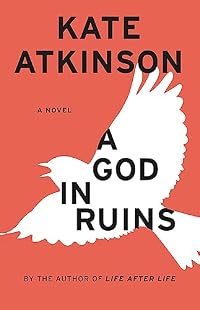
On This Page
Description
He had been reconciled to death during the war and then suddenly the war was over and there was a next day and a next day. Part of him never adjusted to having a future." Kate Atkinson's dazzling Life After Life explored the possibility of infinite chances and the power of choices, following Ursula Todd as she lived through the turbulent events of the last century over and over again. A GOD IN RUINS tells the dramatic story of the 20th Century through Ursula's beloved younger brother show more Teddy{u2014}would-be poet, heroic pilot, husband, father, and grandfather-as he navigates the perils and progress of a rapidly changing world. After all that Teddy endures in battle, his greatest challenge is living in a future he never expected to have. show lessTags
Recommendations










Member Recommendations
Member Reviews
Epic Life and Death Family Saga Continues
Kate Atkinson continues the Todd family saga that she began in her very good and popular Life After Life. However, here she grants Teddy Todd only one life's journey, unlike his sister Ursula, who experienced many, learning a bit more in each. Those who enjoyed the reincarnation gimmick of Life After Life may find themselves missing it here. Others, though, will recognize that keeping Teddy and the Todds on a straight course, more or less, adds greater, and greatly appreciated, emotional depth that may not always have been apparent in Atkinson's preceding effort. In other words, A God in Ruins is both a better and more satisfying novel.
We meet Teddy in 1944, briefly, as he prepares to take his show more last, fateful bomber flight, then shift back in time to him as a boy at Fox Corners. The novel continues in this fashion, jumping around in the long life span of Teddy Todd, from his WWII war experiences as a Halifax bomber skipper, to his boyhood, to his life with Nancy (Shawcross), to their only child Viola, to his grandchildren Sunny and Bertie, to his time with his Aunt Izzie and her recreation of him in her series of children's books, "The Adventures of Augustus." While the structure may sound dizzying, it works well, especially in pulling the reader through to the end, a quite natural conclusion with the death of Teddy in old age. (Please be assured the latter gives nothing away as the novel is about a full life.)
Teddy proves himself to be an engaging individual, a true steady hand, a man who when confronted with life's biggest trials manages admirable equanimity. He is the wartime leader you wished you served under; he is the father most anybody would love having; he is the husband many women dream of. If there might be a knock against him, it is that he might be too nice a guy.
But please, don't take these iterations to mean he led a charmed life. All the pain and suffering that buffet our lives do the same to his, and to a greater degree. Nothing could be more harrowing than the death of a spouse, especially in the prime of her life. Nancy suffers this fate in a section ("1960: His Little Unremembered Acts of Kindness and of Love" that will leave you shaken; that will give you another way to measure selflessness). Children can sometimes be a trial but Viola (Teddy's daughter) proves utterly dislikable while yet being saved from despicableness by her humanness. You'll find yourself amazed that her children survive and thrive in spite of what she subjects them to. Add to that her treatment of her father and you'll marvel at how Teddy could possibly bear her.
Readers of Life After Life will remember the London Blitz sequence resulting in one of Ursula's deaths. Here you'll find the wartime bookend, the Allied bombing campaign against Germany presented in all of its moral ambiguity. Atkinson does an excellent job of putting you squarely in the middle of battle and gives just due to those who flew to their deaths and the memories that haunted those who survived.
Atkinson has rendered a wondrous portrait of a man, his family, a period, and the joys and especially the travails of life that's not to be missed. show less
Kate Atkinson continues the Todd family saga that she began in her very good and popular Life After Life. However, here she grants Teddy Todd only one life's journey, unlike his sister Ursula, who experienced many, learning a bit more in each. Those who enjoyed the reincarnation gimmick of Life After Life may find themselves missing it here. Others, though, will recognize that keeping Teddy and the Todds on a straight course, more or less, adds greater, and greatly appreciated, emotional depth that may not always have been apparent in Atkinson's preceding effort. In other words, A God in Ruins is both a better and more satisfying novel.
We meet Teddy in 1944, briefly, as he prepares to take his show more last, fateful bomber flight, then shift back in time to him as a boy at Fox Corners. The novel continues in this fashion, jumping around in the long life span of Teddy Todd, from his WWII war experiences as a Halifax bomber skipper, to his boyhood, to his life with Nancy (Shawcross), to their only child Viola, to his grandchildren Sunny and Bertie, to his time with his Aunt Izzie and her recreation of him in her series of children's books, "The Adventures of Augustus." While the structure may sound dizzying, it works well, especially in pulling the reader through to the end, a quite natural conclusion with the death of Teddy in old age. (Please be assured the latter gives nothing away as the novel is about a full life.)
Teddy proves himself to be an engaging individual, a true steady hand, a man who when confronted with life's biggest trials manages admirable equanimity. He is the wartime leader you wished you served under; he is the father most anybody would love having; he is the husband many women dream of. If there might be a knock against him, it is that he might be too nice a guy.
But please, don't take these iterations to mean he led a charmed life. All the pain and suffering that buffet our lives do the same to his, and to a greater degree. Nothing could be more harrowing than the death of a spouse, especially in the prime of her life. Nancy suffers this fate in a section ("1960: His Little Unremembered Acts of Kindness and of Love" that will leave you shaken; that will give you another way to measure selflessness). Children can sometimes be a trial but Viola (Teddy's daughter) proves utterly dislikable while yet being saved from despicableness by her humanness. You'll find yourself amazed that her children survive and thrive in spite of what she subjects them to. Add to that her treatment of her father and you'll marvel at how Teddy could possibly bear her.
Readers of Life After Life will remember the London Blitz sequence resulting in one of Ursula's deaths. Here you'll find the wartime bookend, the Allied bombing campaign against Germany presented in all of its moral ambiguity. Atkinson does an excellent job of putting you squarely in the middle of battle and gives just due to those who flew to their deaths and the memories that haunted those who survived.
Atkinson has rendered a wondrous portrait of a man, his family, a period, and the joys and especially the travails of life that's not to be missed. show less
I finished this book about a month ago and haven't been able to come up with a review that seems worthy, without sounding like the many other reviewers here who are giving it 5 stars and gasping for breath.
I will say, I think it is a book to be savored, not hurried through. For me, it surpasses Atkinson's first novel involving the Todd family, "Life After Life" - I feel like Atkinson was making notes on the side, prepping for this, for Teddy Todd's story, while she was still writing the first one.
I would love it if she decided she wasn't quite finished with the Todd family. I'm certainly not.
For brilliant writing, for an immersive story of one family throughout the years before, during, and after WWII, leading us right into the 21st show more century - I can heartily recommend this book.
It did not end the way I thought it would. I'm still not over it.
Oh, Teddy. ❤️ show less
I will say, I think it is a book to be savored, not hurried through. For me, it surpasses Atkinson's first novel involving the Todd family, "Life After Life" - I feel like Atkinson was making notes on the side, prepping for this, for Teddy Todd's story, while she was still writing the first one.
I would love it if she decided she wasn't quite finished with the Todd family. I'm certainly not.
For brilliant writing, for an immersive story of one family throughout the years before, during, and after WWII, leading us right into the 21st show more century - I can heartily recommend this book.
It did not end the way I thought it would. I'm still not over it.
Oh, Teddy. ❤️ show less
What larks
A tale of flight. Teddy is a bird-lover, and the story is full of birds and of flying and fleeing.
His long life is marked by war: born in 1914, he becomes a bomber pilot in WW2.
“He had been reconciled to death during the war and then suddenly it was over… Part of him never adjusted to having a future.”
Teddy’s life story is told non-chronologically, in chapters labelled with the years. There’s occasional foreshadowing and rather more looking back, but it’s never confusing. Early on, we know that Teddy marries Nancy, has a daughter (Viola), grandchildren (Sunny and Bertie (Moon Roberta)), and that Nancy dies before Viola is an adult.
It’s a richly reflective and melancholic story of loss, despite elements of show more joy, love, and beauty. The camaraderie, experiences, stress, and superstitions of bomber crews are vividly portrayed, as is a traumatic time in Sunny’s life, aged about seven, when he’s trying to work out the illogical rules imposed on him by confused and confusing adults. It’s compounded when he’s unjustly blamed for a tragedy. Viola experiences trauma at a similar age, but the details are only revealed towards the end, so for most of the book she’s extremely and inexplicably heartless, with no redeeming qualities.
I don’t normally read war novels (that’s only one aspect of this), but found it a well-told and compelling read, despite Viola.
Image: A Eurasian skylark (Source)
Types of love
“Love had always seemed to Teddy to be a practical act as much as anything.”
There’s love of many kinds in these pages, but it’s not always a many-splendored thing.
“‘The mistake,’ Sylvie said, ‘is to think love equates with happiness.’”
There are plenty of secrets between loved-ones, sometimes to spare the other, sometimes because memories hurt, and other times for national security. But often, guilt is at the root. Is it cheating if you don’t go through with it? Sylvie and, separately, Hugh. What about when you think you or your partner are going to die, or that your partner already has? Teddy and Nancy.
“Afterwards [the war]… he resolved that he would always try to be kind. It was the best he could do. It was all that he could do. And it might be love.”
Killing
A book featuring a WW2 bomber pilot can’t escape the ethics of killing, especially of civilians.
“Teddy didn’t think of them as people. They were towns.”
But it’s more passive killing that is trickier: deciding whether to save mother or baby, letting a person who is suffering die - and maybe helping them do so. Those horrified in one instance feel differently in others. Selfishness, secrecy, and guilt are a toxic combination.
Image: A Canadian Fleet Finch, similar to what Teddy learned to fly (Source)
Birds and flight
“They were not so much warriors as sacrifices for the greater good. Birds thrown against a wall in the hope that eventually, if there were enough birds, they would break that wall.”
Teddy prefers to fly than take the desk-job his rank entitles him to, and twice in his life, external constraints put him in a position where he feels like a bird whose wings have been clipped. The plot and mood repeatedly soar and descend.
More than a dozen birds are mentioned (as well as RAF planes, some of which are named after creatures and birds):
A list, not a plot spoiler
• Bird with wings clipped: Teddy, after his gap year, when working in the bank, and later, when moving from the countryside to a York suburb.
• Budgie: Viola’s pet in their suburban home.
• Cuckoo: Viola is described as one (though leech would be more apt): “She was always looking to be given things, a cuckoo rather than a predator.”
• Finch: Teddy learned to fly in a Fleet Finch.
• Geese: Viola is chased as a child and forever scared of them.
• Hawks: used by Germans to kill British homing pigeons.
• Jackdaws: name of Nancy’s family home.
• Larks: Teddy is horrified that Aunt Izzie ate them in France. Larkspur flowers are mentioned, too.
• Love birds: in a cage at a care home.
• Peacocks: noisy in York Museum gardens.
• Pheasant: tail feathers in Izzie’s hat.
• Pigeons: homing pigeons at RAF base.
• Skylark: what Nancy would like Teddy to be reincarnated as.
• Sparrow: Viola’s first novel is called “Sparrows at Dawn”.
• Swallow: in his gap year, Teddy describes his travels south as being like a swallow.
• Swift: surname of Augustus, Izzie’s fictional slant on young Teddy.
Parenting - good and very bad
There’s a huge range of parenting styles, with obviously different outcomes, exploring fate versus free will.
• Sylvie: benign Edwardian detachment, even to Teddy, the favourite of her five children.
• Teddy: brilliant, loving, and practical, but unappreciated by his daughter. He compensates with his grandchildren.
“Her childhood had been warped by his reasonableness.” and his being “an irritatingly patient teacher.”
“Teddy knew he had failed Viola but he wasn’t sure how.”
• Nancy: loving, loved, and diligent. When she knows she’s dying, she buys clothes for Viola for one and two years ahead, makes lists for Teddy, and reads stories of orphans and resourceful girls to Viola.
• Viola: shockingly bad (and knows her children would be better off without her). She can barely organise the basics for physical survival, and seems incapable of loving her children. She lives off other people’s money, ideas, and kindness.
“Viola… resented other people’s pleasure, as if it subtracted something from the world rather than adding to it.”
• Dominic: absent in mind and body.
• Antonia Villiers: “The evil witch who claimed to be his grandmother”, who renames, reclothes, and tries to re-educate Sunny.
• Izzie: leaves her house to her German granddaughter, so she was more connected to the child she put up for adoption just before WW1 than Life After Life suggests.
Image: “Nurturing”, a sculpture of two heads, by Beatrice Hoffman (Source)
Fate and ‘what if?’
This is a major and inescapable theme of the earlier book about the Todd family (Life After Life) because Teddy’s sister, Ursula, leads many different lives. In this, it’s mostly limited to occasional idle conjecture about alternatives:
“Sometimes… I think if only I could go back in time and shoot Hitler.” [Teddy]
And
“If Viola could start again - there are no second chances… but if she could... She would learn how to love.”
There is outright rejection of alternatives:
“The war had been a great chasm and there could be no going back to the other side.”
Plus some that are just for the reader: Teddy’s permission for leave to attend his father’s funeral is rescinded at the last minute. The convoy he would have gone on is bombed.
Near the end, “fractals of the future” are floated in a single paragraph.
Then, when Teddy's family think he’s dead, Ursula says to Nancy:
“I believe we have just one life, and I believe that Teddy lived his perfectly.”
According to most of this book, he's a PoW, and returns a couple of years later. But perhaps he did die, and this whole book is a fiction within a fiction, illustrating all the lost lives and experiences of bomber crews.
See also
• This is a “companion” to Life After Life (see my review HERE), not a sequel or prequel. Whereas that explored many possible lives of Ursula Todd, this tells one life of her brother, Teddy, in a conventional way, with just the occasional nod to other possibilities, which is ironic given that the end of Life After Life suggests Teddy might also have an inkling of his alternative lives . It’s probably better to read Life After Life first, but not essential.
• Just over a year ago, we visited the International Bomber Command Centre near Lincoln. Very sobering (55,573 Bomber Command crew died and 500,000 Germans, mostly civilians, were killed by the Allied bombing campaign) and far more interesting than I expected. What Atkinson writes about Teddy’s experience fits with what I learned there. If you can’t visit in person, see HERE.
• In an afterword, Atkinson acknowledges the clear similarities between Izzie Todd’s series of children’s books about Augustus Swift and Richmal Crompton’s Just William, which I reviewed briefly, HERE.
• The bohemian alternative to Scouts, Kibbo Kift, was a real organisation, HERE.
Quotes
• “The mirror was once her friend, but now she felt that it regarded her with indifference.” [Sylvie]
• “She felt as if she had been on the outside of happiness her whole life.” [Viola]
• “It was the life of an unpaid eighteenth-century servant.” [Adam’s Acre commune]
• “Sometimes Teddy wondered if everyone had done well out of the war except for those who had fought in it.”
• “They could stand at their front door and watch the weather come towards them, like an approaching foe. It lived with them, it had a personality.”
• “Sunny was much better behaved than the dogs and yet was treated much worse.” [a sort of inverse of Augustus, who was based on his grandfather, Teddy] show less
A tale of flight. Teddy is a bird-lover, and the story is full of birds and of flying and fleeing.
His long life is marked by war: born in 1914, he becomes a bomber pilot in WW2.
“He had been reconciled to death during the war and then suddenly it was over… Part of him never adjusted to having a future.”
Teddy’s life story is told non-chronologically, in chapters labelled with the years. There’s occasional foreshadowing and rather more looking back, but it’s never confusing. Early on, we know that Teddy marries Nancy, has a daughter (Viola), grandchildren (Sunny and Bertie (Moon Roberta)), and that Nancy dies before Viola is an adult.
It’s a richly reflective and melancholic story of loss, despite elements of show more joy, love, and beauty. The camaraderie, experiences, stress, and superstitions of bomber crews are vividly portrayed, as is a traumatic time in Sunny’s life, aged about seven, when he’s trying to work out the illogical rules imposed on him by confused and confusing adults. It’s compounded when he’s unjustly blamed for a tragedy. Viola experiences trauma at a similar age, but the details are only revealed towards the end, so for most of the book she’s extremely and inexplicably heartless, with no redeeming qualities.
I don’t normally read war novels (that’s only one aspect of this), but found it a well-told and compelling read, despite Viola.
Image: A Eurasian skylark (Source)
Types of love
“Love had always seemed to Teddy to be a practical act as much as anything.”
There’s love of many kinds in these pages, but it’s not always a many-splendored thing.
“‘The mistake,’ Sylvie said, ‘is to think love equates with happiness.’”
There are plenty of secrets between loved-ones, sometimes to spare the other, sometimes because memories hurt, and other times for national security. But often, guilt is at the root. Is it cheating if you don’t go through with it?
“Afterwards [the war]… he resolved that he would always try to be kind. It was the best he could do. It was all that he could do. And it might be love.”
Killing
A book featuring a WW2 bomber pilot can’t escape the ethics of killing, especially of civilians.
“Teddy didn’t think of them as people. They were towns.”
But it’s more passive killing that is trickier: deciding whether to save mother or baby, letting a person who is suffering die - and maybe helping them do so. Those horrified in one instance feel differently in others. Selfishness, secrecy, and guilt are a toxic combination.
Image: A Canadian Fleet Finch, similar to what Teddy learned to fly (Source)
Birds and flight
“They were not so much warriors as sacrifices for the greater good. Birds thrown against a wall in the hope that eventually, if there were enough birds, they would break that wall.”
Teddy prefers to fly than take the desk-job his rank entitles him to, and twice in his life, external constraints put him in a position where he feels like a bird whose wings have been clipped. The plot and mood repeatedly soar and descend.
More than a dozen birds are mentioned (as well as RAF planes, some of which are named after creatures and birds):
A list, not a plot spoiler
• Bird with wings clipped: Teddy, after his gap year, when working in the bank, and later, when moving from the countryside to a York suburb.
• Budgie: Viola’s pet in their suburban home.
• Cuckoo: Viola is described as one (though leech would be more apt): “She was always looking to be given things, a cuckoo rather than a predator.”
• Finch: Teddy learned to fly in a Fleet Finch.
• Geese: Viola is chased as a child and forever scared of them.
• Hawks: used by Germans to kill British homing pigeons.
• Jackdaws: name of Nancy’s family home.
• Larks: Teddy is horrified that Aunt Izzie ate them in France. Larkspur flowers are mentioned, too.
• Love birds: in a cage at a care home.
• Peacocks: noisy in York Museum gardens.
• Pheasant: tail feathers in Izzie’s hat.
• Pigeons: homing pigeons at RAF base.
• Skylark: what Nancy would like Teddy to be reincarnated as.
• Sparrow: Viola’s first novel is called “Sparrows at Dawn”.
• Swallow: in his gap year, Teddy describes his travels south as being like a swallow.
• Swift: surname of Augustus, Izzie’s fictional slant on young Teddy.
Parenting - good and very bad
There’s a huge range of parenting styles, with obviously different outcomes, exploring fate versus free will.
• Sylvie: benign Edwardian detachment, even to Teddy, the favourite of her five children.
• Teddy: brilliant, loving, and practical, but unappreciated by his daughter. He compensates with his grandchildren.
“Her childhood had been warped by his reasonableness.” and his being “an irritatingly patient teacher.”
“Teddy knew he had failed Viola but he wasn’t sure how.”
• Nancy: loving, loved, and diligent.
• Viola: shockingly bad (and knows her children would be better off without her). She can barely organise the basics for physical survival, and seems incapable of loving her children. She lives off other people’s money, ideas, and kindness.
“Viola… resented other people’s pleasure, as if it subtracted something from the world rather than adding to it.”
• Dominic: absent in mind and body.
• Antonia Villiers: “The evil witch who claimed to be his grandmother”, who renames, reclothes, and tries to re-educate Sunny.
• Izzie: leaves her house to her German granddaughter, so she was more connected to the child she put up for adoption just before WW1 than Life After Life suggests.
Image: “Nurturing”, a sculpture of two heads, by Beatrice Hoffman (Source)
Fate and ‘what if?’
This is a major and inescapable theme of the earlier book about the Todd family (Life After Life) because Teddy’s sister, Ursula, leads many different lives. In this, it’s mostly limited to occasional idle conjecture about alternatives:
“Sometimes… I think if only I could go back in time and shoot Hitler.” [Teddy]
And
“If Viola could start again - there are no second chances… but if she could... She would learn how to love.”
There is outright rejection of alternatives:
“The war had been a great chasm and there could be no going back to the other side.”
Plus some that are just for the reader: Teddy’s permission for leave to attend his father’s funeral is rescinded at the last minute. The convoy he would have gone on is bombed.
Near the end, “fractals of the future” are floated in a single paragraph.
Then, when Teddy's family think he’s dead, Ursula says to Nancy:
“I believe we have just one life, and I believe that Teddy lived his perfectly.”
See also
• This is a “companion” to Life After Life (see my review HERE), not a sequel or prequel. Whereas that explored many possible lives of Ursula Todd, this tells one life of her brother, Teddy, in a conventional way, with just the occasional nod to other possibilities, which is ironic given that
• Just over a year ago, we visited the International Bomber Command Centre near Lincoln. Very sobering (55,573 Bomber Command crew died and 500,000 Germans, mostly civilians, were killed by the Allied bombing campaign) and far more interesting than I expected. What Atkinson writes about Teddy’s experience fits with what I learned there. If you can’t visit in person, see HERE.
• In an afterword, Atkinson acknowledges the clear similarities between Izzie Todd’s series of children’s books about Augustus Swift and Richmal Crompton’s Just William, which I reviewed briefly, HERE.
• The bohemian alternative to Scouts, Kibbo Kift, was a real organisation, HERE.
Quotes
• “The mirror was once her friend, but now she felt that it regarded her with indifference.” [Sylvie]
• “She felt as if she had been on the outside of happiness her whole life.” [Viola]
• “It was the life of an unpaid eighteenth-century servant.” [Adam’s Acre commune]
• “Sometimes Teddy wondered if everyone had done well out of the war except for those who had fought in it.”
• “They could stand at their front door and watch the weather come towards them, like an approaching foe. It lived with them, it had a personality.”
• “Sunny was much better behaved than the dogs and yet was treated much worse.” [a sort of inverse of Augustus, who was based on his grandfather, Teddy] show less
This was excellent. Atkinson has written a companion book to Life After Life that follows the life of Teddy, Ursula's (the main character in Life After Life) brother. In Life After Life, Teddy is the perfect person, who Ursula loves unconditionally and everyone else seems to love too. In A God in Ruins, we get to delve in to Teddy's war experience as a bomber pilot in WWII. We also get to know him as more than the beloved and idealized brother and son that he is in the first book.
As in every other book I've read by Atkinson, time is fluid and death is prominent. Though sections of the book are organized with headings stating a time period, each section also flashes backwards and forwards so that sometimes I'd have to go back to check show more which time period was supposed to be home base. At first this annoyed me, but I ended up liking it. Chronology is not the point; linked experiences, themes, symbols, and shared moments are instead what orient this book. Death is pervasive and there is a lot of exploration about how life ends, what happens afterward, and how the inevitability of death should effect how we live life. Some of these topics, especially with one of the characters, made for some emotional reading for me.
Since most readers of this book will have read Life After Life as well, I will say that this book worked much better for me. Even though I really loved Life AFter Life, I was always bothered because I thought that her idea for the book, Ursula's many lives, sort of ended up clouding the writing and overshadowing the story and character development. This book didn't have that problem and I thought that the characters were really well developed without losing creative form and innovation. I really loved this book. show less
As in every other book I've read by Atkinson, time is fluid and death is prominent. Though sections of the book are organized with headings stating a time period, each section also flashes backwards and forwards so that sometimes I'd have to go back to check show more which time period was supposed to be home base. At first this annoyed me, but I ended up liking it. Chronology is not the point; linked experiences, themes, symbols, and shared moments are instead what orient this book. Death is pervasive and there is a lot of exploration about how life ends, what happens afterward, and how the inevitability of death should effect how we live life. Some of these topics, especially with one of the characters, made for some emotional reading for me.
Since most readers of this book will have read Life After Life as well, I will say that this book worked much better for me. Even though I really loved Life AFter Life, I was always bothered because I thought that her idea for the book, Ursula's many lives, sort of ended up clouding the writing and overshadowing the story and character development. This book didn't have that problem and I thought that the characters were really well developed without losing creative form and innovation. I really loved this book. show less
In this novel, Kate Atkinson brings back one of the major characters from her earlier, excellent Life After Life. In that book, the protagonist, Ursula Todd, repeatedly returns to life. After every death, the snow that fell the night of her birth begins falling again, and she gets another go at it. She’s never consciously aware that this is happening to her but has a persistent feeling of deja-vu. In addition, she acts on compulsions that hinder some tragedy from a previous go around.
One tragedy she’s unable to forestall is the death of her bomber pilot brother, Ted. He’s her favorite sibling, as well as being the only child their mother loves. In A God in Ruins, we read an alternate ending to Ted’s story. Rather than die in his show more 70th sortie, he survives the crash of his bomber and spends the final year of World War Two in a POW camp, unbeknownst to his loved ones.
In this version, Ted returns, marries his childhood sweetheart, they have a child, and settle into what his wife describes as “plodding.” Happy-end? Well, decide for yourself when you read it. I was sorry to see Ted, who was everyone’s golden boy before the war, spend most of his post-war life experiencing something else.
It’s tough to put a rating on this. Kate Atkinson is one of my favorite writers, and this book, like her others, is excellent. She shifts back and forth in time, but not in a gimmicky way. Instead, it’s an effective way to have Ted’s story, and that of other major characters, unfold. But nearly every time I put the book down, I said, “poor Ted.”
Atkinson writes in the Afterword that war is humanity’s ultimate fall from grace. This book exemplifies this eloquently. And I love the title, which Atkinson borrows from Ralph Waldo Emerson (the quotation appears as an epigraph to the book), and which ties in nicely with a payoff scene near the end of the book. All in all, despite my mixed feelings, I feel this was a very good read. show less
One tragedy she’s unable to forestall is the death of her bomber pilot brother, Ted. He’s her favorite sibling, as well as being the only child their mother loves. In A God in Ruins, we read an alternate ending to Ted’s story. Rather than die in his show more 70th sortie, he survives the crash of his bomber and spends the final year of World War Two in a POW camp, unbeknownst to his loved ones.
In this version, Ted returns, marries his childhood sweetheart, they have a child, and settle into what his wife describes as “plodding.” Happy-end? Well, decide for yourself when you read it. I was sorry to see Ted, who was everyone’s golden boy before the war, spend most of his post-war life experiencing something else.
It’s tough to put a rating on this. Kate Atkinson is one of my favorite writers, and this book, like her others, is excellent. She shifts back and forth in time, but not in a gimmicky way. Instead, it’s an effective way to have Ted’s story, and that of other major characters, unfold. But nearly every time I put the book down, I said, “poor Ted.”
Atkinson writes in the Afterword that war is humanity’s ultimate fall from grace. This book exemplifies this eloquently. And I love the title, which Atkinson borrows from Ralph Waldo Emerson (the quotation appears as an epigraph to the book), and which ties in nicely with a payoff scene near the end of the book. All in all, despite my mixed feelings, I feel this was a very good read. show less
“The whole edifice of civilization turned out to be constructed from an unstable mix of quicksand and imagination.”
“He thought of all the men he knew who had been killed. The dead, like demons and angels, were legion.”
We first met Teddy in Life After Life. He was Ursula Todd's younger brother. An RAF bomber pilot. He is the central figure in this story and we follow him, through the war and many years beyond, until he is an old man, reflecting on his past. There are shifting timelines and narratives but Atkinson keeps the story flowing, through her masterful prose and dark, spiky humor.
I ended up liking this more than Life After Life and I think her writing keeps getting better and better. I do not think it is necessary to read show more the earlier novel first but I am sure you will want to go back and read it, after finishing this astonishing companion piece. show less
“He thought of all the men he knew who had been killed. The dead, like demons and angels, were legion.”
We first met Teddy in Life After Life. He was Ursula Todd's younger brother. An RAF bomber pilot. He is the central figure in this story and we follow him, through the war and many years beyond, until he is an old man, reflecting on his past. There are shifting timelines and narratives but Atkinson keeps the story flowing, through her masterful prose and dark, spiky humor.
I ended up liking this more than Life After Life and I think her writing keeps getting better and better. I do not think it is necessary to read show more the earlier novel first but I am sure you will want to go back and read it, after finishing this astonishing companion piece. show less
I love Kate Atkinson's novels, and have gobbled up everything from her early character-driven mysteries to the critically acclaimed Life After Life, which told the story of Ursula Todd, who somehow lived the events of the 20th century over and over again. Atkinson's latest work, A God In Ruins, is the story of Ursula's brother, Teddy. Teddy appears to lead a more typical life than his sister, coming of age in England between the wars and, like so many of his generation, serving his country in World War II. Teddy was a bomber pilot, lucking into a leadership role by virtue of his class and education. Despite his rather unassuming manner and lack of experience, he earns the respect of his crew and turns out to be quite effective leading show more them into conflict.
But this book is so much more than Teddy's war story. It's also the story of Teddy's wife Nancy, his daughter Viola, and his grandchildren, Sunny & Bertie. Atkinson moves elegantly between different time periods and points of view. Some chapters are set before the war and others much, much later, when Teddy is quite old. Some are told from another character's point of view. Atkinson often hints at the fate of certain characters and fills in the details gradually, challenging the reader to assemble a giant puzzle in their imagination.
Teddy's story is quite poignant. After the war, he is content to settle down to a quiet life with his family, his garden, and an ever-present dog. But Atkinson has other plans for him. Teddy's daughter Viola makes a series of disastrous decisions growing up, and becomes quite a vile young woman. It took a long time to identify the pivotal moment when it all went wrong for her, and at that moment she became less distasteful and more sympathetic. Atkinson kept the surprises coming, all the way up to the final pages. A God in Ruins is billed as a companion book to Life After Life. Although the two books are only loosely related, if they are read in order readers will appreciate Atkinson's creativity and the plot twists much more. I sincerely hope A God in Ruins is nominated for a major literary prize -- it's truly amazing. show less
But this book is so much more than Teddy's war story. It's also the story of Teddy's wife Nancy, his daughter Viola, and his grandchildren, Sunny & Bertie. Atkinson moves elegantly between different time periods and points of view. Some chapters are set before the war and others much, much later, when Teddy is quite old. Some are told from another character's point of view. Atkinson often hints at the fate of certain characters and fills in the details gradually, challenging the reader to assemble a giant puzzle in their imagination.
Teddy's story is quite poignant. After the war, he is content to settle down to a quiet life with his family, his garden, and an ever-present dog. But Atkinson has other plans for him. Teddy's daughter Viola makes a series of disastrous decisions growing up, and becomes quite a vile young woman. It took a long time to identify the pivotal moment when it all went wrong for her, and at that moment she became less distasteful and more sympathetic. Atkinson kept the surprises coming, all the way up to the final pages. A God in Ruins is billed as a companion book to Life After Life. Although the two books are only loosely related, if they are read in order readers will appreciate Atkinson's creativity and the plot twists much more. I sincerely hope A God in Ruins is nominated for a major literary prize -- it's truly amazing. show less
Members
- Recently Added By
Published Reviews
ThingScore 69
Kate Atkinson writes a brilliant follow-up to her brilliant novel, focusing on Teddy, the RAF pilot and brother of the previous book’s heroine....But if A God in Ruins suffers from a touch too much tidiness, if it overcalculates the glories of a sensitive “artistic soul,” those flaws pale next to Atkinson’s wit, humanity, and wisdom. In her afterword, she alludes to the “great show more conceit hidden at the heart of the book to do with fiction and the imagination, which is revealed only at the end.” It is a great conceit. But it’s also a testament to the novel’s craft and power that the conceit isn’t what you’ll remember when it’s over. show less
added by vancouverdeb
A God in Ruins doesn’t have a plot so much as a question, namely: How does such a lovely, perfect guy produce such a horrible, ungrateful daughter? Atkinson’s characteristic intelligence and wit are often on prominent display in the novel, yet it isn’t quite idiosyncratic enough to avoid the pitfalls of plotlessness. The chapters describing Teddy’s wartime exploits, in particular, feel show more over-long and over-detailed. One gets the sense that Atkinson has done a lot of painstaking research and doesn’t want to waste the fruits of her labour. ...Unlike Life After Life, which began flamboyantly and had a large cast of nuanced characters, this novel’s rewards come late in its pages. Until they do, we’re left in the company of two people who are ultimately rather dull: one because he’s “deplorably honest,” the other because she’s exasperatingly self-serving. Narrative psychology tells us there’s bound to be an explanation for this, and there is; the question is whether readers will have the patience to stick around and find out what it is. show less
added by vancouverdeb
But then you read a novel like Kate Atkinson’s “A God in Ruins,” a sprawling, unapologetically ambitious saga that tells the story of postwar Britain through the microcosm of a single family, and you remember what a big, old-school novel can do. Atkinson’s book covers almost a century, tracks four generations, and is almost inexhaustibly rich in scenes and characters and incidents. It show more deploys the whole realist bag of tricks, and none of it feels fake or embarrassing. In fact, it’s a masterly and frequently exhilarating performance by a novelist who seems utterly undaunted by the imposing challenges she’s set for herself....Taken together, “Life After Life” and “A God in Ruins” present the starkest possible contrast. In the first book, there’s youth and a multitude of possible futures. In the second, there’s only age and decay, and a single immutable past. This applies not only to the characters, but to England itself, which is portrayed over and over as a drab and diminished place. The culprit is obvious — it’s the war itself, “the great fall from grace.” show less
added by vancouverdeb
Lists

2016 Baileys Women's Prize for Fiction
18 works; 10 members

Top Five Books of 2015
811 works; 240 members

Top Five Books of 2017
757 works; 231 members

Female Author
1,235 works; 64 members

Top Five Books of 2016
795 works; 228 members

Books about World War II
241 works; 22 members

Books Read in 2023
5,547 works; 144 members

Books Read in 2016
4,666 works; 197 members
International Dublin Literary Award Longlist 2017
147 works; 3 members

Dublin Literary Award Longlist 2017
147 works; 2 members
Books Read in 2015
3,299 works; 127 members

Books recommended by Calgary Public Library staff
1,588 works; 4 members
Kirkus Starred Fiction Reviews of Books Published in 2015
310 works; 6 members

TBR - Older Books
92 works; 1 member

Books Read in 2021
5,361 works; 114 members

Kirkus Reviews Best Fiction of 2015
98 works; 6 members

The Five Books That Represent Us
390 works; 147 members
Author Information

36+ Works 52,440 Members
Kate Atkinson was born in York, and studied English Literature at the University of Dundee. She earned her Masters Degree from Dundee in 1974. She then went on to study for a doctorate in American Literature but she failed at the viva (oral examination) stage. After leaving the university, she took on a variety of jobs from home help to legal show more secretary and teacher. Her first novel, Behind the Scenes at the Museum, won the 1995 Whitbread Book of the Year ahead of Salman Rushdie's The Moor's Last Sigh and Roy Jenkins's biography of William Ewart Gladstone. It went on to be a Sunday Times bestseller. Since then, she has published another five novels, one play, and one collection of short stories. Her work is often celebrated for its wit, wisdom and subtle characterisation, and the surprising twists and plot turns. Her most recent work has featured the popular former detective Jackson Brodie. In 2009, she donated the short story Lucky We Live Now to Oxfam's 'Ox-Tales' project, four collections of UK stories written by 38 authors. Atkinson's story was published in the 'Earth' collection. In March 2010, Atkinson appeared at the York Literature Festival, giving a world-premier reading from an early chapter from her forthcoming novel Started Early, Took My Dog, which is set mainly in the English city of Leeds. Atkinson's bestselling novel, Life after Life, has won numerous awards, including the COSTA Novel Award for 2013. The follow-up to Life After Life is A God in Ruins and was published in 2015. This title won a Costa Book Award 2015 in the novel category. (Bowker Author Biography) show less
Some Editions
Awards and Honors
Awards
Distinctions
Notable Lists
Series

Work Relationships
Has as a reference guide/companion
Common Knowledge
- Canonical title
- A God in Ruins
- Original title
- A God in Ruins
- Original publication date
- 2015
- People/Characters
- Edward Beresford Todd; Ursula Beresford Todd; Nancy Shawcross; Viola Romaine
- Important places
- Naseby, Northamptonshire, England, UK; York, North Yorkshire, England, UK; Harrogate, Yorkshire, England, UK; Bali, Indonesia
- Important events
- World War II; Bombing of Nuremberg (1944-03-31); Bombing of Berlin (1943); Diamond Jubilee of Queen Elizabeth II
- Epigraph
- 'A man is a god in ruins. When men are innocent, life shall be no longer, and shall pass into the immortal, as gently as we awake from dreams.'
Ralph Waldo Emerson, Nature
'The purpose of Art is to convey the truth of a thing, not to be the truth itself.'
Sylvie Beresford Todd - Dedication
- For Reuben
- First words
- He walked as far as the hedge that signalled the end of the airfield.
- Quotations
- He had been reconciled to death during the war and then suddenly the war was over and there was a next day and a next day and a next day. Part of him never adjusted to having a future.
Maurice was a Whitehall mandarin, a pillar of respectability ... Maurice would have been very annoyed to be considered junior enough to rubber-stamp anything. He signed. A fluid, careless signature from his silver Sheaffer. - Last words
- (Click to show. Warning: May contain spoilers.)"I know that," Teddy said. "But please stop reading now."
- Publisher's editor
- Velmans, Marianne
- Original language
- English
Classifications
Statistics
- Members
- 3,373
- Popularity
- 4,964
- Reviews
- 153
- Rating
- (4.03)
- Languages
- 12 — Chinese, Danish, Dutch, English, Finnish, French, German, Italian, Portuguese, Swedish, Turkish, Vietnamese
- Media
- Paper, Audiobook, Ebook
- ISBNs
- 50
- ASINs
- 13