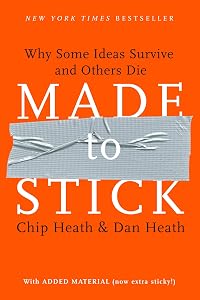
Made to Stick: Why Some Ideas Survive and Others Die
by Chip Heath, Dan Heath
On This Page
Description
Urban legends, conspiracy theories, and bogus public-health scares circulate effortlessly. Meanwhile, people with important ideas--business people, teachers, politicians, journalists, and others--struggle to make their ideas "stick." Why do some ideas thrive while others die? And how do we improve the chances of worthy ideas? Educators and idea collectors Chip and Dan Heath reveal the anatomy of ideas that stick and explain ways to make ideas stickier, such as applying the "human scale show more principle," using the "Velcro Theory of Memory," and creating "curiosity gaps." In this fast-paced tour of success stories (and failures), we discover that sticky messages of all kinds--from the infamous "kidney theft ring" hoax to a coach's lessons on sportsmanship to a vision for a new product at Sony--draw their power from the same six traits. This book that will transform the way you communicate ideas.--From publisher description. show lessTags
Recommendations

Member Recommendations
Member Reviews
Saturday February 24, 2007
The Guardian
Buy Made to Stick at the Guardian bookshop
Made to Stick: How Some Ideas Take Hold and Others Come Unstuck
by Chip and Dan Heath
304pp, Random House, £12.99
This is a book about what makes some ideas more effective than others. It explains what it is that makes you notice them, understand them, care about them, remember them, and act on them. And the simple answer is: presentation. Spin is crucial. Of course, substance is important, too. But the message of this smart, lively book is that if your spin is bad, you're nowhere.
As the authors say: "Good ideas often have a hard time succeeding in the world. Yet the ridiculous kidney heist tale keeps circulating, with no resources whatsoever to support show more it."
Kidney heist tale? That's right. The authors, Chip and Dan Heath, brothers from California, tell us the story of a guy who goes into a bar in an unfamiliar city and orders a drink, after which an attractive woman approaches him and asks him if he'd like another. And that's the last thing he remembers, until he wakes up the next morning in a bathtub full of ice. He has a wound in his back with a tube sticking out. He calls the emergency services. The operator says, "Sir, don't panic, but one of your kidneys has been harvested."
Next, the authors give us an example of something unmemorable. I won't quote it in full, but to give you an idea: "Comprehensive community building naturally lends itself to a return-on-investment rationale that can be modelled ..." We are asked to imagine what would happen if we closed the book and tried to tell someone about the kidney heist and the jargon. We'd be able to remember the heist. We'd have forgotten the jargon. The authors ask us: "Which sounds closer to the communications you encounter at work?"
This is a self-help book for ideas. Like a diet book, it tells you to slim your ideas down. Simplicity is the key. Dan, an educational publisher, studied teachers and what made them effective. Chip, a social science professor at Stanford, spent time researching the concept "How could a false idea displace a true one?" Both brothers were impressed by the concept of "stickiness", as explained by Malcolm Gladwell in his book The Tipping Point - some ideas stick in the mind, while others don't. "We want to pay tribute to Gladwell for the word 'stickiness'," they say. "It stuck."
There are various things, according to the Heaths, that make ideas memorable. Apart from simplicity, it helps if ideas are unexpected. You need to grab people's attention. They describe an advertising spot in which the viewer sees a happy family getting into a minivan and cruising blandly through suburban streets. Then, apparently out of nowhere - bang! An appalling crash. The idea: "Buckle up." The reason that the ad was effective: "It violates our schema of real-life neighbourhood trips."
Other things that make ideas stick: adding concrete details, dumping complicated statistics, connecting with people's emotions and telling stories. We hear about an anti-nuclear campaigner who wanted to give people the idea that the world was full of dangerous nuclear warheads - 5,000, in fact. Expressed as a number, he realised, this was not a particularly sticky idea. So he gave lectures, taking along a metal bucket and thousands of BB pellets. He dropped one pellet into the bucket and told his audience: "This is the Hiroshima bomb." Later, he poured 5,000 pellets into the bucket. This was the world's current nuclear capability. His audience was stunned into silence.
This is one of many examples that make this book such fun to read. We learn about good communicators, which is inspiring. How do you get people to unlearn an idea which is sticky but false, such as the notion that lots of people are attacked by sharks? Not by telling people the actual numbers, but by asking them whether they are more likely to be killed by a shark or a deer. Of course, the deer is more dangerous. This is something you're likely to remember. It's funny. It's something you'll want to tell people.
So why is this book scary? For one thing, it gives you an insight into the power of bad ideas - simple, concrete, emotive, story-based ideas will stick in spite of being wrong. For another, it makes you think of the world of ideas as a kind of arms race. Everybody is trying to seduce you, using concepts that, over time, are more and more fiendishly sticky. Sometimes, someone on the side of good will find a way of getting you to think about road safety or nuclear warheads. But who owns most of the sticky ideas? Surely it's the big corporations, who can afford to employ people who know how to keep their messages crisp and memorable.
When I finished this book, I wondered what it had taught me. It has taught me a simple thing about communication: keep it simple. And an unexpected thing: that, to be clever, you have to avoid being complex. And a statistical thing: forget about numbers. And an emotional thing: he who spins, wins, which is sad. And which is why it's worth reading this book. In the right hands, it will help. show less
The Guardian
Buy Made to Stick at the Guardian bookshop
Made to Stick: How Some Ideas Take Hold and Others Come Unstuck
by Chip and Dan Heath
304pp, Random House, £12.99
This is a book about what makes some ideas more effective than others. It explains what it is that makes you notice them, understand them, care about them, remember them, and act on them. And the simple answer is: presentation. Spin is crucial. Of course, substance is important, too. But the message of this smart, lively book is that if your spin is bad, you're nowhere.
As the authors say: "Good ideas often have a hard time succeeding in the world. Yet the ridiculous kidney heist tale keeps circulating, with no resources whatsoever to support show more it."
Kidney heist tale? That's right. The authors, Chip and Dan Heath, brothers from California, tell us the story of a guy who goes into a bar in an unfamiliar city and orders a drink, after which an attractive woman approaches him and asks him if he'd like another. And that's the last thing he remembers, until he wakes up the next morning in a bathtub full of ice. He has a wound in his back with a tube sticking out. He calls the emergency services. The operator says, "Sir, don't panic, but one of your kidneys has been harvested."
Next, the authors give us an example of something unmemorable. I won't quote it in full, but to give you an idea: "Comprehensive community building naturally lends itself to a return-on-investment rationale that can be modelled ..." We are asked to imagine what would happen if we closed the book and tried to tell someone about the kidney heist and the jargon. We'd be able to remember the heist. We'd have forgotten the jargon. The authors ask us: "Which sounds closer to the communications you encounter at work?"
This is a self-help book for ideas. Like a diet book, it tells you to slim your ideas down. Simplicity is the key. Dan, an educational publisher, studied teachers and what made them effective. Chip, a social science professor at Stanford, spent time researching the concept "How could a false idea displace a true one?" Both brothers were impressed by the concept of "stickiness", as explained by Malcolm Gladwell in his book The Tipping Point - some ideas stick in the mind, while others don't. "We want to pay tribute to Gladwell for the word 'stickiness'," they say. "It stuck."
There are various things, according to the Heaths, that make ideas memorable. Apart from simplicity, it helps if ideas are unexpected. You need to grab people's attention. They describe an advertising spot in which the viewer sees a happy family getting into a minivan and cruising blandly through suburban streets. Then, apparently out of nowhere - bang! An appalling crash. The idea: "Buckle up." The reason that the ad was effective: "It violates our schema of real-life neighbourhood trips."
Other things that make ideas stick: adding concrete details, dumping complicated statistics, connecting with people's emotions and telling stories. We hear about an anti-nuclear campaigner who wanted to give people the idea that the world was full of dangerous nuclear warheads - 5,000, in fact. Expressed as a number, he realised, this was not a particularly sticky idea. So he gave lectures, taking along a metal bucket and thousands of BB pellets. He dropped one pellet into the bucket and told his audience: "This is the Hiroshima bomb." Later, he poured 5,000 pellets into the bucket. This was the world's current nuclear capability. His audience was stunned into silence.
This is one of many examples that make this book such fun to read. We learn about good communicators, which is inspiring. How do you get people to unlearn an idea which is sticky but false, such as the notion that lots of people are attacked by sharks? Not by telling people the actual numbers, but by asking them whether they are more likely to be killed by a shark or a deer. Of course, the deer is more dangerous. This is something you're likely to remember. It's funny. It's something you'll want to tell people.
So why is this book scary? For one thing, it gives you an insight into the power of bad ideas - simple, concrete, emotive, story-based ideas will stick in spite of being wrong. For another, it makes you think of the world of ideas as a kind of arms race. Everybody is trying to seduce you, using concepts that, over time, are more and more fiendishly sticky. Sometimes, someone on the side of good will find a way of getting you to think about road safety or nuclear warheads. But who owns most of the sticky ideas? Surely it's the big corporations, who can afford to employ people who know how to keep their messages crisp and memorable.
When I finished this book, I wondered what it had taught me. It has taught me a simple thing about communication: keep it simple. And an unexpected thing: that, to be clever, you have to avoid being complex. And a statistical thing: forget about numbers. And an emotional thing: he who spins, wins, which is sad. And which is why it's worth reading this book. In the right hands, it will help. show less
Many business folk seek the one great idea that’ll transform the world and their bank accounts. They want to start a company or a product line to take them to the top or provide more stability. In our information age, however, ideas are everywhere; people able to push those ideas forward into beneficial, lasting change are harder to find. Leadership gurus (and brothers) Chip and Dan Heath seek to educate us about how to make our concepts “stick” around in the minds and lives of our listeners.
In an age where authoritarian tendencies are seemingly flourishing, the Heath brothers offer a refreshing look at persuasion. They do so by pulling examples from dozens of different fields – all with the common theme of making lasting show more change. Obviously, you need a good idea, but most good ideas don’t morph into results without good rhetoric. They show us how to identify those story lines and narrative hooks in our own lines. Thus, at the proper time, we can pull out the proper push to inspire, challenge, or springboard our audience to reach new heights.
I’ve appreciated both Chip Heath’s and Dan Heath’s writing in other domains, but I found this book not up to their usual standard. The examples are interesting, but the central, take-home message is weaker. The book dissected different ways people pitched ideas, but I finished the book without a lot of action items for my daily life and work. I guess you could say that the book itself didn’t have much “stickiness” for me. Don’t get me wrong: The concepts were good and sound, but it read more like a normal business book rather than reaching the high bar these two have set for themselves. show less
In an age where authoritarian tendencies are seemingly flourishing, the Heath brothers offer a refreshing look at persuasion. They do so by pulling examples from dozens of different fields – all with the common theme of making lasting show more change. Obviously, you need a good idea, but most good ideas don’t morph into results without good rhetoric. They show us how to identify those story lines and narrative hooks in our own lines. Thus, at the proper time, we can pull out the proper push to inspire, challenge, or springboard our audience to reach new heights.
I’ve appreciated both Chip Heath’s and Dan Heath’s writing in other domains, but I found this book not up to their usual standard. The examples are interesting, but the central, take-home message is weaker. The book dissected different ways people pitched ideas, but I finished the book without a lot of action items for my daily life and work. I guess you could say that the book itself didn’t have much “stickiness” for me. Don’t get me wrong: The concepts were good and sound, but it read more like a normal business book rather than reaching the high bar these two have set for themselves. show less
I generally don't like business books, and I like business principles applied to teaching even less. But this is a great book for getting teachers at any level to think about conveying abstract material in a concrete manner, and focus on the big picture - identifying the core things you want your students to learn, without getting sidetracked by a million tiny details.
We all want our views to be heard, understood and remembered: even better, if we can convince another person of our veracity. For those of us involved, at any level, of politics, this is crucial but, it is apparent that, more often than not, people throw their ideas to the wolves.
This book is filled with lots of common sense and a few ground breaking ideas. This is not to decry it in the least. It is always useful to have the obvious concepts gathered together and, this book has so much more. I believe that a book is worth reading, if it gives the reader one new point to ponder. I have many from this tome that will need to be chewed over and with which, I will need to experiment to get the best use.
Trying to summarise a book in a few show more short paragraphs is rather demeaning to the author because, if it is possible so to do, why has he/she taken nearly three hundred pages? The answer to that, is that Chip and Dan Heath make a much better job than I am about to do: however, below, you will find what I hope to be a brief flavour.
The book gives examples of memorable stories and examines why they stick in our mind. It also includes examples in which a standard reportage could have been used and the version that was actually released. These make it glaringly obvious that presentation is vital. In their original formats, the stories drift from the memory as fast as one reads them; in their amended form - which, it is important to stress, differ only in the presentation, and not by exaggeration or lying about events - many of them are stuck in my mind, even after finishing the book.
I would rate this as a must read for anyone wishing their words to be memorable. show less
This book is filled with lots of common sense and a few ground breaking ideas. This is not to decry it in the least. It is always useful to have the obvious concepts gathered together and, this book has so much more. I believe that a book is worth reading, if it gives the reader one new point to ponder. I have many from this tome that will need to be chewed over and with which, I will need to experiment to get the best use.
Trying to summarise a book in a few show more short paragraphs is rather demeaning to the author because, if it is possible so to do, why has he/she taken nearly three hundred pages? The answer to that, is that Chip and Dan Heath make a much better job than I am about to do: however, below, you will find what I hope to be a brief flavour.
The book gives examples of memorable stories and examines why they stick in our mind. It also includes examples in which a standard reportage could have been used and the version that was actually released. These make it glaringly obvious that presentation is vital. In their original formats, the stories drift from the memory as fast as one reads them; in their amended form - which, it is important to stress, differ only in the presentation, and not by exaggeration or lying about events - many of them are stuck in my mind, even after finishing the book.
I would rate this as a must read for anyone wishing their words to be memorable. show less
Teachers, writers, public speakers, anyone with an interest in spreading ideas should read Made to Stick. It’s absolutely brilliant. Chip is a professor of organizational behavior and Dan is a consultant and former business researcher. Together they have put together a fascinating history of some of the ideas that have “stuck” with us, from urban legends about Elvis’ motorcycle to memorable ad campaigns like “Where’s the Beef?”
But Made to Stick is really about how to make your ideas memorable, and this is really the heart of the book. Using the simple mnemonic device SUCCESs, the Heath brothers have identied the essential elements of a sticky idea: Simplicity, Unexpectedness, Concreteness, Credibility, Emotion, and Story. show more Sure, these elements have been talked about before, but not with such clarity and insight.
One of the great features of the book is what they call the “Clinic.” At the end of each chapter Chip and Dan take a situation and show how applying one or more of the six elements can make
the idea more “sticky.”
I’m a teacher, writer and speaker, and Made to Stick has already had an impact on my work. It’s one of the most practical and insightful books I’ve read in a long time, and I highly recommend it. show less
But Made to Stick is really about how to make your ideas memorable, and this is really the heart of the book. Using the simple mnemonic device SUCCESs, the Heath brothers have identied the essential elements of a sticky idea: Simplicity, Unexpectedness, Concreteness, Credibility, Emotion, and Story. show more Sure, these elements have been talked about before, but not with such clarity and insight.
One of the great features of the book is what they call the “Clinic.” At the end of each chapter Chip and Dan take a situation and show how applying one or more of the six elements can make
the idea more “sticky.”
I’m a teacher, writer and speaker, and Made to Stick has already had an impact on my work. It’s one of the most practical and insightful books I’ve read in a long time, and I highly recommend it. show less
Very readable, with practical advice for communicating your ideas and generating action. The key to success is "SUCCESs": simple, unexpected, concrete, credible, emotional stories stick with people.
Chip and Dan Heath have managed to produce a wonderful book explaining the underlying factors that make ideas stick. From examining these factors, to providing a structured approach to what one can do to make their ideas (presentations, work, speeches, etc.) more memorable in the minds of their audience.
I started reading this book at the same time (day before) I started working on the elevator pitch for my business. One thing that hounded me was, "what can I say to my potential clients to make them believe that my business solutions were right for them?". I struggled. And then I started reading the book. Almost, from the first chapter on, I started getting new (whether they were great will depend on a lot of things, including my show more execution) ideas as to how I can develop my elevator pitch.
Instead of being stuck, I moved forward. And I attribute it to the ideas presented in this book.
It is a book I recommend if you wish to make your idea stick. It might not get you there, but it will definitely get you rolling. show less
I started reading this book at the same time (day before) I started working on the elevator pitch for my business. One thing that hounded me was, "what can I say to my potential clients to make them believe that my business solutions were right for them?". I struggled. And then I started reading the book. Almost, from the first chapter on, I started getting new (whether they were great will depend on a lot of things, including my show more execution) ideas as to how I can develop my elevator pitch.
Instead of being stuck, I moved forward. And I attribute it to the ideas presented in this book.
It is a book I recommend if you wish to make your idea stick. It might not get you there, but it will definitely get you rolling. show less
Members
- Recently Added By
Published Reviews
ThingScore 81
The book is a rare combination of being both "an easy read" as well as providing thoughtful information that can be readily applied.
added by Katya0133
I especially like that this book follows its own rules for stickiness.
added by Katya0133
"Made to Stick" might have followed its own advice a bit more. The analytical point of all those sticky ideas almost gets lost in the welter of anecdotes.
added by Katya0133
Lists

The Great Courses: How Ideas Spread
4 works; 1 member

My List
302 works; 1 member
Author Information

15+ Works 10,424 Members
Chip Heath, is an American bestselling author, and speaker. He, along with his brother Dan Heath, has co-authored three books, Switch: How to Change Things When Change Is Hard, Made to Stick: Why Some Ideas Survive and Others Die, and Decisive. He is also a columnist for Fast Company magazine. Made to Stick, was named the Best Business Book of the show more Year, was on the BusinessWeek bestseller list for 24 months, and has been translated into 29 languages. In 2013, his title Decisive made The New York Times Best Seller List. (Bowker Author Biography) show less

16+ Works 10,683 Members
Dan Heath, is an American bestselling author, and speaker. He, along with his brother Chip Heath, has co-authored three books, Switch: How to Change Things When Change Is Hard, Made to Stick: Why Some Ideas Survive and Others Die, and Decisive. He is also a columnist for Fast Company magazine. Made to Stick, was named the Best Business Book of the show more Year, was on the BusinessWeek bestseller list for 24 months, and has been translated into 29 languages. In 2013, his title Decisive made The New York Times Best Seller List. (Bowker Author Biography) show less
Some Editions
Awards and Honors
Common Knowledge
- Canonical title
- Made to Stick: Why Some Ideas Survive and Others Die
- Original title
- Made to Stick: Why Some Ideas Survive and Others Die
- Original publication date
- 2007
- People/Characters*
- Tom Kolditz; James Carville; Paul Begala; Herb Kelleher; Bill Clinton; James Carville (show all 13); Ross Perot; Hoover Adams; Jeff Hawkins; Karen Wood; Jim Collins; Jerry I. Porras; Nora Ephron
- Dedication
- To Dad, for driving an old tan Chevette while putting us through college.
To Mom, for making us breakfast every day for eighteen years. Each. - First words
- A friend of a friend of ours is a frequent business traveler.
- Last words
- (Click to show. Warning: May contain spoilers.)(We're not sure heiress races will do the trick.)
- Original language
- English
*Some information comes from Common Knowledge in other languages. Click "Edit" for more information.
Classifications
Statistics
- Members
- 4,869
- Popularity
- 2,894
- Reviews
- 85
- Rating
- (4.02)
- Languages
- 13 — Arabic, Czech, Dutch, English, French, German, Hungarian, Italian, Polish, Slovak, Spanish, Thai, Portuguese (Portugal)
- Media
- Paper, Audiobook, Ebook
- ISBNs
- 39
- ASINs
- 23