On This Page
Description
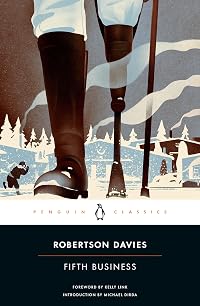
Ramsay is a man twice born, a man who has returned from the hell of the battle-grave at Passchendaele in World War I decorated with the Victoria Cross and destined to be caught in a no man's land where memory, history, and myth collide. As Ramsay tells his story, it begins to seem that from boyhood, he has exerted a perhaps mystical, perhaps pernicious, influence on those around him. His apparently innocent involvement in such innocuous events as the throwing of a snowball or the teaching of show more card tricks to a small boy in the end prove neither innocent nor innocuous. Fifth Business stands alone as a remarkable story told by a rational man who discovers that the marvelous is only another aspect of the real. show lessTags
Recommendations













Member Recommendations


Member Reviews
Highly weird (though it starts off in a mundane enough way) but BRILLIANT prose and unforgettable characters.
The narrator- a history master/ author on the brink of retirement - relates his life story. As the son of a fairly average family in a small Canadian town at the turn of the century, things change forever when an accident brings him into contact with the pregnant girl bride of the dour local vicar..
Myth, magic, religion...I loved it.
The narrator- a history master/ author on the brink of retirement - relates his life story. As the son of a fairly average family in a small Canadian town at the turn of the century, things change forever when an accident brings him into contact with the pregnant girl bride of the dour local vicar..
Myth, magic, religion...I loved it.
Dunstable Ramsay, in looking back upon his life, determines that his has been the role of 'fifth business'. It is a dramatic term to describe non-central characters who are nonetheless required in order to steer the drama of others' lives forward, always positioned at the right place and time to do so. He does, as it turns out, occupy some of the other positions in the eyes of society and his friends - a hero of the war, for example, though he feels it a false title. Is all the world a stage, and does life only have import if you are its hero, or are the auxiliary roles just as important? Is it all merely a matter of perception? If Dunstan Ramsey is only fifth business who's role is the hero in the life that he knows? Is it Percy? It is show more Mrs. Dempster? In spite of his perception and his broad view of life, he remains the hero of his own story, as do we all. At the same time, this being only a novel and Dunstan only its narrator, its other pieces must come together if he is not to be its central figure.
Dunstan becomes intrigued by hagiography, the study of saints and miracles. He's extremely rationale in his philosophy but cannot and will not doubt or deny the miraculous acts he witnesses. Unable to explain them, he still integrates them as facts into his world view and devotes his life to exploring this mystery without ever crossing the line into embracing irrationalism. To my mind this is the perfect melding and integration of a sense of wonder. The wonder of this book was how it became increasingly more intriguing and interesting as it went on, without ever becoming too complex or difficult to understand. In large part this is due to the characterizations that bring such incredible life to some most unusual people. I wished I might know them in reality, their wisdom, their repartee. I had only intended to read this first book, but there's no question I'll be reading the other two Deptford novels to explore the full picture. show less
Dunstan becomes intrigued by hagiography, the study of saints and miracles. He's extremely rationale in his philosophy but cannot and will not doubt or deny the miraculous acts he witnesses. Unable to explain them, he still integrates them as facts into his world view and devotes his life to exploring this mystery without ever crossing the line into embracing irrationalism. To my mind this is the perfect melding and integration of a sense of wonder. The wonder of this book was how it became increasingly more intriguing and interesting as it went on, without ever becoming too complex or difficult to understand. In large part this is due to the characterizations that bring such incredible life to some most unusual people. I wished I might know them in reality, their wisdom, their repartee. I had only intended to read this first book, but there's no question I'll be reading the other two Deptford novels to explore the full picture. show less
Magnus Eisengrim: “We all forget many of the things we do, especially when they do not fit into the character we have chosen for ourselves” (248).
I suppose that this is a coming of age story, but it is an odd one. Dunstable Ramsey (later Dunstan) is retelling the story of his life that he traces from the moment he dodged a snowball that struck a pregnant woman (Mary Dempster), causing her to fall, which trigged premature labor, which triggered one life event after another.
Main characters like Percy Stauton (later Boy Stauton), and Paul Dempster (later Magnus Eisengrim) are people within whom Dunstan seems to reflect part of his own sense of self. He figures himself out as a person through these other people in the ways that they show more reflect aspects of his self that he admires and detests. And at the center of it all is Mary Dempster, the common link and the focal point through which these main characters relate to each other. In this central role, Dunstan imagines Mary to be a saint, the intercessional figure who provides him not with a means of appealing to God but of accessing aspects of himself that are easier to understand when seen as embodied in Percy and Paul (when Dunstan was still Dunstable) and in Boy and Magnus (after Dunstable became Dunstan).
But more than being a story about a person’s lifelong focus on a woman who he imagines to be a saint, I think this novel is pointing to a modernized function of the “saint” figure. As I read it, saints represent interests and concerns that are specific to certain groups of people in their trades and at particular moments in life. In a way, they are templates of action and comportment. But it is perhaps also the case that we recognize saintly duties, more broadly and less divinely cast, in people who are not officially recognized as saints but are instead public figures or mere people in our lives who, whether by virtue of the good things they do, the burdens they bear, the afflictions they suffer, or other things they do, become meaningful ways for us to understand ourselves and to relate to others.
Dunstan himself seems to reflect on his own role as an intercessional figure. I doubt that he would think himself a saint, but as a teacher at a boys college he does have a role that at least aspires to motivate young minds to aid reflection and introspection. Except that Dunstan feels that he flounders a bit, reflecting at one time that “[y]ou are now thirty-four, without a wife or child, and no better plan than your own whim; you teach boys who, very properly, regard you as a signpost on the road they are to follow, and like a signpost they pass you by without a thought” (156). In fact, the title of the book comes from a realization that he reaches about this role.
The narrative style of the book is introspective and searching. Dunstan tells a story with the investigative rigor of an academic and none of the guarded or muted or other deflective ways of telling a life story that guards one’s ego. There is a charming sincerity about the narration. Dunstan is frank about his successes and failures, his virtues and his vices. And Davies’ writing style amplifies the story by giving Dunstan a voice that is a charismatic mix of curiosity, wisdom, a bit of stuffy pomposity, and subtle humor. It is a voice that perfectly fits the Dunstan who is the narrator of the letter/memoir through which the book is delivered.
This book is easily one of my new favorites. show less
I suppose that this is a coming of age story, but it is an odd one. Dunstable Ramsey (later Dunstan) is retelling the story of his life that he traces from the moment he dodged a snowball that struck a pregnant woman (Mary Dempster), causing her to fall, which trigged premature labor, which triggered one life event after another.
Main characters like Percy Stauton (later Boy Stauton), and Paul Dempster (later Magnus Eisengrim) are people within whom Dunstan seems to reflect part of his own sense of self. He figures himself out as a person through these other people in the ways that they show more reflect aspects of his self that he admires and detests. And at the center of it all is Mary Dempster, the common link and the focal point through which these main characters relate to each other. In this central role, Dunstan imagines Mary to be a saint, the intercessional figure who provides him not with a means of appealing to God but of accessing aspects of himself that are easier to understand when seen as embodied in Percy and Paul (when Dunstan was still Dunstable) and in Boy and Magnus (after Dunstable became Dunstan).
But more than being a story about a person’s lifelong focus on a woman who he imagines to be a saint, I think this novel is pointing to a modernized function of the “saint” figure. As I read it, saints represent interests and concerns that are specific to certain groups of people in their trades and at particular moments in life. In a way, they are templates of action and comportment. But it is perhaps also the case that we recognize saintly duties, more broadly and less divinely cast, in people who are not officially recognized as saints but are instead public figures or mere people in our lives who, whether by virtue of the good things they do, the burdens they bear, the afflictions they suffer, or other things they do, become meaningful ways for us to understand ourselves and to relate to others.
Dunstan himself seems to reflect on his own role as an intercessional figure. I doubt that he would think himself a saint, but as a teacher at a boys college he does have a role that at least aspires to motivate young minds to aid reflection and introspection. Except that Dunstan feels that he flounders a bit, reflecting at one time that “[y]ou are now thirty-four, without a wife or child, and no better plan than your own whim; you teach boys who, very properly, regard you as a signpost on the road they are to follow, and like a signpost they pass you by without a thought” (156). In fact, the title of the book comes from a realization that he reaches about this role.
The narrative style of the book is introspective and searching. Dunstan tells a story with the investigative rigor of an academic and none of the guarded or muted or other deflective ways of telling a life story that guards one’s ego. There is a charming sincerity about the narration. Dunstan is frank about his successes and failures, his virtues and his vices. And Davies’ writing style amplifies the story by giving Dunstan a voice that is a charismatic mix of curiosity, wisdom, a bit of stuffy pomposity, and subtle humor. It is a voice that perfectly fits the Dunstan who is the narrator of the letter/memoir through which the book is delivered.
This book is easily one of my new favorites. show less
Over the years, I have thought a lot about the difference between fiction and literature. Every devoted reader undoubtedly has his or her own definition of that demarcation, but here is mine: Fiction—good fiction, at least—can be nothing more than an entertaining and satisfying story, but a work of literature rises well above that. Indeed, literature teaches you something that you did not know about yourself or the world at large; it is like a mirror that you hold up to reveal things that are both enlightening and, often, a little surprising. Of course, the best literature also tells a really good story. Like everything I have ever read by Robertson Davies, Fifth Business is good literature.
The novel records the history of Dunstan show more Ramsay, a man destined to be a supporting player in the lives of others. (In operatic terms, “fifth business” refers to a character considered necessary to the plot, but not central to it.) The first volume of the author’s celebrated Deptford Trilogy, it is written as a memoir released after Ramsay’s retirement from his position as a master at a private boy’s school in Toronto. Covering much of the last century, the story begins when 10-year old Ramsay dodges a snowball thrown by his friend and rival Percy Boy Staunton, which hits Mary Dempster, the pregnant wife of the local minister. The force of the blow has severe consequences as it brings about the premature birth of Paul Dempster and causes Mary to lose her grip on reality. Much of the ensuing narrative revolves around Ramsay’s life-long remorse over his role in this singular event.
What follows amounts to an account of what becomes of Mary, Boy, and Paul (who transforms himself into Magnus Eisengrim, a world-famous magician), as seen through Ramsay’s eyes. Along the way, we also learn a considerable amount about the narrator, including his reclusive nature, his service as a war hero, his passion for chronicling the lives of saints, and his role as Staunton’s confessor and confidant as the latter rises to a position of wealth and political prominence. Ramsay’s relationship with Mary is particularly poignant; he considers her to be a saint for three “miracles” he associates her with, but is greatly conflicted as he observes her slow, heart-breaking descent into madness. He also serves as the catalyzing force that brings Boy and Eisengrim together as the book reaches its dramatic conclusion.
Davies wrote such wonderfully compelling stories that it is easy to overlook how much his prose has to teach us. Beyond its rich details on topics such as hagiography, mythology, illusionism, and Jungian psychology, what I found most striking about Fifth Business was its great insight into the nature of responsibility and guilt. In fact, so much of what transpires in the novel can be viewed in terms of Ramsay’s struggle to resolve the issue of the point at which responsibility for one’s actions begins, a lesson he appeared to learn very late in life. This book is an almost perfect marriage of great story-telling with a rich set of insights into what it means to be human; it is exactly what literature should be and one to be savored again and again. show less
The novel records the history of Dunstan show more Ramsay, a man destined to be a supporting player in the lives of others. (In operatic terms, “fifth business” refers to a character considered necessary to the plot, but not central to it.) The first volume of the author’s celebrated Deptford Trilogy, it is written as a memoir released after Ramsay’s retirement from his position as a master at a private boy’s school in Toronto. Covering much of the last century, the story begins when 10-year old Ramsay dodges a snowball thrown by his friend and rival Percy Boy Staunton, which hits Mary Dempster, the pregnant wife of the local minister. The force of the blow has severe consequences as it brings about the premature birth of Paul Dempster and causes Mary to lose her grip on reality. Much of the ensuing narrative revolves around Ramsay’s life-long remorse over his role in this singular event.
What follows amounts to an account of what becomes of Mary, Boy, and Paul (who transforms himself into Magnus Eisengrim, a world-famous magician), as seen through Ramsay’s eyes. Along the way, we also learn a considerable amount about the narrator, including his reclusive nature, his service as a war hero, his passion for chronicling the lives of saints, and his role as Staunton’s confessor and confidant as the latter rises to a position of wealth and political prominence. Ramsay’s relationship with Mary is particularly poignant; he considers her to be a saint for three “miracles” he associates her with, but is greatly conflicted as he observes her slow, heart-breaking descent into madness. He also serves as the catalyzing force that brings Boy and Eisengrim together as the book reaches its dramatic conclusion.
Davies wrote such wonderfully compelling stories that it is easy to overlook how much his prose has to teach us. Beyond its rich details on topics such as hagiography, mythology, illusionism, and Jungian psychology, what I found most striking about Fifth Business was its great insight into the nature of responsibility and guilt. In fact, so much of what transpires in the novel can be viewed in terms of Ramsay’s struggle to resolve the issue of the point at which responsibility for one’s actions begins, a lesson he appeared to learn very late in life. This book is an almost perfect marriage of great story-telling with a rich set of insights into what it means to be human; it is exactly what literature should be and one to be savored again and again. show less
The writing in "Fifth Business" is impressive, a skillful mix of narrative, tongue in cheek humor, ironical phrasings and exquisitely developed prose. The story is continued for two more volumes in the series, but is full and sufficient in and of itself in this first volume of the trilogy.
The character and secrets of boys shapes and forms their lives and destinies across decades until the secrets finally catch up with them. The secrets themselves may have been fairly benign in that the event they concern, a pregnant woman being hit by a rock filled snowball and going into early labor and delivery, was probably accidental. No matter how benign the secrets may have been, the character and personalities of the children involved in the show more incident magnify their beliefs about their roles in the tragedy. Both boys spend their lives trying to assuage their imagined guilt in ways characteristic of their childhoods: one through denial and the other in ill-founded guilt.
As a work of literature the book is wonderful. Seldom does an author so fully develop the characteristics of his characters so beautifully that they persist and show themselves throughout the lives of the boys.
Since this novel was written almost 50 years ago, the demand to read it these days will not be great, yet, that is unfortunate, because a novel this well written and this well structured simply does not come along very often. show less
The character and secrets of boys shapes and forms their lives and destinies across decades until the secrets finally catch up with them. The secrets themselves may have been fairly benign in that the event they concern, a pregnant woman being hit by a rock filled snowball and going into early labor and delivery, was probably accidental. No matter how benign the secrets may have been, the character and personalities of the children involved in the show more incident magnify their beliefs about their roles in the tragedy. Both boys spend their lives trying to assuage their imagined guilt in ways characteristic of their childhoods: one through denial and the other in ill-founded guilt.
As a work of literature the book is wonderful. Seldom does an author so fully develop the characteristics of his characters so beautifully that they persist and show themselves throughout the lives of the boys.
Since this novel was written almost 50 years ago, the demand to read it these days will not be great, yet, that is unfortunate, because a novel this well written and this well structured simply does not come along very often. show less
I think I would rate this book lower if I hadn't known going in that it's the first book in a trilogy, and would view the weak ending differently - unsatisfactory - after an engaging, well-told story. I find it worrisome that Fifth Business is on the 1,001 Books You Must Read Before You Die list but the successive volumes are not, because it deserves to be and I want the next novels to be just as good.
Fifth Business is the story of Dunstable Ramsey and his friend and nemesis Percy Boyd Staunton, who we witness grow from mischievous boys in small-town 1908 Canada to old men. Across their fifty year journey, they harbor a secret which altered the lives of the Dempsters by causing the premature birth of their only son. Dunstable will spend show more his life attempting to, if not rectify, at least pay penance for the consequences of his and Staunton's actions. He will lose a leg and be disfigured during the Great War (an extremely well-written section of the novel) and end up unmarried, teaching history at an all-boys school, where he goes by his shortened name Dunstan.
But Dunstan's life is not a lonely, academic existence. He is a hagiographist; he spends his vacations traveling the world researching the lives of saints, about whom he writes multiple best-selling books. Even though he professes to not be religious, he expends a great deal of thought and discussion on Christianity in an attempt to have Mrs Dempster canonized for the three miracles she performs. The book's most challenging concept is that a man can be lead to Christ through his sinful interaction with her.
In his travels, Dunstan also encounters the now-grown Dempster son, a world-class illusionist who still bears the emotional scars of his childhood. I usually object to these types of fantastic coincidences, but in this story they fit perfectly within the narrative and enrich its complexity.
You will not drown in Fifth Business's details but keep google handy so that you'll understand several of the historical and mythological references (e.g. Cauldron of Ceridwen). They add depth to an entertaining, thought-provoking work worth reading. show less
Fifth Business is the story of Dunstable Ramsey and his friend and nemesis Percy Boyd Staunton, who we witness grow from mischievous boys in small-town 1908 Canada to old men. Across their fifty year journey, they harbor a secret which altered the lives of the Dempsters by causing the premature birth of their only son. Dunstable will spend show more his life attempting to, if not rectify, at least pay penance for the consequences of his and Staunton's actions. He will lose a leg and be disfigured during the Great War (an extremely well-written section of the novel) and end up unmarried, teaching history at an all-boys school, where he goes by his shortened name Dunstan.
But Dunstan's life is not a lonely, academic existence. He is a hagiographist; he spends his vacations traveling the world researching the lives of saints, about whom he writes multiple best-selling books. Even though he professes to not be religious, he expends a great deal of thought and discussion on Christianity in an attempt to have Mrs Dempster canonized for the three miracles she performs. The book's most challenging concept is that a man can be lead to Christ through his sinful interaction with her.
In his travels, Dunstan also encounters the now-grown Dempster son, a world-class illusionist who still bears the emotional scars of his childhood. I usually object to these types of fantastic coincidences, but in this story they fit perfectly within the narrative and enrich its complexity.
You will not drown in Fifth Business's details but keep google handy so that you'll understand several of the historical and mythological references (e.g. Cauldron of Ceridwen). They add depth to an entertaining, thought-provoking work worth reading. show less
There's something distinctly lacking in a lot of modern literature that this somewhat more antiquated piece of literature has in spades: enthusiasm. In fact, not since the better prose of Saul Bellow have I experienced a literature so determinedly skillful and driven to a single point, that point being adventurous literary exploration and analysis of themes and ideas fettered smoothly to the act of storytelling; that the depth of theme never overshadows the exigencies of storytelling puts Robertson Davies somewhat on par with a Bellow though lacking just a bit in what Bellow had, that is, a singular and distinctive voice.
Now, don't get me wrong, Davies writes with a consummate skill. But unlike a Bellow who so self-consciously (at show more times to the point of bursting) set out to manicure and cultivate a dialectical voice that was equal parts 'American', 'European', and overall 'Jewish' (though the protean nature of the final term is such that, surprise, Bellow is hardly the final word on the subject, thankfully), Davies adheres just a bit too much to the occidental, to the old and classically European school of literary expression. This isn't a bad thing, far from it. Rather it just more directly shows Davies influences and authorial precedents...but I would be lying if I said that Davies definitively and insolubly declared himself in the face of all these influences, rather he writes 'his turn'.
But overall this is a reader's novel and should be enjoyed (very much so) as such. If you're looking for the kind of literature that is unfortunately just this side of scarce in our modern, cynical, and ironic era, then give yourself leave to read this earnest and very compelling story of a man 'twice born'. show less
Now, don't get me wrong, Davies writes with a consummate skill. But unlike a Bellow who so self-consciously (at show more times to the point of bursting) set out to manicure and cultivate a dialectical voice that was equal parts 'American', 'European', and overall 'Jewish' (though the protean nature of the final term is such that, surprise, Bellow is hardly the final word on the subject, thankfully), Davies adheres just a bit too much to the occidental, to the old and classically European school of literary expression. This isn't a bad thing, far from it. Rather it just more directly shows Davies influences and authorial precedents...but I would be lying if I said that Davies definitively and insolubly declared himself in the face of all these influences, rather he writes 'his turn'.
But overall this is a reader's novel and should be enjoyed (very much so) as such. If you're looking for the kind of literature that is unfortunately just this side of scarce in our modern, cynical, and ironic era, then give yourself leave to read this earnest and very compelling story of a man 'twice born'. show less
Members
- Recently Added By
Published Reviews
ThingScore 100
"A marvelously enigmatic novel, then, elegantly written and driven by irresistible narrative force."
added by GYKM
Lists

1001 Books You Must Read Before You Die
1,448 works; 1,134 members
501 Must-Read Books
529 works; 72 members

The Best of Canadian Literature
235 works; 33 members

Magic Realism
371 works; 52 members

20th Century Literature
1,161 works; 54 members
CBC Books - Canada's 100 (+ bonus 10): Which have you read?
110 works; 23 members

Favourite Books
1,819 works; 308 members

Books Set in Canada
80 works; 16 members

Canon de la narrativa universal del siglo XX
254 works; 6 members
Didactic Fiction
29 works; 3 members

Daria Morgendorffer's Bookshelf
70 works; 5 members

Most Popular Books Tagged Ontario
35 works; 2 members

CBC's Great Canadian Reading List
149 works; 5 members
TML 200 Best Books 1950-1999
202 works; 10 members

Canada
42 works; 3 members

Most Popular Books Tagged Canada
34 works; 1 member

Swinging Seventies
255 works; 18 members

Published in 1970
58 works; 7 members

Books You Couldn't Finish
202 works; 32 members

Tonikat reading completed on Librarything journals
329 works; 2 members

My TBR
371 works; 3 members

AP Lit
363 works; 6 members

Books You Read For University
184 works; 3 members

Books We Love to Reread
688 works; 296 members

1970 Club
85 works; 2 members
Canon de la narrativa universal del s. XX (cicutadry)
499 works; 3 members

fictional librarians
53 works; 19 members

The Modern Library (The Two Hundred Best Novels....
202 works; 1 member
Talk Discussions
Past Discussions
Davies - The Deptford Trilogy - discussion in Literary Centennials (December 2012)
Author Information

89+ Works 24,729 Members
William Robertson Davies was born in Thamesville, Ontario in 1913. He taught English at the University of Toronto and was an actor, journalist, and newspaper editor before winning acclaim as a novelist with Tempest-Tost, the first of his Salterton trilogy. His most famous trilogy, The Deptford Trilogy--Fifth Business, The Manticore, and World of show more Wonders--develops the earlier Salterton novels. The locale is a fictitious Ontario city that prizes its English tradition, including the Anglican Church and the genealogy of the old families. Robertson's novels have been translated into approximately 20 languages. His masterful story-telling encompasses such issues as evil, love, fear, tradition, and magic as he brings his characters to life with wisdom and humor. Robertson Davies died in 1995. (Bowker Author Biography) Robertson Davies (1913-1995) had three successive careers during the time he became an internationally acclaimed author: first as an actor with the Old Vic Company in England; then as publisher of "The Peterborough Ontario Examiner"; & finally as professor & first master of Massey College at the University of Toronto. With twelve novels & several volumes of essays & plays to his credit, Davies was the first Canadian to be inducted to the American Academy & Institute of Arts & Letters. His last novel, "The Cunning Man" (Viking 1995), was a national bestseller. (Publisher Provided) show less
Some Editions
Awards and Honors
Distinctions
Notable Lists
Series

Belongs to Publisher Series
Work Relationships
Is contained in
Has as a student's study guide
Common Knowledge
- Canonical title
- Fifth Business
- Original title
- Fifth Business
- Original publication date
- 1970
- People/Characters
- Dunstan Ramsay; Paul Dempster; Mrs. Dempster; Boy Staunton; Lieslotte Naegeli; Magnus Eisengrim
- Important places
- Deptford, Ontario, Canada; Toronto, Ontario, Canada; France; London, England, UK; South America; Colborne College, Canada
- Epigraph
- Fifth Business ... Definition
Those roles which, being neither those of
Hero nor Heroine, Confidante nor Villain,
but were none the less essential to
bring about the Recognition or the denouement
were ca... (show all)lled the Fifth Business in drama
and opera companies organized according
to the old style; the player who acted these
parts was often referred to as Fifth Business.
- Tho. Overskou, Den Danske Skueplads - First words
- My lifelong involvement with Mrs Dempster began at 5:58 o'clock p.m. on 27 December 1908, at which time I was ten years and seven months old.
- Quotations
- " ... You despise almost everyone except Paul's mother. No wonder she seems like a saint to you; you have made her carry the affection you should have spread among fifty people. Do not look at me with that tragic face. You sh... (show all)ould thank me. At fifty years old you should be glad to know something of yourself. That horrid village and your hateful Scots family made you a moral monster. Well, it is not too late for you to enjoy a few years of almost normal humanity."
For I was, as you have already guessed, a collaborator with Destiny, not one who put a pistol to its head and demanded particular treasures.
God, youth is a terrible time! So much feeling and so little notion of how to handle it! - Last words
- (Click to show. Warning: May contain spoilers.)And that, Headmaster, is all I have to tell you.
- Original language
- English
Classifications
Statistics
- Members
- 3,454
- Popularity
- 4,814
- Reviews
- 94
- Rating
- (4.15)
- Languages
- 13 — Catalan, Czech, Dutch, English, Estonian, Finnish, French, German, Italian, Norwegian (Bokmål), Portuguese, Spanish, Swedish
- Media
- Paper, Audiobook, Ebook
- ISBNs
- 44
- ASINs
- 25