On This Page
Description
Looking through the kitchen window, a little girl and her doting grandparents watch stars, play games, and, most importantly, say hello and goodbye.Tags
Recommendations



Member Recommendations
Member Reviews
On the title page, a little girl springs away from her parents; turn the page, and the reader sees only her arms on the gate, the reader taking her perspective as she looks over to the white clapboard house where her Nanna and Poppy’s faces stare equally eagerly out of the Hello, Goodbye Window.
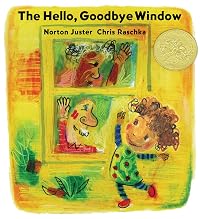
The exuberant tot proceeds to spend a thoroughly idyllic overnight with her loving grandparents, the stay punctuated by a harmonica serenade, a bike ride (“Not in the street, please”) and a nap. Juster adopts the voice of the child, whose present-tense narration is just right, describing pleasures (saying good night to the stars) and perils (the tiger at the back of the garden) with a steady, sweet candor. Raschka’s mixed-media show more illustrations are characteristically loose and energetic, depicting this happy, biracial family with jewel tones and extravagant swirls.
As the little girl unwinds at the end of the stay, she imagines the many possible visitors who might come to the Hello, Goodbye Window—but no one is more happily welcomed than her parents, who pick her up after her picture-perfect day. (Picture book. 3-7)
-Kirkus Review show less
The exuberant tot proceeds to spend a thoroughly idyllic overnight with her loving grandparents, the stay punctuated by a harmonica serenade, a bike ride (“Not in the street, please”) and a nap. Juster adopts the voice of the child, whose present-tense narration is just right, describing pleasures (saying good night to the stars) and perils (the tiger at the back of the garden) with a steady, sweet candor. Raschka’s mixed-media show more illustrations are characteristically loose and energetic, depicting this happy, biracial family with jewel tones and extravagant swirls.
As the little girl unwinds at the end of the stay, she imagines the many possible visitors who might come to the Hello, Goodbye Window—but no one is more happily welcomed than her parents, who pick her up after her picture-perfect day. (Picture book. 3-7)
-Kirkus Review show less
I really enjoyed the Hello Goodbye Window. I liked how the author managed to show how the child had a very loving and humorous relationship with her grandparents, and how the simple things in life are meaningful and etched in memories. The illustrations have very bold colors and somewhat childlike features, giving it just the right touch to appeal to young readers.This book also had another very important underlining message. The fact that the parents and grandparents were biracial couples stuck out to me. I thought that was a very nice touch to the story. The importance of a child feeling they belong is very important even though they have parents from two different races or ethnicities.
I recently read, "The Hello, Goodbye Window," by Norton Juster. I liked this book for several reasons. First, I liked how the story was easily relatable. For example, the narrator sleeps over her grandparents house. I found this relatable because I used to sleep over my grandparents house when I was younger, too. Secondly, I liked the illustrations. I liked them because they were very colorful and enhanced the story line. The pictures enhanced the story line because it looks like the narrator, the little girl, drew the pictures. Furthermore, I liked how the illustrations depicted the ethnicities of the characters in the story. The grandmother and the little girl both looked as if they were African American. I liked how this detail was show more not written in the story because it made the fact that the family was multicultural look normal, as it should be. Lastly, I liked the story because of the main idea. The main idea of the story is to enjoy the time spent with family because like anyone else, they can become your best friends. This idea is evident in the story because the little girl tells the reader about all the fun times she has with her grandparents. show less
Summary:
This book is about a little girl who spends a lot of time at her grandparent's house. There is a special window in her Nanna and Poppy's kitchen (the hello, goodbye window) that is described as the "magic gateway". The little girl is especially attached to this magic window because so many important parts of her life are centered around the window. She can see the stars from the window, say hello and goodbye from it, and even see her reflection in it. She has a strong bond with not only her grandparents, but also the hello, goodbye window.
Personal reaction:
I loved how detailed the little girl was as she narrated this story. I could hear her sweet little voice in every word. This book reminded me of the priceless memories I have show more of visiting my own grandmother as a little girl. I read this book to my two children and they loved it too, especially my 5 year old as he could relate with the little girl.
Classroom extensions:
1. Since this book portrays the bond between a child and her grandparents, I would read this book to my students on or around Grandparent's Day. I would discuss the special relationship we have with our grandparents.
2. I would discuss the imagination aspect of this book. The little girl described many different things that can occur in the window, like the Queen of England visiting. I would have my students use their imagination and describe what they would see or do in the window. show less
This book is about a little girl who spends a lot of time at her grandparent's house. There is a special window in her Nanna and Poppy's kitchen (the hello, goodbye window) that is described as the "magic gateway". The little girl is especially attached to this magic window because so many important parts of her life are centered around the window. She can see the stars from the window, say hello and goodbye from it, and even see her reflection in it. She has a strong bond with not only her grandparents, but also the hello, goodbye window.
Personal reaction:
I loved how detailed the little girl was as she narrated this story. I could hear her sweet little voice in every word. This book reminded me of the priceless memories I have show more of visiting my own grandmother as a little girl. I read this book to my two children and they loved it too, especially my 5 year old as he could relate with the little girl.
Classroom extensions:
1. Since this book portrays the bond between a child and her grandparents, I would read this book to my students on or around Grandparent's Day. I would discuss the special relationship we have with our grandparents.
2. I would discuss the imagination aspect of this book. The little girl described many different things that can occur in the window, like the Queen of England visiting. I would have my students use their imagination and describe what they would see or do in the window. show less
I really enjoyed this book! This book allows the readers to think back to their childhood and relate a lot to the little girl in the story. I love the illustration in this book. I especially like how the grandmother and grandfather were a bi-racial couple and that it was never mentioned in the story. I feel like that allows the readers so see it's not a big deal who you love and everyone can be happy together. It also shows children that every family is different because they might not have a bi-racial couple in their family or have to go to their grandparent's house when their parents are at work. I really liked this story and would definitely read it to my future class.
Using a mixture of crayon and watercolor Rascka's naive style perfectly matches Juster's spot-on childlike tone. Beyond the brightly colored illustrations and simple, yet exuberant, text what also makes this a standout are the multi-race couples depicted with no comment. Most authors and illustrators would be tempted to make this a lesson on racial tolerance but Juster and Raschka just leave it as the way things are without making a big hairy deal out of the issue. A refreshing breath of fresh air.
I was surprised how much I loved this picture book! The cover is not very attractive or eye-catching. I'm familiar with the artist, but it's not particularly to my taste, so it would have been something I'd pass by. However, the story is beyond sweet, especially for anyone who has grandparents that they adore, or who is a grandparent! It describes the relationship and the uncomplicated loving interactions perfectly. The story is narrated from the perspective of a young girl with the charming egocentrism of the very young: "When I get tired I come in and take my nap and nothing happens until I get up." I grew to love the messy artwork; it reminded me of how a child might draw, very indistinct and imprecise, but of course with loads of show more technique from the accomplished artist. I thoroughly enjoyed this title and think it would do well in storytime but also as a lapsit story, hopefully from a grandparent to a little one! show less
Members
- Recently Added By
Published Reviews
PreS-Gr 1-The window in Nanna and Poppy's kitchen is no ordinary window-it is the place where love and magic happens. It's where the girl and her doting grandparents watch stars, play games, and, most importantly, say hello and goodbye. The first-person text is both simple and sophisticated, conjuring a perfectly child-centered world. Sentences such as "When I get tired I come in and take my show more nap and nothing happens until I get up" typify the girl's happy, imaginative world. While the language is bouncy and fun, it is the visual interpretation of this sweet story that sings. Using a bright rainbow palette of saturated color, Raschka's impressionistic, mixed-media illustrations portray a loving, mixed-race family. The artwork is at once lively and energetic, without crowding the story or the words on the page; the simple lines and squiggles of color suggest a child's own drawings, but this is the art of a masterful hand. Perfect for lap-sharing, this book will find favor with children and adults alike.-Angela J. Reynolds, Washington County Cooperative Library Services, Hillsboro, OR Copyright 2005 Reed Business Information. show less
added by sriches
Juster (The Phantom Tollbooth) crafts a cozy portrait of a grandchild and her grandparents in this endearing book, illustrated in paintbox colors by Raschka (Be Boy Buzz). A curly haired girl-who dances with wiggly energy in Raschka's lush paintings-describes playful visits to her Nanna and Poppy, whose kitchen window provides the perfect venue to say hello and goodbye. "You can climb up on show more the flower barrel and tap," she says, "then duck down and they won't know who did it." Her grandparents welcome her into a sunlit, spacious kitchen filled with plants, where she doodles and listens to Poppy play "Oh, Susannah" on the harmonica. At night, the "Hello, Goodbye Window" functions as a mirror, and the girl jokes about being outside looking in: "Poppy says, `What are you doing out there? You come right in and have your dinner.' And I say, `But I'm here with you, Poppy,' and then he looks at me in his funny way." Juster departs from the over-the-top punning of his earlier works to create a gently humorous account of a family's conversations and games, all centered on the special window. Raschka warms the pages with glowing yellow, emerald, sapphire and golden brown, and he pictures the garden and trees in emphatic midsummer greens. The characters smile at one another with a doting twinkle in their eyes, and grandparents especially will be charmed by this relaxed account of how a child's visit occasions everyday magic. Ages 2-up. (Apr.) Copyright 2005 Reed Business Information. show less
added by sriches
A young girl takes us to her Nanna and Poppy's house to see a very special window. Most of the time her Nanna and Poppy are there in the kitchen so she can tap on the window, then hide, or they can wave at her when she arrives. We share her joy in the fun she has with Poppy's harmonica playing, watching reflections in the window at supper, saying goodnight to the stars with Nanna, looking show more through the window at the garden, playing outside. Sometimes through the window she sees people; sometimes her imagination fills it with other more amazing sights. Saying goodbye through the window when Mommy and Daddy pick her up is sad, but she looks forward to having her own "Hello, Goodbye Window" some day. Raschka turns the pages into scenes of innocent joy. His paints barely suggest objects as he applies intuitive areas of color, he then uses black lines here and there to define a face, a bicycle, a spouting hose. The personalities of the grandparents and their loving interactions with the narrator make this an engaging tale, while the artist's imagination forms something special from a bit of childhood. 2005, Michael Di Capua Books/Hyperion Books for Children, Ages 3 to 6. show less
added by sriches
Lists

Caldecott Medal Books
91 works; 15 members

Children's picture books with kids of color
129 works; 15 members

Books Read in 2023
5,638 works; 147 members
Author Information

18+ Works 25,755 Members

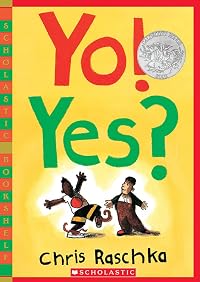
Chris Raschka was born in Huntingdon, Pennsylvania on March 6, 1959. He received a B.A. from St. Olaf College in 1981. Before becoming a full-time author, he was an art teacher in St. Croix, Virgin Islands and a freelance artist, cartoonist, and editorial illustrator. He is an author and illustrator of children's books including Yo! Yes?, Charlie show more Parker Played Be Bop, and Mysterious Thelonious. Hello, Goodbye Window won the Caldecott Medal in 2006 and A Ball for Daisy won the Caldecott Medal in 2012. (Bowker Author Biography) show less
Awards and Honors
Awards
Distinctions
Series

Common Knowledge
- Canonical title
- The Hello, Goodbye Window
- Original publication date
- 2005
- Dedication
- For Tori -- N.J.
For Eliana -- C.R. - First words
- Nanna and Poppy live in a big house in the middle of town.
- Last words
- (Click to show. Warning: May contain spoilers.)I don't know who the Poppy will be, but I hope he can play the harmonica.
Classifications
Statistics
- Members
- 3,387
- Popularity
- 4,995
- Reviews
- 397
- Rating
- (4.01)
- Languages
- Chinese, English, French, Japanese
- Media
- Paper, Audiobook
- ISBNs
- 20
- UPCs
- 1
- ASINs
- 11