Love
by Stendhal
On This Page
Description
In 1818, when he was in his mid-thirties, Stendhal met and fell passionately in love with the beautiful Mathilde Dembowski. She, however, was quick to make it clear that she did not return his affections, and in his despair he turned to the written word to exorcise his love and explain his feelings. The result is an intensely personal dissection of the process of falling - and being - in love- a unique blend of poetry, anecdote, philosophy, psychology and social observation. Bringing show more together the conflicting sides of his nature, the deeply emotional and the coolly analytical, Stendhal created a work that is both acutely personal and universally applicable. show lessTags
Recommendations











Member Reviews
I was lucky enough to snag an Early Reviewer’s Copy of the Hesperus Press paperback edition of Stendhal’s On Love. Having always wanted to read some Stendhal and not having got around to it yet, this was a good opportunity to remedy that with a short book on a topic that everyone ponders at some point in their life. Love. A.C. Grayling, in his forward, says, “…this is a gem of literature, one of many possible windows into the human soul, a book one must at some point read and meditate upon.”
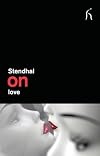
First of all, I’d like to say something about the edition that Hesperus was kind enough to send me. This is a high quality paperback. Nice thick covers that fold over in the front and the back and can be used as a bookmarker if you so show more choose. Good quality paper that is not so transparent as to be distracting, copious footnotes and endnotes. Hesperus Press, as suggested by the Latin motto 'Et Remotissima Prope', is committed to bringing near what is far - far both in space and time. Works written by the greatest authors, and unjustly neglected or simply little known in the English-speaking world, are made accessible through new translations and a completely fresh editorial approach. Through these classic works, the reader is introduced to the greatest writers from all times and cultures. This is book is apparently part of their “on” series…I would certainly buy their editions over the usual paperbacks you see on the market these days.
I really liked this book and the way Stendhal broke up love into four different types: Passionate love, mannered love, physical love, and vain love. Physical love is where we all start around our teens. We may move on to experience the other types of love at different times in our life, although I don’t think Vain Love, or what I call “arm candy style” love, is one I hope I never succumb to. He further describes seven states of love: admiration, increasingly thinking about the person, hope, the birth of love, the first crystallization, the appearance of doubts, and the second crystallization.
The crystallization process is very interesting in and of itself. This is the process of “beautifying” and covering up the faults and slights of our lover with exaggerations and emphasis of their charms. I believe it’s called “spin” in our times! But it’s not necessarily a bad think in the case of love, as Stendhal goes on to describe in detail. He calls it the “beautification of a loved one in the act of loving”.
Stendhal was a lover of love and a lover of women. Grayling calls him a feminist in that he believed that “the encounter with the feminine in the special circumstances of courtship is valuable in itself, one of the life-enhancing experiences.” He goes on to state that the task of writing about love fully and coherently is difficult if not impossible.
Some of my favorite quotes:
'Indeed, half - the most beautiful half - of life is hidden from one who has not loved passionately'
'If both are perfectly at ease, the happiness of two individuals ends by melting into one. Thanks to affinities and other laws of human nature, this is quite simply the greatest happiness we can wish for.'
'There are some moments with one's beloved that the imagination never tires of replaying and embellishing. This is what makes it so difficult to forget a woman with whom one has found happiness.'
'Besides, there cannot be ingratitude in love: the pleasure of the moment always seems to reward even the greatest sacrifices. The greatest mistake, in my opinion, is lack of honesty, for a lover ought simply to show his true feelings.'
'The difference between the meanings of unfaithfulness for the two sexes is so great that a woman in love may pardon an infidelity... Here is an authoritative rule for distinguishing truly passionate love from that founded on 'pique': for women, infidelity will practically destroy the one but will strengthen the other.'
'It seems to me that the entire art of love comes down to saying exactly what the current moment's degree of intoxication requires; in other words, it is all about listening to your heart. Of course, that is easier said than done.' show less
First of all, I’d like to say something about the edition that Hesperus was kind enough to send me. This is a high quality paperback. Nice thick covers that fold over in the front and the back and can be used as a bookmarker if you so show more choose. Good quality paper that is not so transparent as to be distracting, copious footnotes and endnotes. Hesperus Press, as suggested by the Latin motto 'Et Remotissima Prope', is committed to bringing near what is far - far both in space and time. Works written by the greatest authors, and unjustly neglected or simply little known in the English-speaking world, are made accessible through new translations and a completely fresh editorial approach. Through these classic works, the reader is introduced to the greatest writers from all times and cultures. This is book is apparently part of their “on” series…I would certainly buy their editions over the usual paperbacks you see on the market these days.
I really liked this book and the way Stendhal broke up love into four different types: Passionate love, mannered love, physical love, and vain love. Physical love is where we all start around our teens. We may move on to experience the other types of love at different times in our life, although I don’t think Vain Love, or what I call “arm candy style” love, is one I hope I never succumb to. He further describes seven states of love: admiration, increasingly thinking about the person, hope, the birth of love, the first crystallization, the appearance of doubts, and the second crystallization.
The crystallization process is very interesting in and of itself. This is the process of “beautifying” and covering up the faults and slights of our lover with exaggerations and emphasis of their charms. I believe it’s called “spin” in our times! But it’s not necessarily a bad think in the case of love, as Stendhal goes on to describe in detail. He calls it the “beautification of a loved one in the act of loving”.
Stendhal was a lover of love and a lover of women. Grayling calls him a feminist in that he believed that “the encounter with the feminine in the special circumstances of courtship is valuable in itself, one of the life-enhancing experiences.” He goes on to state that the task of writing about love fully and coherently is difficult if not impossible.
Some of my favorite quotes:
'Indeed, half - the most beautiful half - of life is hidden from one who has not loved passionately'
'If both are perfectly at ease, the happiness of two individuals ends by melting into one. Thanks to affinities and other laws of human nature, this is quite simply the greatest happiness we can wish for.'
'There are some moments with one's beloved that the imagination never tires of replaying and embellishing. This is what makes it so difficult to forget a woman with whom one has found happiness.'
'Besides, there cannot be ingratitude in love: the pleasure of the moment always seems to reward even the greatest sacrifices. The greatest mistake, in my opinion, is lack of honesty, for a lover ought simply to show his true feelings.'
'The difference between the meanings of unfaithfulness for the two sexes is so great that a woman in love may pardon an infidelity... Here is an authoritative rule for distinguishing truly passionate love from that founded on 'pique': for women, infidelity will practically destroy the one but will strengthen the other.'
'It seems to me that the entire art of love comes down to saying exactly what the current moment's degree of intoxication requires; in other words, it is all about listening to your heart. Of course, that is easier said than done.' show less
 This review was written for LibraryThing Early Reviewers.
I must admit, I had a difficult time reading Stendhal's On Love, the first time through. It seems disjointed (ADHD comes to mind). Thinking that perhaps this was more a function of how I was reading the volume (bits here and there), I re-read and thoroughly enjoyed the book. Given the numerous, short chapters (40 in less than 110 pages), it is tempting to read in short bursts-- don't!! Looking at the volume as a whole, Stendhal walks us through his four types of love (passionate, mannered, physical and vain), the seven stages of love and in particular, a detailed discussion of one stage - crystallisation. On the way he addresses topics such as Hope, Modesty, Infatuation, Intimacy and Jealousy (including tips on how to fend off a rival!) show more I could not help thinking of the term "trophy wife" while reading the section on Vain Love. Historically Interesting from the vantage point of early 18th century roles of men and women with some added insight as to what other authors Stendhal was reading. An example of the eye-brow raising advice he offers is:
"Many husbands ensure long years of a loving marriage simply by taking a little mistress two months after the wedding."
The Hesperus volume has a strong cover (all of their volumes I have received have been very well built), extended flaps that can serve as bookmarks, is well annotated (provdes great contextual information) and has a good Foreword by AC Grayling setting the stage for the volume. show less
"Many husbands ensure long years of a loving marriage simply by taking a little mistress two months after the wedding."
The Hesperus volume has a strong cover (all of their volumes I have received have been very well built), extended flaps that can serve as bookmarks, is well annotated (provdes great contextual information) and has a good Foreword by AC Grayling setting the stage for the volume. show less
This review was written for LibraryThing Early Reviewers.As Stendhal was obsessed with love, in many ways we all are. We all can understand passion, of not always having that passion or love returned, and of discovering different varieties of love as we experience life. This long essay really brings home how universal love is: the book was written in 1822 and yet it seems nothing about love has changed since then.
Love being so strongly and universally felt, it is easy to understand how difficult it would be to write down exactly what love is. And so while enjoyable to read from the standpoint of being relating, the book is also incomplete, fleeting, and sometimes arbitrary in its discussions. And yet, that is exactly how we all experience it.
Love being so strongly and universally felt, it is easy to understand how difficult it would be to write down exactly what love is. And so while enjoyable to read from the standpoint of being relating, the book is also incomplete, fleeting, and sometimes arbitrary in its discussions. And yet, that is exactly how we all experience it.
This review was written for LibraryThing Early Reviewers.There are various reasons why this book is a joy to read. First, it's by Stendhal and you recognise his tone of voice immediately: solid writing, witty and thorough thinking. Second, it brings you back to the 19th century and gives you a nice view on how things were in those days, especially when it comes to love, romance and relationships. Thirdly, both the foreword and the introduction are very insightful. A.C. Grayling and Sophie Lewis are both very helpful to understand this book: why was it written, how should we understand it, what did the author intend with it and how should we put this writing in perspective. Sure, it's a tough read sometimes. But it's well worth it. And because romantic feelings and love never change, this book show more (apart from the historical context) is still very relevant and insightful. show less
This review was written for LibraryThing Early Reviewers.Poised between artifice and authentic emotionalism, Stendahl’s On Love explores the topic of love, combining the rational and the romantic. The stylistic balance fits the personality of Stendahl, the nom de plume of Henri-Marie Beyle. The short work combines analytical passages and excerpts from the dairy of Salviati, another guise Stendahl uses to investigate the concept of love.
The accretion of different personae, pseudonyms of pseudonyms, creates a fascinating literary product. The book’s genesis can be traced back to a rebuff Stendahl received from Matilde Dembowski, “the aristocratic young wife of a Polish officer” Sophie Lewis says in the Introduction of the Hesperus Edition.
Emotionally devastated, Stendahl wrote an essay show more emblematic of the Post-Napoleonic landscape. An influential concept Stendahl postulated was that of “crystallization.” In Salzburg, Austria, young couples would place a branch in the local salt mine. After several days, crystals would cover the branch. Stendahl relates this to love, the crystallization symbolizing how the lover will attribute characteristics of perfection to his beloved. The crystallization turns the beloved into an object of perfection, despite evidence to the contrary.
Building upon this revolutionary concept, Stendahl continues to study the forms of love, including vain love, passionate love, and mannered love. Sometimes he analyzes the concept with numerical points, analytic and concise. Other times he will give an excerpt from Salviati’s diary or quote an excerpt from Dante, Sir Walter Scott, or Shakespeare. The effect is an essay that has a modern feeling. The concept of crystallization would go on to influence modern psychology.
http://driftlessareareview.wordpress.com/2010/05/21/on-love-1822-by-stendahl/ show less
The accretion of different personae, pseudonyms of pseudonyms, creates a fascinating literary product. The book’s genesis can be traced back to a rebuff Stendahl received from Matilde Dembowski, “the aristocratic young wife of a Polish officer” Sophie Lewis says in the Introduction of the Hesperus Edition.
Emotionally devastated, Stendahl wrote an essay show more emblematic of the Post-Napoleonic landscape. An influential concept Stendahl postulated was that of “crystallization.” In Salzburg, Austria, young couples would place a branch in the local salt mine. After several days, crystals would cover the branch. Stendahl relates this to love, the crystallization symbolizing how the lover will attribute characteristics of perfection to his beloved. The crystallization turns the beloved into an object of perfection, despite evidence to the contrary.
Building upon this revolutionary concept, Stendahl continues to study the forms of love, including vain love, passionate love, and mannered love. Sometimes he analyzes the concept with numerical points, analytic and concise. Other times he will give an excerpt from Salviati’s diary or quote an excerpt from Dante, Sir Walter Scott, or Shakespeare. The effect is an essay that has a modern feeling. The concept of crystallization would go on to influence modern psychology.
http://driftlessareareview.wordpress.com/2010/05/21/on-love-1822-by-stendahl/ show less
This review was written for LibraryThing Early Reviewers.The book is strictly speaking about infatuation and courtship. His theory of love, which he calls crystallization, is based on the stage of idealization of the other when everything about him/her seem perfect and doubt about the feelings of the other permeates the relationship. I don't think there is a word written in this book about long-term companionship.
There is some interesting insights to be gained of European bourgeois/upper class society at Stendhal's time. For example I got the impression no one seemed to have married for love. You married for status and got a lover at the side for love.
For my part I found the writing boring, I found his theory of love superficial and I didn't feel I gained any new insights or deeper show more understanding of love. I appreciate his effort in writing about the subject and I'm sure some readers will find it enlightening, but for me it is a one star rating book. show less
There is some interesting insights to be gained of European bourgeois/upper class society at Stendhal's time. For example I got the impression no one seemed to have married for love. You married for status and got a lover at the side for love.
For my part I found the writing boring, I found his theory of love superficial and I didn't feel I gained any new insights or deeper show more understanding of love. I appreciate his effort in writing about the subject and I'm sure some readers will find it enlightening, but for me it is a one star rating book. show less
Charming, diverting essay by the famed French novelist on the subject that dominated so much of his fiction-love. His views about women are outdated and not always easy to read, but overall the book is delightful and the Hesperus edition is beautifully packaged with French flaps and evocative cover art. ON LOVE is a lovely way to spend a leisurely afternoon.
This review was written for LibraryThing Early Reviewers.Members
- Recently Added By
Published Reviews
ThingScore 75
And it is because it is anecdotal, discursive and always running up against the idea of the inarticulacy and dumbfounded silence of love, that we can trust Stendhal's insights and realise at times that this is, even when being light, a work of great psychological worth and acuity.
added by sneuper
Lists

Edward Gorey Covers
150 works; 8 members

Harold Bloom - The Western Canon: C. The Democratic Age
336 works; 15 members

How to Read a Book's Recommended Reading List
309 works; 10 members

1820s
8 works; 1 member
Author Information

479+ Works 21,792 Members
One of the great French novelists of the nineteenth century, Stendhal (pseudonym for Marie-Henri Beyle) describes his unhappy youth with sensitivity and intelligence in his autobiographical novel The Life of Henri Brulard. It was written in 1835 and 1836 but published in 1890, long after his death. He detested his father, a lawyer from Grenoble, show more France, whose only passion in life was making money. Therefore, Stendhal left home as soon as he could. Stendhal served with Napoleon's army in the campaign in Russia in 1812, which helped inspire the famous war scenes in his novel The Red and the Black (1831). After Napoleon's fall, Stendhal lived for six years in Italy, a country he loved during his entire life. In 1821, he returned to Paris for a life of literature, politics, and love affairs. Stendhal's novels feature heroes who reject any form of authority that would restrain their sense of individual freedom. They are an interesting blend of romantic emotionalism and eighteenth-century realism. Stendhal's heroes are sensitive, emotional individuals who are in conflict with the society in which they live, yet they have the intelligence and detachment to analyze their society and its faults. Stendhal was a precursor of the realism of Flaubert. He once described the novelist's function as that of a person carrying a mirror down a highway so that the mirror would reflect life as it was, for all society. (Bowker Author Biography) show less
Some Editions
Series
Belongs to Publisher Series
Sammlung Dieterich (126)
insel taschenbuch (0124)
Work Relationships
Is contained in
Is abridged in
Common Knowledge
- Canonical title
- Love
- Original title
- De l'amour
- Original publication date
- 1822
- People/Characters
- Don Juan; Werther; Ernestine; Goncelin; Guillaume; Louise d'Épinay (show all 17); Louise d'Epinay; Madame Dayssin; Madame du Deffand; Signora Gherardi; Julie de Lespinasse; Sextus Aurelius Propertius; Marie-Jeanne Roland; Madame Roland; Stendhal; Albius Tibullus; Lisio Visconti
- Important places
- Bologna, Emilia Romagna, Italia; Rome, Italy; Provence, France; Paris, Île-de-France, France; Hallein, Salzburg, Austria
- First words*
- Je cherche à me rendre compte de cette passion dont tous les développements sincères ont un caractère de beauté.
- Quotations*
- "Aimer, c'est avoir du plaisir à voir, toucher, sentir par tous les sens, et d'aussi près que possible un objet aimable et qui nous aime".
- Last words*
- (Click to show. Warning: May contain spoilers.)On la maria l'année suivante à un vieux lieutnant général fort riche et chevalier de plusieurs ordres.
- Original language
- French
*Some information comes from Common Knowledge in other languages. Click "Edit" for more information.
Classifications
Statistics
- Members
- 996
- Popularity
- 26,101
- Reviews
- 14
- Rating
- (3.58)
- Languages
- 18 — Danish, Dutch, English, Finnish, French, German, Greek, Hungarian, Italian, Japanese, Korean, Norwegian (Bokmål), Portuguese, Romanian, Slovak, Spanish, Swedish, Turkish
- Media
- Paper, Ebook
- ISBNs
- 67
- ASINs
- 43