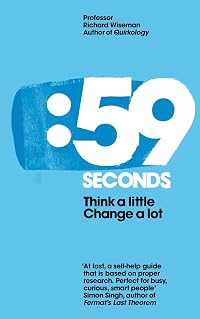
59 Seconds: Think a Little, Change a Lot
by Richard Wiseman
On This Page
Description
New Age. Psychology. Self-Improvement. Nonfiction. HTML:A psychologist and best-selling author gives us a myth-busting response to the self-help movement, with tips and tricks to improve your life that come straight from the scientific community.Richard Wiseman has been troubled by the realization that the self-help industry often promotes exercises that destroy motivation, damage relationships, and reduce creativity: the opposite of everything it promises. Now, in 59 Seconds, he fights show more back, bringing together the diverse scientific advice that can help you change your life in under a minute, and guides you toward becoming more decisive, more imaginative, more engaged, and altogether more happy.
From mood to memory, persuasion to procrastination, resilience to relationships, Wiseman outlines the research supporting the new science of “rapid change” and, with clarity and infectious enthusiasm, describes how these quirky, sometimes counterintuitive techniques can be effortlessly incorporated into your everyday life. Or, as he likes to say: “Think a little, change a lot.”. show less
Tags
Recommendations






Member Recommendations

peter_vandenbrande Uitwerking van enkele punten van Richard Wiseman in een leuk geschreven en ontnuchterend boekje.

peter_vandenbrande Dezelfde opzet als Wiseman, maar dan verder uitgewerkt per onderwerp. Evenzeer leuk geschreven.

Member Reviews
The next time you are trying to be creative in a meeting, gently lean forward and pull against the table. When the going gets tough, cross your arms to help perseverance in the face of failure, and if that doesn't work, lie down. If anyone accuses you of being lazy, quietly explain that you are employing your locus coeruleus in the war against rigid thinking.
This book was written by a scientist who decided to look into the scientific basis for the techniques recommended by the self-help industry.
There are some interesting findings from the cited scientific studies, and a lot of the techniques mentioned in this book really do seem to provide a big reward for not too much effort. I really should try some of the techniques from the chapter show more on happiness, as it seems as though it is easy to increase your happiness even though a large proportion of how happy you are is innate.
Another thing I have problems with is procrastination and the studies apparently show that if you force yourself to do spend just a few minutes on the task you have been putting off, a kind of subconscious 'must finish this task anxiety' takes over, so that even if you stop part-way through the task you are less likely to procrastinate when it is time to get back to it. So it seems that I should listen to my usual thoughts telling me to 'just do something' when overwhelmed by the number of tasks on my to do list at work.
I was looking forward to finding out how a pet frog could help you to convince anyone of anything, but more interesting in the end was the discovery that you can make charity boxes up to 200 percent more effective by painting them red, labelling them 'every penny helps' and placing them anywhere except Birmingham. As for motivation, the often recommended technique of visualising your desired outcome has actually been shown to be counter-productive. It seems that by visualising yourself having succeeded, you convince your subconscious that you are half-way to your goal already, so you end up making less effort.
Having watched the Derren Brown series in which he primed people over the course of a few weeks to do certain things without them even knowing that they had been selected for the show, I know how much people can be affected by things they don't even consciously notice. When it comes to creativity, something as seemingly unconnected to the task in hand as the subject of a picture on the wall can drastically increase the creativity of the ideas generated.
Many of the items in this book make a lot of sense, but I was surprised to read that people would generally rather take a £50k job where they would earn more than their colleagues over a £60k job where they would earn less than their colleagues. Surely the second job would give you more scope for pay rises as well as a higher starting salary? I guess a lot of people must be more concerned with status than I am.
The final section on Personality includes a quick and easy personality test.
My results are:
Openness - HIGH
Conscientiousness - LOW
Extroversion - LOW
Agreeableness - HIGH
Neuroticism - HIGH
I borrowed this book from the library to read for a book club, but I have already bought my own copy for future reference. The subjects covered are so wide-ranging that you may well be able to donate all your other self-help books to a charity shop and never buy another one. show less
This book was written by a scientist who decided to look into the scientific basis for the techniques recommended by the self-help industry.
There are some interesting findings from the cited scientific studies, and a lot of the techniques mentioned in this book really do seem to provide a big reward for not too much effort. I really should try some of the techniques from the chapter show more on happiness, as it seems as though it is easy to increase your happiness even though a large proportion of how happy you are is innate.
Another thing I have problems with is procrastination and the studies apparently show that if you force yourself to do spend just a few minutes on the task you have been putting off, a kind of subconscious 'must finish this task anxiety' takes over, so that even if you stop part-way through the task you are less likely to procrastinate when it is time to get back to it. So it seems that I should listen to my usual thoughts telling me to 'just do something' when overwhelmed by the number of tasks on my to do list at work.
I was looking forward to finding out how a pet frog could help you to convince anyone of anything, but more interesting in the end was the discovery that you can make charity boxes up to 200 percent more effective by painting them red, labelling them 'every penny helps' and placing them anywhere except Birmingham. As for motivation, the often recommended technique of visualising your desired outcome has actually been shown to be counter-productive. It seems that by visualising yourself having succeeded, you convince your subconscious that you are half-way to your goal already, so you end up making less effort.
Having watched the Derren Brown series in which he primed people over the course of a few weeks to do certain things without them even knowing that they had been selected for the show, I know how much people can be affected by things they don't even consciously notice. When it comes to creativity, something as seemingly unconnected to the task in hand as the subject of a picture on the wall can drastically increase the creativity of the ideas generated.
Many of the items in this book make a lot of sense, but I was surprised to read that people would generally rather take a £50k job where they would earn more than their colleagues over a £60k job where they would earn less than their colleagues. Surely the second job would give you more scope for pay rises as well as a higher starting salary? I guess a lot of people must be more concerned with status than I am.
The final section on Personality includes a quick and easy personality test.
My results are:
Openness - HIGH
Conscientiousness - LOW
Extroversion - LOW
Agreeableness - HIGH
Neuroticism - HIGH
I borrowed this book from the library to read for a book club, but I have already bought my own copy for future reference. The subjects covered are so wide-ranging that you may well be able to donate all your other self-help books to a charity shop and never buy another one. show less
Why not invest a minute to be happier? Because that's not really what is being offered--that's just the marketing. If we were really doing science, we should follow up with the actual time it would take and statistics on how many readers of this book actually changed their lives
I started reading this for the dubious reason of wanting to see what another author I was reviewing recommended. I'm not an unhappy person, nor a wildly happy one--I'm not really sure what the abstraction "happiness" means even though others are comfortable giving an exact number from 1 to 10. I'd probably be happier if I were one of those others. I'd think less and smile more.
Also, I'm not eager to change anything about myself. One would think the author could show more understand why. He cites research that people who won the lottery didn't become happier. (Let's ignore for the moment that their experiment didn't control for people who wouldn't ever play the lottery--scientists who understand that it's a tax on those who are bad at math.) My take away from the experiment wasn't the official one--that an influx of cash doesn't create happiness--it was that that people are wrong about what they imagine will make them happy (e.g. winning money). And yet this book regularly assumes the reader knows in advance how they want to change or how they will feel about it afterwards. What about "Be careful what you wish for"?
Since he early on quotes from a Woody Allen movie, let me do the same. In Annie Hall, a happy couple accounts for their success with both people saying "I'm very shallow and empty and I have no ideas and nothing interesting to say." These people are his ideal readership (or would be but they're already happy.) The author doesn't seem to believe that people are complicated--just misinformed on the science.
In one of the first experiments he writes about, the data shows that nursing home residents given a plant to care for reported themselves happier (and lived longer--a rare example of objective data) than those given plants that would be cared for by the staff. I assumed his conclusion would be that an experience of caring makes one happier, but no--it was that giving people more control over their lives makes them happier.
This is science?
How about that attitude of gratitude? (And does repeating those rhyming words really help matters?) I imagine feeling pure unadulterated gratitude must feel great. I have to imagine because for me, gratitude is usually mixed with a host of other feelings. Am I the only one who is complicated this way? Am I supposed to repress the other feelings? No, because that just strengthens them, says the research. Evidently science thinks that people's actual feelings are identical to those expressed on a greeting card. And how can it be better to give than receive when that decrease the opportunities to feel gratitude?
I'm also one of those who believe in what Wiseman calls "the myth of active listening." Science has shown that couples don't have to listen to each other. The presumption of the listening exercises is that members of a couple actually want to empathize with each other. Forcing them to do so against their will isn't really the purpose, but if you think behavioristically, science is only about what you do.
Writing is better than thinking because you organize your thoughts and give them a structure. I always suspected I'd hate a book like this but felt I should give it a chance and now I can hate it in a deeper structured way. I played several games of chess online before writing this review which is supposed to reinforce the logical thought that went into the ideas expressed herein. I just skimmed the last half which may mean I missed the most worthwhile parts but it made me happy to be done with it and isn't happiness the goal?
The research suggests that I'd probably have felt a lot better giving this book more than one star though my actual experience suggests otherwise. show less
I started reading this for the dubious reason of wanting to see what another author I was reviewing recommended. I'm not an unhappy person, nor a wildly happy one--I'm not really sure what the abstraction "happiness" means even though others are comfortable giving an exact number from 1 to 10. I'd probably be happier if I were one of those others. I'd think less and smile more.
Also, I'm not eager to change anything about myself. One would think the author could show more understand why. He cites research that people who won the lottery didn't become happier. (Let's ignore for the moment that their experiment didn't control for people who wouldn't ever play the lottery--scientists who understand that it's a tax on those who are bad at math.) My take away from the experiment wasn't the official one--that an influx of cash doesn't create happiness--it was that that people are wrong about what they imagine will make them happy (e.g. winning money). And yet this book regularly assumes the reader knows in advance how they want to change or how they will feel about it afterwards. What about "Be careful what you wish for"?
Since he early on quotes from a Woody Allen movie, let me do the same. In Annie Hall, a happy couple accounts for their success with both people saying "I'm very shallow and empty and I have no ideas and nothing interesting to say." These people are his ideal readership (or would be but they're already happy.) The author doesn't seem to believe that people are complicated--just misinformed on the science.
In one of the first experiments he writes about, the data shows that nursing home residents given a plant to care for reported themselves happier (and lived longer--a rare example of objective data) than those given plants that would be cared for by the staff. I assumed his conclusion would be that an experience of caring makes one happier, but no--it was that giving people more control over their lives makes them happier.
This is science?
How about that attitude of gratitude? (And does repeating those rhyming words really help matters?) I imagine feeling pure unadulterated gratitude must feel great. I have to imagine because for me, gratitude is usually mixed with a host of other feelings. Am I the only one who is complicated this way? Am I supposed to repress the other feelings? No, because that just strengthens them, says the research. Evidently science thinks that people's actual feelings are identical to those expressed on a greeting card. And how can it be better to give than receive when that decrease the opportunities to feel gratitude?
I'm also one of those who believe in what Wiseman calls "the myth of active listening." Science has shown that couples don't have to listen to each other. The presumption of the listening exercises is that members of a couple actually want to empathize with each other. Forcing them to do so against their will isn't really the purpose, but if you think behavioristically, science is only about what you do.
Writing is better than thinking because you organize your thoughts and give them a structure. I always suspected I'd hate a book like this but felt I should give it a chance and now I can hate it in a deeper structured way. I played several games of chess online before writing this review which is supposed to reinforce the logical thought that went into the ideas expressed herein. I just skimmed the last half which may mean I missed the most worthwhile parts but it made me happy to be done with it and isn't happiness the goal?
The research suggests that I'd probably have felt a lot better giving this book more than one star though my actual experience suggests otherwise. show less
I don't have a lot of respect for self-help books in general. My feeling is that they tend to be based around platitudes, wishful thinking, and a desire on the author's part to make a quick buck, often with a generous helping of psuedoscience in the mix. Richard Wiseman doesn't talk about them in terms anywhere near that strong, but he does point out that, according to scientific research, a lot of the most beloved ideas embraced by self-help gurus are incorrect. So in this book, he looks what the experimental evidence says about how human psychology actually works and offers some quick and simple self-help tips and exercises based on that.
Which sounds like a great idea to me, but I did have some mixed feelings about the execution. show more Wiseman has some decent bits of advice for dealing with certain specific situations and for altering your general approach to achieving your goals. (Examples: If you need help, ask people one at a time rather than appealing to a big group, because people in crowds tend to mill around waiting for someone else to step forward. And if you want your kids to be successful, praise them for trying hard when they do well, rather than telling them that doing well means they're smart. They'll be more likely to try hard and do well next time, too.) A lot of the self-help exercises seemed a bit contrived and gimmicky to me, though. And while altering your behavior based on ideas with some scientific support is obviously better than doing so based on ideas that are clearly wrong, a lot of the experimental conclusions here seem to be a bit iffy, offering interesting suggestive indications rather than concrete proof. The human mind, after all, is extremely complex, and altering tiny details in how you conduct experiments on it can lead to big differences in results. Wiseman does acknowledge that, but not quite as much as I'd like.
If you're interested in learning where lots of self-help books go wrong, though, or in reading about interesting, quirky little psychology experiments, this one is worth a look. show less
Which sounds like a great idea to me, but I did have some mixed feelings about the execution. show more Wiseman has some decent bits of advice for dealing with certain specific situations and for altering your general approach to achieving your goals. (Examples: If you need help, ask people one at a time rather than appealing to a big group, because people in crowds tend to mill around waiting for someone else to step forward. And if you want your kids to be successful, praise them for trying hard when they do well, rather than telling them that doing well means they're smart. They'll be more likely to try hard and do well next time, too.) A lot of the self-help exercises seemed a bit contrived and gimmicky to me, though. And while altering your behavior based on ideas with some scientific support is obviously better than doing so based on ideas that are clearly wrong, a lot of the experimental conclusions here seem to be a bit iffy, offering interesting suggestive indications rather than concrete proof. The human mind, after all, is extremely complex, and altering tiny details in how you conduct experiments on it can lead to big differences in results. Wiseman does acknowledge that, but not quite as much as I'd like.
If you're interested in learning where lots of self-help books go wrong, though, or in reading about interesting, quirky little psychology experiments, this one is worth a look. show less
Finished 59 Seconds: Think a Little, Change a Lot by Richard Wiseman (3/5).
Books in the self help genre tend to promise quick fixes grounded in little evidence (and, not uncommonly, contradicting actual evidence). Psychological literature sometimes has validated advice, but much of it, not surprisingly, requires a large investment of time and effort. Wiseman wanted to share the scientifically validated but easy to apply tips that people could use to improve their lives.
The number of quick tips which have evidence behind them are few and lack the miraculous impact self help books promise. In this single volume, Wiseman covers many of the stable topic of self help -- happiness, persuasion, motivation, creativity, attraction, stress, show more relationships, decision making, parenting, and personality. It works out to only about 30 pages per topic (compare that to the shelves of self help books on each topic).
You can read the book if you want more background, but here's a taste[1]:
- Listing things you are grateful for or things that have gone well increases happiness
- Acts of kindness, even small ones, increase happiness. Donate, give blood, buy a surprise gift.
- Placing a mirror in front of people when they are choosing food reduces consumption of unhealthy food
- Plants in the office seem to boost creativity. Possibly by reducing stress and improving moods
- Write about your deepest feelings about your relationships to increase the odds of the relationship lasting. Writing tends to remind people of all the good things about the relationship.
- People lie less over recorded communication media (like email).
- When speaking, liars tend to have less detail, use more ummms and aaahs, and use less self reference words (I, me, my)
- Praise a child's effort, not their ability.
- Visualize yourself working through the process of achieving your goal rather than the actual success. Visualization from a third person perspective seems to be more effective.
Some criticisms: The first is specific to the quality of this as an audio book. Many of the "In 59 seconds" summaries at the end of each chapter involve forms or checklists. These make for tedious listening, and it's not very useful to just have them in audio. It would have been nice for the audio book to come with supplementary material for all of these forms.
I don't know if it's the author or the research community, but the chapters on relationships and attraction seem to exude a subtle sexism. Almost all of the tips and studies mentioned describe men as active agents and woman as passive agents. This active/passive division was not the conclusion of some study (and, therefore, worth considering even if I don't like the result). Rather, they were baked into the setup of the studies. For example, a couple of studies focused on how various factors such as a man's confidence or a woman's breast size affected behavior in a night club (results were not surprising). In each of these studies, regardless of what was being varied, the researchers decided to use a setup where men were always the approachers and woman the approached. This was, to put it mildly, annoying.
Finally, this is a book that you should read for its content, not the quality of its writing. It's not bad, but it can be formulaic.
Since I tend to prefer books categorized as "psychology" over those categorized as "self help", many of these tips were not new to me. However, if you want a concise look at the science of improving your life, this book fulfills that goal.
[1] Dear Amazon/Audible, when I buy the audio version of a book, it would be really nice if I were allowed full text capabilities on the
Search Inside version when it exists. Pretty please? show less
Books in the self help genre tend to promise quick fixes grounded in little evidence (and, not uncommonly, contradicting actual evidence). Psychological literature sometimes has validated advice, but much of it, not surprisingly, requires a large investment of time and effort. Wiseman wanted to share the scientifically validated but easy to apply tips that people could use to improve their lives.
The number of quick tips which have evidence behind them are few and lack the miraculous impact self help books promise. In this single volume, Wiseman covers many of the stable topic of self help -- happiness, persuasion, motivation, creativity, attraction, stress, show more relationships, decision making, parenting, and personality. It works out to only about 30 pages per topic (compare that to the shelves of self help books on each topic).
You can read the book if you want more background, but here's a taste[1]:
- Listing things you are grateful for or things that have gone well increases happiness
- Acts of kindness, even small ones, increase happiness. Donate, give blood, buy a surprise gift.
- Placing a mirror in front of people when they are choosing food reduces consumption of unhealthy food
- Plants in the office seem to boost creativity. Possibly by reducing stress and improving moods
- Write about your deepest feelings about your relationships to increase the odds of the relationship lasting. Writing tends to remind people of all the good things about the relationship.
- People lie less over recorded communication media (like email).
- When speaking, liars tend to have less detail, use more ummms and aaahs, and use less self reference words (I, me, my)
- Praise a child's effort, not their ability.
- Visualize yourself working through the process of achieving your goal rather than the actual success. Visualization from a third person perspective seems to be more effective.
Some criticisms: The first is specific to the quality of this as an audio book. Many of the "In 59 seconds" summaries at the end of each chapter involve forms or checklists. These make for tedious listening, and it's not very useful to just have them in audio. It would have been nice for the audio book to come with supplementary material for all of these forms.
I don't know if it's the author or the research community, but the chapters on relationships and attraction seem to exude a subtle sexism. Almost all of the tips and studies mentioned describe men as active agents and woman as passive agents. This active/passive division was not the conclusion of some study (and, therefore, worth considering even if I don't like the result). Rather, they were baked into the setup of the studies. For example, a couple of studies focused on how various factors such as a man's confidence or a woman's breast size affected behavior in a night club (results were not surprising). In each of these studies, regardless of what was being varied, the researchers decided to use a setup where men were always the approachers and woman the approached. This was, to put it mildly, annoying.
Finally, this is a book that you should read for its content, not the quality of its writing. It's not bad, but it can be formulaic.
Since I tend to prefer books categorized as "psychology" over those categorized as "self help", many of these tips were not new to me. However, if you want a concise look at the science of improving your life, this book fulfills that goal.
[1] Dear Amazon/Audible, when I buy the audio version of a book, it would be really nice if I were allowed full text capabilities on the
Search Inside version when it exists. Pretty please? show less
Think of your typical self-help book. Now remove all the pseudo-scientific unproven babble and replace it with documented information complete with references to actual scientific studies. Add an entertaining, conversational writing style and more than a dash of humor and then you have this book. Not perfect by any means, but very good
Most people would like to be more creative, more persuasive and more attractive. For years, gurus and 'life coaches' have urged people to improve their lives by changing the way they think and behave, but scientific research has revealed that many of their techniques, from group brainstorming to visualization, are ineffective. Fortunately, psychologist Richard Wiseman is on hand to provide fast-acting, myth-busting scientific answers to a huge range of everyday problems. From job-hunting to relationships, and from parenting to self-esteem, personal and professional success may be less than a minute away. This title helps to: find out why putting a pencil between your teeth instantly makes you feel happier; discover why even thinking show more about going to the gym can help you keep in shape; and, learn how putting just one thing in your wallet will improve the chance of it being returned if lost. show less
This book does exactly what it says. Sensible, evidence backed ways to improve your life.
What it also does extremely well is also show how evidence and a rational approach just doesn't "feel" as good as wishing for stuff, learning super powers and being able to control other folk minds. Perhaps this is simply because the author respects and values us as readers rather than treating us as marks.
If you live in the real world and would like to do it slightly better then read this book.
What it also does extremely well is also show how evidence and a rational approach just doesn't "feel" as good as wishing for stuff, learning super powers and being able to control other folk minds. Perhaps this is simply because the author respects and values us as readers rather than treating us as marks.
If you live in the real world and would like to do it slightly better then read this book.
Members
- Recently Added By
Lists

Psicología - Clásicos
165 works; 2 members

The Great Courses: Your Deceptive Mind
60 works; 1 member

GraceCollection TBR/To Buy List
106 works; 1 member

Books Read in 2024
4,623 works; 126 members
Author Information

22+ Works 3,730 Members
Richard Wiseman, Ph.D. is Professor of Public Understanding of Psychology at the University of Hertfordshire
Some Editions
Awards and Honors
Distinctions
Common Knowledge
- Canonical title
- 59 Seconds: Think a Little, Change a Lot
- Original title
- 59 Seconds
- Alternate titles
- 59 Seconds: Change Your Life in Under a Minute; Fifty nine seconds : Think a Little, Change a Lot; Fifty nine seconds : : Change Your Life in Under a Minute
- Original publication date
- 2009
- People/Characters
- Lawrence Tabak; Sonja Lyubomirsky; David G. Myers; Daniel Merton Wegner; Emmanuelle Zech; Marsha L. Richins (show all 19); James D. Laird; Daniel M. Oppenheimer; Gabriele Oettingen; Brian Wansink; Koert van Ittersum; Ap Dijksterhuis; Ad van Knippenberg; Nicolas Guéguen; John Mordecai Gottman; Martin E. P. Seligman; Christopher Peterson; E. Glenn Schellenberg; J. T. Manning
- Dedication
- To a very good friend
in times of change - First words
- Do you want to improve an important aspect of your life?
- Last words
- (Click to show. Warning: May contain spoilers.)Asking people to spend just a minute imagining a close friend standing up at their funeral and reflecting on their personal and professional legacy helps them to identify their long-term goals, and assess the degree to which they are progressing towards making those goals a reality.
- Blurbers
- Brown, Derren; Shubin, Neil; Gosling, Sam; Shermer, Michael; Singh, Simon; Eagleman, David
- Disambiguation notice
- Originally published in paperback: London : Macmillan.
"A portion of this work originally appeared in Elle magazine." T.p. verso
Classifications
Statistics
- Members
- 1,289
- Popularity
- 18,805
- Reviews
- 30
- Rating
- (3.62)
- Languages
- 11 — Czech, Dutch, English, Finnish, French, German, Hungarian, Japanese, Polish, Portuguese, Spanish
- Media
- Paper, Audiobook, Ebook
- ISBNs
- 37
- ASINs
- 21