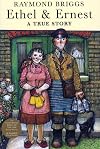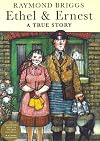
Ethel and Ernest: A True Story
by Raymond Briggs
On This Page
Description
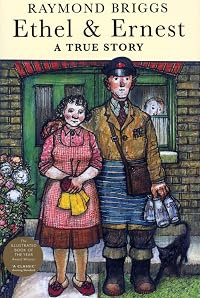
Utterly original, deeply moving and very funny, Ethel & Ernest is the story of Raymond Brigg`s parents' marriage, from their first chance encounter to their deaths told in Brigg`s unique strip-cartoon format. Nothing is invented, nothing embroidered - this is the reality of two decent, ordinary lives of two people who, as Briggs tells the story, become representative of us all. The book is also social history; we see the dark days of the Second World War, the birth of the Welfare State, the show more advent of television and all the changes which were so exhilarating and bewildering for Ethel and Ernest. A marvellous, life-enhancing book for all ages. show lessTags
Recommendations
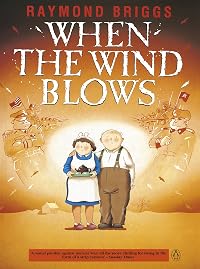












Member Recommendations
Member Reviews
A short and very touching yet unsentimental portrait of the author's parents, from their first meeting to their deaths over forty years later. Ethel (born 1894) and Ernest (born 1900) live lives that must have been typical of many people of their generation, and the book can almost be read as a social history of Britain in the twentieth century. This is a book that is made up of the small and insignificant events that constituted ordinary people's lives: a baby is born, the Second World War comes and goes, but there is a deep sense of continuity as their day to day life continues.
Ernest, a milkman, is a lifelong Labour party supporter, with strong hopes of seeing the rise of the working man as the Labour government takes power after the show more war. Ethel is adamant that they are not 'working-class' and has aspirations both for herself and for her son Raymond, which seem to be being fulfilled as he wins a place at grammar school. But these are aspirations which she can't quite bring herself to believe or act upon. One of the most poignant scenes in the book was when the old and sick Ethel is wheeled by her husband past a derelict and boarded-up building in the local park, a place that forty years previously had been a smart cafe which she had longed to visit: in all the time it had been open she had never been in, considering it too posh for people like them. Ernest's enthusiastic embrace of technological progress in most of its forms contrasts hugely with Ethel's reluctance: she is naturally suspicious of anything new. But both are equally confused by the changes in society brought by the 50's and 60's, in particular their son's desire to be an artist rather than get a steady job.
One of the reasons that I liked this so much was that the characters seemed so real. They were almost exact contemporaries of my own grand-parents and I could certainly recognise aspects of my grandparents and other older relatives in Ethel and Ernest; Ernest's rages against politicians and other aspects of the modern world certainly remind me of my grandfather. There is even a little bit of Ethel in my mother with her extreme reluctance to take on new technology. And it is clear that Raymond Briggs bases aspects of the characters for his other books on those of his own parents. So a great graphic memoir - recommended. show less
Ernest, a milkman, is a lifelong Labour party supporter, with strong hopes of seeing the rise of the working man as the Labour government takes power after the show more war. Ethel is adamant that they are not 'working-class' and has aspirations both for herself and for her son Raymond, which seem to be being fulfilled as he wins a place at grammar school. But these are aspirations which she can't quite bring herself to believe or act upon. One of the most poignant scenes in the book was when the old and sick Ethel is wheeled by her husband past a derelict and boarded-up building in the local park, a place that forty years previously had been a smart cafe which she had longed to visit: in all the time it had been open she had never been in, considering it too posh for people like them. Ernest's enthusiastic embrace of technological progress in most of its forms contrasts hugely with Ethel's reluctance: she is naturally suspicious of anything new. But both are equally confused by the changes in society brought by the 50's and 60's, in particular their son's desire to be an artist rather than get a steady job.
One of the reasons that I liked this so much was that the characters seemed so real. They were almost exact contemporaries of my own grand-parents and I could certainly recognise aspects of my grandparents and other older relatives in Ethel and Ernest; Ernest's rages against politicians and other aspects of the modern world certainly remind me of my grandfather. There is even a little bit of Ethel in my mother with her extreme reluctance to take on new technology. And it is clear that Raymond Briggs bases aspects of the characters for his other books on those of his own parents. So a great graphic memoir - recommended. show less
This is Raymond Brigg's story of his parents as a couple from the moment they met until death did them part. Simplistic in graphic novel form but powerful in message. What started off as an accidental communication for the couple kicked off a poignant romance that lasted fifty years. Brigg's loving tribute continues through his parents's courtship and marriage, his mom giving birth to him at 38 years old (their only child), the war and the political aftermath, the ravages of aging, and finally each of their deaths. What makes the retelling so heartwarming is Brigg's ability to communicate parental emotion. Every fear, hope, happiness and expectation they felt towards their son was delivered and exposed in loving detail.
In this tender and loving tribute to his parents, Raymond Briggs has created a mini masterpiece of subtle expression and real beauty. I've been a long-time fan of his work with delights such as Fungus the Bogeyman, When the Wind Blows, his Father Christmas books, etc., but this one just caught me by the heart.
The graphic novelette (only 103 pages, surely not a novel?) takes the reader from the meeting of Ethel and Ernest in 1928 to their deaths in 1971, capturing in images their life together. They are humble, hard-working, honest, naive (Ethel), canny (Ernest)...Briggs does it all with a few words and wonderful facial expressions. It is poignant and funny, bittersweet and wonderful all at once. I think this will be a gift I will be show more giving to people over and over again. show less
The graphic novelette (only 103 pages, surely not a novel?) takes the reader from the meeting of Ethel and Ernest in 1928 to their deaths in 1971, capturing in images their life together. They are humble, hard-working, honest, naive (Ethel), canny (Ernest)...Briggs does it all with a few words and wonderful facial expressions. It is poignant and funny, bittersweet and wonderful all at once. I think this will be a gift I will be show more giving to people over and over again. show less
This is probably Raymond Briggs' (author of When the Wind Blows) most personal graphic novel. It tells the story of the lives of his parents in brief vignettes, from the time they first met, she a lady's maid and he a milk deliveryman till their deaths in 1970 and 1971 respectively. Its obviously a labour of love and in the course of the tale, one grows to know both as warm-hearted, kind people very much in love with each other. Whether its the wonder of buying their own home, disagreements over politics (Ernest is a staunch supporter of labour while Ethel puts her faith in the gentlemen of the conservative party), their joy when their only son qualifies for grammar school or their consternation when he decides to take up art, one can't show more help but be moved by the way they respond to their changing fortunes, both good and bad. Nor can one fail to be moved by the devotion of their son in penning and painting this work of art in their memory. show less
Heart-breakingly tender and sweet telling of a family's life together. It can't have been fun for Briggs to draw himself as the patronising oaf of youth from thevantage of his later years; it's not pleasant to look back on that stage of life. Ernest in the hallway for Raymond's birth gets me every time.
Cartoonist Raymond Briggs tells the story of his parents’ marriage in this sweet graphic novel. His parents met in 1928, when his father was a milkman and his mother was a lady’s maid. Together they weathered the changes of the mid-20th century, including the rise of Hitler, World War II, post-war rationing, and the introduction of modern conveniences like refrigerators and television. Raymond was their much-doted-on only child. I think his parents would have been pleased with this loving tribute to their quiet lives.
Lovely, poignant reading from someone you might not think of in those terms if you're a fan of Fungus the Bogeyman; however, bearing in mind that this is also by the creator of When The Wind Blows makes it seem less unlikely.
It's a simple, quiet story of Briggs' parents' life, told with repeating motifs and many moments both amusing and sweet. It works both as a piece of social history and as a tribute to two people who were of their times.
The last few pages reliably make me cry.
Edited to add: some of the other reviews on this site make me think that the style may be rather too understated for some tastes, and that may be a particularly British aspect of it too. For me, the details are very telling and not at all throwaway, but if you show more don't make much of them on reading then you may not find that this grabs you. show less
It's a simple, quiet story of Briggs' parents' life, told with repeating motifs and many moments both amusing and sweet. It works both as a piece of social history and as a tribute to two people who were of their times.
The last few pages reliably make me cry.
Edited to add: some of the other reviews on this site make me think that the style may be rather too understated for some tastes, and that may be a particularly British aspect of it too. For me, the details are very telling and not at all throwaway, but if you show more don't make much of them on reading then you may not find that this grabs you. show less
Members
- Recently Added By
Lists

Tracks of my tears ~ novels that I sobbed through
15 works; 2 members

Best Biographies, Autobiographies and Memoirs
464 works; 156 members
Author Information

109+ Works 9,842 Members
Raymond Briggs was born in London in 1934. One of the most innovative & popular author-illustrators in the world, he has won many awards for his work. His children's books, including the classics "The Snowman" & "Father Christmas" have sold millions of copies worldwide. He lives in England. (Publisher Provided)
Some Editions
Awards and Honors
Awards
Work Relationships
Has the adaptation
Common Knowledge
- Canonical title*
- Ethel & Ernest
- Original title
- Ethel & Ernest. A true story
- Original publication date
- 1998
- People/Characters
- Ethel Briggs; Ernest Briggs; Raymond Briggs
- Important places
- London, England, UK
- First words
- Monday, 1928.
- Last words
- (Click to show. Warning: May contain spoilers.)I grew it from a pip.
- Original language
- English
- Canonical DDC/MDS
- 741.5942
*Some information comes from Common Knowledge in other languages. Click "Edit" for more information.
Classifications
- Genre
- Graphic Novels & Comics
- DDC/MDS
- 741.5942 — Arts & recreation Drawing & decorative arts Drawing Comic books, graphic novels, fotonovelas, cartoons, caricatures, comic strips History, geographic treatment, biography European England & Wales
- LCC
- CT788 .B7742 .B75 — Auxiliary Sciences of History Biography Biography National biography
- BISAC
Statistics
- Members
- 722
- Popularity
- 39,116
- Reviews
- 21
- Rating
- (4.16)
- Languages
- 7 — Chinese, English, French, German, Italian, Polish, Spanish
- Media
- Paper, Ebook
- ISBNs
- 14
- ASINs
- 5