
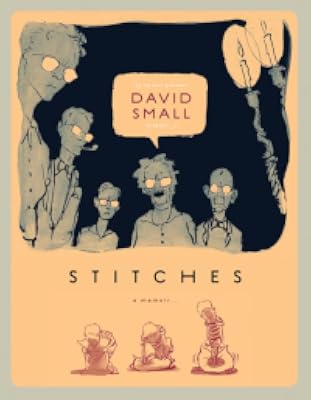
Stitches: A Memoir
by David Small
On This Page
Description
Finalist for the 2009 National Book Award and finalist for two 2010 Will Eisner Comic Industry Awards: the prize-winning children's author depicts a childhood from hell in this searing yet redemptive graphic memoir. One day David Small awoke from a supposedly harmless operation to discover that he had been transformed into a virtual mute. A vocal cord removed, his throat slashed and stitched together like a bloody boot, the fourteen-year-old boy had not been told that he had cancer and was show more expected to die. In Stitches, Small, the award-winning children's illustrator and author, re-creates this terrifying event in a life story that might have been imagined by Kafka. As the images painfully tumble out, one by one, we gain a ringside seat at a gothic family drama where David, a highly anxious yet supremely talented child, all too often became the unwitting object of his parents' buried frustration and rage. Believing that they were trying to do their best, David's parents did just the reverse. Edward Small, a Detroit physician who vented his own anger by hitting a punching bag, was convinced that he could cure his young son's respiratory problems with heavy doses of radiation, possibly causing David's cancer. Elizabeth, David's mother, tyrannically stingy and excessively scolding, ran the Small household under a cone of silence where emotions, especially her own, were hidden. Depicting this coming-of-age story with dazzling, kaleidoscopic images that turn nightmare into fairy tale, Small tells us of his journey from sickly child to cancer patient, to the troubled teen whose risky decision to run away from home at sixteen, with nothing more than the dream of becoming an artist, will resonate as the ultimate survival statement. A silent movie masquerading as a book, Stitches renders a broken world suddenly seamless and beautiful again. show lessTags
Recommendations


Member Recommendations
by kristenn
Member Reviews
This memoir is a pretty bleak story, but rather than making me flinch like some memoirs do, this one had a cinematic quality and quiet, deceptively simple style that made it beautiful as well as sad. The author's comments at the end about his adult perspective versus his childhood perspective of his parents was also really beautiful without being sentimental.
Small’s memoir is a harrowing tale of how a boy can both literally and figuratively lose his voice. Using simple black and white illustrations and spare wording, this novel evokes empathy in very profound ways. This book is emotionally rough as Small’s experiences were pretty extraordinary in the worst of ways and he withstood some serious parental neglect. That said, I feel as if my students could also surprise me with stories of what they’ve gone through and come out the other side of. Perhaps hearing and seeing someone else’s true story could help a student find someone to talk to or help a student empathize, knowing the student right next to them could be struggling too.
The illustrations are as haunting as the text in David Small’s Stitches. In this memoir, written as a comic book, Small gives the reader glimpses into his childhood. From surviving cancer to discovering his mother’s secret lesbian lover to encounters with a nearly-abusive grandmother, Small’s story is harrowing. He manages to avoid the dreaded therapist’s couch, and though his story strikes sympathy with the reader, he does not wallow in the aftermath of his hardships. Small sections his book by years, with single pages that state his age and then tell the story of that period of his life. These sections reflect how Smalls has compartmentalized his life, perhaps to deal with the trauma of its events. The black and white drawings show more contribute to the overall melancholy tone. I would readily keep this book as part of a class library and recommend it to readers interested in graphic novels and/or memoirs. show less
The graphic novel Stitches, written and illustrated by David Small, is a testament to the power of silence. Throughout the book, David encounters the icy chill of his family’s silence, and when he is robbed of his own physical voice, he essentially becomes invisible to the people around him. While David’s experiences are not individually unique, they have the potential to cripple anyone when combined in such magnitude; because of this, Small’s story is a powerful demonstration of the human spirit’s ability to cope with suffering and still survive.
Over the course of the story, Small shows the reader a variety of horrors that the author faced in his own life: childhood cancer, emotionally-distant parents, mentally-unstable show more grandparents, and crippling depression. All of these experiences result in painful scars – both physical and emotional – that David must overcome over the course of his life. Fortunately for the reader, Small has not let his personal pain overshadow his talent with pictures and words, and Stitches is the result of his survival.
The target audience of Stitches seems to be adults – the grown-up children who remember the painful scars of their youth, but who have enough emotional distance to look back on the past without feeling overwhelmed by the pain. However, the book can just as easily speak to disenfranchised teenagers, many of whom are still in the throngs of painful adolescence experiences. Because Small’s visual style utilizes a cartoonish format, it can seem playful and childlike at times; however, Stitches is definitely more Frank Miller than Jack Kirby in its presentation. Small’s artwork is stark and unsettling, with no color added to the illustrations: in this regard, the art recalls old black and white photographs, which capture a moment in time without fleshing out the full set of emotions involved.
As far as memoirs go, Stitches is powerful and poignant, encapsulating the challenges of adolescence without falling prey to nostalgia. The book also reminds us of the power that families have over children, as David’s parents essentially paralyze his voice (literally and figuratively) until he is able to reclaim it as his own many years later. Although some readers may unwisely dismiss Stitches because it follows the graphic novel format, it is a vivid depiction of familial dysfunction that deserves to be read by adults and adolescents alike. show less
Over the course of the story, Small shows the reader a variety of horrors that the author faced in his own life: childhood cancer, emotionally-distant parents, mentally-unstable show more grandparents, and crippling depression. All of these experiences result in painful scars – both physical and emotional – that David must overcome over the course of his life. Fortunately for the reader, Small has not let his personal pain overshadow his talent with pictures and words, and Stitches is the result of his survival.
The target audience of Stitches seems to be adults – the grown-up children who remember the painful scars of their youth, but who have enough emotional distance to look back on the past without feeling overwhelmed by the pain. However, the book can just as easily speak to disenfranchised teenagers, many of whom are still in the throngs of painful adolescence experiences. Because Small’s visual style utilizes a cartoonish format, it can seem playful and childlike at times; however, Stitches is definitely more Frank Miller than Jack Kirby in its presentation. Small’s artwork is stark and unsettling, with no color added to the illustrations: in this regard, the art recalls old black and white photographs, which capture a moment in time without fleshing out the full set of emotions involved.
As far as memoirs go, Stitches is powerful and poignant, encapsulating the challenges of adolescence without falling prey to nostalgia. The book also reminds us of the power that families have over children, as David’s parents essentially paralyze his voice (literally and figuratively) until he is able to reclaim it as his own many years later. Although some readers may unwisely dismiss Stitches because it follows the graphic novel format, it is a vivid depiction of familial dysfunction that deserves to be read by adults and adolescents alike. show less
Small, an award-winning childrens book illustrator, here puts his artistic talents to use in this graphic novel depiction of the story of his own childhood. His father was an emotionally stilted radiologist who bombarded the sickly David with “healing” x-rays in his youth. His mother was a frigid, unhappy closeted lesbian who never showed her children any love. His grandmother was cranky, judgmental, and quite possibly crazy. Growing up in this deeply dysfunctional household, art was David’s only real refuge…especially after the operation at age 14 to remove a growth from David’s neck. The operation, supposedly routine, left David with only half of his vocal cords and functionally mute for years. Later, David discovered the show more reason: the “growth” on his neck was actually cancer caused by his father’s supposed “treatments” of radiation, but the cancer had been kept secret from him at the time. Bitter, angry, and depressed, it took a caring psychiatrist and a surprisingly simple truth to allow David to move on. The black-and-white artwork accompanying the story is evocative, perceptive, and, at times, almost hallucinatory as they depict the imagination of a young boy attempting to make sense of situations beyond his easy comprehension. Many segments are entirely wordless, with the images alone ably carrying the weight of the plot. Compelling, powerful, and, in the end, cathartic. show less
So I've been spending a lot of time at my local library lately, taking advantage of the free wifi while Jefferson is in preschool. In the process, I've done more than a few laps around the new acquisitions shelves. Few of the books on those shelves tempted me (probably a good thing, considering my history of library fines), but this one did. So when one day I found myself in Mecosta for the afternoon without my laptop, I went straight to this book.
Despite the immense size of Stitches, it's a blazingly quick read, even for a graphic novel. Partially this is due to Small's style -- heavy on scenery and light on text. Partially it's because Small's family life is just that kind of train wreck that you can't take your eyes away from. I show more turned each page wondering how people could treat each other this way.
The true miracle of Stitches is, that despite a childhood that would give Small every right to bitterness, every excuse and reason to be a miserable human being and terror of a parent himself, ultimately Small shows insight and compassion for all the characters portrayed, himself included. And while he documents a pattern of abuse and neglect, there is also evidence that each generation did what they could, with what resources and grace they had at hand, to not perpetuate that violence. Even those still miserable and doling out misery were doing what they could to hold back what they could. At least in Small's generous reckoning.
Not that this is what I saw when I first put the book down. In that first moment, collaborating with a recent discussion I'd had about people perpetuating cycles of abuse and continuing it with their own children -- I was overcome by the darkness of it all. But distance gave perspective, and I think thanks to this book, I can now appreciate that even the man who was the subject of our discussion -- surely in his own mind is not abusing his daughter. In his own mind, he must be holding so much back from the abuse inflicted on him. And with grace, and with the resources given by her mother and stepfather, perhaps his daughter will finally be able to step free, and raise her children in a home without abuse.
Maybe there is more hope for this poor, broken human race than just these acts of abuse themselves would suggest. show less
Despite the immense size of Stitches, it's a blazingly quick read, even for a graphic novel. Partially this is due to Small's style -- heavy on scenery and light on text. Partially it's because Small's family life is just that kind of train wreck that you can't take your eyes away from. I show more turned each page wondering how people could treat each other this way.
The true miracle of Stitches is, that despite a childhood that would give Small every right to bitterness, every excuse and reason to be a miserable human being and terror of a parent himself, ultimately Small shows insight and compassion for all the characters portrayed, himself included. And while he documents a pattern of abuse and neglect, there is also evidence that each generation did what they could, with what resources and grace they had at hand, to not perpetuate that violence. Even those still miserable and doling out misery were doing what they could to hold back what they could. At least in Small's generous reckoning.
Not that this is what I saw when I first put the book down. In that first moment, collaborating with a recent discussion I'd had about people perpetuating cycles of abuse and continuing it with their own children -- I was overcome by the darkness of it all. But distance gave perspective, and I think thanks to this book, I can now appreciate that even the man who was the subject of our discussion -- surely in his own mind is not abusing his daughter. In his own mind, he must be holding so much back from the abuse inflicted on him. And with grace, and with the resources given by her mother and stepfather, perhaps his daughter will finally be able to step free, and raise her children in a home without abuse.
Maybe there is more hope for this poor, broken human race than just these acts of abuse themselves would suggest. show less
In his autobiographical graphic novel Stitches, award-winning illustrator David Small reveals his childhood through drawings. From his own serious medical ordeals beginning at the age of eleven, physical and emotional abuse suffered at the hands of his mother and grandmother, and mere survival in a household in which not only is no one happy, but no one is even remotely concerned for his well-being, Small depicts events in a sad, brutally realistic form.
This tragic story of childhood just about broke my heart, and I was relieved to learn that this resilient author ultimately grew up well-adjusted and successful in relationships, career and life (I'm not certain I would have). There is something about cheerless childhoods that is show more particularly heart-rending, and I was most moved by the portrayal of his cold, resentful mother -- so much that I am more conscious and fearful of instances in which my own mood affects how I interact with my own child, and what an indelible mark it can leave. show less
This tragic story of childhood just about broke my heart, and I was relieved to learn that this resilient author ultimately grew up well-adjusted and successful in relationships, career and life (I'm not certain I would have). There is something about cheerless childhoods that is show more particularly heart-rending, and I was most moved by the portrayal of his cold, resentful mother -- so much that I am more conscious and fearful of instances in which my own mood affects how I interact with my own child, and what an indelible mark it can leave. show less
Members
- Recently Added By
Published Reviews
ThingScore 83
Too much setup, not enough payoff.
added by lampbane
It is one thing for an artist to credit his career choice to an unhappy youth in which opportunities for self-expression were perpetually stifled, and quite another for an artist to say that his parents literally took his voice from him. That, however, is the story of David Small’s life as he tells it in “Stitches,” a graphic memoir, which comes out this week.
added by jlelliott
Graphic in every sense of the word, Small's masterfully drawn memoir will arrest readers from the very first cell.
added by Shortride
Lists

Recommended Comics / Graphic Novels
595 works; 120 members

Best Stand-Alone Graphic Novels
107 works; 19 members

W. W. Norton & Company
47 works; 2 members
Best Graphic Novel Nonfiction
199 works; 101 members

Best Biographies, Autobiographies and Memoirs
465 works; 160 members

Books Read in 2021
5,361 works; 114 members

Books Read in 2009
464 works; 11 members

Books Read in 2012
816 works; 34 members

Powell's Indiespensable
79 works; 6 members

Best Autobiographies and Memoirs
370 works; 67 members

to get
244 works; 2 members

Adult Books for YA Readers
194 works; 6 members

Books Read in 2015
3,299 works; 129 members

Recommend the 20 best books you've read in the last five years
2,168 works; 606 members

2008-2012 Notable Books for Adults
127 works; 10 members

Books Read in 2014
2,343 works; 89 members

Dysfunctional Families
133 works; 7 members
Author Information

17+ Works 6,171 Members
David Small was born on February 12, 1945, in Detroit, Michigan. He studied art and English at Wayne State University, and went on to complete graduate studies in art at Yale. After receiving his MFA degree, he taught drawing and printmaking at the State University of New York, Fredonia College, Kalamazoo College, and the University of Michigan. show more He also created editorial cartoons for publications such as the New Yorker, the New York Times, and the Wall Street Journal. In the 1980s, he lost his teaching job due to cutbacks. It was then that he committed himself to combining his loves of writing and art. His first picture book, Eulalie and the Hopping Head, was published in 1981. He earned a 1997 Caldecott Honor and The Christopher Medal for The Gardener, written by his wife, Sarah Stewart. In 2001, he received the Caldecott Medal for his artwork in So, You Want To Be President? by Judith St. George. His editorial drawings regularly appear in publications such as The New York Times, The New Yorker, GQ, and The Washington Post. (Bowker Author Biography) show less
Awards and Honors
Awards
Great Lakes Great Reads Award (2009-04 – 2009)
Distinctions
Common Knowledge
- Canonical title*
- Sprakeloos herinneringen
- Original title
- Stitches : A Memoir
- Original publication date
- 2009
- People/Characters
- David Small
- Important places
- Detroit, Michigan, USA
- Dedication
- To Mark Stewart Guin and to my brother, Ted
- First words
- I was six.
- Quotations
- In the dream I was once again a boy of six...
- Last words
- (Click to show. Warning: May contain spoilers.)I didn't.
- Blurbers
- Feiffer, Jules; Mouly, Françoise; Crumb, Robert; Bliss, Harry; Gantos, Jack; Lee, Stan
- Original language
- English US
*Some information comes from Common Knowledge in other languages. Click "Edit" for more information.
Classifications
- Genres
- Graphic Novels & Comics, Teen
- DDC/MDS
- 818.5409 — Literature & rhetoric American literature in English American miscellaneous writings in English 20th Century 1945-1999
- LCC
- PN6727 .S54465 .S75 — Language and Literature Literature (General) Literature (General) Collections of general literature Comic books, strips, etc.
- BISAC
Statistics
- Members
- 2,141
- Popularity
- 9,517
- Reviews
- 180
- Rating
- (4.15)
- Languages
- 7 — Dutch, English, French, German, Italian, Portuguese, Spanish
- Media
- Paper, Ebook
- ISBNs
- 17
- ASINs
- 8