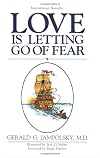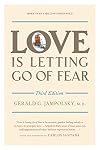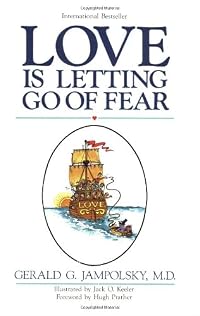
Love Is Letting Go of Fear
by Gerald G. Jampolsky
On This Page
Description
After a quarter century, LOVE IS LETTING GO OF FEAR is still one of the most widely read and best-loved books on personal transformation and has become a classic all over the world. This helpful and hopeful little guide is comprised of twelve carefully crafted lessons that are designed to help us let go of the past and stay focused on the present as we step confidently toward the future. Renowned founder and teacher of Attitudinal Healing, Dr. Gerald Jampolsky reminds us that the only show more impediments to the life we yearn for are the limitations imposed on us by our own minds. Revealing our true selves, the essence of which is love, is a matter of releasing those limited and limiting thoughts. LOVE IS LETTING GO OF FEAR has guided millions of readers toward self-healing with this deeply powerful yet profoundly simple message. Embrace it with an open mind and an open heart and let it guide you to a life in which fear, doubt, and negativity are replaced with optimism, joy, and love. show lessTags
Recommendations








Member Reviews
This book is not the usual type of selection for a religion blog, is it? I’m not sure God is even mentioned in the book. But Love is, and God is Love, right? For all you Bible scholars out there, we shouldn’t get so wrapped up in our fascinating scholarly pursuits that we forget the reason for our religion in the first place.
At the risk of over-analyzing a simple book with a simple message, I confess it struck a chord with me partly because of my recent studies in the Gospel of John. Here’s why: like many scriptures, this book pits good against evil as clearly as God versus Satan, only this time it’s love versus fear. If, at the moment, one of the two (love or fear) is guiding your actions and thoughts, the other is not. Why? show more Well, according to Jerry, it’s because love lives in the present, and fear lives in a reflection of the past into the future. This is a lesson taught over and over. Let go of the past and future, and live in the present.
As Jerry says in the book, “Wouldn’t our lives be more meaningful if we looked to what has no beginning and no ending as our reality? Only Love fits this definition of the eternal. Everything else is transitory and therefore meaningless.”
Now, doesn’t that sound an awful lot like John, the Gospel of Love? Eternal life is ours for the grasping, by living in the eternal now. I’m reminded of another book review I just completed: My Stroke of Insight.
This is a short little book with cute illustrations that you can read in a couple hours. It’s a 25th anniversary reprint of a book that made a big splash in 1974, and it’s worth the two-hour investment. show less
At the risk of over-analyzing a simple book with a simple message, I confess it struck a chord with me partly because of my recent studies in the Gospel of John. Here’s why: like many scriptures, this book pits good against evil as clearly as God versus Satan, only this time it’s love versus fear. If, at the moment, one of the two (love or fear) is guiding your actions and thoughts, the other is not. Why? show more Well, according to Jerry, it’s because love lives in the present, and fear lives in a reflection of the past into the future. This is a lesson taught over and over. Let go of the past and future, and live in the present.
As Jerry says in the book, “Wouldn’t our lives be more meaningful if we looked to what has no beginning and no ending as our reality? Only Love fits this definition of the eternal. Everything else is transitory and therefore meaningless.”
Now, doesn’t that sound an awful lot like John, the Gospel of Love? Eternal life is ours for the grasping, by living in the eternal now. I’m reminded of another book review I just completed: My Stroke of Insight.
This is a short little book with cute illustrations that you can read in a couple hours. It’s a 25th anniversary reprint of a book that made a big splash in 1974, and it’s worth the two-hour investment. show less
Jampolsky shares from his life practices with wisdom and humility & gives examples of how these core concepts can be applied. He teaches 12 "lessons" that can be practiced individually- he suggests choosing one a day to concentrate on. While I wrote down some reminders- I preferred this serving as a reading where I can take what is useful at the moment- keeping one lesson written onto an index card for further practice. This could serve as an ACIM practice or as a gateway for further studies. Some of these concepts are most useful as part of a holistically based spiritual practice.
Dr. Jampolsky has applied the principles of 'A Course in Miracles' to "lessons for personal transformation." He suggests a daily practice of relaxation, active imagination, application, and review of each lesson, repeating the program until the lessons are part of your life. These are powerful practices that can rid us of wasting energy on fears, judgments, and grievances; freeing us to live in the present with joy, openness, and wholeness. When we hold onto grievances we tend to use the past to predict a future in which we must be cautious and avoid being hurt. In contrast, giving love to others unconditionally will bring us the love that we all need. Forgiveness in this light does not mean that we tolerate behavior we don't like; it show more means correcting a misperception that we have been harmed; it means noticing our thoughts that create a fearful external world, choosing instead to see love in the world and to appreciate our common bond with others. "The world we see that seems so insane may be the result of a belief system that isn't working," Jampolsky writes. "Our old belief system assumes that anger occurs because we have been attacked. It also assumes that counterattack is justified... If we are willing, it is possible to change our belief system. However, to do so... means letting go of any investment in holding on to fear, anger, guilt or pain." show less
This is an important and inspiring book with the message – let go of fear and love everyone.
The titles of the 12 lessons are from The Course in Miracles
They are:
1) All that I give is given to myself.
2) Forgiveness is the key to happiness.
3) I am never upset for the reason I think.
4) I am determined to see things differently.
5) I can escape from the world I see by giving up attack thoughts.
6) I am not the victim of the world I see.
7) Today I will judge nothing that occurs.
8) This instant is the only time there is.
9) The past is over – it can touch me not.
10) I could see peace instead of this.
11) I can elect to change all thoughts that hurt.
12) I am responsible for what I see.
Jerry Jampolsky writes in a personal style and presents show more inspiring stories of people who have transformed their life for the better by reading the book.
Jerry is involved with Attitudinal Healing, which is self-healing based on the principle that it is not other people or situations that cause us to be upset but our own thoughts and attitudes concerning those things. At the core of these principles is forgiveness. Forgiveness is a decision to no longer attack oneself and not to suffer, but be happy, let go of judgments, stop hurting others and ourselves and stop “recycling anger and fear”.
“Forgiveness is the bridge to compassion, to inner peace, and to a peaceful world.”
The author wrote the book because he wanted to learn inner peace.
He quotes the Course in Miracles:
“Teach only love for that is what you are.”
The book was published in 1979 and has sold millions of copies since then. It deals with inner healing and spiritual transformation.
The main principles of the book are “having a willingness to see the world differently; seeing the value in letting go of our control issues, judgments and grievances; and making forgiveness as important as breathing”.
By practising the lessons in a Course in Miracles, Jerry began to experience a sense of inner peace and to see how everyone he met was his teacher.
We learn about forgiveness, getting and giving and retraining the mind.
We learn that all minds are joined and are one. We cannot change other people but we can change how we perceive the world, others and ourselves.
There are only two emotions, love and fear. Love is our true reality. Fear is something our mind has made up and is therefore unreal.
What we experience is our state of mind projected outward. If our state of mind is well-being, love and peace, that is what we will project and thus experience.
There are 12 lessons and we should do one each day.
“The law of love is that you are love, and that as you give love to others you teach yourself what you are.”
We learn about letting go of “attack thoughts” and choosing peace instead.
We learn that we are not victims and that only our loving thoughts are real. We learn not to judge others and this is another way of letting go of fear and experiencing love.
“See everyone you meet or think about as either extending love or as being fearful and sending out a call for help, which is a request for love.”
The book is filled with entertaining cartoons.
To sum up, this is an original, enlightening book which I would highly recommend. It pushes one to take a decisive step forward in one’s spiritual development. If everyone were to read this book and transform fear to love, then there would be no more wars. show less
The titles of the 12 lessons are from The Course in Miracles
They are:
1) All that I give is given to myself.
2) Forgiveness is the key to happiness.
3) I am never upset for the reason I think.
4) I am determined to see things differently.
5) I can escape from the world I see by giving up attack thoughts.
6) I am not the victim of the world I see.
7) Today I will judge nothing that occurs.
8) This instant is the only time there is.
9) The past is over – it can touch me not.
10) I could see peace instead of this.
11) I can elect to change all thoughts that hurt.
12) I am responsible for what I see.
Jerry Jampolsky writes in a personal style and presents show more inspiring stories of people who have transformed their life for the better by reading the book.
Jerry is involved with Attitudinal Healing, which is self-healing based on the principle that it is not other people or situations that cause us to be upset but our own thoughts and attitudes concerning those things. At the core of these principles is forgiveness. Forgiveness is a decision to no longer attack oneself and not to suffer, but be happy, let go of judgments, stop hurting others and ourselves and stop “recycling anger and fear”.
“Forgiveness is the bridge to compassion, to inner peace, and to a peaceful world.”
The author wrote the book because he wanted to learn inner peace.
He quotes the Course in Miracles:
“Teach only love for that is what you are.”
The book was published in 1979 and has sold millions of copies since then. It deals with inner healing and spiritual transformation.
The main principles of the book are “having a willingness to see the world differently; seeing the value in letting go of our control issues, judgments and grievances; and making forgiveness as important as breathing”.
By practising the lessons in a Course in Miracles, Jerry began to experience a sense of inner peace and to see how everyone he met was his teacher.
We learn about forgiveness, getting and giving and retraining the mind.
We learn that all minds are joined and are one. We cannot change other people but we can change how we perceive the world, others and ourselves.
There are only two emotions, love and fear. Love is our true reality. Fear is something our mind has made up and is therefore unreal.
What we experience is our state of mind projected outward. If our state of mind is well-being, love and peace, that is what we will project and thus experience.
There are 12 lessons and we should do one each day.
“The law of love is that you are love, and that as you give love to others you teach yourself what you are.”
We learn about letting go of “attack thoughts” and choosing peace instead.
We learn that we are not victims and that only our loving thoughts are real. We learn not to judge others and this is another way of letting go of fear and experiencing love.
“See everyone you meet or think about as either extending love or as being fearful and sending out a call for help, which is a request for love.”
The book is filled with entertaining cartoons.
To sum up, this is an original, enlightening book which I would highly recommend. It pushes one to take a decisive step forward in one’s spiritual development. If everyone were to read this book and transform fear to love, then there would be no more wars. show less
A quick read only 131 pages and lots of cartoons and blank space. A nice book based on A Course in Miracles. Nice stories - not all of them really gel with the section they are in.
inspiring :)
Ratings
Members
- Recently Added By
Author Information

62+ Works 1,438 Members
Gerald G. Jampolsky, MD, a graduate of Stanford Medical School, is an adult and child psychiatrist. The author and coauthor of seventeen books, he is also the founder of the first Center for Attitudinal Healing, now worldwide, and cofounder of Attitudinal Healing International, www.ahinternational.org. When he isn't traveling and teaching around show more the world, Dr. Jampolsky and his wife, Diane Cirincione, PhD, call Northern California and Hawaii home. show less
Some Editions
Classifications
Statistics
- Members
- 653
- Popularity
- 44,041
- Reviews
- 6
- Rating
- (3.66)
- Languages
- 6 — Dutch, English, French, German, Italian, Spanish
- Media
- Paper, Audiobook, Ebook
- ISBNs
- 28
- ASINs
- 13