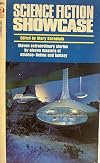
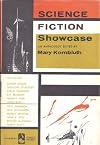
Science Fiction Showcase: Eleven Extraordinary Stories by Eleven Masters of Science-Fiction and Fantasy
by Mary Kornbluth (Editor)
On This Page
Tags
Recommendations








Member Reviews
A tribute to SF writer C.M. Kornbluth, who died at the age of 34 in 1958, Science Fiction Showcase delivers eleven excellent speculative fiction tales edited by Kornbluth’s wife, Mary Byers. Contributing authors include Ray Bradbury, Damon Knight, Ted Sturgeon, Robert Bloch, Frederik Pohl, Avram Davidson, James Blish, Jack Williamson, Phil K. Dick, Poul Anderson, and Richard Matheson.
With a line-up like that, how could you go wrong? It’s a rare occasion when I enjoy every story in an anthology almost equally, but in this case, they were all brilliant. Were I forced to choose favorites, they would be…
Richard Falk, a fugitive from Earth, steals a space freighter and heads to Mars where an alien transportation device was long ago show more uncovered. Unable to live in a society brainwashed into complacency by the government, Falk intends to use the device to begin life anew on a distant world. There’s only problem—once you step inside, where you end up is anyone’s guess in “A Ticket to Anywhere” by Damon Knight.
Anderson “Sonny” Trumie grew up poor, practically raised by robots, in a society whose highest priority was to consume. Yet, time passed Sonny by and he failed to share in its enlightenment. He continued to consume, until he was too obese to move without assistance, and to construct robots to help him acquire his own island… and still he wanted more, for Anderson Trumie was “The Man Who Ate the World” by Frederick Pohl.
In “A Work of Art” by James Blish, 19th century German composer Richard Strauss is resurrected in a new body in the year 2161. Repulsed by what he considers the regression of music in this modern age, Strauss sets out to compose an opera based on Christopher Fry’s play, Venus Observed. Although his opera is wildly successful, Strauss comes to realize two awful truths about himself… and his fate.
The orphaned boy of two American explorers must leave his Tibetan upbringing and migrate to Kansas where he is to be raised by his intolerant Christian aunt who, glaring down at him with one eye brown and other a glassy green, will not bear the boy’s heathen faith and philosophy. Yet despite her chastisements and beatings, the boy holds true to his Tibetan teachings while his aunt learns a lesson in cruelty in Jack Williamson’s “The Cold Green Eye.”
“Mantage” by Richard Matheson – Alfred Hitchcock observed that “drama is life with the dull bits cut out,” but what if you were so eager to achieve your goals that you had the option to live your life without those dull bits? Heed the old adage, you can’t live your life in a day—unless you’re award-winning writer Owen Crowley who learns that the gaps between the accolades are just as precious. show less
With a line-up like that, how could you go wrong? It’s a rare occasion when I enjoy every story in an anthology almost equally, but in this case, they were all brilliant. Were I forced to choose favorites, they would be…
Richard Falk, a fugitive from Earth, steals a space freighter and heads to Mars where an alien transportation device was long ago show more uncovered. Unable to live in a society brainwashed into complacency by the government, Falk intends to use the device to begin life anew on a distant world. There’s only problem—once you step inside, where you end up is anyone’s guess in “A Ticket to Anywhere” by Damon Knight.
Anderson “Sonny” Trumie grew up poor, practically raised by robots, in a society whose highest priority was to consume. Yet, time passed Sonny by and he failed to share in its enlightenment. He continued to consume, until he was too obese to move without assistance, and to construct robots to help him acquire his own island… and still he wanted more, for Anderson Trumie was “The Man Who Ate the World” by Frederick Pohl.
In “A Work of Art” by James Blish, 19th century German composer Richard Strauss is resurrected in a new body in the year 2161. Repulsed by what he considers the regression of music in this modern age, Strauss sets out to compose an opera based on Christopher Fry’s play, Venus Observed. Although his opera is wildly successful, Strauss comes to realize two awful truths about himself… and his fate.
The orphaned boy of two American explorers must leave his Tibetan upbringing and migrate to Kansas where he is to be raised by his intolerant Christian aunt who, glaring down at him with one eye brown and other a glassy green, will not bear the boy’s heathen faith and philosophy. Yet despite her chastisements and beatings, the boy holds true to his Tibetan teachings while his aunt learns a lesson in cruelty in Jack Williamson’s “The Cold Green Eye.”
“Mantage” by Richard Matheson – Alfred Hitchcock observed that “drama is life with the dull bits cut out,” but what if you were so eager to achieve your goals that you had the option to live your life without those dull bits? Heed the old adage, you can’t live your life in a day—unless you’re award-winning writer Owen Crowley who learns that the gaps between the accolades are just as precious. show less
A collection of stories selected in tribute to Cyril M. Kornbluth, the authors recruited by his spouse Mary Kornbluth and based on a personal relationship with their SF colleague. That foundation suggests less thematic coherence than many collections, though a theme weaving through many if not all stories here: ironic fate, perhaps just desserts.
Mine a Science Fiction Book Club edition, the mass edition entitled 11 Tales but this includes 12.
Damon Knight,
"Ticket to Anywhere"
Portal story, with an interesting premise (independent) of mandatory mind implants to govern individual behaviour.
Theodore Sturgeon,
"That Low"
A "failure specialist" gets his fortune told.
Avram Davidson,
"Or the Grasses Grow"
That irony again, within a commentary on show more U.S. racial relations. Never names the Oglala but there are parallels.
Frederik Pohl,
"The Man Who Ate the World"
A cynical take on a post-scarcity economy. Interestingly complies with the Three Laws of Robotics, without naming them.
Poul Anderson,
"The Long Remembering"
Time travel by information exchange; here, Armand submits voluntarily to experimental research. Speculates on Cro Magnon and Neanderthal interaction, not too outdated from later research from what little I've read.
Ray Bradbury,
"The End of the Beginning"
Familiar Bradbury preoccupations with traditional Americana confronted with an uncertain future. Could have fit in with his Martian Chronicles.
James Blish,
"A Work of Art"
Richard Strauss awakes from death in 2161.
Jack Williamson,
"The Cold Green Eye"
A morality play, in one act, Rod Serling directing.
Murray Leinster,
"Med Service" aka "The Mutant Weapon"
The story prompting me to pull this book from my shelf: I mistook it for a Sector General episode, but those are not Leinster, rather James White. I wonder how aware Leinster and Murray were of one another's alien medic stories, evidently they were very different from one another but I can't help but think of them as another Munsters-Addams Family sort of pairing.
The story itself memorable primarily in medic Calhoun reading and quoting from a fictional book, Fitzgerald's Probability and Human Conduct, even as he adventures about on the Med Ship Aesclipus Twenty and risks his life. That, and his companion Murgatroyd, a tormal bred for both company and a combination role petri dish-canary in a colemine.
Philip K Dick,
"Expendable"
Very short, Serling-esque in its twist.
Richard Matheson,
"Mantage"
Deliberately or not, Matheson effectively mimes for the reader the character's experience of living a montage life. If written today, I'd be skeptical of its validity as media critique; written as it was before 1959 (there is no separate copyright listed, presumably written expressly for this compilation) it's merely suggestive and all the more persuasive for that.
Robert Bloch,
"Nightmare Number Four"
Cute and seemingly phildickian in premise, but a more jokey tone and less concern for wider questions of the nature of reality or personal identity. show less
Mine a Science Fiction Book Club edition, the mass edition entitled 11 Tales but this includes 12.
Damon Knight,
"Ticket to Anywhere"
Portal story, with an interesting premise (independent) of mandatory mind implants to govern individual behaviour.
Theodore Sturgeon,
"That Low"
A "failure specialist" gets his fortune told.
Avram Davidson,
"Or the Grasses Grow"
That irony again, within a commentary on show more U.S. racial relations. Never names the Oglala but there are parallels.
Frederik Pohl,
"The Man Who Ate the World"
A cynical take on a post-scarcity economy. Interestingly complies with the Three Laws of Robotics, without naming them.
Poul Anderson,
"The Long Remembering"
Time travel by information exchange; here, Armand submits voluntarily to experimental research. Speculates on Cro Magnon and Neanderthal interaction, not too outdated from later research from what little I've read.
Ray Bradbury,
"The End of the Beginning"
Familiar Bradbury preoccupations with traditional Americana confronted with an uncertain future. Could have fit in with his Martian Chronicles.
James Blish,
"A Work of Art"
Richard Strauss awakes from death in 2161.
Jack Williamson,
"The Cold Green Eye"
A morality play, in one act, Rod Serling directing.
Murray Leinster,
"Med Service" aka "The Mutant Weapon"
The story prompting me to pull this book from my shelf: I mistook it for a Sector General episode, but those are not Leinster, rather James White. I wonder how aware Leinster and Murray were of one another's alien medic stories, evidently they were very different from one another but I can't help but think of them as another Munsters-Addams Family sort of pairing.
The story itself memorable primarily in medic Calhoun reading and quoting from a fictional book, Fitzgerald's Probability and Human Conduct, even as he adventures about on the Med Ship Aesclipus Twenty and risks his life. That, and his companion Murgatroyd, a tormal bred for both company and a combination role petri dish-canary in a colemine.
Philip K Dick,
"Expendable"
Very short, Serling-esque in its twist.
Richard Matheson,
"Mantage"
Deliberately or not, Matheson effectively mimes for the reader the character's experience of living a montage life. If written today, I'd be skeptical of its validity as media critique; written as it was before 1959 (there is no separate copyright listed, presumably written expressly for this compilation) it's merely suggestive and all the more persuasive for that.
Robert Bloch,
"Nightmare Number Four"
Cute and seemingly phildickian in premise, but a more jokey tone and less concern for wider questions of the nature of reality or personal identity. show less
This is quite the tasty morsel. Published in 1959 and edited by Mary Kornbluth, you may find shorts by: Damon Knight, Theodore Sturgeon, Avram Davidson, Frederik Pohl, Poul Anderson, Ray Bradbury, James Blish, Jack Williamson, Murray Leinster, Philip K. Dick, Richard Matheson, and Robert Bloch. One of the most polished and memorable stories here is Murray Leinster's "Med Service". In it Leinster's main character, Calhoun, quotes from Fitzgerald's " Probability and Human Conduct". Does anyone know if this is a factual work? In my "drive-by" research the only person I can come up with who might have written such a work is Irish Physicist and Natural and Experimental Philosopher, George Francis Fitzgerald. Whatever the case may be I know show more that the SCI FI afficionado will will find this collection delectable! show less
Ratings
Members
- Recently Added By
Author Information
All Editions
Some Editions
Series
Belongs to Publisher Series
Work Relationships
Contains
Common Knowledge
- Canonical title
- Science Fiction Showcase: Eleven Extraordinary Stories by Eleven Masters of Science-Fiction and Fantasy
- Original publication date
- 1959 (collection) (collection)
Classifications
Statistics
- Members
- 111
- Popularity
- 292,605
- Reviews
- 3
- Rating
- (3.56)
- Languages
- English
- Media
- Paper
- ASINs
- 14