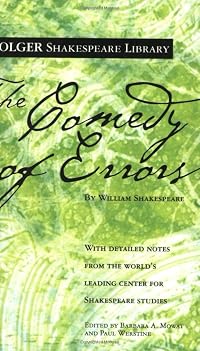
The Comedy of Errors
by William Shakespeare
On This Page
Description
The Comedy of Errors is one of Shakespeare's most popular short comedy plays. The plot is driven by two cases of mistaken identity and witty pun-drenched dialogue. Antipholus of Syracuse and his servant of Dromio of Syraceuse visit the town of Ephesus, not realizing that this is the home of Antipholus of Ephesus and Dromio of Ephesus, their twin brothers lost to them at sea years before. Before reuniting, the doppelgangers cause chaos amongst friends and family when they all assemble in show more Ephesus.. show less
Tags
Recommendations












Member Recommendations

Member Reviews
I may be biased because of previous experience with this play (I volunteered backstage at an outdoor Shakespeare festival for four years, and this was one of the productions I worked on), but this is a really fun romp. Mistaken identities are always a good source of comedy, and Shakespeare gives us a fast and furious story with all sorts of comings and goings and general mayhem, with the comings and goings in particular evoking thoughts of Frasier.
For those of you not familiar with the storyline, I would suggest reading the first act, because Egeon's speech pretty much sums up the backstory. From that you will deduce that the two sets of twins will inadvertently meet in Ephesus and hijinks will ensue. It's much easier to point you to show more that than to try to explain it. Also a lot of the humour from the rest of the play comes from watching it unfold for yourself.
Act 3, Scene 2 is probably my favourite part (although Act 3 Scene 1 is pretty funny as well), because it features the hilarity that is Dromio of Syracuse telling Antipholus of Syracuse of the horror that is Dromio of Ephesus' wife, and how he could find out countries in her various features ("Where stood Belgia? The Netherlands?" "Oh SIR! I did not look so low."). It could just have been the great delivery of the guy playing D. of S. in our production, but this part always got huge laughs and I think it's still pretty accessible to modern audiences. (That line about Scotland being in "the barrenness, hard in the palm of her hand", though? No matter how hard he tried, couldn't get a laugh out of it. The explanatory notes in my edition didn't have any hints either.)
Actually, the whole play is fairly easy to follow, especially with the explanatory notes for the more obscure puns and references. It's short, too -- you can probably breeze through it in a couple of hours. I'd recommend this if you're thinking of reading a Shakespeare play but are somewhat intimidated by the heavier tragedies and histories. Read it aloud for even more fun. show less
For those of you not familiar with the storyline, I would suggest reading the first act, because Egeon's speech pretty much sums up the backstory. From that you will deduce that the two sets of twins will inadvertently meet in Ephesus and hijinks will ensue. It's much easier to point you to show more that than to try to explain it. Also a lot of the humour from the rest of the play comes from watching it unfold for yourself.
Act 3, Scene 2 is probably my favourite part (although Act 3 Scene 1 is pretty funny as well), because it features the hilarity that is Dromio of Syracuse telling Antipholus of Syracuse of the horror that is Dromio of Ephesus' wife, and how he could find out countries in her various features ("Where stood Belgia? The Netherlands?" "Oh SIR! I did not look so low."). It could just have been the great delivery of the guy playing D. of S. in our production, but this part always got huge laughs and I think it's still pretty accessible to modern audiences. (That line about Scotland being in "the barrenness, hard in the palm of her hand", though? No matter how hard he tried, couldn't get a laugh out of it. The explanatory notes in my edition didn't have any hints either.)
Actually, the whole play is fairly easy to follow, especially with the explanatory notes for the more obscure puns and references. It's short, too -- you can probably breeze through it in a couple of hours. I'd recommend this if you're thinking of reading a Shakespeare play but are somewhat intimidated by the heavier tragedies and histories. Read it aloud for even more fun. show less
The Comedy of Errors (Arden Shakespeare)
The Comedy of Errors BBC teleproduction 1983
WHEN IS A FARCE NOT A FARCE
The answer to this question could be when it is written by Shakespeare. People who read and enjoy Shakespeare do so for many reasons, not the least of them are the language, the imagery and the poetry. There are also the wonderful stories the subtle plotting and the resolutions that always seem to make perfect sense of what has gone before. Shakespeare is read also for his his commentary on the human condition, his is a voice that can leap across 420 odd years of time and still make sense to many of his readers in the 21 century. The problems with this aspect is that many readers expect too much from him and worry about those show more aspects of life in Elizabethan times that are frankly abhorrent to many of us today. Because in my view the value of Shakespeare is also in his acute observations of Elizabethan life and his ability to write plays that were entertaining to the audience that watched them. They would have been able to relate to the events on the stage and recognise issues that impacted on their lives and those of the social spheres above or below them, but there are some aspects that make the modern viewer/reader uneasy, squirming perhaps in their seats. The Comedy of Errors can be one of those plays: slavery, marriage and mercantilism all seem to hold us back from laughing out loud at the farce of the mistaken identities that form the central structure of the play.
The play is set in the mercantile port of Ephesus at some period in classical history: Aegeon a merchant from Syracuse has been arrested and sentenced to death as a result of a trade war between the two city's. He tells a story of how he has landed in search of his identical twin sons and their twin slaves who he has not seen for a number of years as they were separated as a result of a shipwreck. Unbeknown to him one of the twins is a prosperous merchant in Ephesus and the other twin has just landed in search of his brother and family. Both are called Antipholus and both of the slaves are called Dromio and they are so alike that they cannot be told apart. The Syracusan Antipholus is mistaken for the Ephesusian Antipholus and the twin brothers cannot even tell the Dromio brothers apart. The brothers do not get to meet until the end of the story and so in the meantime confusion reigns with even Adriana the wife of Antipholus of Ephesus mistaking his twin for her husband. All the action takes place during one eventful day that is to end with the execution of the hapless Aegeon.
There is a long speech at the very start of the play where Aegon tells the story of his lost family, it is a kind of info-dump that sets the scene, but also hints at possible misfortunes or misadventures. The comedy gets going as soon as Dromio from Ephesus sees Antipholus from Syracuse and mistakes him for his master and urges him to return home to his mistress Adriana; who is impatiently waiting to eat lunch. Antipholus is more concerned with the result of an errand that he has sent his Dromio on involving a hefty sum of money. From this moment on Shakespeare keeps the two sets of twins apart with the result that no one seems to be making any sense, but it usually ends with one of the Dromios getting a beating. The stuff of a knockabout farce and when jewellery, sums of money, unpaid debts, a courtesan and a schoolmaster and conjuror become involved then the humour goes into some sort of overdrive. The Dromio twins have an uneasy relationship with their masters who value them for their wit and service, but do not suffer their foolishness gladly. The repartee between master and slave sparkles with wit and invention as each of the Antipholuses who are touchy at best become mad with rage at the confusion and their inability to understand what is going on. Complications follow on hard on the heels of each other until both sets of brothers find themselves under restraint for disturbing the peace. The misadventures are all to do with the mistaken identity, there are no conniving servants or malicious traders involved, no plots to relieve the brothers of their money, but Antipholus of Syracuse soon becomes convinced witchcraft is involved and Antipholus from Ephesus becomes paranoid.
Shakespeare ramps up the comedy as the play progresses, but there are deeper issues involved. Antipholus of Ephesus relationship with his wife Adriana comes under scrutiny, she is not just impatient for his lateness in returning for lunch but sees this incident as a reflection of the state of her marriage. This is not helped when after persuading the wrong Antipholus home to dinner she effectively locks her husband out in the street while her guest makes eyes at her sister Luciana. Adriana complains to Luciana that husbands have too much freedom:
"ADRIANA. Why should their liberty than ours be more?"
Luciana puts her straight in a speech which is of it's time:
"Why, headstrong liberty is lash'd with woe.
There's nothing situate under heaven's eye
But hath his bound, in earth, in sea, in sky.
The beasts, the fishes, and the winged fowls,
Are their males' subjects, and at their controls.
Man, more divine, the master of all these,
Lord of the wide world and wild wat'ry seas,
Indu'd with intellectual sense and souls,
Of more pre-eminence than fish and fowls,
Are masters to their females, and their lords;
Then let your will attend on their accords.
ADRIANA. This servitude makes you to keep unwed.
LUCIANA. Not this, but troubles of the marriage-bed."
The outrageous beatings suffered by the Dromio twins at the hands of masters and mistresses are stock in trade for Elizabethan comedy, but this feels overdone. The treatment of servants which in many instances were little more than slaves during the period were known to be harsh, but the Antipholus twins seem to want it both ways, in one instance they are encouraging their Dromios to be friendly and engage in witty conversation while in the next instance they become annoyed, which soon results in physical abuse. The Dromios are the the most impressionistic and sympathetic characters in the play and contrast with the more aloof and cold personalities of the Antipholus twins.
The city of Ephesus is a proto-capitalist credit dependent economy. Stability and credit worthiness are everything; as soon as a suspicion of indebtedness is cast then a victim is identified. Everyman has his price. The poor unfortunate Aegeon who is bound to be executed could buy off his execution if he could raise 100 ducats, but no one in the city deems him credit worthy. Antipholus of Ephesus is a product of the city his scheme to repair his relationship with Adriana is to have a gold chain made for her and he knows this will be accepted, but when this chain gets caught up in the confusion of the mistaken identities he is in trouble. Antipholus is almost reduced to apoplexy, he becomes incandescent with rage.
The Comedy of Errors is one of Shakespeares earliest plays, perhaps the first comedy that he wrote, probably dating from mid 1594, but could have been a couple of years earlier. It has remained a popular play although in the nineteenth century stripped down and rewritten as a farce imbued with sentimentality. The Boys from Syracuse is a 1940's musical based on the play, but there have been plenty of modern productions that have used much of the original text of the play to make a comedy with added depth. I watched the 1983 BBC production starring Michael Kitchen as the Antipholus twins and an excellent Roger Daltry as the Dromio twins. Directed by James Cellan Jones this production not only made me laugh out loud, but also enabled me to appreciate the structure of the play. This is a comedy first and foremost but it also has other things to say and it all bubbles up to a climax and then a denouement that works particularly well. This production is particularly strong in focusing on the troubled relationship between Antipholus and Adriana, but never loses the fun of the comedy: the witchcraft is treated as a bit of a sideshow but is ever present and the intervention of Doctor Pinch is impressive.
The Arden Shakespeare dates from 2017 and is edited by Kent Cartwright. As usual the background information and notes are extensive with all you need to know to enjoy the play. There is no shortage of information on the internet if you find yourself struggling with the introduction that can be a little over intellectualised. The text however is clear and the notes on the same page as the text work well. This play is superbly entertaining and Shakespeare packed much into what is his shortest play. I loved it and so 5 stars. show less
The Comedy of Errors BBC teleproduction 1983
WHEN IS A FARCE NOT A FARCE
The answer to this question could be when it is written by Shakespeare. People who read and enjoy Shakespeare do so for many reasons, not the least of them are the language, the imagery and the poetry. There are also the wonderful stories the subtle plotting and the resolutions that always seem to make perfect sense of what has gone before. Shakespeare is read also for his his commentary on the human condition, his is a voice that can leap across 420 odd years of time and still make sense to many of his readers in the 21 century. The problems with this aspect is that many readers expect too much from him and worry about those show more aspects of life in Elizabethan times that are frankly abhorrent to many of us today. Because in my view the value of Shakespeare is also in his acute observations of Elizabethan life and his ability to write plays that were entertaining to the audience that watched them. They would have been able to relate to the events on the stage and recognise issues that impacted on their lives and those of the social spheres above or below them, but there are some aspects that make the modern viewer/reader uneasy, squirming perhaps in their seats. The Comedy of Errors can be one of those plays: slavery, marriage and mercantilism all seem to hold us back from laughing out loud at the farce of the mistaken identities that form the central structure of the play.
The play is set in the mercantile port of Ephesus at some period in classical history: Aegeon a merchant from Syracuse has been arrested and sentenced to death as a result of a trade war between the two city's. He tells a story of how he has landed in search of his identical twin sons and their twin slaves who he has not seen for a number of years as they were separated as a result of a shipwreck. Unbeknown to him one of the twins is a prosperous merchant in Ephesus and the other twin has just landed in search of his brother and family. Both are called Antipholus and both of the slaves are called Dromio and they are so alike that they cannot be told apart. The Syracusan Antipholus is mistaken for the Ephesusian Antipholus and the twin brothers cannot even tell the Dromio brothers apart. The brothers do not get to meet until the end of the story and so in the meantime confusion reigns with even Adriana the wife of Antipholus of Ephesus mistaking his twin for her husband. All the action takes place during one eventful day that is to end with the execution of the hapless Aegeon.
There is a long speech at the very start of the play where Aegon tells the story of his lost family, it is a kind of info-dump that sets the scene, but also hints at possible misfortunes or misadventures. The comedy gets going as soon as Dromio from Ephesus sees Antipholus from Syracuse and mistakes him for his master and urges him to return home to his mistress Adriana; who is impatiently waiting to eat lunch. Antipholus is more concerned with the result of an errand that he has sent his Dromio on involving a hefty sum of money. From this moment on Shakespeare keeps the two sets of twins apart with the result that no one seems to be making any sense, but it usually ends with one of the Dromios getting a beating. The stuff of a knockabout farce and when jewellery, sums of money, unpaid debts, a courtesan and a schoolmaster and conjuror become involved then the humour goes into some sort of overdrive. The Dromio twins have an uneasy relationship with their masters who value them for their wit and service, but do not suffer their foolishness gladly. The repartee between master and slave sparkles with wit and invention as each of the Antipholuses who are touchy at best become mad with rage at the confusion and their inability to understand what is going on. Complications follow on hard on the heels of each other until both sets of brothers find themselves under restraint for disturbing the peace. The misadventures are all to do with the mistaken identity, there are no conniving servants or malicious traders involved, no plots to relieve the brothers of their money, but Antipholus of Syracuse soon becomes convinced witchcraft is involved and Antipholus from Ephesus becomes paranoid.
Shakespeare ramps up the comedy as the play progresses, but there are deeper issues involved. Antipholus of Ephesus relationship with his wife Adriana comes under scrutiny, she is not just impatient for his lateness in returning for lunch but sees this incident as a reflection of the state of her marriage. This is not helped when after persuading the wrong Antipholus home to dinner she effectively locks her husband out in the street while her guest makes eyes at her sister Luciana. Adriana complains to Luciana that husbands have too much freedom:
"ADRIANA. Why should their liberty than ours be more?"
Luciana puts her straight in a speech which is of it's time:
"Why, headstrong liberty is lash'd with woe.
There's nothing situate under heaven's eye
But hath his bound, in earth, in sea, in sky.
The beasts, the fishes, and the winged fowls,
Are their males' subjects, and at their controls.
Man, more divine, the master of all these,
Lord of the wide world and wild wat'ry seas,
Indu'd with intellectual sense and souls,
Of more pre-eminence than fish and fowls,
Are masters to their females, and their lords;
Then let your will attend on their accords.
ADRIANA. This servitude makes you to keep unwed.
LUCIANA. Not this, but troubles of the marriage-bed."
The outrageous beatings suffered by the Dromio twins at the hands of masters and mistresses are stock in trade for Elizabethan comedy, but this feels overdone. The treatment of servants which in many instances were little more than slaves during the period were known to be harsh, but the Antipholus twins seem to want it both ways, in one instance they are encouraging their Dromios to be friendly and engage in witty conversation while in the next instance they become annoyed, which soon results in physical abuse. The Dromios are the the most impressionistic and sympathetic characters in the play and contrast with the more aloof and cold personalities of the Antipholus twins.
The city of Ephesus is a proto-capitalist credit dependent economy. Stability and credit worthiness are everything; as soon as a suspicion of indebtedness is cast then a victim is identified. Everyman has his price. The poor unfortunate Aegeon who is bound to be executed could buy off his execution if he could raise 100 ducats, but no one in the city deems him credit worthy. Antipholus of Ephesus is a product of the city his scheme to repair his relationship with Adriana is to have a gold chain made for her and he knows this will be accepted, but when this chain gets caught up in the confusion of the mistaken identities he is in trouble. Antipholus is almost reduced to apoplexy, he becomes incandescent with rage.
The Comedy of Errors is one of Shakespeares earliest plays, perhaps the first comedy that he wrote, probably dating from mid 1594, but could have been a couple of years earlier. It has remained a popular play although in the nineteenth century stripped down and rewritten as a farce imbued with sentimentality. The Boys from Syracuse is a 1940's musical based on the play, but there have been plenty of modern productions that have used much of the original text of the play to make a comedy with added depth. I watched the 1983 BBC production starring Michael Kitchen as the Antipholus twins and an excellent Roger Daltry as the Dromio twins. Directed by James Cellan Jones this production not only made me laugh out loud, but also enabled me to appreciate the structure of the play. This is a comedy first and foremost but it also has other things to say and it all bubbles up to a climax and then a denouement that works particularly well. This production is particularly strong in focusing on the troubled relationship between Antipholus and Adriana, but never loses the fun of the comedy: the witchcraft is treated as a bit of a sideshow but is ever present and the intervention of Doctor Pinch is impressive.
The Arden Shakespeare dates from 2017 and is edited by Kent Cartwright. As usual the background information and notes are extensive with all you need to know to enjoy the play. There is no shortage of information on the internet if you find yourself struggling with the introduction that can be a little over intellectualised. The text however is clear and the notes on the same page as the text work well. This play is superbly entertaining and Shakespeare packed much into what is his shortest play. I loved it and so 5 stars. show less
http://nhw.livejournal.com/1091936.html
I dimly remember the Rowan Atkinson sketch where he is a schoolmaster trying to beat respect for English literature into the heads of a host of invisible and improbably named schoolboys. One of the great lines is when he insists that there is only one joke in Shakespeare, and it is in A Comedy of Errors, when "Two people look like each other. Twice." Pause. "It's not that funny!"
Well, actually, it is that funny. It's a much shorter play than the histories I've read/listened to so far; it's a bit more original, in that Shakespeare has boiled together bits of Plautus (who was also pretty funny in his day) to produce a mock-classical, proto-pantomime slapstick piece.
Anyway, the play itself relies on show more the stable foundation of farce, where we the audience know what is going on but the characters don't; two visitors to Ephesus get mistaken for their long-lost twin brothers who are local residents, and hilarity ensues. The key to the mystery is held by their father, who appears only in the first scene and the last, to set the scene for us and then to help resolve matters. Shakespeare himself was the father of twins, born in 1585, though they were not identical, being a boy and a girl. Still, I imagine it gave him a certain inspiration as he wrote this play in the early to mid 1590s.
The key drama in the play is the story of the visiting Antipholus of Syracuse, who finds that though a complete stranger, Adriana, incomprehensibly claims him as her husband, he is much more attracted to her sister Luciana. (His twin, the local Antipholus of Ephesus, seems to be much more of a bastard; and their servants, the two Dromios, are basically clowns.) There are other bits of tension, mainly to do with arbitrary justice and summary execution, but that is the main plot. With the right people, it can work very well.
In the Arkangel version I've been listening to, David Tennant turns in yet another great performance as Antipholus of Syracuse, doing his English accent. The Ephesians are all Irish - Adriana and Luciana played by two of the Cusack sisters (Niamh and Sorcha), and a generally well-chosen run of accents populating the town - Pauline McLynn, for instance, is the Courtesan. Most gloriously, the sorcerous Dr Pinch is played with an Ulster accent, clearly intended to be reminiscent of Ian Paisley. It's almost worth listening to for his brief scenes alone.
Anyway, it's short but sweet, and reminds me that I'm listening to these plays not just because they are classics but because most of them are very good. show less
I dimly remember the Rowan Atkinson sketch where he is a schoolmaster trying to beat respect for English literature into the heads of a host of invisible and improbably named schoolboys. One of the great lines is when he insists that there is only one joke in Shakespeare, and it is in A Comedy of Errors, when "Two people look like each other. Twice." Pause. "It's not that funny!"
Well, actually, it is that funny. It's a much shorter play than the histories I've read/listened to so far; it's a bit more original, in that Shakespeare has boiled together bits of Plautus (who was also pretty funny in his day) to produce a mock-classical, proto-pantomime slapstick piece.
Anyway, the play itself relies on show more the stable foundation of farce, where we the audience know what is going on but the characters don't; two visitors to Ephesus get mistaken for their long-lost twin brothers who are local residents, and hilarity ensues. The key to the mystery is held by their father, who appears only in the first scene and the last, to set the scene for us and then to help resolve matters. Shakespeare himself was the father of twins, born in 1585, though they were not identical, being a boy and a girl. Still, I imagine it gave him a certain inspiration as he wrote this play in the early to mid 1590s.
The key drama in the play is the story of the visiting Antipholus of Syracuse, who finds that though a complete stranger, Adriana, incomprehensibly claims him as her husband, he is much more attracted to her sister Luciana. (His twin, the local Antipholus of Ephesus, seems to be much more of a bastard; and their servants, the two Dromios, are basically clowns.) There are other bits of tension, mainly to do with arbitrary justice and summary execution, but that is the main plot. With the right people, it can work very well.
In the Arkangel version I've been listening to, David Tennant turns in yet another great performance as Antipholus of Syracuse, doing his English accent. The Ephesians are all Irish - Adriana and Luciana played by two of the Cusack sisters (Niamh and Sorcha), and a generally well-chosen run of accents populating the town - Pauline McLynn, for instance, is the Courtesan. Most gloriously, the sorcerous Dr Pinch is played with an Ulster accent, clearly intended to be reminiscent of Ian Paisley. It's almost worth listening to for his brief scenes alone.
Anyway, it's short but sweet, and reminds me that I'm listening to these plays not just because they are classics but because most of them are very good. show less
I went into this fairly skeptical of how much I would actually enjoy it. I was told that it was Shakespeare's first play and that the only reason that my instructor was having us read it was because it is actually being performed here on campus and we are required to attend the one-night-only performance. Not a glowing recommendation to have before starting a book!
The play is surprisingly easy to follow and understand. The humor is actually funny and I found myself chuckling out loud and enjoying the many puns and instances of word play that take place throughout caused by the many mistakes in identity that occur due to the presence of two sets of long separated twins. The play does require the reader/viewer to suspend reality in order show more for the premise to work, but all in all, it's quite entertaining and worth checking out if you're interested in this sort of thing. show less
The play is surprisingly easy to follow and understand. The humor is actually funny and I found myself chuckling out loud and enjoying the many puns and instances of word play that take place throughout caused by the many mistakes in identity that occur due to the presence of two sets of long separated twins. The play does require the reader/viewer to suspend reality in order show more for the premise to work, but all in all, it's quite entertaining and worth checking out if you're interested in this sort of thing. show less
Shakespeare set this farce about identical twins in the ancient world. Early in the play, the father of one set of twins explains how the pairs were separated in a ship wreck. This background prepares the audience for scene after scene of mistaken identity as the Syracusan and Ephesian pairs move about Ephesus. I read along as I listened to the Arkangel audio production and laughed aloud at the characters’ confusion. It doesn’t pay to think too deeply about the plot. The Syracusan pair had been traveling for several years in search of their lost twins, so why didn’t it occur to them that their twins were living in Ephesus when all these strangers thought they were someone else?
Generally believed to be Shakespeare's first comedy, The Comedy of Errors was first performed at the London Inns of Court in 1594, and has been unfairly dismissed as a piece of knockabout farce from Shakespeare's apprentice years. The play's action is very funny, especially in performance. Shipwrecked many years before the start of the play, Egeon of Syracuse searches vainly for his lost wife, one of his twin sons and one of their twin servants. Landing in Ephesus he falls foul of an obscure law condemning him to death unless he pays an enormous fine within 24 hours. The clock starts ticking and the action of the play begins to unfold. Egeon is not aware that his son Antipholus of Syracuse and his servant Dromio have also landed in show more Ephesus, but even worse, it soon becomes clear to the audience that Ephesus is also the home of the lost twin and servant, Antipholus and Dromio of Ephesus. So begins the comedy of errors, as the pairs of twins are repeatedly and hilariously mistaken for each other, much to the consternation of their friends, creditors and lovers. Yet the play is also shot through with more serious issues. The sentence of death hangs over the father from the very beginning of the play, strange things happen to time as the play progresses, and the space of trade and the marketplace are never far away. The laughter of mistaken identity also gives way to more profound questions of identity, as when Antipholus of Syracuse says of himself that "I to the world am like a drop of water/That in the ocean seeks another drop." The Comedy of Errors is a much neglected play which is only now achieving the critical and theatrical attention it deserves. --Jerry Brotton show less
Have you ever seen the 1988 movie Big Business? If you have then you know the general idea of this play’s premise. Two sets of twins are born in the same place on the same night. One set of twins is wealthy, the other is not. The twins are separated at birth and one brother from each set end up growing up together as servant and master. Just to add to the confusion, the twins from each pair have the same name.
The play is one big case of mistaken identity. Friends, lovers, foes, everyone is completely confused as they run into the brothers and mistake them for their twin. I think this would be an incredibly entertaining play for kids to see, especially if they’re new to Shakespeare’s work. It’s easy to follow and contains lots show more of big laughs.
In later plays the Bard uses cases of mistaken identity and sets of twins to aid a larger story. This play feels like an early draft of the greater work to come, but it lacks the depth of his other plays.
BOTTOM LINE: This is the shortest and shallowest of Shakespeare’s comedies. I have a feeling it would be really fun to see performed live, but it doesn’t work as well in the written form. show less
The play is one big case of mistaken identity. Friends, lovers, foes, everyone is completely confused as they run into the brothers and mistake them for their twin. I think this would be an incredibly entertaining play for kids to see, especially if they’re new to Shakespeare’s work. It’s easy to follow and contains lots show more of big laughs.
In later plays the Bard uses cases of mistaken identity and sets of twins to aid a larger story. This play feels like an early draft of the greater work to come, but it lacks the depth of his other plays.
BOTTOM LINE: This is the shortest and shallowest of Shakespeare’s comedies. I have a feeling it would be really fun to see performed live, but it doesn’t work as well in the written form. show less
Members
- Recently Added By
Lists

Favorite Shakespeare plays?
37 works; 45 members

Books Read in 2021
5,361 works; 114 members

My Play Collection
769 works; 3 members

Recommended Reading : 600 Classics Reviewed, Editors of Salem Press, 2015
634 works; 6 members

'Books You Can't Live Without: The Top 100', The Guardian, 2007
156 works; 7 members
Essential/Recognized Stage Plays
115 works; 4 members

Greatest Books, allegedly
484 works; 9 members
1:28 p.m.'s 350 Stage Plays Challenge
94 works; 3 members

Rory Gilmore Book Club
193 works; 5 members
Stage Plays/Screenplays/Dialogues/Anything Dialogue-Storytelling Related
81 works; 2 members
Books available on Open Library
171 works; 4 members
Plays I Like
230 works; 31 members

Books Featured on Gilmore Girls
307 works; 21 members

Authors from England
147 works; 4 members

Read the book and saw the movie
1,170 works; 195 members

Western World's Greatest Books - Project Gutenberg
295 works; 15 members
Early Modern (Shakesperean)
64 works; 2 members

Books with Twins
175 works; 12 members

Literary Works Read in College
316 works; 15 members

University literature
145 works; 5 members

Ambleside Books
459 works; 18 members

The Complete Rory Gilmore Reading List
506 works; 5 members
Author Information

William Shakespeare, 1564 - 1616 Although there are many myths and mysteries surrounding William Shakespeare, a great deal is actually known about his life. He was born in Stratford-Upon-Avon, son of John Shakespeare, a prosperous merchant and local politician and Mary Arden, who had the wealth to send their oldest son to Stratford Grammar School. show more At 18, Shakespeare married Anne Hathaway, the 27-year-old daughter of a local farmer, and they had their first daughter six months later. He probably developed an interest in theatre by watching plays performed by traveling players in Stratford while still in his youth. Some time before 1592, he left his family to take up residence in London, where he began acting and writing plays and poetry. By 1594 Shakespeare had become a member and part owner of an acting company called The Lord Chamberlain's Men, where he soon became the company's principal playwright. His plays enjoyed great popularity and high critical acclaim in the newly built Globe Theatre. It was through his popularity that the troupe gained the attention of the new king, James I, who appointed them the King's Players in 1603. Before retiring to Stratford in 1613, after the Globe burned down, he wrote more than three dozen plays (that we are sure of) and more than 150 sonnets. He was celebrated by Ben Jonson, one of the leading playwrights of the day, as a writer who would be "not for an age, but for all time," a prediction that has proved to be true. Today, Shakespeare towers over all other English writers and has few rivals in any language. His genius and creativity continue to astound scholars, and his plays continue to delight audiences. Many have served as the basis for operas, ballets, musical compositions, and films. While Jonson and other writers labored over their plays, Shakespeare seems to have had the ability to turn out work of exceptionally high caliber at an amazing speed. At the height of his career, he wrote an average of two plays a year as well as dozens of poems, songs, and possibly even verses for tombstones and heraldic shields, all while he continued to act in the plays performed by the Lord Chamberlain's Men. This staggering output is even more impressive when one considers its variety. Except for the English history plays, he never wrote the same kind of play twice. He seems to have had a good deal of fun in trying his hand at every kind of play. Shakespeare wrote 154 sonnets, all published on 1609, most of which were dedicated to his patron Henry Wriothsley, The Earl of Southhampton. He also wrote 13 comedies, 13 histories, 6 tragedies, and 4 tragecomedies. He died at Stratford-upon-Avon April 23, 1616, and was buried two days later on the grounds of Holy Trinity Church in Stratford. His cause of death was unknown, but it is surmised that he knew he was dying. (Bowker Author Biography) show less
Some Editions
Awards and Honors
Notable Lists
Series
Belongs to Publisher Series
Work Relationships
Is contained in
Classic Comedies (Signet classics) Lysistrata, The comedy of Errors, The Inspector General, The Misanthrope,Candida by Maurice Charney
The Works of William Shakespeare: The Henry Irving Shakespeare: Volume 1: Love's Labour's Lost, A Comedy of Errors, Two Gentlemen of Verona by William Shakespeare
5 Plays: The Comedy of Errors; Love's Labours Lost; A Midsummer Night's Dream; The Taming of the Shrew; The Two Gentlemen of Verona by William Shakespeare
4 Plays: The Comedy of Errors; The Merry Wives of Windsor; A Midsummer Night's Dream; The Taming of the Shrew by William Shakespeare
Has the adaptation
Was inspired by
Has as a study
Has as a supplement
Has as a student's study guide
Common Knowledge
- Canonical title
- The Comedy of Errors
- Original title
- The Comedy of Errors
- Alternate titles*
- Erehdysten komedia
- Original publication date
- 1623 (Folio) (Folio); 1623
- People/Characters
- Solinus; Aegeon; Syracuse; Emilia; Antipholus of Ephesus; Antipholus of Syracuse (show all 15); Dromio of Ephesus; Dromio of Syracuse; Adriana; Luciana; Nell; Luce; Balthazar; Angelo; Doctor Pinch
- Important places
- Ancient Greece; Ephesus; Greece
- Related movies
- Great Performances: The Comedy of Errors (1987 | IMDb)
- First words
- Proceed, Solinus, to procure my fall
And, by the doom of death, end woes and all. - Quotations
- Small cheer and great welcome makes a merry feast.
- Last words
- (Click to show. Warning: May contain spoilers.)Nay, then, thus:
We came into the world like brother and brother:
And now let's go hand in hand, not one before another. - Publisher's editor
- Wells, Stanley (New Penguin Shakespeare)
- Disambiguation notice
- This work is for the complete The Comedy of Errors only. Do not combine this work with abridgements, adaptations or "simplifications" (such as "Shakespeare Made Easy"), Cliffs Notes or similar study guides, or anything... (show all) else that does not contain the full text. Do not include any video recordings. Additionally, do not combine this with other plays.
ISBN 1782260056 is for The Comedy of Errors: A Shakespeare Children's Story
Please do not combine The Comedy of Errors (No Fear Shakespeare) with The Comedy of Errors.
*Some information comes from Common Knowledge in other languages. Click "Edit" for more information.
Classifications
Statistics
- Members
- 3,906
- Popularity
- 4,065
- Reviews
- 63
- Rating
- (3.62)
- Languages
- 21 — Catalan, Dutch, English, Esperanto, Finnish, French, German, Greek, Hungarian, Italian, Japanese, Korean, Multiple languages, Norwegian (Bokmål), Norwegian, Polish, Portuguese, Russian, Spanish, Swedish, Turkish
- Media
- Paper, Audiobook, Ebook
- ISBNs
- 270
- UPCs
- 4
- ASINs
- 112