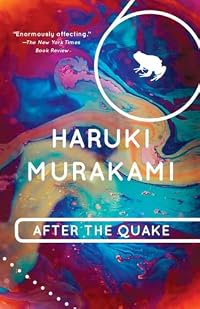
After the Quake: Stories
by Haruki Murakami
On This Page
Description
Set at the time of the catastrophic 1995 Kobe earthquake, the mesmerizing stories in After the Quake are as haunting as dreams and as potent as oracles.An electronics salesman who has been deserted by his wife agrees to deliver an enigmatic package— and is rewarded with a glimpse of his true nature. A man who views himself as the son of God pursues a stranger who may be his human father. A mild-mannered collection agent receives a visit from a giant talking frog who enlists his help in show more saving Tokyo from destruction. The six stories in this collection come from the deep and mysterious place where the human meets the inhuman—and are further proof that Murakami is one of the most visionary writers at work today. show less
Tags
Recommendations




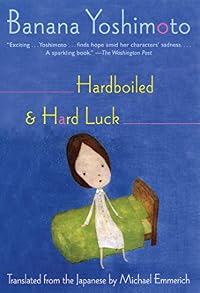
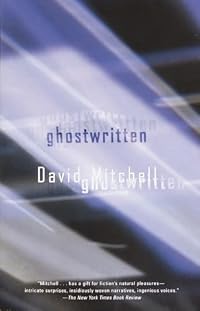
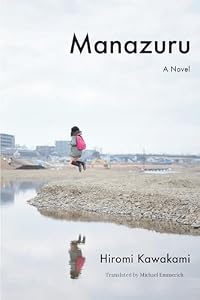
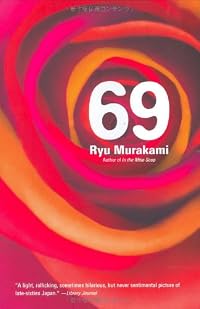

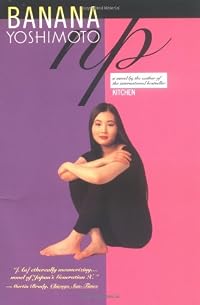
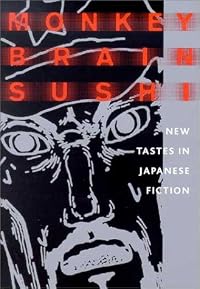
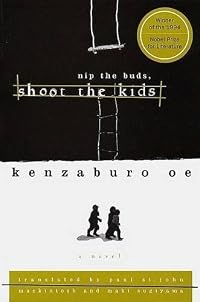
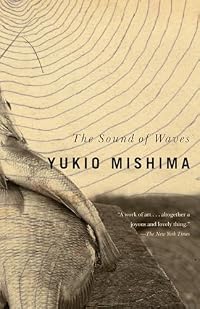



Member Recommendations
cammykitty Murakami's stories verge on poetry as do these.
andomck Surreal short stories.
Member Reviews
Murakami's stories are masterful, as playful as they are believable. Where magical realism slips int, particularly in "Super-Frog saves Tokyo", there's also an element of adult-type wonder that isn't easy to find with other authors. It makes Murakami's work all the more special and memorable.
And though these are short stories, none particularly long, it's not difficult to get sucked in to each world. Much as the themes might overlap, the characters are as various as the plots, and nothing here is repetitive. Simply enough, you'll be hard-pressed to not read this short collection in one sitting.
Absolutely recommended.
And though these are short stories, none particularly long, it's not difficult to get sucked in to each world. Much as the themes might overlap, the characters are as various as the plots, and nothing here is repetitive. Simply enough, you'll be hard-pressed to not read this short collection in one sitting.
Absolutely recommended.
Each of the short stories in the collection "After the Quake" are linked to the terrible earthquake that shook Kobe in Jan'95. Although none are actually set in Kobe, the epicentre of the devastation, allusions to the disaster flit briefly into the radar of each story before quickly dipping out of sight again. Though the characters in these haunting stories are far removed from the scene of the tragedy, the earthquake, nonetheless, reverberates in subtle ways deep into their troubled lives.
In "Landscape With Flat Iron", Junko, a young woman, enjoys the company of Miyake, a forty-something painter who lights midnight beach bonfires stacked from driftwood. Miyake can look at fires in the way "a sculptor can imagine the pose of a figure show more hidden in a lump of stone." Gazing at the shapes the bonfire makes elevates Junko to a higher plane of being where revelations and deeper truths come to her. . . . . similar revelatory moments are experienced in "All God's Children Can Dance" by Yoshiya - he has been following the man he thought was the father he has been searching for - as he stands on the pitchers mound in a deserted baseball pitch bathed in the light of a huge moon. . . . . In "Thailand", a female doctor on vacation, soured and embittered by a divorce, is driven by her chauffeur to see an old woman who informs her, "There is a stone inside your body ...You must get rid of the stone." . . . . . The earthquake is perhaps more central to "Super Frog Saves Tokyo" than it is in other stories. A giant frog enlists Kalagiri's help to save Tokyo from a gigantic worm that causes earthquakes when it's angry. Frog says earthquakes make people realise how fragile the ordinary world - in this case the city of Tokyo - really is. Murakami here, is referring not just to the fragile physical environment but also to the fragility of emotional rocks such as love, marriage, the family unit, friendships that underpin our inner lives.
"Honey Pie", the last and best story (IMO), is also the most conventional. Junpei, too shy to move in on Sayoko, his heart's desire, loses out in the marriage stakes to the more forward Takasaki, his best friend. Sala, the young child of the marriage, deeply fears "the earthquake man". When Sayoko and Takasaki later divorce, Junpei, who has remained close to them, is still unable to express his undying love for Sayoko. He tells Sala a story to ease
her mind about "the earthquake man"...
If you enjoy these unconventional short stories, often containing elements of realism and surrealism, and often with no neatly wrapped-up endings, then you may wish to try another Murakami short-story collection, "The Elephant Vanishes". show less
In "Landscape With Flat Iron", Junko, a young woman, enjoys the company of Miyake, a forty-something painter who lights midnight beach bonfires stacked from driftwood. Miyake can look at fires in the way "a sculptor can imagine the pose of a figure show more hidden in a lump of stone." Gazing at the shapes the bonfire makes elevates Junko to a higher plane of being where revelations and deeper truths come to her. . . . . similar revelatory moments are experienced in "All God's Children Can Dance" by Yoshiya - he has been following the man he thought was the father he has been searching for - as he stands on the pitchers mound in a deserted baseball pitch bathed in the light of a huge moon. . . . . In "Thailand", a female doctor on vacation, soured and embittered by a divorce, is driven by her chauffeur to see an old woman who informs her, "There is a stone inside your body ...You must get rid of the stone." . . . . . The earthquake is perhaps more central to "Super Frog Saves Tokyo" than it is in other stories. A giant frog enlists Kalagiri's help to save Tokyo from a gigantic worm that causes earthquakes when it's angry. Frog says earthquakes make people realise how fragile the ordinary world - in this case the city of Tokyo - really is. Murakami here, is referring not just to the fragile physical environment but also to the fragility of emotional rocks such as love, marriage, the family unit, friendships that underpin our inner lives.
"Honey Pie", the last and best story (IMO), is also the most conventional. Junpei, too shy to move in on Sayoko, his heart's desire, loses out in the marriage stakes to the more forward Takasaki, his best friend. Sala, the young child of the marriage, deeply fears "the earthquake man". When Sayoko and Takasaki later divorce, Junpei, who has remained close to them, is still unable to express his undying love for Sayoko. He tells Sala a story to ease
her mind about "the earthquake man"...
If you enjoy these unconventional short stories, often containing elements of realism and surrealism, and often with no neatly wrapped-up endings, then you may wish to try another Murakami short-story collection, "The Elephant Vanishes". show less
This remarkable collection includes six stories, each of which occurs in the wake of the devastating 1995 Kobe earthquake and each of which takes part of its context and meaning from the psychological reverberations of that quake. Deceptively quick to read, the stories are multilayered and generously peppered with allusion, metaphor, and an eerie sort of magical realism. Murakami's characters are palpable and true; their passions and their flaws are easy to believe. Each story can be read as just that: a story. But each one also holds hidden kernels of philosophical (metaphysical, existential -- he won't be tied down) wisdom. I finished each story with that satisfying mental check, often translated as "huh," which means I want to read show more it again and see if I can more fully ascertain the author's rich exploration of the themes of death, loss, connection, and the questionable sense of reality that comes with being human. Did I mention that Murakami has a delightfully sly sense of humor? show less
Each of the stories in this collection is set one month after the devastating 1995 earthquake in Kobe, Japan. That alone is the tie that binds and even then it is loosely bound. The earthquake is peripheral to each story at best and yet there is something decidedly central about its occurance. These stories feel like the ripples on a lake into which the earthquake has been thrown.
For me, Murakami's genius lies in his ability to craft such distinct and powerful characters. He tells profound truths through simple storytelling and earnest protagonists. The value of life, the importance of connecting with other human beings, the intense psychic power that disaster and trauma bring about in humans is delicately and beautifully explored in show more this short collection. show less
For me, Murakami's genius lies in his ability to craft such distinct and powerful characters. He tells profound truths through simple storytelling and earnest protagonists. The value of life, the importance of connecting with other human beings, the intense psychic power that disaster and trauma bring about in humans is delicately and beautifully explored in show more this short collection. show less
Lovely collection of short stories. The connection to the Kobe earthquake gives each story a link to the whole and keeps the collection from feeling scattered. To me, the best story is 'honey pie': a character driven story (with meta elements) which was tied to the smallest bit of supernatural horror. It was a mix that really worked.
It's a weird moment when a middle-aged debt collector visited by a giant frog who tells him they need to save Tokyo from an earthquake is the most relatable character in a book? These short surreal stories feel more real than most fiction - despite the bizarre elements, the emotional atmosphere is so accurate to life that somehow the hanging plot-threads of every single story somehow don't matter? Even if we don't know how things are going to work out for the characters, the psychological portraits are, for the most part, so skilfully drawn that we don't need to know, which is the best part of Murakami's work in general and this book in particular.
When I am really impressed with a fiction writer, I often endeavor to read all or most of their works. Alas, William Faulkner was too dense and too prolific for me to succeed, but if I live long enough I may crack that nut. I had better luck with Ernest Hemingway, Gabriel Garcia Marquez and Cormac McCarthy. I’m almost there with Haruki Murakami, who has quite the long catalog.
The problem with reviewing the same author of multiple works is that it is sometimes difficult to find new ground to cover. My latest Murakami read was After the Quake, a collection of six short stories – or are these long stories? – centered around the cataclysmic Kobe earthquake in 1995. Except they are not. The characters in these six stories, all show more narrated from the third person, do not actually experience the earthquake directly, but are made aware of it peripherally, primarily through television news. Still, the event clearly unsettles them all and it is a pronounced sense of resonating palpable unease that binds these tales into a coherent collection. Another natural adhesive is the fact that these stories were all written in 1999-2000, so we have a snapshot of the kind of writer Murakami was during this phase of his career as well as a logical rationale for including these in a single collection. That image is sharpened because we also know by the author’s own words that he never writes short stories and novels at the same time: he either works on one or another.
Murakami has had a long writing career that dates back to 1979, which has seen a marked evolution in style and presentation while retaining some elements present at the creation, so to speak. After the Quake originally appeared in Japanese in 2000 (and in English translation in 2002), which for Murakami fans means the time between the novels Sputnik Sweetheart (1999) and Kafka on the Shore (2002). I have read two of his other short story collections – The Elephant Vanishes and Blind Willow, Sleeping Women – which together contain a medley of forty-one stories written over the long period of 1980-2005 that are neither arranged chronologically nor thematically. Like a carelessly arranged anthology album of a rock band that has been performing in various iterations since the 1960s, there is the potential for a kind of dissonance in this kind of jumble, even if the quality of the tracks are impressive. (Side note: no such dissonance in Hemingway or Faulkner, for instance, because their respective writing styles and thematic approach remained so similar over time.) Because After the Quake was written in the same era and orbit (however peripherally) around a central event, there is a logic that enhances the ability of the review process to effectively compare and contrast the contents. At the same time, it should be underscored, each of these stories can stand on its own and does not need to appear in a volume with the others in order to succeed.
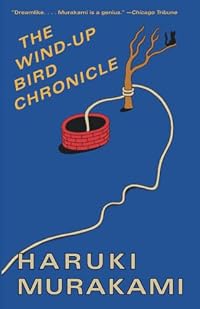
“UFO in Kushiro,” opens the collection and makes reference to the earthquake more frequently and in more detail than the others. Here it serves as a tectonic shift (pun fully intended!) of sorts for Komura – one of those dull, passive Murakami male protagonists – whose wife walks out on him while he is at work five days after the earthquake with no notice, little explanation and an irrevocable determination to never return, in circumstances similar to that in the earlier novel The Wind-Up Bird Chronicle. Komura’s sudden divorce makes for a series of unlikely events to follow for him that include smuggling an unnamed object, cavorting with a couple of edgy young women, a funny story about a bear and a bell, sexual dysfunction and existentialism. Not bad for twenty pages of text! I cannot be certain what the story means, but I enjoyed it enough to read it twice through.
“Landscape with Flatiron,” perhaps the finest story in the collection, is also manifestly existential, involving a young woman’s platonic bond (but perhaps that could change …) with an older man who collects driftwood to build masterful fires on the beach that she is powerfully drawn to for emotional succor. This is an especially rich tale pregnant with metaphor that is enhanced by Murakami’s gift for crafting female characters who often are far more developed and complex than their male counterparts. “All God’s Children Can Dance” is a strange, disquieting tale of religion, the potential for incest, the prospect of virgin birth, an unusually large penis, and a man with a missing earlobe that has been bitten off by a dog – in a strange contrast to the author’s typical use of a woman’s ear as an object of sexual fetish. It is as if Japanese literary doppelgangers of Stephen King, Rod Serling, John Irving and Edgar Allen Poe got together for a weird collaboration. I’m not sure how I feel about the story, but it is by all means worth the read.
Of the remaining stories, I very much enjoyed both “Thailand” – which contains familiar Murakami elements of jazz music and a hint of magical realism – as well as the quirky love story “Honey Pie.” I was less impressed with “Super-Frog Saves Tokyo,” an attempt at magical whimsy that seemed to me to fall flat whether intended as an allegory, a comedy or a psychodrama. But perhaps I just missed something.
Whether you are a diehard Murakami fan or simply curious about an author who gets a lot of press in the literary world, I would recommend this slender volume for your reading pleasure. show less
The problem with reviewing the same author of multiple works is that it is sometimes difficult to find new ground to cover. My latest Murakami read was After the Quake, a collection of six short stories – or are these long stories? – centered around the cataclysmic Kobe earthquake in 1995. Except they are not. The characters in these six stories, all show more narrated from the third person, do not actually experience the earthquake directly, but are made aware of it peripherally, primarily through television news. Still, the event clearly unsettles them all and it is a pronounced sense of resonating palpable unease that binds these tales into a coherent collection. Another natural adhesive is the fact that these stories were all written in 1999-2000, so we have a snapshot of the kind of writer Murakami was during this phase of his career as well as a logical rationale for including these in a single collection. That image is sharpened because we also know by the author’s own words that he never writes short stories and novels at the same time: he either works on one or another.
Murakami has had a long writing career that dates back to 1979, which has seen a marked evolution in style and presentation while retaining some elements present at the creation, so to speak. After the Quake originally appeared in Japanese in 2000 (and in English translation in 2002), which for Murakami fans means the time between the novels Sputnik Sweetheart (1999) and Kafka on the Shore (2002). I have read two of his other short story collections – The Elephant Vanishes and Blind Willow, Sleeping Women – which together contain a medley of forty-one stories written over the long period of 1980-2005 that are neither arranged chronologically nor thematically. Like a carelessly arranged anthology album of a rock band that has been performing in various iterations since the 1960s, there is the potential for a kind of dissonance in this kind of jumble, even if the quality of the tracks are impressive. (Side note: no such dissonance in Hemingway or Faulkner, for instance, because their respective writing styles and thematic approach remained so similar over time.) Because After the Quake was written in the same era and orbit (however peripherally) around a central event, there is a logic that enhances the ability of the review process to effectively compare and contrast the contents. At the same time, it should be underscored, each of these stories can stand on its own and does not need to appear in a volume with the others in order to succeed.
“UFO in Kushiro,” opens the collection and makes reference to the earthquake more frequently and in more detail than the others. Here it serves as a tectonic shift (pun fully intended!) of sorts for Komura – one of those dull, passive Murakami male protagonists – whose wife walks out on him while he is at work five days after the earthquake with no notice, little explanation and an irrevocable determination to never return, in circumstances similar to that in the earlier novel The Wind-Up Bird Chronicle. Komura’s sudden divorce makes for a series of unlikely events to follow for him that include smuggling an unnamed object, cavorting with a couple of edgy young women, a funny story about a bear and a bell, sexual dysfunction and existentialism. Not bad for twenty pages of text! I cannot be certain what the story means, but I enjoyed it enough to read it twice through.
“Landscape with Flatiron,” perhaps the finest story in the collection, is also manifestly existential, involving a young woman’s platonic bond (but perhaps that could change …) with an older man who collects driftwood to build masterful fires on the beach that she is powerfully drawn to for emotional succor. This is an especially rich tale pregnant with metaphor that is enhanced by Murakami’s gift for crafting female characters who often are far more developed and complex than their male counterparts. “All God’s Children Can Dance” is a strange, disquieting tale of religion, the potential for incest, the prospect of virgin birth, an unusually large penis, and a man with a missing earlobe that has been bitten off by a dog – in a strange contrast to the author’s typical use of a woman’s ear as an object of sexual fetish. It is as if Japanese literary doppelgangers of Stephen King, Rod Serling, John Irving and Edgar Allen Poe got together for a weird collaboration. I’m not sure how I feel about the story, but it is by all means worth the read.
Of the remaining stories, I very much enjoyed both “Thailand” – which contains familiar Murakami elements of jazz music and a hint of magical realism – as well as the quirky love story “Honey Pie.” I was less impressed with “Super-Frog Saves Tokyo,” an attempt at magical whimsy that seemed to me to fall flat whether intended as an allegory, a comedy or a psychodrama. But perhaps I just missed something.
Whether you are a diehard Murakami fan or simply curious about an author who gets a lot of press in the literary world, I would recommend this slender volume for your reading pleasure. show less
Members
- Recently Added By
Published Reviews
ThingScore 100
I loved this book before last week’s earthquake, because it illuminated a few things about my own condition at the time that I read it. But now the truth in this collection of fiction has a new depth to it; its general conclusions have become amazingly relevant and important to us this week. It offers no solutions and I don’t even think it offers much comfort, but it holds a hauntingly show more accurate mirror to our world now. show less
added by sduff222
Lists

1001 Books You Must Read Before You Die
1,448 works; 1,132 members

Japanese Literature
230 works; 40 members

Magic Realism
371 works; 51 members
Haruki Murakami's Books
16 works; 5 members

Short Story Collections and Anthologies
260 works; 40 members

Favorite Short Fiction
228 works; 99 members

Authors from Japan
3 works; 1 member

2015 UpROOTed
28 works; 1 member

Books Read in 2012
815 works; 31 members

Books Read in 2013
1,630 works; 51 members
Author Information

284+ Works 174,102 Members
Haruki Murakami was born on January 12, 1949 in Kyoto, Japan and studied at Tokyo's Waseda University. He opened a coffeehouse/jazz bar in the capital called Peter Cat with his wife. He became a full-time author following the publication of his first novel, Hear the Wind Sing, in 1979. He writes both fiction and non-fiction works. His fiction show more works include Norwegian Wood, Colorless Tsukuru Tazaki and His Years of Pilgrimage, The Strange Library, and Men Without Women. Several of his stories have been adapted for the stage and as films. His nonfiction works include What I Talk About When I Talk About Running. He has received numerous literary awards including the Franz Kafka Prize for Kafka on the Shore, the Yomiuri Prize for The Wind-Up Bird Chronicle, and the Jerusalem Prize. He has translated into Japanese literature written by F. Scott Fitzgerald, Raymond Carver, Truman Capote, John Irving, and Paul Theroux. (Bowker Author Biography) show less
Some Editions
Awards and Honors
Distinctions
Notable Lists
Series
Belongs to Publisher Series
Work Relationships
Contains
Common Knowledge
- Canonical title*
- Después del Terremoto
- Original title
- 神の子どもたちはみな踊る; Kami no kodomo-tachi wa mina odoru
- Original publication date
- 2000
- People/Characters
- Satsuki; Junpei; Miyake; Sala; Frog; Katagiri
- Important places
- Kobe, Japan; Japan; Tokyo, Japan
- Important events
- Kobe earthquake (1995)
- Related movies
- All God's Children Can Dance (2008 | IMDb)
- Epigraph
- “Liza! What was it yesterday, then?”
“It was what it was.”
“That’s impossible! That’s cruel!”
—Fyodor Dostoevsky, Demons
RADIO: …garrison already decimated by the Vietcong, who lost 115 of their men…
WOMAN: It’s awful, isn’t it, it’s so anonymous.
MAN: What is?
WOMAN: They say 115 guerillas, yet it doesn’t mean anything, be... (show all)cause we don’t know anything about these men, who they are, whether they love a woman, or have children, if they prefer the cinema to the theatre. We know nothing. They just say…115 dead.
—Jean-Luc Godard, Pierrot le Fou - First words
- Five straight days she spend in front of the television, staring at crumbled banks and hospitals, whole blocks of stores in flames, severed rail lines and expressways.
- Last words*
- (Click to show. Warning: May contain spoilers.)Aunque el cielo se derrumbe, aunque la tierra, rugiendo, se abra.
- Original language
- Japanese
- Disambiguation notice
- Please do not combine this entry with the entries for the individual short stories.
*Some information comes from Common Knowledge in other languages. Click "Edit" for more information.
Classifications
- Genres
- General Fiction, Fiction and Literature
- DDC/MDS
- 895.635 — Literature & rhetoric Asian Literature Literatures of East and Southeast Asia Japanese Japanese fiction 1945–2000
- LCC
- PL856 .U673 .K3613 — Language and Literature Languages and literatures of Eastern Asia, Africa, Oceania Languages of Eastern Asia, Africa, Oceania Japanese language and literature Japanese literature Individual authors and works
- BISAC
Statistics
- Members
- 4,513
- Popularity
- 3,243
- Reviews
- 120
- Rating
- (3.77)
- Languages
- 18 — Catalan, Czech, Danish, Dutch, English, French, German, Greek, Hebrew, Icelandic, Italian, Japanese, Norwegian (Bokmål), Norwegian, Romanian, Russian, Spanish, Thai
- Media
- Paper, Audiobook, Ebook
- ISBNs
- 54
- UPCs
- 2
- ASINs
- 20