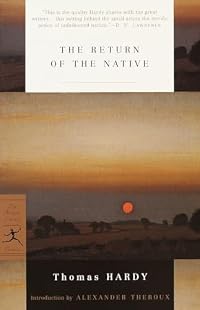
The Return of the Native
by Thomas Hardy
On This Page
Description
Dip into a classic work of fiction that many critics regard as one of the novels that helped to usher in the modern era of literature. When it was originally published, Thomas Hardy's The Return of the Native rocked Victorian England with its frank discussion of titillating subjects such as out-of-wedlock relationships. Today, the novel offers readers a fascinating glimpse into the mores and moral constraints of a bygone era..
Tags
Recommendations









Member Recommendations
Porua I would like to recommend another Thomas Hardy novel, Far from the Madding Crowd. When I first read The Return of the Native it kind of surprised me to see how very similar it is to Far from the Madding Crowd. They are very similar in their story lines, characterization and narrative style.
20
Member Reviews
This classic of British literature was great, despite everyone in it being a hot mess, each in their own way. I loved the tension between love vs. possession and nature vs. society, and Hardy's descriptions of the heath were very evocative, if occasionally over-long. Eustacia is a piece of work, Clym is a boring milquetoast, Wildeve is a d-bag, and Thomasin would benefit from some 21st century ideas of agency. Yes, I'm being a bit flip and reductive, but I truly did enjoy listening to this, especially as read by Alan Rickman. It was my first Hardy but I don't think it will be my last.
I have enjoyed reading and rereading this novel since I was in my teens. In thinking about this I can only suggest that from the first reading I was impressed with Hardy's ability to create a complete believable setting where the characters interacted not just with one another but with the world in which they lived. That world was a rural Victorian one, but it resonated with my own somewhat rural experience even though it occurred more than one hundred years earlier.
What Thomas Hardy created was a tale of passion and tragedy on Egdon Heath located in his fictional Wessex. Egdon Heath itself is the first "character" introduced into the book. The heath proves physically and psychologically important throughout the novel: characters are show more defined by their relation to the heath. Among them is Eustacia Vye whose desire to lead a life elsewhere is dashed when she marries Clym Yeobright (the Native) upon his return from Paris. The pair represents the archetype of two people caught up in their passion for each other and conflicting ambitions. For Clym, the heath is beautiful; for Eustacia, it is hateful. The plot of the novel emphasizes just this kind of difference in perception. What impresses me upon rereading this is the intricate plotting of Eustacia who throughout the novel is weaving a web of deceit with the aim of enhancing her own life. Her hubris knows few bounds and is exacerbated by her lack of understanding of those in whose lives she has intervened. She raves, "How have I tried and tried to be a splendid woman, and how destiny has been against me! I do not deserve my lot! O, the cruelty of putting me into this ill-conceived world! I was capable of much; but I have been injured and blighted and crushed by things beyond my control! O, how hard it is of Heaven to devise such tortures for me, who have done no harm to Heaven at all!"(Book 5, Chapter 7) This lack of understanding is an example of the importance of misconception in the novel which is not limited to the character of Eustacia. Ambiguity builds as the novel progresses and the main characters remain obscure for the reader. When The Return of the Native was first published, contemporary critics criticized the novel for its lack of sympathetic characters. All of the novel's characters prove themselves deeply flawed, or--at the very least--of ambiguous motivation. What I found redeeming about the novel was the way Hardy brings the lives of this couple and their friends and families alive through detail that reinforces his penetrating portrayal of the community on the heath.
The final section provides some hope for the future, tempering the otherwise bleak landscape of the novel. This was Thomas Hardy's first great novel and he would follow it with bleaker tales this is the one that I return to when reminiscing of the joy of reading Thomas Hardy's novels. show less
What Thomas Hardy created was a tale of passion and tragedy on Egdon Heath located in his fictional Wessex. Egdon Heath itself is the first "character" introduced into the book. The heath proves physically and psychologically important throughout the novel: characters are show more defined by their relation to the heath. Among them is Eustacia Vye whose desire to lead a life elsewhere is dashed when she marries Clym Yeobright (the Native) upon his return from Paris. The pair represents the archetype of two people caught up in their passion for each other and conflicting ambitions. For Clym, the heath is beautiful; for Eustacia, it is hateful. The plot of the novel emphasizes just this kind of difference in perception. What impresses me upon rereading this is the intricate plotting of Eustacia who throughout the novel is weaving a web of deceit with the aim of enhancing her own life. Her hubris knows few bounds and is exacerbated by her lack of understanding of those in whose lives she has intervened. She raves, "How have I tried and tried to be a splendid woman, and how destiny has been against me! I do not deserve my lot! O, the cruelty of putting me into this ill-conceived world! I was capable of much; but I have been injured and blighted and crushed by things beyond my control! O, how hard it is of Heaven to devise such tortures for me, who have done no harm to Heaven at all!"(Book 5, Chapter 7) This lack of understanding is an example of the importance of misconception in the novel which is not limited to the character of Eustacia. Ambiguity builds as the novel progresses and the main characters remain obscure for the reader. When The Return of the Native was first published, contemporary critics criticized the novel for its lack of sympathetic characters. All of the novel's characters prove themselves deeply flawed, or--at the very least--of ambiguous motivation. What I found redeeming about the novel was the way Hardy brings the lives of this couple and their friends and families alive through detail that reinforces his penetrating portrayal of the community on the heath.
The final section provides some hope for the future, tempering the otherwise bleak landscape of the novel. This was Thomas Hardy's first great novel and he would follow it with bleaker tales this is the one that I return to when reminiscing of the joy of reading Thomas Hardy's novels. show less
Eustacia Vye lives with her grandfather on Hardy’s famous Egdon Heath, suffering its loneliness by waiting for rescue in a state of undirected passion. At first attracted to the unavailability of the formerly attentive Wildeve, she next clings to the arrival of Clym Yeobright, who falls in love with and marries her; but her notion of rescue involves leaving the heath far behind, and Clym means to stay; and, as this is Thomas Hardy, events tend tragedy-wards.
It took me an inordinately long to time to get around to listening to this; my lassitude was caused in part by being bitten by Tess of the D’Urbervilles at an early age, and in part by not being sure whether I’d want to read along, or just listen (I don’t often ‘read’ by show more audiobook, and the experience wasn’t something I imagined I’d enjoy without a book in hand as well). As it turns out, all one can do is listen; Alan Rickman’s voice is tyrannical in its insistence on absolute devotion of attention.
I was hooked from word one… what rapturously bleak descriptions of the heath-land Hardy embarks upon, and my own inner voice would have done it scant justice; if the entire book had simply been Mr. Rickman vocalising Hardy’s lyrical rural scenic creation, I wouldn’t have cared, even though once he began to bring the voices of characters alive I was captured anew. Then the plot begins to emerge, people move about and Mr. Rickman slips gracefully into the background and lets the story do its work... the story is a grand mixture of the unfortunate, the desperate, the hysterical, the passive and the hopeful that I have met in Hardy’s other works; his plots, while readable, are secondary to the description, as with no other writer but each of the characters in The Return of the Native inspire pity and interest in the listener.
I have no idea if the experience of simply reading The Return of the Native would have moved me to a five-star rating; I only know that this edition of the book, with its sublime marriage of writing and reading, has absolutely captivated me for hours on end. show less
It took me an inordinately long to time to get around to listening to this; my lassitude was caused in part by being bitten by Tess of the D’Urbervilles at an early age, and in part by not being sure whether I’d want to read along, or just listen (I don’t often ‘read’ by show more audiobook, and the experience wasn’t something I imagined I’d enjoy without a book in hand as well). As it turns out, all one can do is listen; Alan Rickman’s voice is tyrannical in its insistence on absolute devotion of attention.
I was hooked from word one… what rapturously bleak descriptions of the heath-land Hardy embarks upon, and my own inner voice would have done it scant justice; if the entire book had simply been Mr. Rickman vocalising Hardy’s lyrical rural scenic creation, I wouldn’t have cared, even though once he began to bring the voices of characters alive I was captured anew. Then the plot begins to emerge, people move about and Mr. Rickman slips gracefully into the background and lets the story do its work... the story is a grand mixture of the unfortunate, the desperate, the hysterical, the passive and the hopeful that I have met in Hardy’s other works; his plots, while readable, are secondary to the description, as with no other writer but each of the characters in The Return of the Native inspire pity and interest in the listener.
I have no idea if the experience of simply reading The Return of the Native would have moved me to a five-star rating; I only know that this edition of the book, with its sublime marriage of writing and reading, has absolutely captivated me for hours on end. show less
Hardy at his best. First tier in storytelling, character development, and use of language and description. It is like being served a feast to listen to Hardy entone over the features of the heath. The wet young beeches were undergoing amputations, bruises, cripplings, and harsh lacertations, from which the wasting sap would bleed for many a day to come, and which would leave scars visible till the day of their burning. Each stem was wrenched at the root, where it moved like a bone in its socket, and at every onset of the gale convulsive sounds came from the branches, as if pain were felt" So real and bleak and unforgiving a place, yet so full of love and loveliness and longing.
Was there ever a more heartbreaking woman than Eustacia show more Vye? I feel so deeply for her angst at being misplaced in Egdon and pity her dreams and desires of another world (which most likely does not exist in the way that she believes it does). She makes a poor bargain, and she makes it over and over again. She always takes the wrong course and is so thoroughly misunderstood by everyone, with the possible exception of Damon.
Was there ever a man more inept than Clym Yeobright? While he dawdles over who should make the first move, who is owed forgiveness most, and what is the best action to take, he lets every opportunity to stem disaster slide through his fingers. He is so sadly on that path of good intentions that leads to a sure hell, that he makes you scream in your head, "do something".
Was there ever a man harder to fathom than Damon Wildeve? He is neither good enough to love nor evil enough to hate. In the end, he is the catalyst that sets all the sadness in motion and makes it inevitable that no one can be truly happy who falls within his sphere. He seems incapable of any real love until his choice seals his fate.
So much misunderstanding and misadventure is overwhelming, as if it were God playing with Job or perhaps just winking at the way the humans stumble into one avoidable quagmire after another. The sense of doom hangs over everything, even the joyful wedding parties, in such a typically Hardy fashion. One cannot help wondering if happiness is even possible in this environ or if the heath itself does not eschew human delights and loves.
Living in a time when so few options were open to women, Hardy is a master of capturing the sadness and despair that can accompany them in their lot. Eustacia fights against this norm, and finds herself more trapped than most. Thomasin might find herself in the same situation but for a kinder fate guiding her steps (and the interferences of Diggory Venn). That a woman can be too easily ruined is obvious; that she is at the mercy of the morality of men leaves her in constant danger. She has, in fact, very little control over her own fate.
I loved this novel. Like [b:Jude the Obscure|50798|Jude the Obscure|Thomas Hardy|https://d.gr-assets.com/books/1389403264s/50798.jpg|41342119] and [b:The Mayor of Casterbridge|56759|The Mayor of Casterbridge|Thomas Hardy|https://d.gr-assets.com/books/1388276915s/56759.jpg|2390173], this left me heart torn and feeling very vulnerable and human. I kept wanting to warn the characters, especially Clym, to be more aware of the possible consequences of their choices, to hurry or to slow down, to make one small change and save themselves and all around them. But, of course, none of Hardy's characters ever listen to me. show less
Was there ever a more heartbreaking woman than Eustacia show more Vye? I feel so deeply for her angst at being misplaced in Egdon and pity her dreams and desires of another world (which most likely does not exist in the way that she believes it does). She makes a poor bargain, and she makes it over and over again. She always takes the wrong course and is so thoroughly misunderstood by everyone, with the possible exception of Damon.
Was there ever a man more inept than Clym Yeobright? While he dawdles over who should make the first move, who is owed forgiveness most, and what is the best action to take, he lets every opportunity to stem disaster slide through his fingers. He is so sadly on that path of good intentions that leads to a sure hell, that he makes you scream in your head, "do something".
Was there ever a man harder to fathom than Damon Wildeve? He is neither good enough to love nor evil enough to hate. In the end, he is the catalyst that sets all the sadness in motion and makes it inevitable that no one can be truly happy who falls within his sphere. He seems incapable of any real love until his choice seals his fate.
So much misunderstanding and misadventure is overwhelming, as if it were God playing with Job or perhaps just winking at the way the humans stumble into one avoidable quagmire after another. The sense of doom hangs over everything, even the joyful wedding parties, in such a typically Hardy fashion. One cannot help wondering if happiness is even possible in this environ or if the heath itself does not eschew human delights and loves.
Living in a time when so few options were open to women, Hardy is a master of capturing the sadness and despair that can accompany them in their lot. Eustacia fights against this norm, and finds herself more trapped than most. Thomasin might find herself in the same situation but for a kinder fate guiding her steps (and the interferences of Diggory Venn). That a woman can be too easily ruined is obvious; that she is at the mercy of the morality of men leaves her in constant danger. She has, in fact, very little control over her own fate.
I loved this novel. Like [b:Jude the Obscure|50798|Jude the Obscure|Thomas Hardy|https://d.gr-assets.com/books/1389403264s/50798.jpg|41342119] and [b:The Mayor of Casterbridge|56759|The Mayor of Casterbridge|Thomas Hardy|https://d.gr-assets.com/books/1388276915s/56759.jpg|2390173], this left me heart torn and feeling very vulnerable and human. I kept wanting to warn the characters, especially Clym, to be more aware of the possible consequences of their choices, to hurry or to slow down, to make one small change and save themselves and all around them. But, of course, none of Hardy's characters ever listen to me. show less
I loved revisiting Egdon Heath, especially while reading during the long autumnal evenings of October. In The Return of the Native, Hardy is off doing what Hardy does best: bitter romances unfolding in a richly portrayed (but often coldly indifferent) natural setting. As usual, he explores disastrous marriage choices and how our impulsive romantic delusions can destroy not only our own lives, but also our familial relationships and the lives of others around us! WOO HOO
Though Eustacia Vye certainly makes for a memorably tragic heroine, I must admit that in my opinion the show is stolen by Diggory Venn (The Reddleman? More like the Meddleman, am I right ladies?!)-- one of my all-time favourite Hardy characters. His narrative of show more persistence in the face of rejection is slightly creepy but majorly inspirational. Some people handle romantic rejection in a #basic way (tears, ice cream, Internet stalking) and some people handle it in an #iconic way (dying yourself red from head to toe, lurking in the woods, becoming a mythical figure, thwarting your adversary in morally-questionable-but-undeniably-epic ways). So even though this is an undeniably sad novel, Diggory Venn brought me a lot of joy so I’d say it all balances out in the end.
(Also quick shout out to my second fave, true-tragic-hero Christian Cantle!) show less
Though Eustacia Vye certainly makes for a memorably tragic heroine, I must admit that in my opinion the show is stolen by Diggory Venn (The Reddleman? More like the Meddleman, am I right ladies?!)-- one of my all-time favourite Hardy characters. His narrative of show more persistence in the face of rejection is slightly creepy but majorly inspirational. Some people handle romantic rejection in a #basic way (tears, ice cream, Internet stalking) and some people handle it in an #iconic way (dying yourself red from head to toe, lurking in the woods, becoming a mythical figure, thwarting your adversary in morally-questionable-but-undeniably-epic ways). So even though this is an undeniably sad novel, Diggory Venn brought me a lot of joy so I’d say it all balances out in the end.
(Also quick shout out to my second fave, true-tragic-hero Christian Cantle!) show less
Hardy is synonymous with 19th century English country landscapes, and never more so than in Return of the Native. Set on the mythical Egdon Heath, this novel is the next best thing to a time machine, so evocative are his descriptions of these bygone Wessex rural scenes. One doesn't just read a Hardy novel - it's a completely immersive virtual reality experience, and for this reason he remains up there as one of my favourite novelists of all time.
Although perhaps not so well known as Hardy's greats such as The Mayor of Casterbridge, this is still a very fine novel. In typical Hardy fashion there is heartbreak and tragedy in spades, yet it is the rural landscape that almost becomes the main protagonist. The descriptions are incredibly show more vivid, yet their conveyance is so deftly subtle that it adds an additional dimension and depth to the story rather than getting in the way of it.
Whilst many novels of that era excel at transplanting you as a fly on the wall to the centre of English social history, I can't think of a better way to experience English natural history than through the experience of a Hardy novel. By the end of Return of the Native the heath was as familiar to me as the countryside on my own doorstep. No, on second thoughts, it was significantly more familiar. Our green space has changed in so many ways since that time, but whilst some of the flora and fauna has changed forever (for instance, adders are much rarer in number now in the English countryside than they would have been back then), it is our interaction with it which has changed most acutely. In Hardy's time the average rural dweller had little option but to traverse their local countryside by foot, often travelling many miles in a day to run an errand or visit a neighbour. Imagine, therefore, how much more familiar and in touch with the earth you become when you are literally walking through it's rural midst every day. And that is precisely the experience that Hardy brings with this novel. You feel 19th century England.
This was Hardy book number six for me, and thinking I'd already peaked with his best work I was absolutely delighted to be proved wrong with this novel.
4 stars - a wonderful sojourn in rural Victorian England. show less
Although perhaps not so well known as Hardy's greats such as The Mayor of Casterbridge, this is still a very fine novel. In typical Hardy fashion there is heartbreak and tragedy in spades, yet it is the rural landscape that almost becomes the main protagonist. The descriptions are incredibly show more vivid, yet their conveyance is so deftly subtle that it adds an additional dimension and depth to the story rather than getting in the way of it.
Whilst many novels of that era excel at transplanting you as a fly on the wall to the centre of English social history, I can't think of a better way to experience English natural history than through the experience of a Hardy novel. By the end of Return of the Native the heath was as familiar to me as the countryside on my own doorstep. No, on second thoughts, it was significantly more familiar. Our green space has changed in so many ways since that time, but whilst some of the flora and fauna has changed forever (for instance, adders are much rarer in number now in the English countryside than they would have been back then), it is our interaction with it which has changed most acutely. In Hardy's time the average rural dweller had little option but to traverse their local countryside by foot, often travelling many miles in a day to run an errand or visit a neighbour. Imagine, therefore, how much more familiar and in touch with the earth you become when you are literally walking through it's rural midst every day. And that is precisely the experience that Hardy brings with this novel. You feel 19th century England.
This was Hardy book number six for me, and thinking I'd already peaked with his best work I was absolutely delighted to be proved wrong with this novel.
4 stars - a wonderful sojourn in rural Victorian England. show less
Two words: Alan Rickman.
Okay, well the book deserves more than two words, and about Mr. Rickman I could go on and on. This is a heartbreaking story of love and betrayal, and of scheming and misunderstanding set on the wildly bleak and beautiful Egdon Heath. The story opens with Thomasin Yeobright being returned home in disgrace in reddleman Diggory Venn's van, her anticipated marriage to inn-owner Damon Wildeve not taking place due to an error in the marriage license. In the aftermath of the non-wedding, Wildeve receives a bonfire signal from former lover Eustacia Vye, and the two resume their flirtation. Wildeve is ready to return to Eustacia, Eustacia considers, and Thomasin and her aunt attempt to save Thomasin's honor by proceeding show more with the wedding to Wildeve. Into this climate returns Thomasin's cousin Clym, the handsome, educated pride of the village, home from Paris. The idea of Clym captivates Eustacia, who is miserable on the heath and dreams of a grand life in Paris. Thus a web is woven, with strands connecting Clym, Eustacia, Thomasin, and Wildeve, with Clym's mother Mrs. Yeobright and reddleman Diggory Venn (long in love with Thomasin) worrying on the periphery.
Mr. Hardy writes well-developed characters, the most interesting and complex of which is Eustacia. With Eustacia, as with the timeless heath, marked by the ancient Celts, Mr. Hardy brings to life the uneasy blend of Christian and Pagan. "Eustacia Vye was the raw material of a divinity. On Olympus she would have done well with a little preparation. She had the passions and instincts which make a model goddess, that is, those which make not quite a model woman." A beautiful outsider disinclined to interact with any neighbors, she is admired by some and suspected by others to be a witch. She can be maddeningly selfish, fiendishly scheming, and utterly tragic.
As for Mr. Rickman... I could hardly attend to the story for pretty much the entire first disc, I was so giddy about his narration! But as with the best narrators, Mr. Rickman gradually disappeared and the story came to full, glorious, tragic life. This was one of the best audiobook experiences ever -- right up there with Jeremy Irons narrating [Brideshead Revisited]. What a shame that Mr. Rickman never narrated another book, for this one was amazing. show less
Okay, well the book deserves more than two words, and about Mr. Rickman I could go on and on. This is a heartbreaking story of love and betrayal, and of scheming and misunderstanding set on the wildly bleak and beautiful Egdon Heath. The story opens with Thomasin Yeobright being returned home in disgrace in reddleman Diggory Venn's van, her anticipated marriage to inn-owner Damon Wildeve not taking place due to an error in the marriage license. In the aftermath of the non-wedding, Wildeve receives a bonfire signal from former lover Eustacia Vye, and the two resume their flirtation. Wildeve is ready to return to Eustacia, Eustacia considers, and Thomasin and her aunt attempt to save Thomasin's honor by proceeding show more with the wedding to Wildeve. Into this climate returns Thomasin's cousin Clym, the handsome, educated pride of the village, home from Paris. The idea of Clym captivates Eustacia, who is miserable on the heath and dreams of a grand life in Paris. Thus a web is woven, with strands connecting Clym, Eustacia, Thomasin, and Wildeve, with Clym's mother Mrs. Yeobright and reddleman Diggory Venn (long in love with Thomasin) worrying on the periphery.
Mr. Hardy writes well-developed characters, the most interesting and complex of which is Eustacia. With Eustacia, as with the timeless heath, marked by the ancient Celts, Mr. Hardy brings to life the uneasy blend of Christian and Pagan. "Eustacia Vye was the raw material of a divinity. On Olympus she would have done well with a little preparation. She had the passions and instincts which make a model goddess, that is, those which make not quite a model woman." A beautiful outsider disinclined to interact with any neighbors, she is admired by some and suspected by others to be a witch. She can be maddeningly selfish, fiendishly scheming, and utterly tragic.
As for Mr. Rickman... I could hardly attend to the story for pretty much the entire first disc, I was so giddy about his narration! But as with the best narrators, Mr. Rickman gradually disappeared and the story came to full, glorious, tragic life. This was one of the best audiobook experiences ever -- right up there with Jeremy Irons narrating [Brideshead Revisited]. What a shame that Mr. Rickman never narrated another book, for this one was amazing. show less
Members
- Recently Added By
Lists

1001 Books You Must Read Before You Die
1,448 works; 1,132 members

Classics you know you should have read but probably haven't
421 works; 405 members

Unread books
1,063 works; 82 members

Favourite 19th century fiction
257 works; 62 members

Fictional Characters With Disabilities
43 works; 9 members

Folio Society
831 works; 48 members

Publisher's Weekly Bestsellers Prior to 1895 in Chronological Order
95 works; 6 members

Love Triangles in Literature
108 works; 15 members

A Novel Cure
742 works; 23 members
Lamont's Hundred Best Novels (1947)
100 works; 4 members

Books Read in 2016
4,666 works; 197 members

Well-Educated Mind
150 works; 3 members
SHOULD Read Books!
354 works; 9 members

Books Read in 2022
5,164 works; 113 members

The Well-Educated Mind, Susan Wise Bauer, 2016
179 works; 3 members

Recommended Reading : 600 Classics Reviewed, Editors of Salem Press, 2015
634 works; 6 members

DigitalDreamDoor top 300
300 works; 4 members

naturalism / realism
5 works; 1 member

1964 College Preparatory Reading List
202 works; 8 members

AP Lit
363 works; 6 members

Greatest Books, allegedly
484 works; 9 members

Books Read in 2010
631 works; 11 members
Trinity College Booklist (1951): Class Ten, English Literature
358 works; 5 members
Harold Bloom - The Western Canon: D. The Chaotic Age
833 works; 24 members
School Made Us Read It
380 works; 196 members
Author Information

476+ Works 85,026 Members
Thomas Hardy was born on June 2, 1840, in Higher Bockhampton, England. The eldest child of Thomas and Jemima, Hardy studied Latin, French, and architecture in school. He also became an avid reader. Upon graduation, Hardy traveled to London to work as an architect's assistant under the guidance of Arthur Bloomfield. He also began writing poetry. show more How I Built Myself a House, Hardy's first professional article, was published in 1865. Two years later, while still working in the architecture field, Hardy wrote the unpublished novel The Poor Man and the Lady. During the next five years, Hardy penned Desperate Remedies, Under the Greenwood Tree, and A Pair of Blue Eyes. In 1873, Hardy decided it was time to relinquish his architecture career and concentrate on writing full-time. In September 1874, his first book as a full-time author, Far from the Madding Crowd, appeared serially. After publishing more than two dozen novels, one of the last being Tess of the d'Urbervilles, Hardy returned to writing poetry--his first love. Hardy's volumes of poetry include Poems of the Past and Present, The Dynasts: Part One, Two, and Three, Time's Laughingstocks, and The Famous Tragedy of the Queen of Cornwall. From 1833 until his death, Hardy lived in Dorchester, England. His house, Max Gate, was designed by Hardy, who also supervised its construction. Hardy died on January 11, 1928. His ashes are buried in Poet's Corner at Westminster Abbey. (Bowker Author Biography) show less
Some Editions
Awards and Honors
Awards
Notable Lists
Series
Belongs to Publisher Series
Tauchnitz Collection of British and American Authors (1796, 1797)
Airmont Classics (38)
Reader's Enrichment Series (RE 317)
Penguin English Library, 2012 series (2012-08)
Modern Library (121)
Work Relationships
Is contained in
The Collected Novels: Volume I (Modern Library: Far from the Madding Crowd ∙ The Return of the Native ∙ The Mayor of Casterbridge) by Thomas Hardy
Far From the Madding Crowd / Jude the Obscure / The Mayor of Casterbridge / The Return of the Native / Tess of the d'Urbervilles (Five Novels) by Thomas Hardy
Works of Thomas Hardy. (200 Works) The Return of the Native, Desperate Remedies, Tess of the d'Urbervilles, Jude the Obscure & more (Mobi Collected Works) by Thomas Hardy
Far from the Madding Crowd / Jude the Obscure / The Mayor of Casterbridge / The Return of the Native / Tess of the d'Urbervilles / The Woodlanders (The Wessex Novels) by Thomas Hardy
Far from the Madding Crowd / The Mayor of Casterbridge / The Return of the Native / Tess of the D'Urbervilles / The Trumpet Major / Under the Greenwood Tree (6 Wessex novels) by Thomas Hardy
Contains
Has the adaptation
Is abridged in
Has as a study
Has as a commentary on the text
Has as a student's study guide
Common Knowledge
- Canonical title
- The Return of the Native
- Original title
- The Return of the Native
- Original publication date
- 1878
- People/Characters
- Diggory Venn; Tamsin Yeobright (Thomasin Yeobright); Damon Wildeve; Mrs. Yeobright; Eustacia Vye; Clym Yeobright (Clement Yeobright) (show all 15); Captain Vye; Timothy Fairway; Grandfer Cantle; Christian Cantle; Humphrey; Susan Nunsuch; Johnny Nunsuch; Charley; Egdon Heath
- Important places
- Egdon Heath; Bloom's End; Budmouth; America; Paris, France; Shadwater Weir
- Important events
- Guy Fawkes Night
- Related movies
- Hallmark Hall of Fame: The Return of the Native (1994 | IMDb)
- Epigraph
- "To sorrow
I bade good morrow,
And thought to leave her far away behind;
But cheerly, cheerly,
She loves me dearly;
She is so constant to me, and so kind.
I would deceive her,
And so leave her,
But ah... (show all)! she is so constant and so kind." - First words
- A Saturday afternoon in November was approaching the time of twilight, and the vast tract of unenclosed wild known as Egdon Heath embrowned itself moment by moment.
- Quotations
- Human beings, in their generous endeavour to construct a hypothesis that shall not degrade a First Cause, have always hesitated to conceive a dominant power of lower moral quality than their own; and, even while they sit down... (show all) and weep by the waters of Babylon, invent excuses for the oppression which prompts their tears.
As for Thomasin, I never expected much from her; and she has not disappointed me. - Last words
- (Click to show. Warning: May contain spoilers.)But everywhere he was kindly received, for the story of his life had become generally known.
- Original language
- English UK
- Disambiguation notice
- The Return of the Native was first published in Belgravia magazine in 12 parts in 1878 and revised by Hardy in 1895 and 1912, when he produced a definitive Wessex Edition of all of his novels.
Classifications
Statistics
- Members
- 8,726
- Popularity
- 1,246
- Reviews
- 101
- Rating
- (3.94)
- Languages
- 13 — Arabic, Chinese, Czech, English, Finnish, French, German, Hungarian, Italian, Norwegian (Bokmål), Polish, Portuguese, Spanish
- Media
- Paper, Audiobook, Ebook
- ISBNs
- 299
- UPCs
- 5
- ASINs
- 273