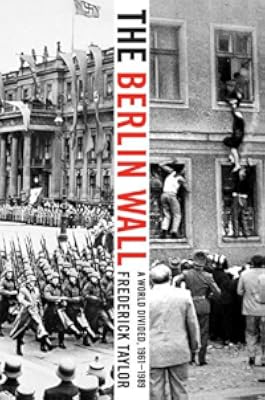
The Berlin Wall: 13 August 1961–9 November 1989
by Frederick Taylor
On This Page
Description
One morning in 1961, the residents of East Berlin found themselves cut off from family, friends and jobs in the West by a tangle of barbed wire that ruthlessly cut a city of four million in two. Within days the barbed wire became a 103-mile-long wall guarded by three hundred watchtowers. A physical manifestation of the Cold War that would stand for nearly thirty years, the Berlin Wall was the fault line between East and West on which rested the fate of all humanity. Historian Taylor weaves show more together official history, archival materials and personal accounts to tell the complete story of the Wall's rise and fall, from the postwar political tensions that created a divided Berlin to the internal and external pressures that led to the Wall's demise. He also explores the geopolitical ramifications, as well as the impact the Wall had on ordinary lives, still felt today.--From publisher description. show lessTags
Recommendations

Member Recommendations
Member Reviews
While I generally prefer memoirs or character-driven narratives for non-fiction subjects, I still found this book to be quite a good read. The author's narrow focus on Berlin provides us with an in-depth view of this historical city and the tumultuous time period that separated East and West Berlin. The language is clear and concise, so chronological events are presented in an orderly and easy to understand manner. It would have been useful to have a chronology and cast of characters though presented in addendum (there are a lot of political players from various countries and allegiances), but the major characters are pretty easy to recognize and the author provided mini-biographies as the book progressed to set up important background show more information.
Most of these characters are political or military in nature (expected considering the postwar era), but Taylor throws in just enough personal stories of local Berliners to keep things interesting. Most of these stories relate specifically to major events (escapes, politically-driven murders, etc), which is useful, but I find it surprising how few personal interviews or documents the author included. There's plenty of quotes from the politicians from their speeches, letters, and other peoples' interviews, but it doesn't look like the author gathered any information from personally conducted interviews (some of these people must still be alive?!?!). Even including quotes from memoirs or diaries held in archives could not have been that difficult, and really would have given the narrative a more personal feeling.
I've studied the post-war era in German history quite extensively, so my only major complaint about this book is that the author's bias is a bit too obviously tilted towards the Western German perspective. Some events (such as the airlift which provided food and supplies to cut-off West Berlin) paint the Western Allies in a rightly heroic light, but the depiction of life in East Berlin (and thus East Germany) is decidedly dark. Sure, there was a lot of corruption in government, a lack of access to information, and a huge Stasi spy network, but people still lived and some even flourished. There is little talk about the community aspects of living in this society - a huge positive to the all-inclusive Soviet lifestyle - so the benefits as such (increased cooperation, close neighbourhoods, practical outdoors training programs, etc.) are swept under the rug. show less
Most of these characters are political or military in nature (expected considering the postwar era), but Taylor throws in just enough personal stories of local Berliners to keep things interesting. Most of these stories relate specifically to major events (escapes, politically-driven murders, etc), which is useful, but I find it surprising how few personal interviews or documents the author included. There's plenty of quotes from the politicians from their speeches, letters, and other peoples' interviews, but it doesn't look like the author gathered any information from personally conducted interviews (some of these people must still be alive?!?!). Even including quotes from memoirs or diaries held in archives could not have been that difficult, and really would have given the narrative a more personal feeling.
I've studied the post-war era in German history quite extensively, so my only major complaint about this book is that the author's bias is a bit too obviously tilted towards the Western German perspective. Some events (such as the airlift which provided food and supplies to cut-off West Berlin) paint the Western Allies in a rightly heroic light, but the depiction of life in East Berlin (and thus East Germany) is decidedly dark. Sure, there was a lot of corruption in government, a lack of access to information, and a huge Stasi spy network, but people still lived and some even flourished. There is little talk about the community aspects of living in this society - a huge positive to the all-inclusive Soviet lifestyle - so the benefits as such (increased cooperation, close neighbourhoods, practical outdoors training programs, etc.) are swept under the rug. show less
The title of this book is a little deceiving, in that a good portion of the text deals with events prior to 1961. Not that this is a fault, Taylor actually gives a good accounting of the events that led up to the wall, including a brief history of Berlin and the German state. The period of 1945-61 are discussed in detail, including the roles of the occupying powers, the city, and the two German states. A solid biography of the main players is presented, such as Ulbricht, Brandt, and Honicker.
What I thought was a little odd, was when I was 300 pages into the book, I was still on 1962/63. The actual life of the wall is only discussed in a few chapters, and for those intrigued by the cold war espionage legends of Check Point Charlie, that show more angle was not prominent in this book, although John Le Carre's name does arise a few times. The book mainly concentrates on the immigration, economic, and leadership issues surrounding the wall, the divided city of Berlin, and the divided nation of Germany, and using this theme, Taylor does an excellent job. His findings and conclusions seem to correlate with previous information I possessed about the topic, which allowed me to be comfortable with the credibility of the work.
On the whole, I would highly recommend this book. 450 pages may scare off the feint hearted, but the narration itself is not a very difficult read. show less
What I thought was a little odd, was when I was 300 pages into the book, I was still on 1962/63. The actual life of the wall is only discussed in a few chapters, and for those intrigued by the cold war espionage legends of Check Point Charlie, that show more angle was not prominent in this book, although John Le Carre's name does arise a few times. The book mainly concentrates on the immigration, economic, and leadership issues surrounding the wall, the divided city of Berlin, and the divided nation of Germany, and using this theme, Taylor does an excellent job. His findings and conclusions seem to correlate with previous information I possessed about the topic, which allowed me to be comfortable with the credibility of the work.
On the whole, I would highly recommend this book. 450 pages may scare off the feint hearted, but the narration itself is not a very difficult read. show less
I gave this book 4 stars, which is really an average of 5 stars for content and 3 (barely) for the writing.
I found Taylor's style really annoying. There are lots of sentences. Without verbs. For dramatic effect. And it's a bit repetitive. Some of the translations are bizarre (e.g. High Burgomaster for mayor), and I did not really need to know that Lyndon Johnson ate oatmeal and melon for breakfast the day he was in Berlin. But most of the content is terrific. I've just come back from a trip to Berlin and it enriched my visit hugely. I filled it with sticky notes and then visited some of the streets, like Bernauerstrasse where the wall split the street.
Taylor presents a good overview of what happened in Germany and Berlin at the end of show more WW2. The East German regime was repressive from the start and funnily enough the East German people did not fall in love with communism and the SED (Communist party). Many tried to leave. After 1949, when the German Democratic Republic was created out of the Soviet zone, this became very difficult, except through West Berlin - if you could get to the airport there, you could get on a plane and leave, and thousands did. Berlin in turn was divided into 4 sectors in 1945, and there was more-or-less free flow of Berliners among the sectors. If you lived in the Russian sector, you could work in the other sectors and earn West German marks, or send your kids to school there - not without heavy criticism and accusations of being a traitor, but you could do it.
By 1961, the East German government was desperate to stop the flow of emigrants, and finally got the go-ahead from Stalin to put a barrier up around West Berlin, so that it was completely closed in. This happened in secret and overnight. Taylor goes on to describe the repression, the escape attempts, diplomatic negotiations and cold war politics, West and East German politics, and of course what happened at the end. If you're going to Berlin, or interested in the period, I would read this book as well as The File by Timothy Garten Ash, or Stasiland by Anna Funder. show less
I found Taylor's style really annoying. There are lots of sentences. Without verbs. For dramatic effect. And it's a bit repetitive. Some of the translations are bizarre (e.g. High Burgomaster for mayor), and I did not really need to know that Lyndon Johnson ate oatmeal and melon for breakfast the day he was in Berlin. But most of the content is terrific. I've just come back from a trip to Berlin and it enriched my visit hugely. I filled it with sticky notes and then visited some of the streets, like Bernauerstrasse where the wall split the street.
Taylor presents a good overview of what happened in Germany and Berlin at the end of show more WW2. The East German regime was repressive from the start and funnily enough the East German people did not fall in love with communism and the SED (Communist party). Many tried to leave. After 1949, when the German Democratic Republic was created out of the Soviet zone, this became very difficult, except through West Berlin - if you could get to the airport there, you could get on a plane and leave, and thousands did. Berlin in turn was divided into 4 sectors in 1945, and there was more-or-less free flow of Berliners among the sectors. If you lived in the Russian sector, you could work in the other sectors and earn West German marks, or send your kids to school there - not without heavy criticism and accusations of being a traitor, but you could do it.
By 1961, the East German government was desperate to stop the flow of emigrants, and finally got the go-ahead from Stalin to put a barrier up around West Berlin, so that it was completely closed in. This happened in secret and overnight. Taylor goes on to describe the repression, the escape attempts, diplomatic negotiations and cold war politics, West and East German politics, and of course what happened at the end. If you're going to Berlin, or interested in the period, I would read this book as well as The File by Timothy Garten Ash, or Stasiland by Anna Funder. show less
New Year's Eve 2009/2010 I wanted to be on my own, as I have many New Year's Eves, but a few days before a good friend invited me over to be with his girlfriend and a female friend of theirs. Still reluctant, and ambivalent about the fact I was convinced they were trying to set me up, I accepted and drove over.
This friend of theirs was a teacher, was convinced of her own intellectual brilliance, and had a tendency to micro-manage conversation until the whole evening became one long, dread, succession of parlour games. Who would we invite to the ideal dinner party (I hate dinner parties), Barack Obama apparently, to which my unenthused response earned me the assured "Don't you read Time". No, I don't. Another such game led somehow to us show more discussing what would be our Mastermind topic. Hers was Elvis, and she issued a torrent of facts (and those justifications masquarading as facts that are never far from a true fanatic's lips). B_____'s would be Rallying in the '90s. His girlfriend's, I think, would be something to do with the Berlin Wall. At any rate, one thing I took away from the evening, aside from my own unsuitability for company of any kind and my desire to be a perfect recluse, as I had more or less managed that half year, was that, though I had many special interests as fiercely obsessive as our Elvis aficionado's that night, I was master of none of them; the fact that I had managed one tenuously assimilated fact about the Berlin Wall that night, and that I had for many years had an interest in precisely this period of Central and Eastern European history, and the Cold War seemed particularly stark, and I played a game of Solitaire Humiliations with myself for a long while afterwards.
Soon after moving to North Wales I was walking around Bangor, a University town, and indeed, a university town I could have lived in had things turned out differently - for most of the summer, awaiting A-Level results, I had indeed believed I would end up at my second choice, studying English with Creative Writing, and looking back now I could see for sure it would have suited me better - and taking a look at the Oxfam, I could not hold back from buying Taylor's book on the very subject I had proven myself to not understand. One thought I depolyed against the compulsive purchase of the book was that I would never in a million years finish it. I don't do well with such long books. The faltering motivation and shifting priorities of my ADHD see to that. But it was no good.
Two, three months on, I am glad of that. The book was a slog. I stalled on it numerous times and, though I left myself notes and To Do lists, and though I picked up the book again and again and pushed myself on, my self conscious re-focusing sessions were difficult. Something changed perhaps when I got one hundred and fifty or so pages in and the wall was built. Suddenly the recondite machinations of the various political parties and cabals were thrown into sharp relief by the very real human stories of the individuals and groups on either side of the wall.
Unusually for me I zipped through the next few hundred pages, reading them quickly for me at any rate. The realities of events in the GDR and the larger than life characters of those such as Lyndon Johnson, Walter Ulbricht, John F Kennedy, Nikita Krushchev and, more particularly, those lesser known but, incredibly, equally rare individuals, are for me more enthralling than any political thriller.
It may well be that the events were enthralling enough to keep me reading despite the lacklustre text. There were few passages where Taylor's prose or delivery stood out and it struck me that perhaps at times the scarcely believable events could have been better served. Still, I am glad I persisted, and feel no less determined, at the end of it, that any future games of Solitaire Humiliations will not find me so ignorant of an area of history I should by now be pretty sure of.
Outside of the text I have a few of my usual bugbears. Acronyms and abbreviations can be opaque at the best of times, and histories concerning the Cold War especially so given the fact that many such are taken from the already perplexing initials of foreign institutions. At the very least I believe a history such as this ought to have a list of abbreviations used. Equally useful, though, would be a list of the key figures. It is not only those with ADHD like myself who may find themselves putting such a book as this aside for a time. It needs an investment of concentration and energy many people lack over a prolonged period. It can be difficult to remember a large cast of characters at the best of times.
Overall, though, reading this book has made me less intimidated by serious historical texts, less liable to persuade myself that I would be unable to make it through them, and indeed, more likely to persist. I may well seek out Taylor's more highly rated Dresden, and try again with such texts as Timothy Garton Ash's We The People and The Polish Revolution. Whatever my reservations, this itself must be a high recommendation. show less
This friend of theirs was a teacher, was convinced of her own intellectual brilliance, and had a tendency to micro-manage conversation until the whole evening became one long, dread, succession of parlour games. Who would we invite to the ideal dinner party (I hate dinner parties), Barack Obama apparently, to which my unenthused response earned me the assured "Don't you read Time". No, I don't. Another such game led somehow to us show more discussing what would be our Mastermind topic. Hers was Elvis, and she issued a torrent of facts (and those justifications masquarading as facts that are never far from a true fanatic's lips). B_____'s would be Rallying in the '90s. His girlfriend's, I think, would be something to do with the Berlin Wall. At any rate, one thing I took away from the evening, aside from my own unsuitability for company of any kind and my desire to be a perfect recluse, as I had more or less managed that half year, was that, though I had many special interests as fiercely obsessive as our Elvis aficionado's that night, I was master of none of them; the fact that I had managed one tenuously assimilated fact about the Berlin Wall that night, and that I had for many years had an interest in precisely this period of Central and Eastern European history, and the Cold War seemed particularly stark, and I played a game of Solitaire Humiliations with myself for a long while afterwards.
Soon after moving to North Wales I was walking around Bangor, a University town, and indeed, a university town I could have lived in had things turned out differently - for most of the summer, awaiting A-Level results, I had indeed believed I would end up at my second choice, studying English with Creative Writing, and looking back now I could see for sure it would have suited me better - and taking a look at the Oxfam, I could not hold back from buying Taylor's book on the very subject I had proven myself to not understand. One thought I depolyed against the compulsive purchase of the book was that I would never in a million years finish it. I don't do well with such long books. The faltering motivation and shifting priorities of my ADHD see to that. But it was no good.
Two, three months on, I am glad of that. The book was a slog. I stalled on it numerous times and, though I left myself notes and To Do lists, and though I picked up the book again and again and pushed myself on, my self conscious re-focusing sessions were difficult. Something changed perhaps when I got one hundred and fifty or so pages in and the wall was built. Suddenly the recondite machinations of the various political parties and cabals were thrown into sharp relief by the very real human stories of the individuals and groups on either side of the wall.
Unusually for me I zipped through the next few hundred pages, reading them quickly for me at any rate. The realities of events in the GDR and the larger than life characters of those such as Lyndon Johnson, Walter Ulbricht, John F Kennedy, Nikita Krushchev and, more particularly, those lesser known but, incredibly, equally rare individuals, are for me more enthralling than any political thriller.
It may well be that the events were enthralling enough to keep me reading despite the lacklustre text. There were few passages where Taylor's prose or delivery stood out and it struck me that perhaps at times the scarcely believable events could have been better served. Still, I am glad I persisted, and feel no less determined, at the end of it, that any future games of Solitaire Humiliations will not find me so ignorant of an area of history I should by now be pretty sure of.
Outside of the text I have a few of my usual bugbears. Acronyms and abbreviations can be opaque at the best of times, and histories concerning the Cold War especially so given the fact that many such are taken from the already perplexing initials of foreign institutions. At the very least I believe a history such as this ought to have a list of abbreviations used. Equally useful, though, would be a list of the key figures. It is not only those with ADHD like myself who may find themselves putting such a book as this aside for a time. It needs an investment of concentration and energy many people lack over a prolonged period. It can be difficult to remember a large cast of characters at the best of times.
Overall, though, reading this book has made me less intimidated by serious historical texts, less liable to persuade myself that I would be unable to make it through them, and indeed, more likely to persist. I may well seek out Taylor's more highly rated Dresden, and try again with such texts as Timothy Garton Ash's We The People and The Polish Revolution. Whatever my reservations, this itself must be a high recommendation. show less
Not only covering the diplomatic and political background of the Wall, the author also interleaves personal stories of ordinary Berliners, creating dynamic history of what was an ugly scar on a city I love. I remember my first sight of the Wall in 1984, and watching its downfall on TV just 5 years later. This was the best history of the Berlin Wall I have read.
At school they taught me that, after World War II, Germany was divided in two, with the soviets on one side and the other allies on the other. And that Berlin suffered the same fate. The story is a lot more complicated than that, and this book details all the painful processes that brought to the birth of the two separate states and the suffering the people in Berlin had to go through. Strongly recommended!
A wall which divided a city and thousands of lives for decades and where dozens of people died. An easy to read and informative book about maybe the strangest symbolic monument of the XX. century.
Members
- Recently Added By
Author Information

7+ Works 1,739 Members
Frederick Taylor is the author of Dresden, The Berlin Wall, and other works of history, and he edited and translated The Coebbels Diaries, 1939-41. He lives in Cornwall, England.
Some Editions
Awards and Honors
Awards
Series
Belongs to Publisher Series
Common Knowledge
- Canonical title
- The Berlin Wall: 13 August 1961–9 November 1989
- Original title
- The Berlin Wall, 13 August 1961-9 November 1989
- Alternate titles*
- Le mur de Berlin. 1961-1989
- Original publication date
- 2006 (1e édition originale anglaise ∙ Bloomsbury) (1e édition originale anglaise ∙ Bloomsbury); 2009-08-26 (1e traducitn et édition française ∙ Jean-Claude Lattès) (1e traducitn et édition française ∙ Jean-Claude Lattès); 2011-08-25 (Réédition française, Tempus, Perrin) (Réédition française, Tempus, Perrin)
- People/Characters
- Walter Ulbricht; Erich Honecker; Nikita Khrushchev; Lyndon Baines Johnson; John F. Kennedy (John Fitzgerald "Jack" Kennedy); Charles de Gaulle
- Important places
- East Berlin, German Democratic Republic ("East Germany"); Berlin, Germany
- Important events
- Berlin Crisis of 1961
- Related movies
- Das Leben der Anderen (2006 | IMDb); Sonnenallee (1999 | IMDb); Good Bye, Lenin!
- Epigraph*
- « Les autorités gouvernementales et militaires de la République Fédérale allemande, en usant de la tromperie, du chantage et de la corruption, incitent certains éléments installés en RDA à partir pour l’Allemagne ... (show all)de l’Ouest... les États membres du pacte de Varsovie ne peuvent pas ne pas prendre les mesures nécessaires pour assurer leur sécurité et, en premier lieu, la sécurité de la République Démocratique allemande, et cela dans l’intérêt du peuple allemand lui-même. »
— Déclaration des membres du Pacte de Varsovie, publiée à 1h 11 du matin, le samedi 13 août 1961, alors que les premiers barbelés étaient mis en place le long de la frontière entre Berlin-Est et Berlin-Ouest
« Tout l’automne, raclements et secousses d’une guerre nucléaire ;
nous avons parlé de notre extinction à la mort. »
Robert Lowell, Fall 1961<>/i
Ce qui résultait le plus souvent, dit Austerlitz, du recours à des mesures de fortification, marquées en général par une tendance à la paranoïa, c’est que vous attiriez l’attention sur votre point le plus faibleb
« Alors... ils ont construit le Mur pour empêcher les gens de fiche le camp, et maintenant ils le démolissent pour empêcher les gens de fiche le camp. Vous parlez d’une logique ! »
Un consommateur anonyme... (show all)i> dans un bar de Berlin-Est, juste après la chute du Mur, novembre 1989 - Dedication
- For my father / thomas George Arthur Taylor, 1909-61
- First words
- In the summer of 1961, sixteen years after the end of the Second World War, the world was faced for the first time with the realistic threat of nuclear annihilation.
- Last words
- (Click to show. Warning: May contain spoilers.)When we're doing this, and the sun is shining, sometimes we can believe that Hitler never happened, that Auschwitz was just the German name for an obscure village in Poland, and that the Berlin Wall was just a figment of somebody's mad imagination.
- Original language*
- Anglais (Royaume-Uni) (Royaume-Uni)
*Some information comes from Common Knowledge in other languages. Click "Edit" for more information.
Classifications
- Genres
- History, Nonfiction, General Nonfiction, Politics and Government
- DDC/MDS
- 943.1552087 — History & geography History of Europe Central Europe: Germany, Austria, Switzerland, Czech, Poland, Hungary Northeastern Germany Brandenburg and Berlin Berlin
- LCC
- DD881 .T39 — History of Europe, Asia, Africa and Oceania Germany History of Germany Local history and description Berlin
- BISAC
Statistics
- Members
- 642
- Popularity
- 45,412
- Reviews
- 12
- Rating
- (4.03)
- Languages
- 12 — Czech, Danish, Dutch, English, Finnish, French, German, Italian, Norwegian (Bokmål), Portuguese, Spanish, Swedish
- Media
- Paper, Audiobook, Ebook
- ISBNs
- 35
- ASINs
- 11