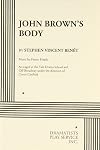
John Brown's Body
by Stephen Vincent Benét
On This Page
Description
One of the most widely read poems of our time--a masterful retelling of the American Civil War. Magnificently readable. --New StatesmanTags
Recommendations
























Member Recommendations
jrgoetziii Both are Civil War stories and Crane loved the Homeric epics. They go together.
Member Reviews
A remarkable poem. Some of it feels very modern, and other parts seem anachronistic even for the time it was written, but always the poem is unexpected in the way these events and these people are portrayed. This poem is one of the few things I've read about the civil war that transcends the expected and manages to make human again an event that has become almost hopelessly entwined with the apocryphal.
Wow is my response to this incredibly ambitious book-length treatment of the Civil War using poetry in a variety of forms. This is a complex book and I find that it isn't accurately treated in a lot of descriptions of it, especially those that call it narrative and blank verse. Though it has narrative strings, they are broken by multiple perspectives, as well as expository and lyrical sections (making it arguably modern). There is blank verse (his best), free verse, prose, ballads, rhymed couplets in tetrameter (his worst), etc. It is primarily a book of many voices and perspectives providing a broad experience of the tragedy of the Civil War.
I discovered this book at my local library and decided I should read it since I have an show more interest in longer works. Notice I said "should" rather than wanted to. I'm not a history buff, especially not a fan of war stories. Also, when I first cracked the book to get a feel for it, I struck an early saccharine passage about Sally Dupre (who is not so sweet and simple as she develops). Uhg. I suspected there would be a lot of that but thankfully there isn't. Benet also tends to juxtapose more sentimental/saccharine passages against those that are stark portrayals of harsh realities (in fact, some of the juxtapositions are brilliant). Sometimes he uses sing-songy rhymed couplets for subject matter that makes the whole passage ironic.
It amazes me that this book has not been a subject of more serious criticism, but I can guess why. The poetry, though it has stellar moments, is not stellar overall. Some of it could simply have been prose; where meter/rhyme is used, it can be clunky. Though I eventually came to watch carefully when he slipped into couplets for how he was using the form to underscore an event or personality or turn it on its head, I still cringed as I read.
Yet the book is complex and fascinating. It does not take a simplistic or even heroic view of this conflict, which is what I suspected/expected. The men/boys are imperfect, good some days and in some circumstances and not so admirable during others. Not only did I get caught up in the tapestry that Benet weaves, but at the end I would have been happy (were there not already too many books and too little time) to turn around and begin again because I think the second read would have been richer now that I see all he was trying to accomplish--all that he eventually portrays about war, being human, being American, America itself, about being flawed and the outcomes of actions large and small. The book also made me curious about the battles of the Civil War and the key players than I ever have been.
So Wow. Definitely a keeper. show less
I discovered this book at my local library and decided I should read it since I have an show more interest in longer works. Notice I said "should" rather than wanted to. I'm not a history buff, especially not a fan of war stories. Also, when I first cracked the book to get a feel for it, I struck an early saccharine passage about Sally Dupre (who is not so sweet and simple as she develops). Uhg. I suspected there would be a lot of that but thankfully there isn't. Benet also tends to juxtapose more sentimental/saccharine passages against those that are stark portrayals of harsh realities (in fact, some of the juxtapositions are brilliant). Sometimes he uses sing-songy rhymed couplets for subject matter that makes the whole passage ironic.
It amazes me that this book has not been a subject of more serious criticism, but I can guess why. The poetry, though it has stellar moments, is not stellar overall. Some of it could simply have been prose; where meter/rhyme is used, it can be clunky. Though I eventually came to watch carefully when he slipped into couplets for how he was using the form to underscore an event or personality or turn it on its head, I still cringed as I read.
Yet the book is complex and fascinating. It does not take a simplistic or even heroic view of this conflict, which is what I suspected/expected. The men/boys are imperfect, good some days and in some circumstances and not so admirable during others. Not only did I get caught up in the tapestry that Benet weaves, but at the end I would have been happy (were there not already too many books and too little time) to turn around and begin again because I think the second read would have been richer now that I see all he was trying to accomplish--all that he eventually portrays about war, being human, being American, America itself, about being flawed and the outcomes of actions large and small. The book also made me curious about the battles of the Civil War and the key players than I ever have been.
So Wow. Definitely a keeper. show less
An amazing piece of work - to write an epic poem which encompasses the entire Civil War. It was surprising readable and very interesting. I can't imagine how Benet put it all together. Did he write it in chronological order or in bits and pieces and then cobbled it together? Did he maybe write the battles first and then decide on the characters he was going to use to connect them and then write their parts? An immense accomplishment.
380. John Brown's Body, by Stephen Vincent Benet (read 29 Mar 1951) (Pulitzer poetry prize for 1929) On Mar 27, 1951, I said: "Began reading John Brown's Body. 'Tis quite a book. What it really is is a verse history of the Civil War by Stephen Vincent Benet and his poetry reaches the tops of greatness at times. Some of it nearly reduces me to paroxysms. Like this picture of Clay Wingate, young Georgia aristocrat: 'Wingate sat in his room at night. . . Reading his Byron with knitted brow While his mind drank in the peace of the house, . . .And the slow clock ticking the time that dies . . .'' Or sallies like this: 'the whole troop grumbled and wondered asking For fighting or fleeing or fornicating Or anything else but this bored show more waiting.' Or this line: 'He only dreams that he is back at home With a heroic wound that does not hurt.' And so it is. Undistiled snatches of greatness and poignancy dot the poem , and thru it all it is eminently readable poetry. With all the work I've to do, you'd think I wouldn't have time. But I'm liking ti so. Am I not entitled to do a little reading like this? It's good for me." On Mar 29 I said: "Finished reading John Brown's Body. 'Tis a great work, and though I'm not good at reading a lot of poetry at once, this didn't even illustrate that fact to me so much, because the meter keeps changing and you never are reduced to a sing-songness that other long poems reduce me to. His account pf Gettysburg, besides reminding me of how little I know of it, was great. These lines knocked me over: 'We have made the sick earth tremble with other shakings in our time, in our time, in our time, but it has not taught us to leave the grain in the field.' Then there was there was this part of John Vilas' soliloquy on returning to Connecticut--the Connecticut he had run away from as a boy--'I shall smell lilac in Connecticut No doubt, before I die, and see the clean White, reticent, small churches of my youth, . . .The pasture -bars I broke to run away. It was my thought to live in an uncropped And savage field no plough had ever scored . ..It was my thought to be beside a stream . . .Too solitary for remembrance.' A tremendous work." show less
The rhythm of this epic poem was superb - an incredible way to read about the Civil War. I was quite caught up with several of the fictional characters and moved by the intimate look into the historical figures as well. Many, such as the passage on Lee-- "I'm always wanting something" -- had me glued to the book and wanting more. It was an experience and well worth the time.
This book, which I read for the first time over 50 years ago when I was 17, changed my life in two ways: I stopped thinking I didn't like poetry, and I started on a life-long fascination with the American Civil War. It's one of the most moving books/stories I have ever read. I still have the copy I got for Christmas in 1954.
This poem won a Pulitzer Prize and is set during the US Civil War. The title of the poem is taken from both an actual event and its resultant song. The poem follows multiple characters both Union and Confederate and multiple social classes from the poor, wealthy plantation owners, slaves, and military personnel. IMHO this is such a great work of history (historical fiction). 357 pages
Members
- Recently Added By
Lists

Best Books of 1926-1935
403 works; 10 members

1964 College Preparatory Reading List
202 works; 8 members

Publisher's Weekly NON-Fiction list - 1912 - 1975
486 works; 4 members
Author Information

135+ Works 2,520 Members
A poet, dramatist, and short story writer, Stephen Vincent Benet was born in Bethlehem, Pennsylvania, in 1898 and attended Yale University. A Guggenhein Fellowship in 1926 enabled him to work in Paris on a long poem that appeared two years later and received the Pulitzer Prize for poetry (1928). The poem John Brown's Body brought Benet instant show more popularity. This narrative history of the Civil War in rhyme and blank verse told from the point of view of ordinary people of both the North and the South is a remarkable epic of the United States. Although Benet had enormously influential on other poets, notably the Harlem Renaissance writer Anne Spencer, and despite his wide popular audience, he has not received high praise from academic critics. Benet died in 1943. (Bowker Author Biography) show less
Some Editions
Awards and Honors
Awards
Distinctions
Work Relationships
Common Knowledge
- Canonical title
- John Brown's Body
- Original publication date
- 1965; 1927-1928
- People/Characters
- Jack Tomelty; John Brown, abolitionist; Marise Tomelty; Ralph Shilling; Bertha Shilling; Emmeline (show all 9); Krassner; Mr Pecry; Fred Macey
- Important places
- USA
- Dedication
- To my mother and to the memory of my father
- First words
- Marise saw at once that this place was far behind Plummer Court.
American muse, whose strong and diverse heart
So many men have tried to understand
But only made it smaller with their art,
Because you are as varied as your land,...
Note: As this is a poem, not a history, it has seemed unnecessary to me to encumber it with notes, bibliography, and other historical apparatus.
Introduction: The Civil War is a sword cut across American history. - Last words
- (Click to show. Warning: May contain spoilers.)It really did send her out of herself, she was like a firework rushing away in a shower of sparks.
(Click to show. Warning: May contain spoilers.)...And while the prophets shudder or adore
Before the flame, hhoping it will give ear,
If you at last must have a word to say,
Say neither, in their way,
"It is a deadly magic and accursed,"
Nor "It is blest," but only "It is here."
Classifications
Statistics
- Members
- 917
- Popularity
- 29,088
- Reviews
- 14
- Rating
- (3.90)
- Languages
- 5 — English, French, German, Italian, Russian
- Media
- Paper, Ebook
- ISBNs
- 21
- ASINs
- 82