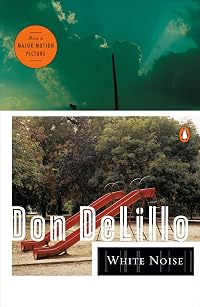
White Noise
by Don DeLillo
On This Page
Description
Now a Netflix film!Winner of the National Book Award, White Noise tells the story of Jack Gladney, his fourth wife, Babette, and four ultramodern offspring as they navigate the rocky passages of family life to the background babble of brand-name consumerism. When an industrial accident unleashes an "airborne toxic event," a lethal black chemical cloud floats over their lives. The menacing cloud is a more urgent and visible version of the "white noise" engulfing the Gladneys—radio show more transmissions, sirens, microwaves, ultrasonic appliances, and TV murmurings—pulsing with life, yet suggesting something ominous. show less
Tags
Recommendations




Member Recommendations
Member Reviews
The outside blurbs on Don Delilo's White Noise emphasize it being funny or the funniest. It is none of these. It is possible that readers with a serious turn of mind need an attitude adjustment before reading. The novel's chief character and his wife are consumed by thoughts of death; presented in the most palatable, approachable, consumer friendly way possible. The couples' children aid in the humor that is part of the mix of this well written book published in 1985. Delillo is a major talent and his gifts shine through in this effort.
Quotes: (pages 81-82) “The family is the cradle of the world's misinformation. There must be something in family life that generates factual error. Over closeness, the noise and heat of being. Perhaps show more something deeper, like the need to survive. Murray says we are fragile creatures surrounded by a world of hostile facts. Facts threaten our happiness and security. The deeper we delve into nature of things, the looser our structure may seem to become. The family process works towards sealing off the world. Small errors grow heads, fictions proliferate. I tell Murray that ignorance and confusion can't possibly be the driving forces behind family solidarity. What an idea, what a subversion. He asks me why the strongest family units exist in the least developed societies. Not to know is a weapon of survival, he says. Magic and superstition become entrenched as the powerful orthodoxy of the clan. The family is strongest where objective reality is most likely to be misinterpreted.”
(page 225) “You're a man, Jack. We all know about men and their insane jealousy. This is somethng men are very good at. Insane and violent jealousy. Homicidal rage. When people are good at something, it's only natural that they look for a chance to do this thing. If I were good at it, I would do it. It happens I”m not. So instead of going into homicidal rages, I read to the blind. In other words I know my limits. I am willing to settle for something less.”
(pages 284-285) “'Do you believe love is stronger that death?'
'Not in a million years.'
'Good, he said. 'Nothing is stronger than death. Do you believe the only people who fear death are those afraid of life?'
'That's crazy. Completely stupid.'
'Right, We all fear death to some extent. Those who claim otherwise are lying to themselves. Shallow people.'
'People with nicknames on there license plates.'
'Excellent, Jack. Do you believe life without death is somehow incomplete?'
'How could it be incomplete? Death is what makes it incomplete.'
'Doesn't our knowledge of death make life more precious?'
'What good is preciousness based on fear and anxiety? Its an anxious quivering thing.'
'True. The most deeply precious things are those we feel secure about. A wife, a child. Does the specter of death make a child more precious?'
'No.'” show less
Quotes: (pages 81-82) “The family is the cradle of the world's misinformation. There must be something in family life that generates factual error. Over closeness, the noise and heat of being. Perhaps show more something deeper, like the need to survive. Murray says we are fragile creatures surrounded by a world of hostile facts. Facts threaten our happiness and security. The deeper we delve into nature of things, the looser our structure may seem to become. The family process works towards sealing off the world. Small errors grow heads, fictions proliferate. I tell Murray that ignorance and confusion can't possibly be the driving forces behind family solidarity. What an idea, what a subversion. He asks me why the strongest family units exist in the least developed societies. Not to know is a weapon of survival, he says. Magic and superstition become entrenched as the powerful orthodoxy of the clan. The family is strongest where objective reality is most likely to be misinterpreted.”
(page 225) “You're a man, Jack. We all know about men and their insane jealousy. This is somethng men are very good at. Insane and violent jealousy. Homicidal rage. When people are good at something, it's only natural that they look for a chance to do this thing. If I were good at it, I would do it. It happens I”m not. So instead of going into homicidal rages, I read to the blind. In other words I know my limits. I am willing to settle for something less.”
(pages 284-285) “'Do you believe love is stronger that death?'
'Not in a million years.'
'Good, he said. 'Nothing is stronger than death. Do you believe the only people who fear death are those afraid of life?'
'That's crazy. Completely stupid.'
'Right, We all fear death to some extent. Those who claim otherwise are lying to themselves. Shallow people.'
'People with nicknames on there license plates.'
'Excellent, Jack. Do you believe life without death is somehow incomplete?'
'How could it be incomplete? Death is what makes it incomplete.'
'Doesn't our knowledge of death make life more precious?'
'What good is preciousness based on fear and anxiety? Its an anxious quivering thing.'
'True. The most deeply precious things are those we feel secure about. A wife, a child. Does the specter of death make a child more precious?'
'No.'” show less
The thing about this book is that, contrary to the published review here, it is just so wrong--it's a book in search of easy, rather snide, answers to big complex questions.
The secret of this book's appeal is that it takes those hard questions--mortality, meaning, the nature of society--and makes the reader feel as if he or she has confronted them, when actually you haven't--it's just an occasion for self-congratulation and a bit of not-too-clever satire.
Someone mentioned Richard Russo, who is obviously brought to mind by this book--but Russo is funnier, a keener observer of both people and institutions, and altogether more honest. One doesn't walk away from Straight Man with the false sense of superiority which, I imagine, is show more DeLillo's strongest appeal for twenty-somethings (at least when they first read him) who lionize him. show less
The secret of this book's appeal is that it takes those hard questions--mortality, meaning, the nature of society--and makes the reader feel as if he or she has confronted them, when actually you haven't--it's just an occasion for self-congratulation and a bit of not-too-clever satire.
Someone mentioned Richard Russo, who is obviously brought to mind by this book--but Russo is funnier, a keener observer of both people and institutions, and altogether more honest. One doesn't walk away from Straight Man with the false sense of superiority which, I imagine, is show more DeLillo's strongest appeal for twenty-somethings (at least when they first read him) who lionize him. show less
Sanayi sonrası toplunun ezici ve amansız güncelliğine hapsolmuş insan yaşamları. Konforun belleksiz ve sonrasız bugününde atan bir yumuşak damar. Beyaz camda biriken uzak geleceğin gölgesi ve bir harabeye varan ses duvarı. Delillo, iç içe geçmiş bir çağdaş yaşam sarmalını ağır ağır çözüyor. Çağdaş Amerikan romanının en büyük ustalarından DeLillo, bir insanlık durumunun en sarsıcı anlatılarından biriyle iz sürüyor.
White Noise is a novel I can appreciate intellectually, but it is not one that I enjoyed reading. It is filled with incredibly beautiful sentences and sharp satire, both of which I enjoyed. But it was flat, intentionally flat, but flat nonetheless. I know this is the point. There is no difference in the cadence and emotional resonance of the different voices -- as if the world exists on a flattened plain. I cannot say it is a collection of beautiful sentences without a plot, because there is a plot, even though it is not a plot-driven story. In fact, I am not convinced it is a story at all.
I think White Noise is an excellent representation of a particular moment in the post-modern absurdist mindset. A part of me remembers being a show more student of literature, remembers studying twentieth century literature. I think of DeLillo as an heir to Barth but I may have appreciated Barth's humor more. While I was reading, I could not help being struck by the cruelty of its intellectual conceit -- the cold sardonicism, the deliberate mocking tone. DeLillo was writing about how modern invention had created a simulacrum of life, hence the flatness. Reading this novel brought to mind the philosophy of Baudrillard, which I had been quite happy not to think about for some 40 years. In the end I think DeLillo wrote a simulacrum of a novel, although it did prove good fodder for discussion in my book group. show less
I think White Noise is an excellent representation of a particular moment in the post-modern absurdist mindset. A part of me remembers being a show more student of literature, remembers studying twentieth century literature. I think of DeLillo as an heir to Barth but I may have appreciated Barth's humor more. While I was reading, I could not help being struck by the cruelty of its intellectual conceit -- the cold sardonicism, the deliberate mocking tone. DeLillo was writing about how modern invention had created a simulacrum of life, hence the flatness. Reading this novel brought to mind the philosophy of Baudrillard, which I had been quite happy not to think about for some 40 years. In the end I think DeLillo wrote a simulacrum of a novel, although it did prove good fodder for discussion in my book group. show less
Fülszöveget írni nem habos sütemény. De még csak nem is instant kávé. Hanem nehéz kenyér. Pláne, ha mink is van? Egy gigantikus posztmodern klasszikusunk, mintegy mellékesen kirajzolódó alternatív történelmi háttérrel, számos extrém szereplővel, borsos (de kellően áttételes) társadalomkritikával, látszólag irreleváns párbeszédekkel és meglehetősen eklektikus forgatókönyvvel, amely hajlamos pont nem arra kanyarogni, amerre szerintünk kanyarognia kéne. Ilyenkor a fülszövegíró többnyire 1.) megpróbál sikeríteni egy röpke cselekményvázlatot max. három-négy mondatban, de olyat, hogy a reménybeli vásárló épp csak annyira zavarodjon tőle össze, hogy még el akarja olvasni a könyvet 2.) show more és ha ideje engedi, esetleg egy-két mondatban leszögezheti (a félreértések elkerülése végett), hogy ez egy posztmodern klasszikus. Mert a posztmodern klasszikusokat egyesek rendszeresen összekeverik a bénán megírt epikus regényekkel, és nem árt, ha a fülszöveg erre az eshetőségre is felkészül. Ezek figyelembe vételével már egészen vállalható irományokat lehet a belső fülre biggyeszteni, amelyek mindazonáltal meglehetős gyakorisággal fognak spoilert tartalmazni, ráadásul alapvető hátrányuk, hogy puszta létezésükkel olyan cselekményszálakat emelnek ki, amelyeket az író (vagy a reménybeli olvasó) esetleg nem annyira tartana fontosnak. Úgyhogy én bátorkodnék felajánlani három változatot – a nagyobb diverzifikáció érdekében.
a.) Metaforás:
Képzeljük el, hogy a Nagy Amerikai Epikus Regény egy csábítón megvetett ágy, puha dunyhákkal, jó szagú párnákkal, meg minden. Képzeljük el, hogy belefekszünk. Továbbá képzeljük el azt is (ha már úgyis képzelődünk), hogy ebben a puha ágyban, a lepedő alatt számos borsószem van eldugva – úgyhogy csak fészkelődünk, forgolódunk, de valami mindig nyomja az oldalunkat, kizökkentve minket a komfortzónából. Na, ez a borsókkal teli ágy a Fehér zaj. Borsószem-királykisasszonyoknak ajánlom.
b.) Progresszíves-radikálisos:
Mit érdemel az a bűnös, akinek Elvis és Hitler csak egy koordináta-rendszerben vizsgálható, mert filozófiai gondolkodása annyira kiürült, hogy etikai különbségtételekre már-már képtelen? Mit érdemel az a társadalom, amely életét szupermarketekben éli le? Aki jódolgában már nem is a dolgoktól retteg, hanem a dolgoktól való rettegéstől? Megmondom, mit érdemel: egy nagy toxikus méregfelhőt a pofájába, azt. És lőn.
c.) Szintfelmérős:
Definiálja a Nagy Amerikai Halálfélelem fogalmát! Mi a különbség a halálfélelem és a halálfélelemtől való félelem között? Ha semminek sincs már értéke, akkor vajon az életnek van értéke, vagy csak annak van értéke? Fejtse ki 500-600 oldalban. Pluszpontért: olvasmányosan. show less
a.) Metaforás:
Képzeljük el, hogy a Nagy Amerikai Epikus Regény egy csábítón megvetett ágy, puha dunyhákkal, jó szagú párnákkal, meg minden. Képzeljük el, hogy belefekszünk. Továbbá képzeljük el azt is (ha már úgyis képzelődünk), hogy ebben a puha ágyban, a lepedő alatt számos borsószem van eldugva – úgyhogy csak fészkelődünk, forgolódunk, de valami mindig nyomja az oldalunkat, kizökkentve minket a komfortzónából. Na, ez a borsókkal teli ágy a Fehér zaj. Borsószem-királykisasszonyoknak ajánlom.
b.) Progresszíves-radikálisos:
Mit érdemel az a bűnös, akinek Elvis és Hitler csak egy koordináta-rendszerben vizsgálható, mert filozófiai gondolkodása annyira kiürült, hogy etikai különbségtételekre már-már képtelen? Mit érdemel az a társadalom, amely életét szupermarketekben éli le? Aki jódolgában már nem is a dolgoktól retteg, hanem a dolgoktól való rettegéstől? Megmondom, mit érdemel: egy nagy toxikus méregfelhőt a pofájába, azt. És lőn.
c.) Szintfelmérős:
Definiálja a Nagy Amerikai Halálfélelem fogalmát! Mi a különbség a halálfélelem és a halálfélelemtől való félelem között? Ha semminek sincs már értéke, akkor vajon az életnek van értéke, vagy csak annak van értéke? Fejtse ki 500-600 oldalban. Pluszpontért: olvasmányosan. show less
WHITE NOISE muses on an inescapable subject that confronts all of us: death. The narrative swiftly zooms in and out of Jack Gladney's outward poise as an academic authority and his inward sepia maze of jittery moments, fear, and nightmare of death sweat. The text, despite its crispness and modernity, radiates an epic quality as if the novel becomes a literary event of death. Jack is the chairman and the creator of the department of Hitler Studies, a well-established system of the Nazi figure that endows the college to fame. Together with his colleague Murray, who anticipates on founding an institute evolving around Elvis on the same magnitude, they muse on death.
Happily married to the Hitler expert is Babette, who possesses a careless show more dignity of someone too preoccupied with serious matters to know what she looks like. She seems to be pretty content with her family life, which comprises of children from both her and his previous marriages, but, like her husband, Babette is overly death-savvy. The question haunts them: who will die first? The thought of her husband's dying first leaves an abyss in her life, and she is set to engage in a clandestine experimentation that might to lead to a pill that rids of the fear of death. As their touching unfolds against the backdrop of an airborne toxic event that sends the whole town into juggle and paranoia, WHITE NOISE exposes the human obsession with mortality and fear of death to the fullest extent.
Jack and his wife's irrational conviction to overcome the fear of death might have overleaped to the point of morbidity; but the universal fear of mortality is confirmed through the paranoid state stirred up by the chemical spill. WHITE NOISE candidly exposes people's lingering fears about themselves and those whom they love. Do they simply wear a disguise or pretend the fear is not there? Do they think indifference will drive away the fear? Do they just hide the fear from one another out of mutual consent?
Jack's sense of danger is valid in the sense that death is so vague and about which nobody knows. Death is a substatic buzz. An electrical sound. White noise like the TV fuss. A power of suggestion. On top of the social comedy and a disaster, WHITE NOISE is a philosophical musing on how death, despite its immutability and eternal threat, provides a boundary and gives a precious texture to life. Death embellishes life with a sense of definition, to guage the beauty and meaning of what a human being does in his lifetime. show less
Happily married to the Hitler expert is Babette, who possesses a careless show more dignity of someone too preoccupied with serious matters to know what she looks like. She seems to be pretty content with her family life, which comprises of children from both her and his previous marriages, but, like her husband, Babette is overly death-savvy. The question haunts them: who will die first? The thought of her husband's dying first leaves an abyss in her life, and she is set to engage in a clandestine experimentation that might to lead to a pill that rids of the fear of death. As their touching unfolds against the backdrop of an airborne toxic event that sends the whole town into juggle and paranoia, WHITE NOISE exposes the human obsession with mortality and fear of death to the fullest extent.
Jack and his wife's irrational conviction to overcome the fear of death might have overleaped to the point of morbidity; but the universal fear of mortality is confirmed through the paranoid state stirred up by the chemical spill. WHITE NOISE candidly exposes people's lingering fears about themselves and those whom they love. Do they simply wear a disguise or pretend the fear is not there? Do they think indifference will drive away the fear? Do they just hide the fear from one another out of mutual consent?
Jack's sense of danger is valid in the sense that death is so vague and about which nobody knows. Death is a substatic buzz. An electrical sound. White noise like the TV fuss. A power of suggestion. On top of the social comedy and a disaster, WHITE NOISE is a philosophical musing on how death, despite its immutability and eternal threat, provides a boundary and gives a precious texture to life. Death embellishes life with a sense of definition, to guage the beauty and meaning of what a human being does in his lifetime. show less
I've had a deep ambivalence towards DeLillo's goofy writing style in the past; his silly dialogue, wacky characters, and shaggy-dog plots work well when they work, but they come off as boring and frustrating when they don't (I liked Mao II but gave up partway through The Names). Fortunately White Noise makes all of those elements work fairly well, and even DeLillo's inexplicable addiction to bizarrely precocious Woke Toddler child characters can't ruin what turns out to be a fairly thoughtful exploration of mortality, family, and consumerism in an unstable modern world. White Noise was tagged with the infamous "postmodern" label when it came out in 1985, but from nearly 35 years later, it doesn't feel nearly as show more weighty/experimental/metafictional/revelatory as what I usually think of as postmodern novels. Instead it feels more like a humble comic novel with some serious bits rather than as a serious novel with jokes, and consequently it stays on the safe side of the implausible/insufferable chasm that it turns out DeLillo was working in before most other writers. His offhand jokes about doing things purely to be seen doing them are some of the best writing I've seen from him, and it was truly an unhappy realization to see how accurately DeLillo's parody America resembles what's now the real thing.
The premise is pretty funny: protagonist Jack Gladney is a professor of Hitler Studies in an invented Midwestern college town along the lines of Ames or Champaign-Urbana. He doesn't even speak German at first, instead concealing his utter academic uselessness behind hilarious pyrotechnic pomposity whenever he's forced to do anything that resembles teaching. This sort of light-hearted sendup of professorship was probably done better by Nabokov in Pale Fire but is still funny here, even if the fact that real-life universities have made amusingly specialized liberal arts positions like this essentially extinct renders this premise a parody from another era. Gladney and his family evacuate their town when a chemical accident, the Airborne Toxic Event, temporarily engulfs the town, and upon their return he has to confront his own changed sense of mortality, as well as that of his family, since he discovers that his wife has begun an affair to gain access to a drug that helps her cope with her fear of death. After an extended walk-and-talk with a colleague about whether he's at heart "a killer or dier", Gladney attempts to murder the other man, but changes his mind at the last minute. The novel ends with an examination of the supermarket and its emotional centrality to the population of the town.
My main complaint about Don DeLillo's writing style was that it seemed like he wrote himself out of anything really affecting. Coming into White Noise, I felt that his characters were so artificial, with such relentlessly absurd dialogue and odd worldviews, that whenever he tried to drop in "profound" observations into their speech or as a description of a character action it mostly comes off as annoying. I was concerned at why what's so clearly supposed to be a lighthearted, easygoing style wasn't working for me, until I realized that he was just ahead of his time. He perfectly predicted that awful snappy banter dialogue pattern like in Marvel movies where what's clearly supposed to be a meaningful moment is immediately drained of all gravity by some stupid snarky quip and you're onto the next scene before there's a risk of anything actually mattering to the characters. It's aggravating, but it's supposed to be that way.
That said, I still had to actually read this stuff, and it's inarguable that DeLillo isn't the prose stylist that other comic authors are, and often seems to genuinely be trying too hard to be funny when a more naturalistic approach might have worked out better. Sometimes he will have good lines like "Fear is self-awareness raised to a higher level" or that "The twentieth century is all about people going into hiding even when no one is looking for them", but you have to work through a lot of zany chaff to get there. Luckily not all of White Noise is afflicted in this way, and the meandering puffery that Gladney spouts off is funny when he does it, it's just when it's in the mouth of his son Heinrich that it's not so charming. Thomas Pynchon, who DeLillo is often compared to, had a thoughtful take on this exact thing in the Introduction to Slow Learner, his collection of early short stories:
At the heart of the story, most crucial and worrisome, is the defective way in which my narrator, almost but not quite me, deals with the subject of death. When we speak of "seriousness" in fiction ultimately we are talking about an attitude toward death - how characters may act in its presence, for example, or how they handle it when it isn't so immediate.
I think this is true, and seen in that light, the adamantine goofiness every character has is not so bad, in fact it's almost endearing, as they infodump, dodge, and avoid real matters when speaking to each other in just the way that every character in most mass-market entertainment does these days. Likewise, one thing I will give DeLillo is that his depictions of celebrity/voyeur/parasocial culture are not just vivid but incredibly prescient. "The most photographed barn in America" that people drive out of their way simply to photograph and never actually see is a brilliant representation of the increasingly engineered tendency to perform activities just for the sake of being seen. It wasn't new even in the 80s to ponder how many people (yourself included) have documented something without ever actually looking at or enjoying the ostensible subject, which is not even the "real" subject anyway, but rarely have I seen it captured so pithily as DeLillo does here.
There's a little riff on California and natural disasters that I swear must be exactly how Donald Trump watched their recent wildfires:
"We're suffering from brain fade. We need an occasional catastrophe to break up the incessant bombardment of information."
"It's obvious," Lasher said. A slight man with a taut face and slicked-back hair.
"The flow is constant," Alfonse said. "Words, pictures, numbers, facts, graphics, statistics, specks, waves, particles, motes. Only a catastrophe gets our attention. We want them, we need them, we depend on them. As long as they happen somewhere else. This is where California comes in. Mud slides, brush fires, coastal erosion, earthquakes, mass killings, et cetera. We can relax and enjoy these disasters because in our hearts we feel that California deserves whatever it gets. Californians invented the concept of life-style. This alone warrants their doom."
Cotsakis crushed a can of Diet Pepsi and threw it at a garbage pail.
"Japan is pretty good for disaster footage," Alfonse said. "India remains largely untapped. They have tremendous potential with their famines, monsoons, religious strife, train wrecks, boat sinkings, et cetera. But their disasters tend to go unrecorded. Three lines in the newspaper. No film footage, no satellite hookup. This is why California is so important. We not only enjoy seeing them punished for their relaxed life-style and progressive social ideas but we know we're not missing anything. The cameras are right there. They're standing by. Nothing terrible escapes their scrutiny."
It's really disturbing to recognize the President of the United States in a discussion where one of the characters is a Professor of Hitler Studies, and even more dispiriting to remember that Trump's victory depended on winning the votes of exactly the Midwestern consumerism-addled dimwits that populate this novel, but somehow it seems fitting that reality has only recently caught up to the absurd, too-stupid-to-be-real comedy of the past. Oh boy. show less
The premise is pretty funny: protagonist Jack Gladney is a professor of Hitler Studies in an invented Midwestern college town along the lines of Ames or Champaign-Urbana. He doesn't even speak German at first, instead concealing his utter academic uselessness behind hilarious pyrotechnic pomposity whenever he's forced to do anything that resembles teaching. This sort of light-hearted sendup of professorship was probably done better by Nabokov in Pale Fire but is still funny here, even if the fact that real-life universities have made amusingly specialized liberal arts positions like this essentially extinct renders this premise a parody from another era. Gladney and his family evacuate their town when a chemical accident, the Airborne Toxic Event, temporarily engulfs the town, and upon their return he has to confront his own changed sense of mortality, as well as that of his family, since he discovers that his wife has begun an affair to gain access to a drug that helps her cope with her fear of death. After an extended walk-and-talk with a colleague about whether he's at heart "a killer or dier", Gladney attempts to murder the other man, but changes his mind at the last minute. The novel ends with an examination of the supermarket and its emotional centrality to the population of the town.
My main complaint about Don DeLillo's writing style was that it seemed like he wrote himself out of anything really affecting. Coming into White Noise, I felt that his characters were so artificial, with such relentlessly absurd dialogue and odd worldviews, that whenever he tried to drop in "profound" observations into their speech or as a description of a character action it mostly comes off as annoying. I was concerned at why what's so clearly supposed to be a lighthearted, easygoing style wasn't working for me, until I realized that he was just ahead of his time. He perfectly predicted that awful snappy banter dialogue pattern like in Marvel movies where what's clearly supposed to be a meaningful moment is immediately drained of all gravity by some stupid snarky quip and you're onto the next scene before there's a risk of anything actually mattering to the characters. It's aggravating, but it's supposed to be that way.
That said, I still had to actually read this stuff, and it's inarguable that DeLillo isn't the prose stylist that other comic authors are, and often seems to genuinely be trying too hard to be funny when a more naturalistic approach might have worked out better. Sometimes he will have good lines like "Fear is self-awareness raised to a higher level" or that "The twentieth century is all about people going into hiding even when no one is looking for them", but you have to work through a lot of zany chaff to get there. Luckily not all of White Noise is afflicted in this way, and the meandering puffery that Gladney spouts off is funny when he does it, it's just when it's in the mouth of his son Heinrich that it's not so charming. Thomas Pynchon, who DeLillo is often compared to, had a thoughtful take on this exact thing in the Introduction to Slow Learner, his collection of early short stories:
At the heart of the story, most crucial and worrisome, is the defective way in which my narrator, almost but not quite me, deals with the subject of death. When we speak of "seriousness" in fiction ultimately we are talking about an attitude toward death - how characters may act in its presence, for example, or how they handle it when it isn't so immediate.
I think this is true, and seen in that light, the adamantine goofiness every character has is not so bad, in fact it's almost endearing, as they infodump, dodge, and avoid real matters when speaking to each other in just the way that every character in most mass-market entertainment does these days. Likewise, one thing I will give DeLillo is that his depictions of celebrity/voyeur/parasocial culture are not just vivid but incredibly prescient. "The most photographed barn in America" that people drive out of their way simply to photograph and never actually see is a brilliant representation of the increasingly engineered tendency to perform activities just for the sake of being seen. It wasn't new even in the 80s to ponder how many people (yourself included) have documented something without ever actually looking at or enjoying the ostensible subject, which is not even the "real" subject anyway, but rarely have I seen it captured so pithily as DeLillo does here.
There's a little riff on California and natural disasters that I swear must be exactly how Donald Trump watched their recent wildfires:
"We're suffering from brain fade. We need an occasional catastrophe to break up the incessant bombardment of information."
"It's obvious," Lasher said. A slight man with a taut face and slicked-back hair.
"The flow is constant," Alfonse said. "Words, pictures, numbers, facts, graphics, statistics, specks, waves, particles, motes. Only a catastrophe gets our attention. We want them, we need them, we depend on them. As long as they happen somewhere else. This is where California comes in. Mud slides, brush fires, coastal erosion, earthquakes, mass killings, et cetera. We can relax and enjoy these disasters because in our hearts we feel that California deserves whatever it gets. Californians invented the concept of life-style. This alone warrants their doom."
Cotsakis crushed a can of Diet Pepsi and threw it at a garbage pail.
"Japan is pretty good for disaster footage," Alfonse said. "India remains largely untapped. They have tremendous potential with their famines, monsoons, religious strife, train wrecks, boat sinkings, et cetera. But their disasters tend to go unrecorded. Three lines in the newspaper. No film footage, no satellite hookup. This is why California is so important. We not only enjoy seeing them punished for their relaxed life-style and progressive social ideas but we know we're not missing anything. The cameras are right there. They're standing by. Nothing terrible escapes their scrutiny."
It's really disturbing to recognize the President of the United States in a discussion where one of the characters is a Professor of Hitler Studies, and even more dispiriting to remember that Trump's victory depended on winning the votes of exactly the Midwestern consumerism-addled dimwits that populate this novel, but somehow it seems fitting that reality has only recently caught up to the absurd, too-stupid-to-be-real comedy of the past. Oh boy. show less
Members
- Recently Added By
Published Reviews
ThingScore 92
The book is so funny, so mysterious, so right, so disturbing … and yet so enjoyable it has somehow survived being cut open for twenty-five years by critics and post-grads. All of that theoretical poking and prodding, all of that po-mo-simulacra-ambiguity vivisection can’t touch the thrill of reading it
added by Shortride
''White Noise,'' his eighth novel, is the story of a college professor and his family whose small Midwestern town is evacuated after an industrial accident. In light of the recent Union Carbide disaster in India that killed over 2,000 and injured thousands more, ''White Noise'' seems all the more timely and frightening - precisely because of its totally American concerns, its rendering of a show more particularly American numbness. show less
added by steevohenderson
In the main, though, DeLillo's most human instincts prevail in this book, resulting in a wealth of lyrical, touching, and terrifying scenes: the family eating fried chicken together in their car; a visit by Babette's broken-down father; and, most indelibly, the descriptions of the "black billowing cloud, the airborne toxic event, lighted by the clear beams of seven army helicopters. They were show more tracking its windborne movement, keeping it in view"—to the awe of those below in cars and on foot.
DeLillo turns a TV-movie disaster scenario into a new Book of Revelations in these pages: a very disturbing, very impressive achievement. show less
DeLillo turns a TV-movie disaster scenario into a new Book of Revelations in these pages: a very disturbing, very impressive achievement. show less
added by Richardrobert
Lists

1001 Books You Must Read Before You Die
1,448 works; 1,134 members

The Guardian's 1000 Novels Everyone Must Read
1,005 works; 550 members

Radcliffe's 100 Best Novel of the 20th Century
100 works; 32 members
David Bowie's Top 100
97 works; 23 members

Great American Novels
158 works; 42 members
Novels from The Guardian's Great American Novelist Tournament
148 works; 24 members
20th Century Literature
1,161 works; 54 members

Top Five Books of 2013
1,562 works; 721 members

National Book Award - Fiction
78 works; 10 members

Recommend the 20 best books you've read in the last five years
2,168 works; 601 members

Significant works of postmodern fiction
86 works; 25 members

Canon de la narrativa universal del siglo XX
254 works; 6 members

Time Magazine's "All-Time 100"
113 works; 15 members

Books I've Read More Than Once
602 works; 49 members
Favourite Books
1,819 works; 316 members
Harold Bloom - The Western Canon: D. The Chaotic Age
833 works; 24 members

Dark Academia Novels
59 works; 11 members
The American Experience
173 works; 18 members
Time's All-Time 100 Novels
100 works; 27 members
The Well-Educated Mind Reading Challenge
75 works; 7 members
Banned or Challenged Books
400 works; 41 members
1,001 BYMRBYD Concensus
723 works; 27 members
Fiction For Men
142 works; 11 members

Dark Books for Winter Reading
71 works; 11 members

Unread books
1,063 works; 87 members

A Novel Cure
742 works; 23 members
Best of American Literature
146 works; 9 members

Books Read in 2014
2,343 works; 89 members

SomethingAwful TBB BOTM
66 works; 2 members

Love Triangles in Literature
108 works; 15 members

Academia in Fiction
158 works; 23 members

Recommended Philosophic Novels
26 works; 1 member

Books Read in 2023
5,547 works; 145 members
David Bowie's List of Top 100 Books
94 works; 6 members

hopes
34 works; 1 member

50 Books from the Past 50 Years
50 works; 8 members
Overdue Podcast
806 works; 9 members

The American novels that should have won the Booker prize
16 works; 3 members

Well-Educated Mind
150 works; 3 members

recalling favorites...
105 works; 2 members

Books Read in 2020
4,379 works; 124 members

Llibres que he llegit el 2020
50 works; 1 member

Books Read in 2022
5,168 works; 114 members
American Lit for Eng 11 Research Project
368 works; 6 members

Top Five Books of 2024
795 works; 264 members
.
396 works; 1 member
Canon de la narrativa universal del s. XX (cicutadry)
499 works; 3 members
David Bowie’s Top 100 Favourite Reads
100 works; 3 members

Books Read in 2024
4,623 works; 126 members

LIT - Il Bookclub Della McMusa
51 works; 1 member

Retrospective of 20th- and 21st-century literature
154 works; 1 member

Books with Colourful Titles
171 works; 8 members
The Well-Educated Mind, Susan Wise Bauer, 2016
179 works; 3 members

living room bookshelf
150 works; 1 member

A Grand Waste Of Time
20 works; 1 member
GWFKegel's Dystopia Suggestions
12 works; 1 member

My TBR
371 works; 3 members

National Book Award winners
65 works; 11 members

A Rainbow of Books: Colors in the Title
570 works; 24 members
Accidents in Fiction
22 works; 5 members

Don DeLillo books
19 works; 1 member

Speculative Fiction: Slipstream Literature
166 works; 16 members

Blue Pyramid 1,276 Best Books of All Time
1,248 works; 32 members
Talk Discussions
Past Discussions
White Noise by Don DeLillo, (Bowie's Top 100 for June) in 75 Books Challenge for 2016 (June 2016)
Author Information

53+ Works 48,980 Members
Don DeLillo was born in the Bronx, New York on November 20, 1936. He received a bachelor's degree in communication arts from Fordham University in 1958. After graduation, he was a copywriter for an advertising company and wrote short stories on the side. His first story, The River Jordan, was published two years later in Epoch, the literary show more magazine of Cornell University. His first novel, Americana, was published in 1971. His other works include Ratner's Star, The Names, Libra, Underworld, The Body Artist, Cosmopolis, Falling Man, Point Omega, and The Angel Esmeralda, a collection of short stories. He won several awards including the National Book Award for fiction in 1985 for White Noise, the PEN/Faulkner Award in 1992 for Mao II, the PEN/Saul Bellow Award for Achievement in American Fiction in 2010, and the inaugural Library of Congress Prize for American Fiction in 2013. (Bowker Author Biography) show less
Some Editions
Awards and Honors
Awards
Distinctions
Notable Lists
Series
Belongs to Publisher Series
Work Relationships
Is contained in
Has as a reference guide/companion
Has as a commentary on the text
Has as a student's study guide
Common Knowledge
- Canonical title
- White Noise
- Original title
- White Noise
- Alternate titles
- "The American Book of the Dead" (working title) (working title); "Panasonic"
- Original publication date
- 1985
- People/Characters
- Jack Gladney (J.A.K. Gladney); Babette; Heinrich; Denise; Steffie; Wilder
- Related movies
- White Noise (2022 | IMDb)
- Dedication
- To Sue Buck and to Lois Wallace
- First words
- The station wagons arrived at noon, a long shining line that coursed through the west campus.
- Quotations
- "The greater the scientific advance, the more primitive the fear". Jack to Babette when talking about genetically engineered micro-organisms that would digest the 'airborne toxic event'.
"The airborne toxic event is a horrifying thing. Our fear is enormous. Even if there hasn't been great loss of life, don't we deserve some attention for our suffering, our human worry, our terror? Isn't fear news?" Television... (show all) carrying man's speech when the family is stranded in Iron City. - Last words
- (Click to show. Warning: May contain spoilers.)The cults of the famous and the dead.
- Blurbers
- Phillips, Jayne Anne
- Original language
- English
- Canonical DDC/MDS
- 813.54
- Canonical LCC
- PS3554.E4425
Classifications
Statistics
- Members
- 12,420
- Popularity
- 678
- Reviews
- 182
- Rating
- (3.77)
- Languages
- 21 — Chinese, Czech, Danish, Dutch, English, Estonian, Finnish, French, German, Greek, Hungarian, Italian, Norwegian (Bokmål), Polish, Portuguese, Russian, Croatian, Slovenian, Spanish, Swedish, Turkish
- Media
- Paper, Audiobook, Ebook
- ISBNs
- 91
- ASINs
- 35