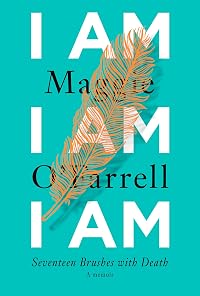
I Am, I Am, I Am: Seventeen Brushes with Death
by Maggie O'Farrell
On This Page
Description
In this astonishing memoir, the New York Times bestselling author of The Marriage Portrait and Hamnet shares the seventeen near-death experiences that have punctuated and defined her life. The childhood illness that left her bedridden for a year, which she was not expected to survive. A teenage yearning to escape that nearly ended in disaster. An encounter with a disturbed man on a remote path. And, most terrifying of all, an ongoing, daily struggle to protect her daughter from a show more condition that leaves her unimaginably vulnerable to life’s myriad dangers. Here, O’Farrell stiches together these discrete encounters to tell the story of her entire life. In taut prose that vibrates with electricity and restrained emotion, she captures the perils running just beneath the surface, and illuminates the preciousness, beauty, and mysteries of life itself. show lessTags
Recommendations




Member Recommendations

Kudos by Rachel Cusk
JuliaMaria Mutterschaft als das bestimmende Lebensthema
Member Reviews
I have mixed feelings about O’Farrell’s memoir or, more specifically, her collection of 17 smaller memoir “pieces”. Ostensibly, the book focuses on the author’s many “brushes” with death, but I think it would be more accurate to say that the stories from O’Farrell’s life included in I am I am I am are actually concerned with moments of heightened feeling or times of psychological transformation. Her opening piece “Neck 1990” in which she recounts her 18-year-old self’s encounter with a sinister man on a remote hiking path is dramatic and stunning. It points to the way in which O’Farrell’s being bullied as a child sensitized her to potential threats and danger, arming her with strategies for self protection show more that woul later save her life. “Neck 2002” (an account of a terrifying experience in Chile) and “Abdomen 2003” (a story about a Caesarean section that goes very wrong due to the appalling paternalism of an obstetrics consultant) are also compellingly and beautifully told. In the latter piece, O’Farrell writes movingly about the power of (safe) touch in the relationship between medical professionals and patients:
“the man in beige is suddenly there . . . and he takes my raised hand. He enfolds it in both of his. I gaze up at him mutely. I had not known, until that moment, what a lonely experience it is to be in danger, in the middle of a room full of people who are frantically working to save your life. . . . His touch is infinitely gentle but firm and sure. There is no way he is letting go, he is telling me, entirely without words.”
Another medically themed piece, “Cerebellum 1980”, placed near the end of the book, is also very fine. It reconstructs O’Farrell’s ordeal with acute encephalitis as a child of eight—an illness which left her with a number of neurological and possibly some psychological impairments.
In general, however, the parts that make up this book are not consistent in quality. A number of pieces (particularly those that involve the author’s romantic relationships) fall short because of O’Farrell’s self-dramatizing , authorial tinkering, and frequent prolixity. (She loves lists, which can go on for a half a page or more and become very tedious.) The story “Bloodstream 1997” is a case in point. Aside from its moving conclusion, in which the author finally moves from a preoccupation with her own health to consider the tragic fate awaiting a gay friend, most of “Bloodstream 1997”, doesn’t work. It opens with an observation—“Occasionally, but not that often, I think about the person I was in my mid-twenties. I consider her. I try to recall how it felt to be that age. What were the framework of her days, the patterns of her thoughts?”—and proceeds to tell a story in the third person about that twenty-something self. Here O’Farrell is a romanticized character in a drama about an unfaithful lover, who doesn’t understand her writerly ambitions and her late-night “typing”. In other pieces, the author’s “stormy”, “difficult”, “wild”, “intractable” child self, “given to screaming fits, emotional outbursts, peaks and troughs of passion”, is remarkably (and unbelievably) precocious. In “Lungs 2000”, for example, O’Farrell presents herself as a five-year-old child, holding onto the wooden handle of a shop door, swinging back and forth as she waits for her mother:
“I remember that, as I swung . . . , something shifted or settled upon me, some extra depth of vision. A sudden recalibration or bifurcation of my perceptions took place. I could see myself both from above and from within. I had a sense of myself as minuscule, inconsequential, a tiny moving automaton in a wide scene, and at the same time I was acutely aware of myself as an organism, a human microcosm. . . . I acquired a simultaneous sense of time as a vast continuum and an awareness that my stretch in it would be short, insignificant. I knew, in that moment, and perhaps for the first time that I would one day die, that at some point there would be nothing left of me, my mittens, my breathing, my curls, my hat. I felt that conviction for the first time. My death felt like a person there next to me.”
These are some pretty big thoughts from a little person—which is not to say children can’t be philosophical. But this line of thinking? It’s possible, I guess, but hard to believe. It’s worth keeping in mind, in reading a O’Farrell’s occasionally improbable recollections, that each time we retrieve a memory, we reconstitute it with the knowledge and experience we now have. Memories are not stable.
Another reservation I have about I am I am I am is related to the author’s sometimes too-clever imagery: similes and metaphors that draw attention to themselves rather than serving the content in a more natural way. As she begins to discover her calling as a novelist, for example, (we are told) “the words scroll . . . out from under a flashing cursor, the paragraphs open . . . out from each other, like Matryoshka dolls.” Paragraphs as Matryoshka dolls? Doesn’t work for me. In other stories, a town is prettily said to be “a necklace of lights” across the bay, major turbulence on an airplane that violently throws around passengers and their belongings causes her “ears and face [to] bloom petals of pain” (Petals? Really?) and a priest’s rosary beads accidentally pressed into her arm leave “a novena of bruises.” (Yes, a novena.) I could go on.
O’Farrell’s book mostly held my interest, but I question why there had to be 17 brushes with death, rather than 10 or 12. I am also not particularly convinced of the effectiveness of naming the segments of the memoir for the body parts or organs most vulnerable or affected. I suspect, though, that O’Farrell was attempting to underscore human corporeality and the multiple ways in which we are physically vulnerable. A final thing that puzzles me is O’Farrell’s decision not to present the memoir pieces chronologically. Reading “Cerebellum 1980” early on would’ve provided the reader with some valuable context for some of the behaviour, decisions, and risks of the writer’s older self.
Rating: A solid 3.5 show less
“the man in beige is suddenly there . . . and he takes my raised hand. He enfolds it in both of his. I gaze up at him mutely. I had not known, until that moment, what a lonely experience it is to be in danger, in the middle of a room full of people who are frantically working to save your life. . . . His touch is infinitely gentle but firm and sure. There is no way he is letting go, he is telling me, entirely without words.”
Another medically themed piece, “Cerebellum 1980”, placed near the end of the book, is also very fine. It reconstructs O’Farrell’s ordeal with acute encephalitis as a child of eight—an illness which left her with a number of neurological and possibly some psychological impairments.
In general, however, the parts that make up this book are not consistent in quality. A number of pieces (particularly those that involve the author’s romantic relationships) fall short because of O’Farrell’s self-dramatizing , authorial tinkering, and frequent prolixity. (She loves lists, which can go on for a half a page or more and become very tedious.) The story “Bloodstream 1997” is a case in point. Aside from its moving conclusion, in which the author finally moves from a preoccupation with her own health to consider the tragic fate awaiting a gay friend, most of “Bloodstream 1997”, doesn’t work. It opens with an observation—“Occasionally, but not that often, I think about the person I was in my mid-twenties. I consider her. I try to recall how it felt to be that age. What were the framework of her days, the patterns of her thoughts?”—and proceeds to tell a story in the third person about that twenty-something self. Here O’Farrell is a romanticized character in a drama about an unfaithful lover, who doesn’t understand her writerly ambitions and her late-night “typing”. In other pieces, the author’s “stormy”, “difficult”, “wild”, “intractable” child self, “given to screaming fits, emotional outbursts, peaks and troughs of passion”, is remarkably (and unbelievably) precocious. In “Lungs 2000”, for example, O’Farrell presents herself as a five-year-old child, holding onto the wooden handle of a shop door, swinging back and forth as she waits for her mother:
“I remember that, as I swung . . . , something shifted or settled upon me, some extra depth of vision. A sudden recalibration or bifurcation of my perceptions took place. I could see myself both from above and from within. I had a sense of myself as minuscule, inconsequential, a tiny moving automaton in a wide scene, and at the same time I was acutely aware of myself as an organism, a human microcosm. . . . I acquired a simultaneous sense of time as a vast continuum and an awareness that my stretch in it would be short, insignificant. I knew, in that moment, and perhaps for the first time that I would one day die, that at some point there would be nothing left of me, my mittens, my breathing, my curls, my hat. I felt that conviction for the first time. My death felt like a person there next to me.”
These are some pretty big thoughts from a little person—which is not to say children can’t be philosophical. But this line of thinking? It’s possible, I guess, but hard to believe. It’s worth keeping in mind, in reading a O’Farrell’s occasionally improbable recollections, that each time we retrieve a memory, we reconstitute it with the knowledge and experience we now have. Memories are not stable.
Another reservation I have about I am I am I am is related to the author’s sometimes too-clever imagery: similes and metaphors that draw attention to themselves rather than serving the content in a more natural way. As she begins to discover her calling as a novelist, for example, (we are told) “the words scroll . . . out from under a flashing cursor, the paragraphs open . . . out from each other, like Matryoshka dolls.” Paragraphs as Matryoshka dolls? Doesn’t work for me. In other stories, a town is prettily said to be “a necklace of lights” across the bay, major turbulence on an airplane that violently throws around passengers and their belongings causes her “ears and face [to] bloom petals of pain” (Petals? Really?) and a priest’s rosary beads accidentally pressed into her arm leave “a novena of bruises.” (Yes, a novena.) I could go on.
O’Farrell’s book mostly held my interest, but I question why there had to be 17 brushes with death, rather than 10 or 12. I am also not particularly convinced of the effectiveness of naming the segments of the memoir for the body parts or organs most vulnerable or affected. I suspect, though, that O’Farrell was attempting to underscore human corporeality and the multiple ways in which we are physically vulnerable. A final thing that puzzles me is O’Farrell’s decision not to present the memoir pieces chronologically. Reading “Cerebellum 1980” early on would’ve provided the reader with some valuable context for some of the behaviour, decisions, and risks of the writer’s older self.
Rating: A solid 3.5 show less
I've read two five star novels by Maggie O'Farrell now (Hamnet and The Marriage Portrait) and I finally made time to dip a toe into her back catalogue. I'd previously worried that I Am, I Am, I Am - Seventeen Brushes with Death would be a misery memoir and I'm just not interested in that type of book. However, I listened to the sample and decided to give this a try and thankfully, I was richly rewarded for taking the chance.
I Am, I Am, I Am - Seventeen Brushes with Death is a memoir by Maggie O'Farrell that deals with seventeen separate experiences in her life, seventeen times she could have died, and didn't.
Near death experiences or NDEs are fascinating, but not what this is about.
I Am, I Am, I Am is about the circumstances leading up show more to each episode and the personal reflection and self assessment the author shares with us. Maggie O'Farrell is able to establish an instant intimacy with the reader by stripping herself bare and sharing her inner most thoughts and revelations from different points in her life with us.
Motherhood and love is at the heart of most of these stories, as is an uncompromising and unflinching self awareness.
The language and writing is absolutely sublime, and Daisy Donovan narrated the audiobook I listened to with passion and spirit and perfect interpretation of mood, subject and feeling.
At the end of I Am, I Am, I Am - Seventeen Brushes with Death I didn't feel weighed down by a hard life, as you might expect. Instead I felt inspired, invigorated and brimming with admiration for this amazing, fierce, complicated, intelligent, flawed and brilliant woman.
Highly recommended! show less
I Am, I Am, I Am - Seventeen Brushes with Death is a memoir by Maggie O'Farrell that deals with seventeen separate experiences in her life, seventeen times she could have died, and didn't.
Near death experiences or NDEs are fascinating, but not what this is about.
I Am, I Am, I Am is about the circumstances leading up show more to each episode and the personal reflection and self assessment the author shares with us. Maggie O'Farrell is able to establish an instant intimacy with the reader by stripping herself bare and sharing her inner most thoughts and revelations from different points in her life with us.
Motherhood and love is at the heart of most of these stories, as is an uncompromising and unflinching self awareness.
The language and writing is absolutely sublime, and Daisy Donovan narrated the audiobook I listened to with passion and spirit and perfect interpretation of mood, subject and feeling.
At the end of I Am, I Am, I Am - Seventeen Brushes with Death I didn't feel weighed down by a hard life, as you might expect. Instead I felt inspired, invigorated and brimming with admiration for this amazing, fierce, complicated, intelligent, flawed and brilliant woman.
Highly recommended! show less
wow wow wow I loved this memoir. It’s structured as vignettes about O’Farrell’s 17 brushes with death from accidents, illnesses and dangerous strangers. They’re not exaggerated incidents; the dangers are dramatic and suspenseful and death seems imminent. Yet at the same time, her voice is gentle and reflective, steady in the present time and weaving in flashbacks and flash-forwards with a mastery that could serve as a writing class. I’m in awe that none of her experiences dim her relentless adventurousness.
The knowledge that I was lucky to be alive, that it so easily could have been otherwise, skewed my thinking. … What else was I going to do with my independence, my ambulatory state, except exploit it for all it was worth?
The knowledge that I was lucky to be alive, that it so easily could have been otherwise, skewed my thinking. … What else was I going to do with my independence, my ambulatory state, except exploit it for all it was worth?
Maggie O'Farrell is a superb writer with a special kind of sensibility - for we all have brushes with death, but often we don't even notice them, let alone reflect. O'Farrell's seventeen "brushes" are of varying seriousness, organized by an indecipherable method (it's not chronological or reverse chronological), but every section, long or short, seems perfectly placed and weighted, from the first - a frightening encounter with a man on a mountain path - to the penultimate and final - a childhood encephalitis with lasting effects, and O'Farrell's daughter's anaphylaxis.
I rushed through this in two days, as it was due back to the library, but I would have liked to have spent longer with it; I can certainly see reading it again. O'Farrell show more is one of my favorite working writers.
https://parnassusmusing.net/2018/03/27/notes-from-ann-springtime-death/
Epigraph:
I took a deep breath and listened to the old
brag of my heart. I am, I am, I am.
-Sylvia Plath
Quotes
We are, all of us, wandering about in a state of oblivion, borrowing our time, seizing our days, escaping our fates, slipping through loopholes, unaware of when the axe may fall...
If you are aware of these moments, they will alter you. (32)
What I wish I had known....[was] that the things in life which don't go to plan are usually more important, more formative, in the long run, that the things that do.
You need to expect the unexpected, to embrace it. The best way, I am about to discover, is not always the easiest way. (55-56)
Something has caught up with me now: the fear that, beside the lake, had held itself in check has invaded my body. (71)
I had not known, until that moment, what a lonely experience it is to be in danger, in the middle of a room full of people who are frantically working to save your life. (90)
Around one in five pregnancies ends in miscarriage; up to 75% of these occur in the first trimester. The risk of pregnancy loss, then, in the first twelve weeks is 15 per cent. (97)
Instead of an intimation of mortality, what is solidifying, taking root inside me, is something else, a welding together of this place with the sensation of a near-miss, an escape from something beyond my control. The feeling of having pulled my head, one more time, out of the noose... (127)
The experiences you live through while gravely ill take on a near-mystical quality. Fever, pain, medicine, immobility: all these things give you both clarity and also distance, depending on which is riding in the ascendant. (226) show less
I rushed through this in two days, as it was due back to the library, but I would have liked to have spent longer with it; I can certainly see reading it again. O'Farrell show more is one of my favorite working writers.
https://parnassusmusing.net/2018/03/27/notes-from-ann-springtime-death/
Epigraph:
I took a deep breath and listened to the old
brag of my heart. I am, I am, I am.
-Sylvia Plath
Quotes
We are, all of us, wandering about in a state of oblivion, borrowing our time, seizing our days, escaping our fates, slipping through loopholes, unaware of when the axe may fall...
If you are aware of these moments, they will alter you. (32)
What I wish I had known....[was] that the things in life which don't go to plan are usually more important, more formative, in the long run, that the things that do.
You need to expect the unexpected, to embrace it. The best way, I am about to discover, is not always the easiest way. (55-56)
Something has caught up with me now: the fear that, beside the lake, had held itself in check has invaded my body. (71)
I had not known, until that moment, what a lonely experience it is to be in danger, in the middle of a room full of people who are frantically working to save your life. (90)
Around one in five pregnancies ends in miscarriage; up to 75% of these occur in the first trimester. The risk of pregnancy loss, then, in the first twelve weeks is 15 per cent. (97)
Instead of an intimation of mortality, what is solidifying, taking root inside me, is something else, a welding together of this place with the sensation of a near-miss, an escape from something beyond my control. The feeling of having pulled my head, one more time, out of the noose... (127)
The experiences you live through while gravely ill take on a near-mystical quality. Fever, pain, medicine, immobility: all these things give you both clarity and also distance, depending on which is riding in the ascendant. (226) show less
This is an unusual memoir. Maggie O’Farrell sketches seventeen episodes that she labels in the subtitle as “Brushes with Death.” They are of unequal length and not arranged chronologically. The title of the collection comes from Sylvia Plath’s Bell Jar, which recounts a (self-induced) brush with death.
O’Farrell emulates neither the protagonist nor the author of that book. Instead, she seems to rush headlong from one danger to another. During one adventure, she tells herself, “I should know better,” a sentence that could appear in more than one of the other chapters.
Yet rather than characterizing her recklessness as a death wish, the author maintains, credibly, that it is a hunger for life after overhearing a nurse in the show more corridor of a hospital hushing a child being hustled along the need to be quiet by saying, “there’s a little girl dying in there.”
She doesn’t, but comes out of the experience changed. The chapter describing it, “Cerebellum,” is the longest and penultimate. The final chapter, “Daughter,” is nearly as long and describes her child’s life-threatening allergies and congenital eczema, a struggle that brings us to the present as of the book’s publication. The reason for the non-chronological order becomes clear. These two chapters mirror each other and together build a crescendo, leaving this reader in awe of the will to endure and of the thin membrane, “easily…perforated,” between life and death. Of her daughter, in the final sentence of the book, she alters Plath’s phrase: “She is, she is, she is.”
Another excellent chapter, “Baby and Bloodstream,” recounts a missed miscarriage: a fetus that had died but that O’Farrell’s body had not expelled. When an ultrasound reveals it, she can’t stop looking at the screen: “I want to remember it, to honor its existence, however short.”
Written with a rich vocabulary and in flowing prose, the book is a quick read but not always an easy one. show less
O’Farrell emulates neither the protagonist nor the author of that book. Instead, she seems to rush headlong from one danger to another. During one adventure, she tells herself, “I should know better,” a sentence that could appear in more than one of the other chapters.
Yet rather than characterizing her recklessness as a death wish, the author maintains, credibly, that it is a hunger for life after overhearing a nurse in the show more corridor of a hospital hushing a child being hustled along the need to be quiet by saying, “there’s a little girl dying in there.”
She doesn’t, but comes out of the experience changed. The chapter describing it, “Cerebellum,” is the longest and penultimate. The final chapter, “Daughter,” is nearly as long and describes her child’s life-threatening allergies and congenital eczema, a struggle that brings us to the present as of the book’s publication. The reason for the non-chronological order becomes clear. These two chapters mirror each other and together build a crescendo, leaving this reader in awe of the will to endure and of the thin membrane, “easily…perforated,” between life and death. Of her daughter, in the final sentence of the book, she alters Plath’s phrase: “She is, she is, she is.”
Another excellent chapter, “Baby and Bloodstream,” recounts a missed miscarriage: a fetus that had died but that O’Farrell’s body had not expelled. When an ultrasound reveals it, she can’t stop looking at the screen: “I want to remember it, to honor its existence, however short.”
Written with a rich vocabulary and in flowing prose, the book is a quick read but not always an easy one. show less
I Am, I Am, I Am was one of my last books in 2020. I loved it! Not all the brushes with death are hers (but most are). I could personally relate to several of the medical incidents, not so much the criminal ones (but they were scary and fascinating), and I was especially moved by the last chapter featuring her daughter who has eczema and allergies.
Each chapter is a different narrow escape, well written, suspenseful and told with insight and humor. You could call her unlucky, but to still be here after all this, I think she is quite the opposite--incredibly lucky!! Recommended. O'Farrell is also the author of Hamnet, another great read.
Each chapter is a different narrow escape, well written, suspenseful and told with insight and humor. You could call her unlucky, but to still be here after all this, I think she is quite the opposite--incredibly lucky!! Recommended. O'Farrell is also the author of Hamnet, another great read.
‘’There is nothing unique or special in a near-death experience. They are not rare; everyone, I would venture, has had them, at one time or another, perhaps without even realising it.’’
How difficult it is to write a text about a memoir...No matter if you liked it or not, no matter whether you shared the writer’s views or not, a memoir is a testament of someone’s heart and soul and how can anyone dissect it so light-heartedly? This memoir by Maggie O’Farrell is one of the most poignant, powerful, altering reads we will ever experience. Therefore, if this review looks to you a bit all over the place, I apologize because I never succeed in explaining my feelings adequately. Once you read this book, I don’t think you will show more ever view life through the same lens as before.
‘’I’m trying to write a life, told only through near-death experiences.’’
17 times when Death’s shadow came too close to her and her children. 17 times when she fought with all her might and succeeded in defeating the enemy who was in a hurry to claim one more soul much too early. She lets us into her life by revealing her most vulnerable moments. Hidden in these memories are shocking details about dangers that came out of nowhere, thoughts on how love started, a boyfriend who was an egoist to the core, a horrible doctor who served a misogynistic, Victorian view of ‘’helping’’ women with their labour, her saviours, the people who made sure she would return, her beautiful family. There are so many aspects of O’Farrell that I admire and marvelled at. She is such a free spirit, her wanderlust comes alive through the pages as she narrates her experiences in diverse places. China, Chile, France, Italy, Wales and her native Northern Ireland. Her affinity to the sea and hiking, her aversion to tea, which I share completely. I was particularly touched by the birth of her first child because I was a star-gazer baby myself that put my mum in extreme danger during labour. There is also a beautiful reference to Karen Blixen’s Seven Gothic Tales.
O’Farrell’s writing strikes your feelings, your heart. I always feel uncomfortable with hospitals, I’ve been to one only once- thank God and all the Heavens- and even reading about them makes me feel terrible. Therefore, the experience of her illness as a child was terrifying to read as was the behaviour of her classmates afterwards. This verified, once again, my conviction that children are often the most heartless creatures in the universe. She describes the era when the HIV nightmare began vividly and full of compassion. In many cases, it is evident that women face extensive dangers because of our sex. As I often say, it is the absolute loss of any trace of equality. As long as we are unable to feel secure beyond any doubt while we’re walking in the street, equality is non-existent. It is an empty word written in such charades as ‘’so-called’’ legislations just so the governments have the opportunity to feel politically correct. It is a utopia, a wish that will never become a fulfilled reality…
The impact of the language she uses is such that even though I knew she survived, in every incident my heart was pounding in agony. Then, you start thinking ‘’what if?’’ What if things have turned out differently? What if this happened to me? What would I do? It definitely makes you think about living and making every moment count, as morbid or detrimental as it may sound. How fragile and, at the same time, how strong our bodies are. Her thoughts on miscarriage should be read by every woman.
This is a book you will live in. Your feelings, your thoughts, your entire self will experience it. I know it changed me, even a small portion of me. I know that I need not complain about mild headaches, seasonal flu or the common cold. The strength she shows in coping with her daughter’s challenges -as it happens with every mother who faces similar situations- is a source of endurance and strength for all of us. I don’t think that a reader can finish this book and remain untouched. The realisation of our own mortality and the fact that there are no limits despite the moments when contradictions hit us like an earthquake. The only limit is this stranger with the dark clothes, waiting in every corner…
‘’We are, all of us, wandering about in a state of oblivion, borrowing our time, seizing our days, escaping our fates, slipping through loopholes, unaware of when the axe may fall.’’
My reviews can also be found on https://theopinionatedreaderblog.wordpress.com show less
How difficult it is to write a text about a memoir...No matter if you liked it or not, no matter whether you shared the writer’s views or not, a memoir is a testament of someone’s heart and soul and how can anyone dissect it so light-heartedly? This memoir by Maggie O’Farrell is one of the most poignant, powerful, altering reads we will ever experience. Therefore, if this review looks to you a bit all over the place, I apologize because I never succeed in explaining my feelings adequately. Once you read this book, I don’t think you will show more ever view life through the same lens as before.
‘’I’m trying to write a life, told only through near-death experiences.’’
17 times when Death’s shadow came too close to her and her children. 17 times when she fought with all her might and succeeded in defeating the enemy who was in a hurry to claim one more soul much too early. She lets us into her life by revealing her most vulnerable moments. Hidden in these memories are shocking details about dangers that came out of nowhere, thoughts on how love started, a boyfriend who was an egoist to the core, a horrible doctor who served a misogynistic, Victorian view of ‘’helping’’ women with their labour, her saviours, the people who made sure she would return, her beautiful family. There are so many aspects of O’Farrell that I admire and marvelled at. She is such a free spirit, her wanderlust comes alive through the pages as she narrates her experiences in diverse places. China, Chile, France, Italy, Wales and her native Northern Ireland. Her affinity to the sea and hiking, her aversion to tea, which I share completely. I was particularly touched by the birth of her first child because I was a star-gazer baby myself that put my mum in extreme danger during labour. There is also a beautiful reference to Karen Blixen’s Seven Gothic Tales.
O’Farrell’s writing strikes your feelings, your heart. I always feel uncomfortable with hospitals, I’ve been to one only once- thank God and all the Heavens- and even reading about them makes me feel terrible. Therefore, the experience of her illness as a child was terrifying to read as was the behaviour of her classmates afterwards. This verified, once again, my conviction that children are often the most heartless creatures in the universe. She describes the era when the HIV nightmare began vividly and full of compassion. In many cases, it is evident that women face extensive dangers because of our sex. As I often say, it is the absolute loss of any trace of equality. As long as we are unable to feel secure beyond any doubt while we’re walking in the street, equality is non-existent. It is an empty word written in such charades as ‘’so-called’’ legislations just so the governments have the opportunity to feel politically correct. It is a utopia, a wish that will never become a fulfilled reality…
The impact of the language she uses is such that even though I knew she survived, in every incident my heart was pounding in agony. Then, you start thinking ‘’what if?’’ What if things have turned out differently? What if this happened to me? What would I do? It definitely makes you think about living and making every moment count, as morbid or detrimental as it may sound. How fragile and, at the same time, how strong our bodies are. Her thoughts on miscarriage should be read by every woman.
This is a book you will live in. Your feelings, your thoughts, your entire self will experience it. I know it changed me, even a small portion of me. I know that I need not complain about mild headaches, seasonal flu or the common cold. The strength she shows in coping with her daughter’s challenges -as it happens with every mother who faces similar situations- is a source of endurance and strength for all of us. I don’t think that a reader can finish this book and remain untouched. The realisation of our own mortality and the fact that there are no limits despite the moments when contradictions hit us like an earthquake. The only limit is this stranger with the dark clothes, waiting in every corner…
‘’We are, all of us, wandering about in a state of oblivion, borrowing our time, seizing our days, escaping our fates, slipping through loopholes, unaware of when the axe may fall.’’
My reviews can also be found on https://theopinionatedreaderblog.wordpress.com show less
Members
- Recently Added By
Lists

Top Five Books of 2018
802 works; 265 members

Top Five Books of 2019
387 works; 111 members

Books Read in 2018
4,360 works; 110 members

To Read
617 works; 7 members

Recommend the 20 best books you've read in the last five years
2,168 works; 606 members

Top Five Books of 2024
795 works; 264 members
Top Five Books of 2025
954 works; 303 members
Author Information

24+ Works 20,611 Members
Maggie O'Farrell is the author of several novels including After You'd Gone, My Lover's Lover, The Vanishing Act of Esme Lennox, Instructions for a Heatwave, and This Must Be the Place. She received a Somerset Maugham Award for The Distance Between Us and the 2010 Costa Novel Award for The Hand That First Held Mine. (Bowker Author Biography)
Awards and Honors
Awards
Distinctions
Common Knowledge
- Canonical title
- I Am, I Am, I Am: Seventeen Brushes with Death
- Original title
- I Am, I Am, I Am
- Alternate titles*
- Ich bin, ich bin, ich bin: Siebzehn Berührungen mit dem Tod
- Original publication date
- 2017
- People/Characters
- Maggie O'Farrell
- Epigraph
- I took a deep breath and listened to the old
brag of my heart. I am, I am, I am.
Sylvia Plath, The Bell Jar - Dedication
- for my children
- First words
- On the path ahead, stepping out from behind a boulder, a man appears.
- Quotations
- It is a story to be kept battened down in some wordless, unvisited dark place. Death brushed past me on that path, so close that I could feel its touch, but it seized that other girl and thrust her under. (p. 21)
The world was suddenly still; nothing was being required of me; I could stand in the quiet of my own skin. (p. 40)
I tread the carpet along the rows of Fiction A-Z and think: I can read whatever I want. The realisation arrives like a gale lashing past me, almost making be stagger. (p. 60)
His hand is infinitely gentle but firm and sure. There is no way he is letting go, he is telling me, entirely without words. (p. 91)
I lift my head. I'm back, on the beach, in India, in knee-deep water, between sky and sea, in the life I thought I'd left -- and barely any time has elapsed at all. I feel as though I've slipped through a fissure, like a pers... (show all)on kidnapped by fairies, as if I've been away for years and returned to find that everything stood still. (p. 124)
Tea-making is a sacred, circumscribed ritual in this house. I would never presume to undertake it, would never encroach on this most delicate of tasks. (p. 141)
I need to start my life: I need to find a path for myself, to find a job that sets me on the right course or, in fact, any course at all. (p. 163)
Quite a skill, this: the tessilation of two body part, the docking of jaw with breast. (p. 188)
If these neuron cells fail to communicate, if the electrical currents between axon and dendrite stop working, if the synapses don't conduct, for whatever reason -- injury, illness, age, a stroke, a virus -- your body does not... (show all)hing. It falls silent, it comes to a stop, like a clockwork toy that has wound down. (p. 217)
Convalensence is a strange, removed state. Hours, days, whole weeks can slide by without your participation. You, as the convalescent, are swaddled in quiet and immobility. You are the only still thing in the house, caught in... (show all) stasis, a fly in amber. (p. 227)
Holding my child, I realized my vulnerability to death: I was frightened of it, for the first time. I knew all too well how fine a membrane separates us from that place, and how easily it can be perforated. (p. 240)
In moments like these, your thinking shrinks, sharpens, narrows. The world shutters up and you are reduced to a crystalline pinpoint a single purpose: to keep your child alive, to ensnare her in the world of the living, to ha... (show all)ng on to her and never let go. (p. 252)
In any fairy-tale, getting what you wish for, comes at a cost. There is always a codicil, an addendum to the granting of a wish. (p. 265) - Last words
- (Click to show. Warning: May contain spoilers.)She is, she is, she is.
- Blurbers
- Porter, Max; Chevalier, Tracey; Cannon, Joanna; O'Neill, Louise; Patchett, Ann; Joyce, Rachel (show all 7); Mosse, Kate
- Original language
- English
*Some information comes from Common Knowledge in other languages. Click "Edit" for more information.
Classifications
Statistics
- Members
- 1,275
- Popularity
- 19,168
- Reviews
- 66
- Rating
- (4.05)
- Languages
- 10 — Catalan, Dutch, English, French, German, Hungarian, Spanish, Swedish, Turkish, Portuguese (Portugal)
- Media
- Paper, Audiobook, Ebook
- ISBNs
- 43
- ASINs
- 12