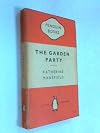
The Garden Party [short story]
by Katherine Mansfield
On This Page
Description
Laura Sheridan find her perspective of life altered when, following her family's garden party, she visits the Sheridan's neighbours to give her condolences on the passing of Mr. Scott. Katherine Mansfield's "The Garden Party" captures the fleeting nature of youth and the unforseen turns that life can take. HarperPerennial Classics brings great works of literature to life in digital format, upholding the highest standards in ebook production and celebrating reading in all its forms. Look for show more more titles in the HarperPerennial Classics collection to build your digital library. show lessTags
Recommendations

































Member Reviews
This is a short story that is on the list of 1001 Books to Read Before You Die. The group on LibraryThing that consists of people trying to read the 1001 books (actually over 1300 on all editions of the list) suggested that we pick a book that we had never heard of before to read in November 2020. This fit the bill for me; in fact I was unfamiliar with the author as well. After I finished the story, which is only 12 pages long, I looked at the Wikipedia entry on Katherine Mansfield and she seems like an interesting woman for her time period at the end of the 19th century and beginning of the 20th century. She was only 34 when she died in 1923, just two years after writing this story. She developed pulmonday tuberculosis and in the days show more before penicillin (it wasn't discovered until 1928) that was pretty much a death sentence.
The story itself starts out on an idyllic summer day in rural England. A garden party is to be held on the grounds of a manor house with all the attendant food, drink and music. Just before it is due to commence one of the daughters of the household hears of the accidental death of a working class person that lives close to the manor house. Her instinct is to cancel the party but she is convinced that the family of the deceased man won't mind if they go ahead. After the party is over her mother sends her to the man's house with a basket full of left-overs from the party. The daughter is quite affected by seeing the body of the accident victim laid out
"There lay a young man, fast asleep--sleeping so soundly, so deeply, that he was far, far away...Oh, so remote, so peaceful. He was dreaming. Never wake him up again. His head was sunk in the pillow, his eyes were closed; they were blind under the closed eyelids. He was given up to his dream. What did garden-parties and baskets and lace frocks matter to him? He was far from all those things. He was wonderful, beautiful. While they were laughing and while the band was playing, this marvel had come to the lane. Happy...happy...All is well, said that sleeping face. This is just as it should be. I am content. But all the same you had to cry..."
The story is very well constructed and conveys a snapshot of class differences in the early 20th century in England. show less
The story itself starts out on an idyllic summer day in rural England. A garden party is to be held on the grounds of a manor house with all the attendant food, drink and music. Just before it is due to commence one of the daughters of the household hears of the accidental death of a working class person that lives close to the manor house. Her instinct is to cancel the party but she is convinced that the family of the deceased man won't mind if they go ahead. After the party is over her mother sends her to the man's house with a basket full of left-overs from the party. The daughter is quite affected by seeing the body of the accident victim laid out
"There lay a young man, fast asleep--sleeping so soundly, so deeply, that he was far, far away...Oh, so remote, so peaceful. He was dreaming. Never wake him up again. His head was sunk in the pillow, his eyes were closed; they were blind under the closed eyelids. He was given up to his dream. What did garden-parties and baskets and lace frocks matter to him? He was far from all those things. He was wonderful, beautiful. While they were laughing and while the band was playing, this marvel had come to the lane. Happy...happy...All is well, said that sleeping face. This is just as it should be. I am content. But all the same you had to cry..."
The story is very well constructed and conveys a snapshot of class differences in the early 20th century in England. show less
A short and concise story about a garden party and how crisis manifests itself differently across class differences. This work is timeless and probably more relevant now than upon its publication.
Tre brevi racconti dalle atmosfere rarefatte, sentimenti semplici, lo stupore, il sesso, l'amore per una piccola creatura.
Bellissimo linguaggio, ma non il mio genere.
Bellissimo linguaggio, ma non il mio genere.
Ratings
Members
- Recently Added By
Lists

Favorite Short Fiction
228 works; 99 members

Books Read in 2024
4,623 works; 126 members
Author Information

386+ Works 8,731 Members
Katherine Mansfield was born Katherine Beauchamp in Wellington, New Zealand on October 14, 1888, the third daughter of a prominent banker. She attended the Wellington College for Girls before entering Queen's College in London in 1903. Her interest in the cello led to lessons at the Royal Academy of Music, where she became secretly engaged to a show more young prodigy named Arnold Trowell, who already had a successful concert career. Upon being summoned back to New Zealand by her father in 1906, she decided to abandon music in favor of writing. She soon had three stories published in a Melbourne monthly and gained her father's consent to return to England. Once there, she became depressed when she found that Trowell no longer loved her, and she rushed into a hasty marriage to a young musician, only to leave him a few days later. She had a miscarriage, which marked the beginning of her decline in health. After returning to England in 1910, Katherine Beauchamp published her work under the name Katherine Mansfield. A collection of her stories, "In a German Pension," was published in 1911. A year later, she met John Middleton Murry, who eventually became her second husband when she was finally able to secure a divorce. By the time of this marriage in 1918, Mansfield was found to have tuberculosis. Her ill health, combined with the death of her brother in World War I, turned the focus of her work inward and on her homeland. Her memoirs, collected in a book entitled "Bliss," secured her reputation as a writer, and she followed it up with the equally acclaimed "Garden Party and Other Stories." Her lyrical style and stream of consciousness method placed her along side James Joyce and Virginia Woolf for her strength of characterization and her subtlety of detail. Katherine Mansfield died on January 9, 1923 at the Gurdjieff Institute for the Harmonic Development of Man at Fontainebleau. (Bowker Author Biography) show less
Some Editions
Series
Belongs to Publisher Series
Salamanderpockets (289)
Work Relationships
Is contained in
Has the adaptation
Has as a student's study guide
Common Knowledge
- Canonical title
- The Garden Party [short story]
- Original publication date
- 1922
- Related movies
- The Garden Party (1973 | IMDb)
- Dedication
- To John Middleton Murry
- First words
- And after all the weather was ideal.
- Last words
- (Click to show. Warning: May contain spoilers.)"Isn't it, darling?" said Laurie.
- Disambiguation notice
- This should be the work for the short story "The Garden Party" only. Other works that include other stories should be separated out and combined with the correct collections.
08.01.21 Someone has screwed this up. T... (show all)he Garden Party is the title of a short story, of the original collection including that short story and others, and of a selection of short stories by Katherine Mansfield published by Everyman, not to be confused with other Selected Stories, and edited and introduced by Claire Tomalin
Classifications
Statistics
- Members
- 83
- Popularity
- 384,034
- Reviews
- 3
- Rating
- (3.87)
- Languages
- 6 — Dutch, English, French, Italian, Portuguese, Spanish
- Media
- Paper, Ebook
- ISBNs
- 11
- ASINs
- 6