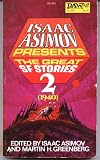
Isaac Asimov Presents : The Great SF Stories 2 (1940)
by Isaac Asimov (Editor, Introduction), Martin H. Greenberg (Introduction), Martin Harry Greenberg (Editor)
On This Page
Tags
Recommendations










Member Reviews
The journey through SF history continues, with more clumsy first steps; this volume is a bit of a letdown from the 1939 volume that began the series.
Two of the stories were (eventually) award nominated, picking up Retro Hugo nominations in 2016, and they are by far the best work in the book. Theodore Sturgeon's "It" sits at the intersection of SF and horror, and it's an effectively scary tale of a strange creature wandering through a forest and the family who live nearby; and Harry Bates's "Farewell to the Master" is the story that inspired The Day the Earth Stood Still, though the movie changed the plot quite dramatically.
There are a few more worthwhile stories to be found.Asimov's "Strange Playfellow" is presented here in its original show more version; Asimov would polish the story a bit and change the title to "Robbie" when it was included in his I, Robot. Willard Hawkins's "The Dwindling Sphere" is notable as an early story on the problem of limited natural resources; Robert Arthur's "Postpaid to Paradise" is a tale of an idyllic tropical isle that can only be reached by fantastic means, a thematic forerunner to some of Jack Finney's work. Ross Rocklynne's "Quietus" is an early entry in a long line of stories in which first contact goes awry because of faulty assumptions made by one side, with an unusually melancholy ending as one character can't stop wondering what he might have done differently.
Rocklynne is one of three authors represented by two stories here, along with Sturgeon and L. Sprague De Camp. There's also some reasonably good work from legends Fritz Leiber and Jack Williamson, another impenetrable slog from A. E. van Vogt, and stories from the less well-remembered Oscar J. Friend and P. Schuyler Miller.
Three stories by Robert A. Heinlein were meant to be included, but rights issues got in the way. Asimov and Greenberg made the unusual choice to give each of those stories a page of the book, contributing their usual introductions -- Greenberg focuses on the career of each author, and Asimov reminisces about his personal relationships -- despite the fact that the stories aren't here. The inclusion of those stories -- "Requiem," "Coventry," and "Blowups Happen," all of which were Retro Hugo nominees -- would have raised the overall quality of the book significantly, and it would have felt more on a par with the 1939 volume. show less
Two of the stories were (eventually) award nominated, picking up Retro Hugo nominations in 2016, and they are by far the best work in the book. Theodore Sturgeon's "It" sits at the intersection of SF and horror, and it's an effectively scary tale of a strange creature wandering through a forest and the family who live nearby; and Harry Bates's "Farewell to the Master" is the story that inspired The Day the Earth Stood Still, though the movie changed the plot quite dramatically.
There are a few more worthwhile stories to be found.Asimov's "Strange Playfellow" is presented here in its original show more version; Asimov would polish the story a bit and change the title to "Robbie" when it was included in his I, Robot. Willard Hawkins's "The Dwindling Sphere" is notable as an early story on the problem of limited natural resources; Robert Arthur's "Postpaid to Paradise" is a tale of an idyllic tropical isle that can only be reached by fantastic means, a thematic forerunner to some of Jack Finney's work. Ross Rocklynne's "Quietus" is an early entry in a long line of stories in which first contact goes awry because of faulty assumptions made by one side, with an unusually melancholy ending as one character can't stop wondering what he might have done differently.
Rocklynne is one of three authors represented by two stories here, along with Sturgeon and L. Sprague De Camp. There's also some reasonably good work from legends Fritz Leiber and Jack Williamson, another impenetrable slog from A. E. van Vogt, and stories from the less well-remembered Oscar J. Friend and P. Schuyler Miller.
Three stories by Robert A. Heinlein were meant to be included, but rights issues got in the way. Asimov and Greenberg made the unusual choice to give each of those stories a page of the book, contributing their usual introductions -- Greenberg focuses on the career of each author, and Asimov reminisces about his personal relationships -- despite the fact that the stories aren't here. The inclusion of those stories -- "Requiem," "Coventry," and "Blowups Happen," all of which were Retro Hugo nominees -- would have raised the overall quality of the book significantly, and it would have felt more on a par with the 1939 volume. show less
Racconti preferiti
— La sfera che rimpiccioliva (The Dwindling Sphere) *****
di Willard Hawkins
— Nella tenebra (Into the Darkness) ****
di Ross Rocklynne
— Quietus (Quietus) ***
di Ross Rocklynne
— Uno strano compagno di giochi (Strange Playfellow) ***
conosciuto anche come: Robbie
di Isaac Asimov
— Addio al padrone (Farewell to the Master) ****
di Harry Bates
— La sfera che rimpiccioliva (The Dwindling Sphere) *****
di Willard Hawkins
— Nella tenebra (Into the Darkness) ****
di Ross Rocklynne
— Quietus (Quietus) ***
di Ross Rocklynne
— Uno strano compagno di giochi (Strange Playfellow) ***
conosciuto anche come: Robbie
di Isaac Asimov
— Addio al padrone (Farewell to the Master) ****
di Harry Bates
I migliori racconti fantastici apparsi nelle riviste di settore nel 1940. Tutti i racconti sono accompagnati dalla recensione dell'epoca e da una breve recensione di Isaac Asimov. La cosa appare più evidente è la differenza di linguaggio e di termini nella distanza di 70 anni. Come è giusto che sia, alcuni sono più belli di altri. Peccato che per scelta editoriale e per problemi di licenze manchino i tre raccondi di Heinlein, pur essendoci i titoli e le recensioni. Da leggere perchè ci si accorge una volta di più che non c'è niente di nuovo sotto il sole.
Feb 19, 2009Italian
Ratings
Members
- Recently Added By
Author Information

Isaac Asimov was born in Petrovichi, Russia, on January 2, 1920. His family emigrated to the United States in 1923 and settled in Brooklyn, New York, where they owned and operated a candy store. Asimov became a naturalized U.S. citizen at the age of eight. As a youngster he discovered his talent for writing, producing his first original fiction at show more the age of eleven. He went on to become one of the world's most prolific writers, publishing nearly 500 books in his lifetime. Asimov was not only a writer; he also was a biochemist and an educator. He studied chemistry at Columbia University, earning a B.S., M.A. and Ph.D. In 1951, Asimov accepted a position as an instructor of biochemistry at Boston University's School of Medicine even though he had no practical experience in the field. His exceptional intelligence enabled him to master new systems rapidly, and he soon became a successful and distinguished professor at Columbia and even co-authored a biochemistry textbook within a few years. Asimov won numerous awards and honors for his books and stories, and he is considered to be a leading writer of the Golden Age of science fiction. While he did not invent science fiction, he helped to legitimize it by adding the narrative structure that had been missing from the traditional science fiction books of the period. He also introduced several innovative concepts, including the thematic concern for technological progress and its impact on humanity. Asimov is probably best known for his Foundation series, which includes Foundation, Foundation and Empire, and Second Foundation. In 1966, this trilogy won the Hugo award for best all-time science fiction series. In 1983, Asimov wrote an additional Foundation novel, Foundation's Edge, which won the Hugo for best novel of that year. Asimov also wrote a series of robot books that included I, Robot, and eventually he tied the two series together. He won three additional Hugos, including one awarded posthumously for the best non-fiction book of 1995, I. Asimov. "Nightfall" was chosen the best science fiction story of all time by the Science Fiction Writers of America. In 1979, Asimov wrote his autobiography, In Memory Yet Green. He continued writing until just a few years before his death from heart and kidney failure on April 6, 1992. (Bowker Author Biography) show less

Martin Harry Greenberg (March 1, 1941 - June 25, 2011) was an American academic and speculative fiction anthologist. In all, he compiled 1,298 anthologies. He founded Tekno Books, a packager of more than 2000 published books; he was also a co-founder of the Sci-Fi Channel. Some of his anthologies included: Past Imperfect (2001), Once Upon a Galaxy show more (2002) and Sirius: The Dog Star (2004). (Bowker Author Biography) show less
All Editions
Some Editions
Series
Belongs to Publisher Series
Work Relationships
Is contained in
Contains
Common Knowledge
- Canonical title
- Isaac Asimov Presents : The Great SF Stories 2 (1940) (1940)
- Original title
- Isaac Asimov Presents: The Great SF Stories 2 (1940) (1940)
- Alternate titles
- Great Science Fiction Stories of 1940
- Original publication date
- 1979
- Original language*
- Englisch
*Some information comes from Common Knowledge in other languages. Click "Edit" for more information.
Classifications
- Genres
- Science Fiction, Fiction and Literature
- DDC/MDS
- 813.0876 — Literature & rhetoric American literature in English American fiction in English By type Genre fiction Adventure fiction Speculative fiction
- LCC
- PS648 — Language and Literature American literature American literature Collections of American literature Prose (General)
- BISAC
Statistics
- Members
- 159
- Popularity
- 205,339
- Reviews
- 4
- Rating
- (3.47)
- Languages
- English, German, Italian
- Media
- Paper
- ISBNs
- 6
- ASINs
- 5