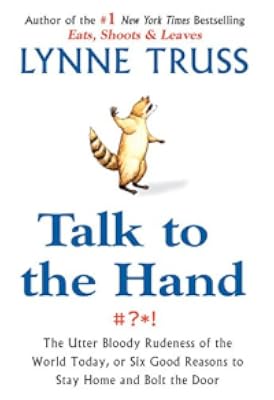
Talk to the Hand
by Lynne Truss
On This Page
Description
An evaluation of the way discourteous behavior has become commonplace and even applauded in today's society is a humorous call to arms that challenges ill manners and the practices that support them.Tags
Recommendations






Member Reviews
I blame myself. Or as author Lynne Truss would have it, I blame my Effing self. I should have been wise to the kind of book Talk to the Hand: #?*! The Utter Bloody Rudeness of the World Today, or Six Good Reasons to Stay Home and Bolt the Door would prove to be: the lament of the agéd against the young. But somehow I never even saw it coming.
Talk to the Hand rapidly degenerates into a diatribe against Generations X, Y and the Millenials.
In fairness, Truss can see her own crotchetiness — on rare occasion.
Actually, Truss’ observation is incorrect. When I was still in high school, my younger brother brought to my attention a lament about how the young were feckless, rude and disrespectful of their elders and betters. The writer bemoaning this new generation lived in Ancient Egypt.
People diagnosed with OCD know in their heads that they shouldn’t be washing their hands at every turn, but they can’t make themselves stop. But, as with someone with OCD, although Truss seems to know in her heart that every generation of senior citizens vilify the young, she can’t manage to make herself stop. If anything, she revs up the invective even more with each ensuing chapter.
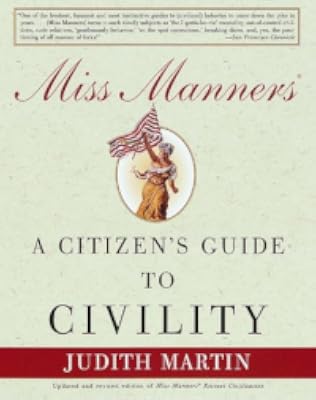
In the chapter, “The First Good Reason: Was That so Hard to Say?,” Truss asks, “Should we get out more? Or is going out the problem, and we should actually stay in?” The answer is neither. Truss should instead read Judith Martin’s Miss Manners' Guide for the Turn-of-the-Millennium. Then she can be free to get out more — but not till then.
Naturally, I would never recommend Martin’s Star-Spangled Manners: In Which Miss Manners Defends American Etiquette to Miss Truss. After all, wouldn’t implying that American manners outclassed Truss’ own British ones be rude? show less
Talk to the Hand rapidly degenerates into a diatribe against Generations X, Y and the Millenials.
Point out bad manners to anyone younger than thirty-five, and you risk a lash-back reflex response of shocking disproportion. “Excuse me, I think your child dropped with sweet wrapper.” “Why don’t you Eff Off, you fat cow,” comes the automatic reply. A man on a London bus recently told off ashow more
gang of boys, and was set on fire. Another was stabbed to death when he objected to someone throwing food at his girlfriend. How many of us dare to cry, “Get off that skateboard, you hooligan!” in such a moral climate?The problem here is that, as Judith Martin (a.k.a. “Miss Manners”) points out in her own etiquette guides, calling people out on their rude behavior is, in itself, rude. (There are other, more satisfactory and effective ways to protect one’s self from bad behavior.) But Truss never once acknowledges that ironic conundrum.
In fairness, Truss can see her own crotchetiness — on rare occasion.
If one takes the view that modern-day manners are superior to the cheerful spit-and-stamp of olden times, a paradox begins to emerge: while standards have been set ever higher, people have become all the more concerned that standards are actually dropping. Basically, people have been complaining about the state of manners since at least the fifteenth century.
Actually, Truss’ observation is incorrect. When I was still in high school, my younger brother brought to my attention a lament about how the young were feckless, rude and disrespectful of their elders and betters. The writer bemoaning this new generation lived in Ancient Egypt.
People diagnosed with OCD know in their heads that they shouldn’t be washing their hands at every turn, but they can’t make themselves stop. But, as with someone with OCD, although Truss seems to know in her heart that every generation of senior citizens vilify the young, she can’t manage to make herself stop. If anything, she revs up the invective even more with each ensuing chapter.
In the chapter, “The First Good Reason: Was That so Hard to Say?,” Truss asks, “Should we get out more? Or is going out the problem, and we should actually stay in?” The answer is neither. Truss should instead read Judith Martin’s Miss Manners' Guide for the Turn-of-the-Millennium. Then she can be free to get out more — but not till then.
Naturally, I would never recommend Martin’s Star-Spangled Manners: In Which Miss Manners Defends American Etiquette to Miss Truss. After all, wouldn’t implying that American manners outclassed Truss’ own British ones be rude? show less
Not quite as electrifying (personally) as Eats, Shoots & Leaves, but quite enjoyable all the same. I particularly enjoyed Truss's criticism of automated phone recordings (e.g. when you call the cable company), and how, despite the multitude of polite words the automated voices use, these systems are the opposite of polite because they do not attempt to meet the customer halfway; they are entirely for the company's convenience. Her examination of private/public space was also interesting; with the advent of cell phones, ipods, tablets, etc., people act as if they are in private even when they are in public, and expect to be left alone in their personal space bubble.
"It is no accident...that adherence to 'manners' has broken down just as show more money and celebrity have largely replaced birth as the measure of social status." (12)
...all the important rules surely boil down to one: remember you are with other people; show some consideration. (12)
Manners were never enforceable, in any case. Indeed, for many philosophers, this is regarded as their chief value: that they are voluntary. (13)
Manners are about imagination, ultimately. They are about imagining being the other person. (24)
When you ask, "Why?" these days, you instantly lose status. Asking, "Why?" usually signals the end of all meaningful exchange. So they get away with it, the bastards. (75)
Count the role models for respectfulness, and...you will have to admit there is only one: Babe. That's it. Just one small sturdy imaginary sheep-pig stands between us and total moral decay. (172-173) show less
"It is no accident...that adherence to 'manners' has broken down just as show more money and celebrity have largely replaced birth as the measure of social status." (12)
...all the important rules surely boil down to one: remember you are with other people; show some consideration. (12)
Manners were never enforceable, in any case. Indeed, for many philosophers, this is regarded as their chief value: that they are voluntary. (13)
Manners are about imagination, ultimately. They are about imagining being the other person. (24)
When you ask, "Why?" these days, you instantly lose status. Asking, "Why?" usually signals the end of all meaningful exchange. So they get away with it, the bastards. (75)
Count the role models for respectfulness, and...you will have to admit there is only one: Babe. That's it. Just one small sturdy imaginary sheep-pig stands between us and total moral decay. (172-173) show less
Wow, I can't remember being this disappointed with a book...well, I was going to say "in a long time," but I might more accurately say "ever." In terms of disparity between my expectations and the reality, this is the most disappointing book I've ever read. I give it one star, and a glance over my reviews will demonstrate that I almost never do that.
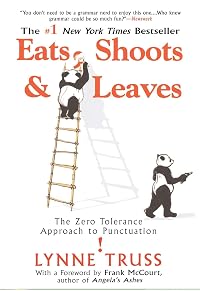
I read, and loved, Truss's previous work, [b:Eats, Shoots & Leaves: The Zero Tolerance Approach to Punctuation|8600|Eats, Shoots & Leaves The Zero Tolerance Approach to Punctuation|Lynne Truss|http://photo.goodreads.com/books/1309285488s/8600.jpg|854886]. It was funny, erudite, and most importantly, it was self-righteous and self-important in exactly the right places and right amounts. That show more it dealt with a topic dear to my heart (the gradual erosion of literacy through shoddy grammar and punctuation) only made it more enjoyable for me.
So when I sat down to read Talk to the Hand, I expected something similar: a humorous yet fiery diatribe, rich with research and examples, only in this case railing against the decline of personal manners rather than grammar. What I got was a crotchety, unfunny whine-fest that continually tried to extrapolate bad manners into low overall moral character. She takes the flamethrower to entire armies of strawmen in this book, as I've simply never met anyone as rude as some of her examples. Her stories about eight-year old kids cussing out their parents in public sound exactly like the "what is our country coming to" chain e-mails I used to get forwarded to me by my fifty-something aunts and cousins years ago, and they ring horribly false. In addition, she lets some rather ugly biases slip with blithe references to "shaven-headed bling bling gangstas" and such.
Worst of all, this wasn't even a fun read. Unlike her last book, which was so stuffed with content that the pages flew by, this one dragged and was amazingly repetitive. Honestly, I was a little worried when I found myself fighting the temptation to skim the end of the introduction, thinking "OK, I get it, I get it, I get it..." This book felt like a 20-page magazine article stretched into a 200-page book. And Truss's decision to sanitize the word fuck into Eff (e.g. Eff this, Eff you, you Effing such-and-such) was jarring, off-putting, and made large stretches of the book just plain annoying to slog through. All in all, this was a grumpy, miserable, spittle-flecked little book, and I can't discourage you strongly enough from picking it up. Stick to the book with the pandas on the cover. show less
I read, and loved, Truss's previous work, [b:Eats, Shoots & Leaves: The Zero Tolerance Approach to Punctuation|8600|Eats, Shoots & Leaves The Zero Tolerance Approach to Punctuation|Lynne Truss|http://photo.goodreads.com/books/1309285488s/8600.jpg|854886]. It was funny, erudite, and most importantly, it was self-righteous and self-important in exactly the right places and right amounts. That show more it dealt with a topic dear to my heart (the gradual erosion of literacy through shoddy grammar and punctuation) only made it more enjoyable for me.
So when I sat down to read Talk to the Hand, I expected something similar: a humorous yet fiery diatribe, rich with research and examples, only in this case railing against the decline of personal manners rather than grammar. What I got was a crotchety, unfunny whine-fest that continually tried to extrapolate bad manners into low overall moral character. She takes the flamethrower to entire armies of strawmen in this book, as I've simply never met anyone as rude as some of her examples. Her stories about eight-year old kids cussing out their parents in public sound exactly like the "what is our country coming to" chain e-mails I used to get forwarded to me by my fifty-something aunts and cousins years ago, and they ring horribly false. In addition, she lets some rather ugly biases slip with blithe references to "shaven-headed bling bling gangstas" and such.
Worst of all, this wasn't even a fun read. Unlike her last book, which was so stuffed with content that the pages flew by, this one dragged and was amazingly repetitive. Honestly, I was a little worried when I found myself fighting the temptation to skim the end of the introduction, thinking "OK, I get it, I get it, I get it..." This book felt like a 20-page magazine article stretched into a 200-page book. And Truss's decision to sanitize the word fuck into Eff (e.g. Eff this, Eff you, you Effing such-and-such) was jarring, off-putting, and made large stretches of the book just plain annoying to slog through. All in all, this was a grumpy, miserable, spittle-flecked little book, and I can't discourage you strongly enough from picking it up. Stick to the book with the pandas on the cover. show less
This is both more thoughtful and more humorous than the title implies. It was interesting to compare cultural and generational differences in our approaches to social interaction. I agree with her on many points, but I also live in a small town in Wisconsin, where most of the people I meet on the street or in stores are nice to strangers because that's still how we're raised to be. Many of her experiences in "shops" or when using public transportation don't really apply to my daily experience. I can see more of what she's talking about when I look at my Yahoo home page "news" items or when I'm navigating a menu of options on the phone, trying to get to a real person.
I'd be interested to see if her ideas of the decline in customer show more service have changed at all in this current climate of unemployment and people needing to hold on to their jobs or businesses for dear life. I imagine her attitude toward do-it-yourself service would be the same, and I'd agree with her, but I think the face-to-face interactions may be shifting back to the more traditional approach of appeasing customers to keep from losing their business.
I liked the emphasis in her conclusion on each of us doing our part if we want things to change, rather than this being simply a book of funny ranting. It made me laugh and it made me reflect. Good ol' Lynne Truss. show less
I'd be interested to see if her ideas of the decline in customer show more service have changed at all in this current climate of unemployment and people needing to hold on to their jobs or businesses for dear life. I imagine her attitude toward do-it-yourself service would be the same, and I'd agree with her, but I think the face-to-face interactions may be shifting back to the more traditional approach of appeasing customers to keep from losing their business.
I liked the emphasis in her conclusion on each of us doing our part if we want things to change, rather than this being simply a book of funny ranting. It made me laugh and it made me reflect. Good ol' Lynne Truss. show less
Talk to the Hand is an amiable rant about the decline in civil behaviour and the concomitant rise in "utter bloody rudeness". I liked it because it is lighthearted, a quick read, and because it conforms to pretty well all of my own prejudices on the subject.
"...the collapse of manners stands for a vast and under-acknowledged problem of social immorality. Manners are based on an ideal of empathy, of imagining the impact of one's own actions on others. They involve doing something for the sake of other people that is not obligatory and attracts no reward. In the current climate of unrestrained solipsistic and aggressive self-interest, you can equate good manners not only with virtue but with positive heroism".
As Truss says, it is really show more not all that complicated: "all the important rules surely boil down to one: remember you are with other people; show some consideration". Alas, even this simple rule seems beyond the ken of many. Truss rants about the loss of little words such as please and thank you in "supportive interchange" between people; the tendency of modern corporations and service providers to increasingly put the onus and work on the customer; the aggrandizement of personal space to the point where it trumps everything else, including interaction with other people; the universal eff-off reflex; the idea that authority is some kind of personal insult that much be challenged and that deference indicates some kind of inferiority; and finally, that, "The once prevalent idea that, as individuals, we have a relationship with something bigger than ourselves, or bigger than our immediate circle, has become virtually obsolete".
As I said, an enjoyable rant and social commentary. show less
"...the collapse of manners stands for a vast and under-acknowledged problem of social immorality. Manners are based on an ideal of empathy, of imagining the impact of one's own actions on others. They involve doing something for the sake of other people that is not obligatory and attracts no reward. In the current climate of unrestrained solipsistic and aggressive self-interest, you can equate good manners not only with virtue but with positive heroism".
As Truss says, it is really show more not all that complicated: "all the important rules surely boil down to one: remember you are with other people; show some consideration". Alas, even this simple rule seems beyond the ken of many. Truss rants about the loss of little words such as please and thank you in "supportive interchange" between people; the tendency of modern corporations and service providers to increasingly put the onus and work on the customer; the aggrandizement of personal space to the point where it trumps everything else, including interaction with other people; the universal eff-off reflex; the idea that authority is some kind of personal insult that much be challenged and that deference indicates some kind of inferiority; and finally, that, "The once prevalent idea that, as individuals, we have a relationship with something bigger than ourselves, or bigger than our immediate circle, has become virtually obsolete".
As I said, an enjoyable rant and social commentary. show less
An examination of the collapse of manners in every day life, Lynne Truss unleashes her wit (and exasperation) in an effort to amend the situation. Exploring the six reasons why one should stay home and bolt the door that revolve around the increasing disappearance of manners and the encroaching lack of respect that happens as a result, Truss explores the history of manners and the reflections on society that manners have. While there are some very funny moments in the book, I was not as taken with this volume as I was with Eats, Shoots & Leaves, perhaps because manners are not as important to me as grammar and punctuation are. Or perhaps, as Truss argues towards the beginning of the book, I am simply too young for many of these things show more to bother me. Additionally, this book is almost exclusively focused on the descent of British manners and makes several arguments surrounding the defunct class system that was far more potent on that side of the pond which means that some of the examples used are not as cross-culturally applicable. An interesting read that will make you think and probably chortle a little, and perhaps encourage you to thank the person who held the door open for you. show less
The topic of Lynne Truss’s follow-up to the highly enjoyable Eats, Shoots and Leaves – rudeness and the perceived decline in public manners – is a winner. It’s fun, it’s engaging, and everyone has an opinion on it.
For the most part, this is enough to sustain Talk to the Hand. It’s a very short book (just over 200 tiny pages), and since anecdotal evidence of rudeness abounds, Truss is never short of entertaining stories and examples.
But I found Truss’s conclusions unsatisfactory. She implies – but never quite acknowledges – that her own (and many, many other people’s) realistic fear of getting physically assaulted for calling out rude people is the trump card for declining civility. Standards drop because we’re show more too afraid to enforce them. To her credit, Truss (who identifies herself as a typical Guardian-reading lefty) realizes that to a large degree this unwillingness to confront rudeness is the result of political correctness and class consciousness. She even quotes approvingly Theodore Dalrymple, who is a conservative’s conservative. But she is ultimately unwilling to concede that the conservative view of civility, and indeed of civilization itself, is a better fit for the reality of human nature. Instead, she sputters and obfuscates and throws up her metaphorical hands.
And that’s too bad, because given her readership, Truss misses an opportunity here to really drive home a serious point, and she undercuts the force of her whole book. show less
For the most part, this is enough to sustain Talk to the Hand. It’s a very short book (just over 200 tiny pages), and since anecdotal evidence of rudeness abounds, Truss is never short of entertaining stories and examples.
But I found Truss’s conclusions unsatisfactory. She implies – but never quite acknowledges – that her own (and many, many other people’s) realistic fear of getting physically assaulted for calling out rude people is the trump card for declining civility. Standards drop because we’re show more too afraid to enforce them. To her credit, Truss (who identifies herself as a typical Guardian-reading lefty) realizes that to a large degree this unwillingness to confront rudeness is the result of political correctness and class consciousness. She even quotes approvingly Theodore Dalrymple, who is a conservative’s conservative. But she is ultimately unwilling to concede that the conservative view of civility, and indeed of civilization itself, is a better fit for the reality of human nature. Instead, she sputters and obfuscates and throws up her metaphorical hands.
And that’s too bad, because given her readership, Truss misses an opportunity here to really drive home a serious point, and she undercuts the force of her whole book. show less
Members
- Recently Added By
Published Reviews
ThingScore 75
Talk to the Hand does occasionally read like a thank-you letter extended ambitiously to the second side of the notepaper. Yet it addresses an important subject with intelligence and humour, and for that we should certainly be grateful.
added by mikeg2
Author Information

42+ Works 24,203 Members
Lynne Truss was born on May 31, 1955, in Kingston upon Thames, England. She is an English writer and journalist. Her book Eats, Shoots & Leaves: The Zero Tolerance Approach to Punctuation was a best-seller in 2003. Truss received a first-class honors degree in English Language and Literature from University College London in 1977. After show more graduation, she worked for the Radio Times as a sub-editor before moving to the Times Higher Education Supplement as the deputy literary editor in 1978. From 1986 to 1990, she was the literary editor of The Listener and was an arts and books reviewer for The Independent on Sunday before joining The Times in 1991. She currently reviews books for The Sunday Times. She has also written numerous books including Tennyson's Gift; Going Loco; Eats, Shoots and Leaves: The Zero Tolerance Approach to Punctuation; and Talk to the Hand: The Utter Bloody Rudeness of the World Today, or Six Good Reasons to Stay Home and Bolt the Door. (Bowker Author Biography) show less
Some Editions
Awards and Honors
Distinctions
Work Relationships
Is contained in
Common Knowledge
- Canonical title
- Talk to the Hand
- Original title
- Talk to the Hand
- Alternate titles*
- Yu shou shuo hua
- Original publication date
- 2005
- Epigraph
- Other people are quite dreadful. The only possible society is oneself.
Oscar Wilde
An apology is a gesture through which an individual splits himself into to parts: the part that is guilty of the offense, and the part that dissociates itself from the delict and affirms a belief in the offended rule.
Fuck off, Norway.
Paul Gasciogne, on being asked if he had a message for the people of Norway. - First words
- Introduction
If you want a short-cut to an alien culture these days, there is no quicker route than to look at a French phrase book.
The trouble with traditional good manners, as any fool knows, is judging where to draw the line. - Last words
- (Click to show. Warning: May contain spoilers.)Or, if we can't go quite that far, let's just remember to put the empty beer can in the bin while we're down there . . .
- Blurbers
- McCourt, Frank
*Some information comes from Common Knowledge in other languages. Click "Edit" for more information.
Classifications
Statistics
- Members
- 2,557
- Popularity
- 7,426
- Reviews
- 57
- Rating
- (3.32)
- Languages
- 9 — English, French, German, Italian, Serbian, Swedish, Portuguese (Portugal), Portuguese (Brazil), Chinese, simplified
- Media
- Paper, Audiobook, Ebook
- ISBNs
- 27
- ASINs
- 13