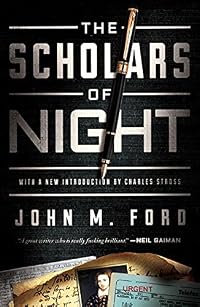
The Scholars of Night
by John M. Ford
On This Page
Description
"Nicholas Hansard is a brilliant historian at a small New England college. He specializes in Christopher Marlowe. But Hansard has a second, secret, career with The White Group, a "consulting agency" with shadowy government connections. There, he is a genius at teasing secrets out of documents old and new--to call him a code-breaker is an understatement. When Hansard's work exposes one of his closest friends as a Russian agent, and the friend then dies mysteriously, the connections seem all show more too clear. Shaken, Hansard turns away from his secret work to lose himself in an ancient Marlowe manuscript. Surely, a lost 400 year old play is different enough from modern murder. He is very, very wrong"--Amazon. show lessTags
Recommendations


















Member Reviews
Still unwell. Ugh. John M Ford, man-about-literature, wrote a spy novel, and it is a clever, elliptical tale of game-playing and historical secrets and a plot that, quite properly, reveals a contempt and hate and fear of the world that gives us spy novels. Ford can be downright obscure in his writing, but I thought it all worked to his advantage here in the murky world of secrets and betrayals and double meanings and triple agents. I do now wish he'd written a novel about Christopher Marlowe. The brief historical bits made me want to go reread The Dragon Waiting (or Waldrop's Heart of Whitenesse.)
This is a Cold War spy thriller, published in 1988, when the Cold War was still on and fear of nuclear annihilation still felt very, very imminent. Ford was a great writer, and this book gives the lie to the defense for the sexism and other attitudes we are often urged not to criticize in older works "He was of his time." Ford's female characters have to deal with the sexism and misogyny of the time, but they themselves are strong, intelligent, independent, and not treated by Ford as if they deserve the attitudes they have to struggle against.
Nicholas Hansard is a young professor of history at a small college, who also has a tiny toehold in the world of espionage--though he's not entirely aware of it. He just does some research and show more document authentication for The White Group, and has no real idea what The White Group really is.
The really important thing he doesn't know, though, is that his mentor, Allan Berenson, is a spy, theoretically part of the US intelligence world, but in reality working for the Russians. When Berenson dies, apparently of a heart attack but in fact a carefully staged elimination of the double agent, things start spinning out of control, not just in Hansard's life, but, especially there.
He nearly quits his enjoyable little side job with The White Group, having realized by events surrounding Berenson's death that something is very odd, but is persuaded to at least delay that resignation with the bait of a newly discovered play purportedly by Christopher Marlowe--who was himself a spy employed by Elizabeth I's spymaster, Francis Walsingham. He's given a copy, and sent to England to do the research necessary to determine if it's real.
Once there, he meets a woman named Ellen Maxwell at the British Library, who is also there apparently doing research.
Meanwhile, we are seeing other parts of the story from other viewpoints, including at a military wargaming center in Britain, a joint NATO operation testing new equipment and plans. We also see high-level Soviet (and more than thirty years later, I initially typed "Russian," because the world has changed) operatives in Britain, and the woman who was the number two in Berenson's ring, still working to carry out his plan, which includes a nuclear strike.
All the different threads and players are intertwined in the story, and we can't always be sure who is really working for who. We don't, above all, know who Berenson's loyal and determined number two, going by code name WAGNER, really is, though there's more than one candidate, as well as the possibility that she's someone else.
This is a subtle intricate, and satisfying Cold War spy thriller, with a greater awareness of the distance between social rules and reality than most (not all) of Ford's contemporaries in the field.
Ford died in 2006, and due to lack of a will and a literary executor, and misunderstandings, his work has been out of print ever since. It's a joy to have this book available again after so many years, with the rest of Ford's work scheduled to be published over the next few years. Fair warning: This is his only book that isn't science fiction or fantasy, and this one is, arguably, alternate history, or secret history. The first to come back into print, last year, was The Dragon Waiting, is an alternate history historical fantasy.
Highly recommended, and I mean that not just for this book, but for all of them, as they become available again.
I bought this book show less
Nicholas Hansard is a young professor of history at a small college, who also has a tiny toehold in the world of espionage--though he's not entirely aware of it. He just does some research and show more document authentication for The White Group, and has no real idea what The White Group really is.
The really important thing he doesn't know, though, is that his mentor, Allan Berenson, is a spy, theoretically part of the US intelligence world, but in reality working for the Russians. When Berenson dies, apparently of a heart attack but in fact a carefully staged elimination of the double agent, things start spinning out of control, not just in Hansard's life, but, especially there.
He nearly quits his enjoyable little side job with The White Group, having realized by events surrounding Berenson's death that something is very odd, but is persuaded to at least delay that resignation with the bait of a newly discovered play purportedly by Christopher Marlowe--who was himself a spy employed by Elizabeth I's spymaster, Francis Walsingham. He's given a copy, and sent to England to do the research necessary to determine if it's real.
Once there, he meets a woman named Ellen Maxwell at the British Library, who is also there apparently doing research.
Meanwhile, we are seeing other parts of the story from other viewpoints, including at a military wargaming center in Britain, a joint NATO operation testing new equipment and plans. We also see high-level Soviet (and more than thirty years later, I initially typed "Russian," because the world has changed) operatives in Britain, and the woman who was the number two in Berenson's ring, still working to carry out his plan, which includes a nuclear strike.
All the different threads and players are intertwined in the story, and we can't always be sure who is really working for who. We don't, above all, know who Berenson's loyal and determined number two, going by code name WAGNER, really is, though there's more than one candidate, as well as the possibility that she's someone else.
This is a subtle intricate, and satisfying Cold War spy thriller, with a greater awareness of the distance between social rules and reality than most (not all) of Ford's contemporaries in the field.
Ford died in 2006, and due to lack of a will and a literary executor, and misunderstandings, his work has been out of print ever since. It's a joy to have this book available again after so many years, with the rest of Ford's work scheduled to be published over the next few years. Fair warning: This is his only book that isn't science fiction or fantasy, and this one is, arguably, alternate history, or secret history. The first to come back into print, last year, was The Dragon Waiting, is an alternate history historical fantasy.
Highly recommended, and I mean that not just for this book, but for all of them, as they become available again.
I bought this book show less
One of the best cold war thrillers ever written. I managed to score a copy of the eARC of the new edition from NetGalley, and promptly started reading. I've owned a copy of the original paperback for many years.
Nicholas Hansard is an historian at a small US college. He plays 'live action' Diplomacy with Dr Allan Berenson and a small circle of friends and students. Both he and Berenson work for the White Group, a US agency. 2 documents are found: a WWII dossier that went missing when the courier died in action, and a lost Christopher Marlowe play found in an English country house. The first implicates Berenson as a double agent, the second Hansard is asked to authenticate after Berenson is assassinated. Unbeknownst to both sides, show more Berenson has been building a network of his own - to start WWIII. After his death, his lover takes over. It's a race against time to prevent this happening.
Written in the format of a play, the action is part flashback, part real-time and part dramatic reconstruction. A typical densely-plotted Ford novel, the story drags you in and keeps you there to the conclusion.
The book is due to be released this autumn - buy it! show less
Nicholas Hansard is an historian at a small US college. He plays 'live action' Diplomacy with Dr Allan Berenson and a small circle of friends and students. Both he and Berenson work for the White Group, a US agency. 2 documents are found: a WWII dossier that went missing when the courier died in action, and a lost Christopher Marlowe play found in an English country house. The first implicates Berenson as a double agent, the second Hansard is asked to authenticate after Berenson is assassinated. Unbeknownst to both sides, show more Berenson has been building a network of his own - to start WWIII. After his death, his lover takes over. It's a race against time to prevent this happening.
Written in the format of a play, the action is part flashback, part real-time and part dramatic reconstruction. A typical densely-plotted Ford novel, the story drags you in and keeps you there to the conclusion.
The book is due to be released this autumn - buy it! show less
I read this because I really liked Dragon Waiting. Scholars of Night is a very different kettle of fish; different in genre and style. John Ford did not, as many, write the same book over and over; this is one of his great virtues. Scholars is a cold war thriller, a story of scholars and spies, and of a long lost Marlowe play. Lots of twists and turns. As usual, Ford takes no prisoners. He expects readers to have a good knowledge of history and literature, and to pay attention. If that doesn't put you off, do yourself a favor and read the book.
Ford is mostly known for his science fiction and fantasy, but this is a spy story and a murder mystery. If you like nice tight ends, this is not the book for you. However, if you like interesting characters caught up in events that are too big for them to handle and gripping action, I recommend giving this a try. Ford's characters always transcend the genre conventions he chose to work with.
The legendarily smart and erudite Ford died young in 2006, and Tor Books is bringing his work back into print. Scholars is a 1988 Cold War spy thriller; the discovery of a list of Soviet double agents triggers a round of murder and betrayal, as the lover of the first murdered agent begins carrying out an audacious plan while Western and Soviet agencies try to stop her. Pulled into the action is Nicholas Hansard, a history professor valued by the spooks for his ability to spot patterns and authenticate documents. Also significant is a recently-found, previously unknown play by [[Christopher Marlowe]] which seems to depict an involvement of Marlowe with the spies of his 1500s-era England.
Hansard's development from analyst to field agent show more is well done. The Mcguffin is a secret computer board involved in warfare command-and-control, a refreshing change from the usual superweapon. The double identity of the vengeful lover is a bit too easy to figure out. Ford, who also wrote excellent poetry, has fun synthesizing verse by Marlowe from the discovered manuscript, and tense scenes with Queen Elizabeth I's spymaster Walsingham. Much is made of board games like Diplomacy, which Handsard and the spooks love to play in their spare time.
I started this book fearing its double crosses might be too intricate for me. However, I followed it without too much trouble - or, of course, it was way too smart for me and I missed a lot. The characters do frequently have realizations about personal relationships that seem opaque to me.
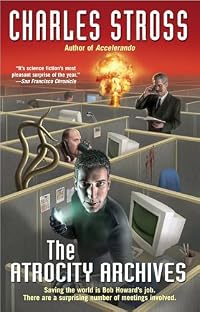
This 2021 edition features a brief introduction by Charles Stross, who also works the vineyard of speculative Cold War thrillers. He reminds us that all such books were and still are written under the shadow of thousands of nuclear weapons, standing always ready to fire.
Well done, but not as good as I expected. show less
Hansard's development from analyst to field agent show more is well done. The Mcguffin is a secret computer board involved in warfare command-and-control, a refreshing change from the usual superweapon. The double identity of the vengeful lover is a bit too easy to figure out. Ford, who also wrote excellent poetry, has fun synthesizing verse by Marlowe from the discovered manuscript, and tense scenes with Queen Elizabeth I's spymaster Walsingham. Much is made of board games like Diplomacy, which Handsard and the spooks love to play in their spare time.
I started this book fearing its double crosses might be too intricate for me. However, I followed it without too much trouble - or, of course, it was way too smart for me and I missed a lot. The characters do frequently have realizations about personal relationships that seem opaque to me.
This 2021 edition features a brief introduction by Charles Stross, who also works the vineyard of speculative Cold War thrillers. He reminds us that all such books were and still are written under the shadow of thousands of nuclear weapons, standing always ready to fire.
Well done, but not as good as I expected. show less
Another slightly dated one now, but a good read. I probably ought not to have read it before bed during a particularly tired week, since I'm sure I missed some of the detail. But lots of intriguing plot twists and so forth, anyway.
Members
- Recently Added By
Lists

Books Read in 2022
5,164 works; 111 members
Author Information

70+ Works 6,000 Members
John M. Ford is the author of eight novels and dozens of short stories. He lives in Minneapolis, Minnesota
Some Editions
Common Knowledge
- Canonical title
- The Scholars of Night
- Original publication date
- 1988
- People/Characters
- Nicholar Hansard
- First words
- Nicholas Hansard knew that he was trapped.
- Last words
- (Click to show. Warning: May contain spoilers.)And rage.
- Blurbers
- Jordan, Robert; Stross, Charles; Gaiman, Neil
Classifications
Statistics
- Members
- 223
- Popularity
- 145,676
- Reviews
- 10
- Rating
- (3.76)
- Languages
- English
- Media
- Paper, Audiobook, Ebook
- ISBNs
- 5
- ASINs
- 2