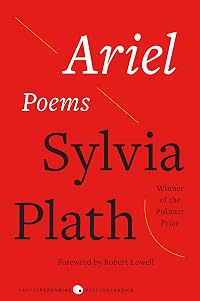
Ariel
by Sylvia Plath 
On This Page
Description
It is sixty years since Ariel was first published. This heritage edition restores Berthold Wolpe's iconic jacket and reproduces the original distinctive typesetting in celebration of the enduring importance of a collection that contains many of Sylvia Plath's best-known poems. Written in an extraordinary burst of creativity just before her death in 1963, the poems are as expressive of joy as they are of desolation. The remarkable combination of artistry and intensity that was recognised on show more this volume's first publication established Plath as one of the most original and gifted poets of the twentieth century. show lessTags
Recommendations












Member Recommendations

Member Reviews
This volume was probably my first introduction to adult poetry (that is, poetry not written for kids) when I was in college. I was swept under Plath's spell immediately. Her gift of language is riveting. The fact that her life was cut short by her own hand leaves with many feelings; one of them is that, had she chosen to live, she would have gone on to find freedom and support in what was then the nascent women's liberation movement. But that's not how it worked out, to the great loss of not only her family, but to the culture as well.
O God, I am not like you
In your vacuous black,
Stars stuck all over, bright stupid confetti.
Eternity bores me,
I never wanted it.
(Years)
Extraordinary, isn’t she? I was captivated by the poems in Ariel and am in agreement with others who view this collection as a masterpiece. For even when I came across a poem I didn’t fully understand, I could still sense the power within the words of Sylvia Plath which are precise, explosive, darkly beautiful.
In the afterword to Ariel author biographer Hal Hager notes the “paradoxical union of the self-destructiveness and creative energy that was the core of (Plath’s) personality”. This is especially evident in poems such as Lady Lazarus or Tulips that recall personal trials with attempted show more suicide or hospitalization. Plath’s metaphors in general are frequently stark; for example, her use of Nazi imagery in Daddy or the way she seeks out the hurt within an otherwise beautiful thing, as in this poem about poppies:
Little poppies, little hell flames,
Do you do no harm?
You flicker. I cannot touch you.
I put my hands among the flames. Nothing burns.
(Poppies in July)
And yet there are glimpses of love and joy in her poems too. Sylvia Plath drew inspiration from motherhood and wrote some heartwarming poems to and about her children; for example, You’re and Morning Song with its most endearing of opening lines (“Love set you going like a fat gold watch.”) In Balloons she captures the sweetness of the “guileless and clear /oval soul animals” floating about the house after the holidays. Even in Nick and the Candlestick, a poem for her son that is more typical Plath in its imagery, there is a touching tenderness. She writes to her son:
O love, how did you get here?
O embryo
Remembering, even in sleep,
Your crossed position.
The blood blooms clean
In you, ruby.
(Nick and the Candlestick)
Just prior to her death in 1962 Sylvia Plath took up beekeeping, a fact which I found fascinating. Her father Otto Plath (of Daddy fame) had been a well-known entomologist at Boston University and was considered a bee expert in his field, which likely accounted for some of her interest. This new pastime formed the foundation for a series of bee poems clustered at the center of Ariel. The poems are quirky, unconventional, and at times humorous, and show another facet to her personality. They may be my favorites of the entire book. Here she writes of the newly arrived bee box:
I lay my ear to furious Latin.
I am not a Caesar.
I have simply ordered a box of maniacs.
They can be sent back.
They can die, I need feed them nothing, I am the owner.
(The Arrival of the Bee Box)
In another passage she expresses so perfectly the curiosity of a woman trying to relate to her all female hive of bees (“Will they hate me/ These women who only scurry/ Whose news is the open cherry, the open clover?”). The entire collection left me in full appreciation of the genius that was Sylvia Plath. It is a pity to think we lost her at only 30 years of age to the suicidal depression that had haunted her for most of her life. Highly recommended for all lovers of poetry. show less
Sylvia Plath churned out her final poems at the remarkable rate of two or three a day, and Robert Lowell describes them as written by "hardly a person at all ... but one of those super-real, hypnotic, great classical heroines." Even more remarkable, she wrote them during one of the coldest, snowiest winters (1962-63) Londoners have ever known. Snowbound, without central heating, she and her two children spent much of their time sniffling, coughing, or running temperatures (In "Fever 103°" she writes, "I have been flickering, off, on, off on. / The sheets grow heavy as a lecher's kiss."). Pipes froze, lights failed, and candles were unobtainable.
As if these physical privations weren't enough, Plath was out in the cold in another show more sense--her husband, Ted Hughes, had left her for another woman earlier that year. Despite all this (or perhaps because of it), the Ariel poems dazzle with their lyricism, their surprising and vivid imagery, and their wit. Rather than confining herself to her bleak surroundings, Plath draws from a wide array of experience. In "Berck-Plage," for instance, clouds are "electrifyingly-coloured sherbets, scooped from the freeze." In "The Night Dances," the poet stands crib-side, reveling in her son's own brand of do-si-do: "Such pure leaps and spirals--Surely they travel / The world forever, I shall not entirely / Sit emptied of beauties, the gift / Of your small breath..."
Though at times they present the reader with hopelessness laid bare, these poems also teem with the brightest shards of a life, confounding those who merely look for the words of a gloomy, dispassionate suicide. Plath rose each morning in the final months of her life to "that still blue, almost eternal hour before the baby's cry" and left us these words like "axes/After whose stroke the wood rings..."
Along with withholding (or allegedly destroying) one of Plath's journals after her death in 1963, Plath's husband, the late English poet laureate Ted Hughes, brought out a version of her second and final book of poems, Ariel, that differed from the manuscript she left on her desk. That edition-for which Hughes dropped 12 poems, added 12 composed a few months later, shifted the poems' ordering and included an introduction by Robert Lowell-has become a classic. The present edition restores the 12 missing poems, drops the 12 added ones, and prints the manuscript in Plath's own order, followed by a facsimile of the typescript Plath left, along with a foreword by Plath and Hughes's daughter Frieda Hughes (Wooroloo), several hand- and typewritten drafts of the book's title poem and notes by David Semanki. The original manuscript's contents have been widely known since Hughes published them in the 1981 Collected Poems, but there is an undeniable thrill to reading Plath's book as she left it-the lacerating "The Rabbit Catcher," left out of the Ted Hughes edition, comes third here, with its rhyme of "force" with "gorse," the flowers of which "had an efficiency, a great beauty,/ And were extravagant, like torture." As to whether this version is a better book, only time will tell. For now, despite Frieda Hughes's repeated references to her father's respect for Plath's work, tally another shot in the Plath wars. show less
As if these physical privations weren't enough, Plath was out in the cold in another show more sense--her husband, Ted Hughes, had left her for another woman earlier that year. Despite all this (or perhaps because of it), the Ariel poems dazzle with their lyricism, their surprising and vivid imagery, and their wit. Rather than confining herself to her bleak surroundings, Plath draws from a wide array of experience. In "Berck-Plage," for instance, clouds are "electrifyingly-coloured sherbets, scooped from the freeze." In "The Night Dances," the poet stands crib-side, reveling in her son's own brand of do-si-do: "Such pure leaps and spirals--Surely they travel / The world forever, I shall not entirely / Sit emptied of beauties, the gift / Of your small breath..."
Though at times they present the reader with hopelessness laid bare, these poems also teem with the brightest shards of a life, confounding those who merely look for the words of a gloomy, dispassionate suicide. Plath rose each morning in the final months of her life to "that still blue, almost eternal hour before the baby's cry" and left us these words like "axes/After whose stroke the wood rings..."
Along with withholding (or allegedly destroying) one of Plath's journals after her death in 1963, Plath's husband, the late English poet laureate Ted Hughes, brought out a version of her second and final book of poems, Ariel, that differed from the manuscript she left on her desk. That edition-for which Hughes dropped 12 poems, added 12 composed a few months later, shifted the poems' ordering and included an introduction by Robert Lowell-has become a classic. The present edition restores the 12 missing poems, drops the 12 added ones, and prints the manuscript in Plath's own order, followed by a facsimile of the typescript Plath left, along with a foreword by Plath and Hughes's daughter Frieda Hughes (Wooroloo), several hand- and typewritten drafts of the book's title poem and notes by David Semanki. The original manuscript's contents have been widely known since Hughes published them in the 1981 Collected Poems, but there is an undeniable thrill to reading Plath's book as she left it-the lacerating "The Rabbit Catcher," left out of the Ted Hughes edition, comes third here, with its rhyme of "force" with "gorse," the flowers of which "had an efficiency, a great beauty,/ And were extravagant, like torture." As to whether this version is a better book, only time will tell. For now, despite Frieda Hughes's repeated references to her father's respect for Plath's work, tally another shot in the Plath wars. show less
Ariel is the second published collection of Sylvia Plath poems; it appeared two years after her suicide. Famously, her husband Ted Hughes exchanged some of the poems Plath had intended to include for others and made changes in the order. The result is, to my mind, uneven. It contains some excellent poems, among them “The Moon and the Yew Tree,” “Sheep in Fog,” and “Ariel.” Then there are a few I don’t understand (“The Couriers,” for instance). And I’m not sure what to make of two of the most famous poems in the collection, “Lady Lazarus” and “Daddy.” The first is often read as prefiguring her suicide, but I read it instead as the declamation of the survivor of a suicide attempt. Admittedly, it’s disturbing show more because of the expectance of more attempts, yet overall the voice is exultant. Yet I found the conflation of the speaker’s persona with a concentration camp victim disturbing. This note is repeated in “Daddy.” To my taste, Plath dealt more successfully with complicated feelings arising from the early loss of one’s father in “Colossus,” the title poem of her first collection.
When her submission for the Yale Younger Poets contest (a collection that predated Colossus) failed to win the prize, she journaled: “How ironic, that all my work to overcome my easy poeticisms merely convinces them that I am rough, anti-poetic, unpoetic. My God” (found in Heather Clark, Red Comet, page 563).
This strikes me as the typical dilemma of a gifted poet. The essential first step is immersion in the tradition, which you must break free of to find your own voice. The work in the transition phase may be less pleasing than that of the apprenticeship. I wonder whether, if Plath’s suicide had been thwarted, we’d think of both Colossus and Ariel as products of her journeyman phase, on the way to the mastery I believe she was capable of?
In these years, Plath had the mixed blessing of her own live-in model, tutor, and rival, Ted Hughes. He challenged and encouraged her in her development. But the price was that she shook off the voice of models such as Theodore Roethke to take on the voice of Hughes, which is what some of the less successful poems here strike me as showing. Nevertheless, when I leaf through the collection again, I find much to admire here. show less
When her submission for the Yale Younger Poets contest (a collection that predated Colossus) failed to win the prize, she journaled: “How ironic, that all my work to overcome my easy poeticisms merely convinces them that I am rough, anti-poetic, unpoetic. My God” (found in Heather Clark, Red Comet, page 563).
This strikes me as the typical dilemma of a gifted poet. The essential first step is immersion in the tradition, which you must break free of to find your own voice. The work in the transition phase may be less pleasing than that of the apprenticeship. I wonder whether, if Plath’s suicide had been thwarted, we’d think of both Colossus and Ariel as products of her journeyman phase, on the way to the mastery I believe she was capable of?
In these years, Plath had the mixed blessing of her own live-in model, tutor, and rival, Ted Hughes. He challenged and encouraged her in her development. But the price was that she shook off the voice of models such as Theodore Roethke to take on the voice of Hughes, which is what some of the less successful poems here strike me as showing. Nevertheless, when I leaf through the collection again, I find much to admire here. show less
So many of my favorite writers have stuggled with the suicidal urge, but like bees who labor for next year's hive, these despairing souls leave works of honey behind. I found her lesser known poems to be as rich as the ones included in all the anthologies.
In the poem "Totem" Plath, in her unique voice, conflates the metaphor of life as a train journey with the reassembly of the self upon waking at dawn:
"There is no terminus, only suitcases
Out of which the same self unfolds like a suit
Bald and shiny, with pockets of wishes,
Notions and tickets, short circuits and folding mirrors."
This passage is remarkable because it is so different from the disparate stack of images - of butchers, snakes, and spiders - built around the theme of show more encroaching death which is the rest of the poem.
"The Rival" is more focused, a thing of devastating beauty and sadness:
"I wake to a mausoleum; you are here,
Ticking your fingers on the marble table, looking for cigarettes,
Spiteful as a woman, but not so nervous,
And dying to say something unanswerable."
Betrayed by her husband, she must endure his silent presence because his mind is elsewhere, thinking of Her - the rival.
Plath, having had her life blown to bits by Hughes's infidelity, falls into the stasis of narcissism, a rickety coping mechanism, and, turning away from the universe, writes in the poem "Years":
"Eternity bores me,
I never wanted it."
Her pain was monumental, her poetry eloquent. Read softly, but carry a big ice-cold beverage. show less
In the poem "Totem" Plath, in her unique voice, conflates the metaphor of life as a train journey with the reassembly of the self upon waking at dawn:
"There is no terminus, only suitcases
Out of which the same self unfolds like a suit
Bald and shiny, with pockets of wishes,
Notions and tickets, short circuits and folding mirrors."
This passage is remarkable because it is so different from the disparate stack of images - of butchers, snakes, and spiders - built around the theme of show more encroaching death which is the rest of the poem.
"The Rival" is more focused, a thing of devastating beauty and sadness:
"I wake to a mausoleum; you are here,
Ticking your fingers on the marble table, looking for cigarettes,
Spiteful as a woman, but not so nervous,
And dying to say something unanswerable."
Betrayed by her husband, she must endure his silent presence because his mind is elsewhere, thinking of Her - the rival.
Plath, having had her life blown to bits by Hughes's infidelity, falls into the stasis of narcissism, a rickety coping mechanism, and, turning away from the universe, writes in the poem "Years":
"Eternity bores me,
I never wanted it."
Her pain was monumental, her poetry eloquent. Read softly, but carry a big ice-cold beverage. show less
Ariel is the collection of poems written in the final months of Plath’s life, as selected and published posthumously by her estranged husband, Ted Hughes. They are of course somber, but have the honesty important for any type of writing, and are executed with skill.
There is a starkness and a pervasive sense of isolation here, and while Plath describes the world around her so well, it’s with detachment and there is a sense that she already has one foot out the door. Many have stared down into the same abyss at varying distances from the edge, and while reading these poems I couldn’t help but feel what a shame this is. Perhaps the depth of feeling and depression are inseparable from Plath and part of what made her great, but it show more doesn’t make it any less a tragedy.
There are hints of feminism, as in “The Applicant” where she describes the view of a wife, provided she is “our sort of person”: “A living doll, everywhere you look. / It can sew, it can cook, / It can talk, talk, talk.” And in “Lesbos”, to a girlfriend she has other thoughts about, while “doped and thick from my last sleeping pill”, filled with hatred of marital life with an “impotent husband”: “I should wear tiger pants, I should have an affair. / We should meet in another life, we should meet in air, / Me and you.” But then later, sadly: “I say I may be back. / You know what lies are for. / Even in your Zen heaven we shan’t meet.”
Plath speaks through her poems and yet one feels hopelessness and frustration, and the idea that she feels like this line from “The Munich Mannequins”: “Voicelessness. The snow has no voice.” She has not lived up to her own high expectations or society’s; from “Sheep in Fog”: “The hills step off into whiteness. / People or stars / Regard me sadly, I disappoint them.”
The denial of one’s attachment to the world is a recurring theme, starting with “Morning Song”, this about her own babies: “I’m no more your mother / Than the cloud that distils a mirror to reflect its own slow / Effacement at the wind’s hand.” It continues on when she’s part of a group in “The Bee Meeting”, and yet so removed, an isolated observer, starting with a question “Who are these people….”, and ending with another, “why am I cold?” Later in “Paralytic” she writes of her wants and desires gone from the perspective of a paralytic in an iron lung. Everywhere it’s stepping back, stepping back, floating upwards, drifting away.
This ain’t cheery stuff, folks. What was a bit shocking was her “seeing herself” as a concentration camp victim more than once, the ultimate dehumanization, including in the poem “Daddy”, which sears on the page and ends with this line: “Daddy, daddy, you bastard, I’m through.” Plath’s father died when she was eight and she never got over it, and apparently pours out her anger here not for having been abused in some way, but for the simple fact that he died and left her. I won’t excerpt that one in its entirety, but it’s the poem I would recommend starting with.
Quotes:
On action, from “Years”:
“O God, I am not like you
In your vacuous black,
Stars stuck all over, bright stupid confetti.
Eternity bores me,
I never wanted it.
What I love is
The piston in motion –
My soul dies before it.
And the hooves of the horses,
Their merciless churn.”
On love, from “Elm”:
“Clouds pass and disperse.
Are those the faces of love, those pale irretrievables?
Is it for such I agitate my heart?”
On purity and fragility, from “Fever 103”:
“I am too pure for you or anyone.
Your body
Hurts me as the world hurts God. I am a lantern –
My head a moon,
Of Japanese paper, my gold beaten skin
Infinitely delicate and infinitely expensive.” show less
There is a starkness and a pervasive sense of isolation here, and while Plath describes the world around her so well, it’s with detachment and there is a sense that she already has one foot out the door. Many have stared down into the same abyss at varying distances from the edge, and while reading these poems I couldn’t help but feel what a shame this is. Perhaps the depth of feeling and depression are inseparable from Plath and part of what made her great, but it show more doesn’t make it any less a tragedy.
There are hints of feminism, as in “The Applicant” where she describes the view of a wife, provided she is “our sort of person”: “A living doll, everywhere you look. / It can sew, it can cook, / It can talk, talk, talk.” And in “Lesbos”, to a girlfriend she has other thoughts about, while “doped and thick from my last sleeping pill”, filled with hatred of marital life with an “impotent husband”: “I should wear tiger pants, I should have an affair. / We should meet in another life, we should meet in air, / Me and you.” But then later, sadly: “I say I may be back. / You know what lies are for. / Even in your Zen heaven we shan’t meet.”
Plath speaks through her poems and yet one feels hopelessness and frustration, and the idea that she feels like this line from “The Munich Mannequins”: “Voicelessness. The snow has no voice.” She has not lived up to her own high expectations or society’s; from “Sheep in Fog”: “The hills step off into whiteness. / People or stars / Regard me sadly, I disappoint them.”
The denial of one’s attachment to the world is a recurring theme, starting with “Morning Song”, this about her own babies: “I’m no more your mother / Than the cloud that distils a mirror to reflect its own slow / Effacement at the wind’s hand.” It continues on when she’s part of a group in “The Bee Meeting”, and yet so removed, an isolated observer, starting with a question “Who are these people….”, and ending with another, “why am I cold?” Later in “Paralytic” she writes of her wants and desires gone from the perspective of a paralytic in an iron lung. Everywhere it’s stepping back, stepping back, floating upwards, drifting away.
This ain’t cheery stuff, folks. What was a bit shocking was her “seeing herself” as a concentration camp victim more than once, the ultimate dehumanization, including in the poem “Daddy”, which sears on the page and ends with this line: “Daddy, daddy, you bastard, I’m through.” Plath’s father died when she was eight and she never got over it, and apparently pours out her anger here not for having been abused in some way, but for the simple fact that he died and left her. I won’t excerpt that one in its entirety, but it’s the poem I would recommend starting with.
Quotes:
On action, from “Years”:
“O God, I am not like you
In your vacuous black,
Stars stuck all over, bright stupid confetti.
Eternity bores me,
I never wanted it.
What I love is
The piston in motion –
My soul dies before it.
And the hooves of the horses,
Their merciless churn.”
On love, from “Elm”:
“Clouds pass and disperse.
Are those the faces of love, those pale irretrievables?
Is it for such I agitate my heart?”
On purity and fragility, from “Fever 103”:
“I am too pure for you or anyone.
Your body
Hurts me as the world hurts God. I am a lantern –
My head a moon,
Of Japanese paper, my gold beaten skin
Infinitely delicate and infinitely expensive.” show less
No te entendía nada. Me desilusionaba pensando que quizá te puse en un altar antes de tiempo. Pero el tiempo y el ir observándote detenidamente, bebiendo de cada una de tus líneas, hizo que cada vez te volvieras más sobrecogedoras. Como si me hubieran agarrado el corazón en un puño fiero, y solo sintiera la opresión de un pecho vacío. Un pecho ajeno al mío que no le salían ni las lágrimas, por que en la intensidad de todo ello, solo eras una niña que se mecía dentro de los versos y que solo buscaba el haber sido querida y entendida. Estoy destrozada.
Members
- Recently Added By
Lists

Books Read in 2013
1,630 works; 51 members

20th Century Literature
1,161 works; 54 members

Bibliography for How to be a Heroine
148 works; 12 members

Literature About Women and Girls
426 works; 40 members

Poetry Corner
187 works; 15 members
Favourite Books
1,820 works; 311 members

Books Read in 2016
4,666 works; 199 members
1960s, Best books published therein
254 works; 22 members

Poetry Collections
79 works; 6 members

100 Hemskaste
81 works; 1 member
Books Read in 2015
3,299 works; 126 members

Literary Witches
86 works; 4 members

Blackwell's Five Foot Bookshelf
72 works; 4 members

sad girl books
41 works; 2 members

Just Kids by Patti Smith
43 works; 1 member
Author Information

133+ Works 55,938 Members
Sylvia Plath's best poetry was produced, tragically, as she pondered self-destruction---in her poems as well as her life---and she eventually committed suicide. She had an extraordinary impact on British as well as American poetry in the few years before her death, and affected many poets, particularly women, in the generation after. She is a show more confessional poet, influenced by the approach of Robert Lowell. Born in Boston, a graduate of Smith College, Plath attended Newnham College, Cambridge University, on a Fulbright Fellowship and married the British poet Ted Hughes. Of her first collection,The Colossus and Other Poems (1962), the Times Literary Supplement remarked, "Plath writes from phrase to phrase as well as with an eye on the larger architecture of the poem; each line, each sentence is put together with a good deal of care for the springy rhythm, the arresting image and---most of all, perhaps---the unusual word." Plath's second book of poetry, Ariel, written in 1962 in a last fever of passionate creative activity, was published posthumously in 1965 and explores dimensions of women's anger and sexuality in groundbreaking new ways. Plath's struggles with women's issues, in the days before the second wave of American feminism, became legendary in the 1970s, when a new generation of women readers and writers turned to her life as well as her work to understand the contradictory pressures of ambitious and talented women in the 1950s. The Bell Jar---first published under a pseudonym in 1963 and later issued under Plath's own name in England in 1966---is an autobiographical novel describing an ambitious young woman's efforts to become a "real New York writer" only to sink into mental illness and despair at her inability to operate within the narrow confines of traditional feminine expectations. Plath was posthumously awarded the Pulitzer Prize for poetry in 1982. In recent years, there have been a number of biographies and critical evaluations of Plath's work. (Bowker Author Biography) show less
Sylvia Plath has a Legacy Library. Legacy libraries are the personal libraries of famous readers, entered by LibraryThing members from the Legacy Libraries group.
Some Editions
Awards and Honors
Awards
Distinctions
Series
Belongs to Publisher Series
Work Relationships
Is contained in
Contains
Has as a study
Has as a commentary on the text
Common Knowledge
- Original publication date
- 1965
- Dedication
- For Frieda and Nicholas
- First words
- Love set you going like a fat gold watch.
- Quotations
- O love, O celibate. Nobody but me walks the waist-high wet. The irreplaceable golds bleed and deepen, the mouths of Thermopylae.
- Last words
- (Click to show. Warning: May contain spoilers.)While / From the bottom of a pool, fixed stars / Govern a life.
- Blurbers
- Steiner, George; Hughes, Frieda; Alvarez, A.
- Original language
- English
- Canonical DDC/MDS
- 811.54
- Canonical LCC
- PS3566.L27
- Disambiguation notice
- This is the 1965 collection of Plath's poems titled Ariel. There is also an individual poem titled Ariel, which is included in the collection. Take care when combining or making work-to-work relationships.
Classifications
Statistics
- Members
- 4,723
- Popularity
- 3,057
- Reviews
- 61
- Rating
- (4.09)
- Languages
- 13 — Czech, Danish, Dutch, English, Finnish, French, German, Greek, Multiple languages, Spanish, Swedish, Turkish, Portuguese (Portugal)
- Media
- Paper, Ebook
- ISBNs
- 47
- ASINs
- 39