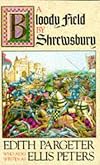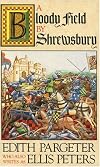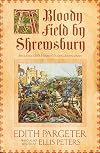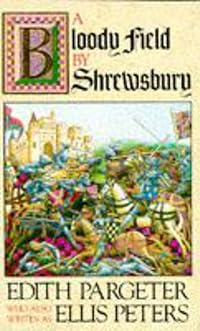
A Bloody Field by Shrewsbury
by Edith Pargeter
On This Page
Description
December 2, 1991Henry IV of England becomes jealous of the friendship between his son Prince Hal and a knight known as Hotspur in this account of events leading up to the 1303 battle of Shrewsbury. Pargeter, who also writes as Ellis Peters, serves up ``a tale compounded of romance, stirring adventure and subtle psychological insight,'' said PW.
. HTML:"Outstanding...a tale compounded of romance, stirring adventure, and subtle psychological insight."
-Publishers Weekly
Henry Bolingbroke knows show more that he should be king of England. It's his God-given destiny, and the young Richard II had no right to banish him and claim the throne. With the help of the powerful lords of Northumberland, especially Harry "Hotspur" Percy, Henry triumphantly overthrows Richard and imprisons him.
But the thrill of becoming Henry IV of England fades as trouble brews in Wales. Rebellion is in the air, and the question of how Richard II really died lingers, poisoning the court.
Henry IV will need all his strength to defend the crown, but the relationships between the king, Hotspur, and the king's son Prince Hal contain the seeds of their own destruction. The king's powerful enemies are poised to pounce as the three men are drawn to bloody collision some two miles from Shrewsbury. Filled with the glorious historical detail that fans of Edith Pargeter have come to expect, A Bloody Field by Shrewsbury is a skillful tapestry of the feuds, loves, and triumphs of Henry IV.
"Chivalry, treachery, conflict of loyalties...are the rich threads in the tapestry...the clash of wills is as stirring as the clash of steel."
-Observer
"A vivid portrait of Hotspur...one of the last knights-errant of the age."
-Sunday Telegraph
. show less
Tags
Recommendations







Member Recommendations
ansate Different time period, but another fantastically written historical novel
Member Reviews
This novel (an old favorite that I first read when it was republished in the late 1980s) is one of the historical novels written by Ellis Peters under her "other" name, Edith Pargeter. It tells a fascinating story, that of the three-way relationship between Henry of Lancaster, who became Henry IV after seizing the English throne from Richard II, his son and heir (who would become Henry V), and a third Henry, Henry Percy, aka Hotspur, who was the equivalent of the idol of the masses, known for his valour & chivalry. (If you've read Shakespeare's novels, you'll have a sense of this.)
The novel opens when young Hal returns from the care of Richard to his father's new court, and is entrusted to Hotspur's guardianship and tutelage. As the show more years pass, Richard dies in captivity, apparently making Henry IV secure on his new throne. But Henry is becoming old before his time; he can no longer trust after he has betrayed the trust of his cousin Richard and taken the throne. When that distrust becomes too large to contain, it leads him to actions that Hotspur and his family can't tolerate, and civil war looms, putting young "Hal" in the midst of a conflict.
Pargeter does an exceptional job here, from writing about battle (both the adrenaline and the aftermath), to the psychological impact of estrangement between fathers and sons. There's an odd kind of romantic sub-plot here which is perhaps a bit unbelievable (although it offers some insights into the links between the Welsh and the English in the Marches at the time, and the lives of young women in the very early 15th century). A more difficult hurdle is the language: it is even more convoluted and flowery than that found in the Cadfael novels, so you have to be able to tolerate phrases such as: "They made their own terms of reference; she, perhaps with knowledge and calculation; the man, after his kind, by impulse and the blind brilliance of his own nature." This somehow works better in historical novels (I've not been able to read a trilogy of Pargeter's set in WW2, because of the language, although had oddly little trouble with the same flowery style in her modern mysteries written as Ellis Peters and featuring George Felse, the detective) but you have to be able to immerse yourself in it and somehow ignore it.
For me, as a historical fiction nut, it's worth it: in this, as in the massive Brothers of Gwynned series she wrote, Pargeter has taken what was an overlooked tale and turned it into a compelling saga. Sharon Penman owes a lot to her; Penman's novels of the last Welsh princes followed Pargeter's and while they are without the flamboyant, flowery style, they also don't have the same sense of time and place. Recommended to those interested in historical novels and the period. 4.1 stars. If you like this, look for "The Brothers of Gwynned" -- be warned, it's a quartet of novels... -- and "The Marriage of Meggotta", another bittersweet novel featuring a manipulative and deceitful monarch. show less
The novel opens when young Hal returns from the care of Richard to his father's new court, and is entrusted to Hotspur's guardianship and tutelage. As the show more years pass, Richard dies in captivity, apparently making Henry IV secure on his new throne. But Henry is becoming old before his time; he can no longer trust after he has betrayed the trust of his cousin Richard and taken the throne. When that distrust becomes too large to contain, it leads him to actions that Hotspur and his family can't tolerate, and civil war looms, putting young "Hal" in the midst of a conflict.
Pargeter does an exceptional job here, from writing about battle (both the adrenaline and the aftermath), to the psychological impact of estrangement between fathers and sons. There's an odd kind of romantic sub-plot here which is perhaps a bit unbelievable (although it offers some insights into the links between the Welsh and the English in the Marches at the time, and the lives of young women in the very early 15th century). A more difficult hurdle is the language: it is even more convoluted and flowery than that found in the Cadfael novels, so you have to be able to tolerate phrases such as: "They made their own terms of reference; she, perhaps with knowledge and calculation; the man, after his kind, by impulse and the blind brilliance of his own nature." This somehow works better in historical novels (I've not been able to read a trilogy of Pargeter's set in WW2, because of the language, although had oddly little trouble with the same flowery style in her modern mysteries written as Ellis Peters and featuring George Felse, the detective) but you have to be able to immerse yourself in it and somehow ignore it.
For me, as a historical fiction nut, it's worth it: in this, as in the massive Brothers of Gwynned series she wrote, Pargeter has taken what was an overlooked tale and turned it into a compelling saga. Sharon Penman owes a lot to her; Penman's novels of the last Welsh princes followed Pargeter's and while they are without the flamboyant, flowery style, they also don't have the same sense of time and place. Recommended to those interested in historical novels and the period. 4.1 stars. If you like this, look for "The Brothers of Gwynned" -- be warned, it's a quartet of novels... -- and "The Marriage of Meggotta", another bittersweet novel featuring a manipulative and deceitful monarch. show less
Or, A Tale of Too Many Henrys
I’d been wanting to read this one for a while now, but had never gotten around to it, so I was pleased when it was chosen as June 2016’s book by the “More Historical than Fiction” bookclub at booklikes. Before this, I had only ever read some of the Cadfael books that Edith Pargeter wrote under the pseudonym Ellis Peters.
Basically, I really liked it. I haven’t read much concerning that exact time period and the battle at Shrewsbury, and I avoided looking up the history while reading the book to keep it sounding fresh, so I won’t comment on the historical accuracy. I both don’t know what to say about it and want to somehow talk about it, so we’ll see how long this ramble gets.
The story follows show more the events leading up to Shrewsbury over the course of several years and the relationships between the three Henrys: King Henry IV, the prince Hal, and Henry Percy (Hotspur). It particularly follows the devolution of the king and the disintegration of his relationship with Hotspur (I was going to mention Hal here too but Henry never really had a relationship with Hal, which was another great thing about the book).
I rather liked Julian. Although tangential to the main plot, her character helped flesh out the world for me by actually having a female character that isn’t one of the wives mentioned in passing and without sacrificing historical accuracy. She’s entirely a woman of her time, but she also shows that women could and did play a role in events. Besides, through Julian we’re introduced to the Welsh side of things, and I quite liked her father, Rhodri Parry.
I didn’t need Julian to be there, but I also thought she gave depth to the other characters, first by showcasing Hal as young but capable judge (yes, he has Hotspur’s help but we see he’s trusted to make his own decisions) and later with her relationship with Hotspur. The beginning of the book would have been drier and there would have been more “telling” without her, I think. Or some of the characters would have been flatter.
I think it would be a mistake to call that relationship with Hotspur a romance. It was both less and more than that. Yes, she loved him, but not romantically (at least, that’s not how I read it). He was the man who gave her back her life (as well as provided her the opportunity to make her own life), and so she greatly admired everything about him. In fact, their relationship was similar to the one that Hotspur had with Hal. She also gave Hotspur the chance to add yet another layer of awesomeness for the modern reader by having him accept her as her own person and treat her as an equal. I mean, some of it could come off as a little patronizing, but I’m not choosing to see it that way. He saw her as a daughter, basically.
I don’t think Hotspur achieves the level of awesomeness of prince Hal, however. Prince Hal was probably my favourite character. Really, Hal at sixteen is more of an adult than most adults ever achieve. He was always so self-possessed that his father basically treated him like an alien creature and actually raced to Shrewsbury not so much to defend him but because Henry couldn’t trust Hal not to betray him. He was afraid Hal’s loyalty to Hotspur would trump his filial loyalty. Of course, that probably says more about Henry and his state of mind than Hal. It exemplifies the kind of brokenness you see in his character as the story progresses. There’s also a theme of finding choices to make versus letting events make your choices for you scattered throughout, but it’s explicitly called out in the epilogue.
Finally, I was quite happy to encounter a not-an-idiot love interest in Iago (for Julian). Especially while reading Venetia (Heyer) and having to deal with Oswald, Edward, and Damerel.
Sorry if that was a bit too long; I’m a known rambler. If you have a chance and you're interested in historical fiction, you should check this one out! show less
I’d been wanting to read this one for a while now, but had never gotten around to it, so I was pleased when it was chosen as June 2016’s book by the “More Historical than Fiction” bookclub at booklikes. Before this, I had only ever read some of the Cadfael books that Edith Pargeter wrote under the pseudonym Ellis Peters.
Basically, I really liked it. I haven’t read much concerning that exact time period and the battle at Shrewsbury, and I avoided looking up the history while reading the book to keep it sounding fresh, so I won’t comment on the historical accuracy. I both don’t know what to say about it and want to somehow talk about it, so we’ll see how long this ramble gets.
The story follows show more the events leading up to Shrewsbury over the course of several years and the relationships between the three Henrys: King Henry IV, the prince Hal, and Henry Percy (Hotspur). It particularly follows the devolution of the king and the disintegration of his relationship with Hotspur (I was going to mention Hal here too but Henry never really had a relationship with Hal, which was another great thing about the book).
I rather liked Julian. Although tangential to the main plot, her character helped flesh out the world for me by actually having a female character that isn’t one of the wives mentioned in passing and without sacrificing historical accuracy. She’s entirely a woman of her time, but she also shows that women could and did play a role in events. Besides, through Julian we’re introduced to the Welsh side of things, and I quite liked her father, Rhodri Parry.
I didn’t need Julian to be there, but I also thought she gave depth to the other characters, first by showcasing Hal as young but capable judge (yes, he has Hotspur’s help but we see he’s trusted to make his own decisions) and later with her relationship with Hotspur. The beginning of the book would have been drier and there would have been more “telling” without her, I think. Or some of the characters would have been flatter.
I think it would be a mistake to call that relationship with Hotspur a romance. It was both less and more than that. Yes, she loved him, but not romantically (at least, that’s not how I read it). He was the man who gave her back her life (as well as provided her the opportunity to make her own life), and so she greatly admired everything about him. In fact, their relationship was similar to the one that Hotspur had with Hal. She also gave Hotspur the chance to add yet another layer of awesomeness for the modern reader by having him accept her as her own person and treat her as an equal. I mean, some of it could come off as a little patronizing, but I’m not choosing to see it that way. He saw her as a daughter, basically.
I don’t think Hotspur achieves the level of awesomeness of prince Hal, however. Prince Hal was probably my favourite character. Really, Hal at sixteen is more of an adult than most adults ever achieve. He was always so self-possessed that his father basically treated him like an alien creature and actually raced to Shrewsbury not so much to defend him but because Henry couldn’t trust Hal not to betray him. He was afraid Hal’s loyalty to Hotspur would trump his filial loyalty. Of course, that probably says more about Henry and his state of mind than Hal. It exemplifies the kind of brokenness you see in his character as the story progresses. There’s also a theme of finding choices to make versus letting events make your choices for you scattered throughout, but it’s explicitly called out in the epilogue.
Finally, I was quite happy to encounter a not-an-idiot love interest in Iago (for Julian). Especially while reading Venetia (Heyer) and having to deal with Oswald, Edward, and Damerel.
Sorry if that was a bit too long; I’m a known rambler. If you have a chance and you're interested in historical fiction, you should check this one out! show less
Better than Shakespeare.
To be fair, the Henry IVs were never my line in Shakespeare. Richard II, yes, and I won’t say better than a few of his speeches, but... worthy to follow on, and she does, she does speech and soliloquies, with a bit of theatrical action, for a level of human portraiture that – how do I end this sentence? – you don’t find often, not in histfic, alas. This is a novel, if you know what I mean.
I get tired, in histfic, of a drab cynicism whereby we have to have a whole cast of rascals, frauds and worse folk, in order to be real. Sorry, that isn’t real. As if nobody ever believed in the knightly ideals, for example. Hotspur believes in them and lives them out, just a few years past their time; he’s a show more great-hearted innocent, like other innocents in fiction, though not batty like Don Quixote and with effectual clout. The Prince, future Henry 5, I visualise as flat-eyed as a fish (though that’s mostly towards his father): you cannot like him, or I can’t, but you can see the hatching of another, less kind sort of greatness. King Henry disgusted me and then snatched my sympathy: a man corrupted by his kingship, once a decent man, who does not recognise himself – I think he might be the subtlest portrait.
These people are written in such depth, and an encounter between them has the excitements of a battle. – Her battles aren’t bad, either. Psyches in conflict, whether it’s King Henry alone with his or these three in a breach.
To my eyes the book’s marred by a nonhistorical person who wanders about getting in the way – who doesn’t need to be there, and whose neatly-inserted presence at historical events threatens my conviction that I am on the field by Shrewsbury. I’ll even blame this person for letting a bit of potential-tragedy pressure leak away, at the culmination (right, the work-up-to-a-tragedy idea isn’t better than Shakespeare, and I’ll be sorry I said that).
Never mind. The lady can write. I reckon she writes just about perfectly: that is, with huge originality, but never for the sake of pretty writing. It’s in the service of her story. show less
To be fair, the Henry IVs were never my line in Shakespeare. Richard II, yes, and I won’t say better than a few of his speeches, but... worthy to follow on, and she does, she does speech and soliloquies, with a bit of theatrical action, for a level of human portraiture that – how do I end this sentence? – you don’t find often, not in histfic, alas. This is a novel, if you know what I mean.
I get tired, in histfic, of a drab cynicism whereby we have to have a whole cast of rascals, frauds and worse folk, in order to be real. Sorry, that isn’t real. As if nobody ever believed in the knightly ideals, for example. Hotspur believes in them and lives them out, just a few years past their time; he’s a show more great-hearted innocent, like other innocents in fiction, though not batty like Don Quixote and with effectual clout. The Prince, future Henry 5, I visualise as flat-eyed as a fish (though that’s mostly towards his father): you cannot like him, or I can’t, but you can see the hatching of another, less kind sort of greatness. King Henry disgusted me and then snatched my sympathy: a man corrupted by his kingship, once a decent man, who does not recognise himself – I think he might be the subtlest portrait.
These people are written in such depth, and an encounter between them has the excitements of a battle. – Her battles aren’t bad, either. Psyches in conflict, whether it’s King Henry alone with his or these three in a breach.
To my eyes the book’s marred by a nonhistorical person who wanders about getting in the way – who doesn’t need to be there, and whose neatly-inserted presence at historical events threatens my conviction that I am on the field by Shrewsbury. I’ll even blame this person for letting a bit of potential-tragedy pressure leak away, at the culmination (right, the work-up-to-a-tragedy idea isn’t better than Shakespeare, and I’ll be sorry I said that).
Never mind. The lady can write. I reckon she writes just about perfectly: that is, with huge originality, but never for the sake of pretty writing. It’s in the service of her story. show less
Edith Pargeter takes us back to the very early 15th century, to a conflict between Sir Henry Percy, “Hotspur”, and Henry IV, the king of England, who has only recently usurped the throne from Richard II with the support of the Percy family. The story follows each man and his relationship with various people as well as their deteriorating relationship with each other as it continually worsens with time.
This book was, honestly, a bit challenging to read. Its prose was, in fact, dated, and although I think that added to the overall feel of the book in a positive way, it made it go very slowly. As a result, a book less than 400 pages took me 4 days to read, which is unusual. In addition, the story doesn’t really sweep the reader away. show more It is interesting and feels medieval, but it’s not fascinating and is pretty easy to put down. The characters remain detached from the reader as well as detached from each other. I felt the most sympathy for Prince Henry, the future Henry V, as we see the formation of his identity since he is fairly young as well as his conflict between his father and close friend. Otherwise, the two main characters somehow remain distant even though we are given the opportunity to get into their heads. This is somewhat rare for me with a work of medieval historical fiction since I’m getting fairly practiced as placing myself into the medieval mindset (or as close as a modern person can get).
I did enjoy it while I was reading it and I found her perspective interesting, but it certainly isn’t one of my favorites, and I’ll probably wait a while before picking up another of her works.
http://chikune.com/blog/?p=101 show less
This book was, honestly, a bit challenging to read. Its prose was, in fact, dated, and although I think that added to the overall feel of the book in a positive way, it made it go very slowly. As a result, a book less than 400 pages took me 4 days to read, which is unusual. In addition, the story doesn’t really sweep the reader away. show more It is interesting and feels medieval, but it’s not fascinating and is pretty easy to put down. The characters remain detached from the reader as well as detached from each other. I felt the most sympathy for Prince Henry, the future Henry V, as we see the formation of his identity since he is fairly young as well as his conflict between his father and close friend. Otherwise, the two main characters somehow remain distant even though we are given the opportunity to get into their heads. This is somewhat rare for me with a work of medieval historical fiction since I’m getting fairly practiced as placing myself into the medieval mindset (or as close as a modern person can get).
I did enjoy it while I was reading it and I found her perspective interesting, but it certainly isn’t one of my favorites, and I’ll probably wait a while before picking up another of her works.
http://chikune.com/blog/?p=101 show less
Relates the personalities and events leading up to the 1303 Battle of Shrewsbury. Engaging read.
This book takes place in the early 15th century. Hotspur, Henry IV and V, Owain Glendwr: a bloody and brutal tale, beautifully told.
Here's what I wrote in 2008 about this read: "Events leading up to the 1303 Battle of Shrewsbury. Another enjoyable medieval, 'lives of the rich and famous' read." Was obviously on a medieval reading course during this time of life; check out other books read during the years 1995-97. And, interesting that they were all written by women.
Members
- Recently Added By
Lists

THE WAR ROOM
813 works; 24 members
Author Information

159+ Works 58,658 Members
Ellis Peters is the pseudonym for Edith Pargeter, who was born in Horsehay, Shropshire. She was a chemist's assistant from 1933 to 1940 and participated during World War II in the Women's Royal Navy Service. The name "Ellis Peters" was adopted by Edith Pargeter to clearly mark a division between her mystery stories and her other work. Her brother show more was Ellis and Petra was a friend from Czechoslovakia, thus the name. She came to writing mysteries, she says, "after half a lifetime of novel-writing." Her detective fiction features well-rounded, knowledgeable characters with whom the reader can empathize. Her most famous literary creation is the medieval monk Brother Cadfael. The blend of history and the formula of the detective story gives Peters's works their popular appeal. As detective hero, Brother Cadfael remains faithful to the requirements of the formula, yet the historical milieu in which he operates is both fully realized and well textured. Peters received the Mystery Writers of America's Edgar Award in 1963 and the Crime Writers Association's Silver Dagger Award in 1981. (Bowker Author Biography) show less
Common Knowledge
- Original title
- The Bloody Field
- Alternate titles
- A Bloody Field by Shrewsbury
- Original publication date
- 1972
- Important places
- Shrewsbury, Shropshire, England, UK (14th Century)
Classifications
Statistics
- Members
- 429
- Popularity
- 72,178
- Reviews
- 7
- Rating
- (3.91)
- Languages
- Czech, English
- Media
- Paper, Audiobook, Ebook
- ISBNs
- 13
- UPCs
- 1
- ASINs
- 6