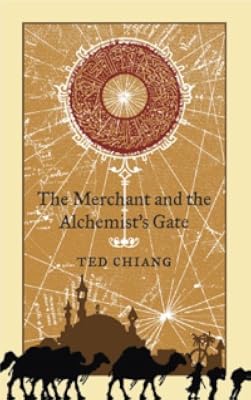
The Merchant and the Alchemist's Gate {novelette}
by Ted Chiang
On This Page
Description
"In medieval Baghdad, a penniless man is brought before the most powerful man in the world, the caliph himself, to tell his story. It begins with a walk in the bazaar, but soon grows into a tale unlike any other told in the caliph's empire. It's a story that includes not just buried treasure and a band of thieves, but also men haunted by their past and others trapped by their future; it includes not just a beloved wife and a veiled seductress, but also long journeys taken by caravan and even show more longer ones taken with a single step. Above all, it's a story about recognizing the will of Allah and accepting it, no matter what form it takes." -- the publisher. show lessTags
Recommendations



















Member Reviews
https://fromtheheartofeurope.eu/the-merchant-and-the-alchemists-gate-by-ted-chia...
ack in 2008, I ranked it second on my Hugo ballot, behind The Cambist and Lord Iron, by Daniel Abraham, and wrote:
"A lovely lovely story of time travel at the time of the Abbasid Caliphate, working up all those human themes of loss and love in a richly imagined fantastic environment that Chiang has done so well before. I expect this will win."
I still think that it is really good, and it has certainly proved to have staying power. It’s a story of time travel paradoxes, predestination and acceptance. I love Borges’ short story “The Other”, in which the writer meets his younger self and finds that they do not understand each other. Chiang riffs on show more this theme as well, with the extra twist that the older self comes to collude in his younger self’s destiny. I also give it good marks for the subtly different portrayals of Baghdad and Cairo, respectful rather than Orientalist (at least that was my take). show less
ack in 2008, I ranked it second on my Hugo ballot, behind The Cambist and Lord Iron, by Daniel Abraham, and wrote:
"A lovely lovely story of time travel at the time of the Abbasid Caliphate, working up all those human themes of loss and love in a richly imagined fantastic environment that Chiang has done so well before. I expect this will win."
I still think that it is really good, and it has certainly proved to have staying power. It’s a story of time travel paradoxes, predestination and acceptance. I love Borges’ short story “The Other”, in which the writer meets his younger self and finds that they do not understand each other. Chiang riffs on show more this theme as well, with the extra twist that the older self comes to collude in his younger self’s destiny. I also give it good marks for the subtly different portrayals of Baghdad and Cairo, respectful rather than Orientalist (at least that was my take). show less
Nice! My first Chiang and I'm duly impressed.
The idea of time travel is always fun and Chiang's short story played with a concept I had not seen before.
Through the alchemist's gate, one can go forward and back in time, each gate defining the exact leap with one gate being a few seconds (as a "demo" product, if you will) and another being 20 years. The various time travelers have differing motivations for wishing to time travel (wouldn't we all?) but no matter what is done when one travels back or forward, the present already had that built in. It is the opposite of the "butterfly effect."
Pretty clever stuff making that work for the various characters in the story, including interlocking them.
Told as stories within a story, it has a show more definite Scheherazade feel. It captures sprinklings of the long Islamic culture which felt authentic—or at least respectful—to this Westerner. Based on Chiang's short bio here on GR, that is admirable since his background is American, Chinese, and works as a technology technical writer of some esteem. For leaps, that is quite an interesting one—to go from a perfectly immersed contemporary life to ancient Cairo and Baghdad. He pulled it off with perfect aplomb.
I enjoyed the wise tidbits of life philosophy included too. Here are a couple that particularly resonated with me:
"...grief burns but does not consume; instead, it makes the heart vulnerable to further suffering..."
"Coincidence and intention are two sides of a tapestry, my lord. You may find one more agreeable to look at, but you cannot say one is true and the other is false."
Thank you to Cecily, a stellar moderator at The Short Story Club GR group, for another well-matched recommendation as a supplement in our group discussions. She's a treasure trove, able to do leaps herself, from one short story to another similar. Here's her profile so you may follow her: https://www.goodreads.com/user/show/1199525-cecily
I just enthusiastically added Chiang to my More This Author shelf...for my own future self. show less
The idea of time travel is always fun and Chiang's short story played with a concept I had not seen before.
Through the alchemist's gate, one can go forward and back in time, each gate defining the exact leap with one gate being a few seconds (as a "demo" product, if you will) and another being 20 years. The various time travelers have differing motivations for wishing to time travel (wouldn't we all?) but no matter what is done when one travels back or forward, the present already had that built in. It is the opposite of the "butterfly effect."
Pretty clever stuff making that work for the various characters in the story, including interlocking them.
Told as stories within a story, it has a show more definite Scheherazade feel. It captures sprinklings of the long Islamic culture which felt authentic—or at least respectful—to this Westerner. Based on Chiang's short bio here on GR, that is admirable since his background is American, Chinese, and works as a technology technical writer of some esteem. For leaps, that is quite an interesting one—to go from a perfectly immersed contemporary life to ancient Cairo and Baghdad. He pulled it off with perfect aplomb.
I enjoyed the wise tidbits of life philosophy included too. Here are a couple that particularly resonated with me:
"...grief burns but does not consume; instead, it makes the heart vulnerable to further suffering..."
"Coincidence and intention are two sides of a tapestry, my lord. You may find one more agreeable to look at, but you cannot say one is true and the other is false."
Thank you to Cecily, a stellar moderator at The Short Story Club GR group, for another well-matched recommendation as a supplement in our group discussions. She's a treasure trove, able to do leaps herself, from one short story to another similar. Here's her profile so you may follow her: https://www.goodreads.com/user/show/1199525-cecily
I just enthusiastically added Chiang to my More This Author shelf...for my own future self. show less
Nested stories of portals to alternative lives, set and told like a Tale of the Arabian Knights.
"Coincidence and intention are two sides of a tapestry, my lord. You may find one more agreeable to look at, but you cannot say one is true and the other is false."
Image: Front and back of tapestry cushion depicting Esther and Ahasuerus in a wreath (Northern Netherlands, 1650-80 - so yes, wrong culture and wrong period!) (Source.)
Traditional sci-fi writers tackle the mechanics and paradoxical consequences of time travel. They include futuristic space-faring, alien planets, and exotic lifeforms. Chiang takes a theological, philosophical, alchemical approach, and sets it on Earth, hundreds of years ago.
Sit comfortably and submit to the show more tangled enchantment of a matryoshka-like story with an ancient, mythical tone. See, hear, and touch the buzz of a Baghdad bazaar long ago. Wander, wonder, and ponder. This has a moral, but does not preach. It might be a tale of Scheherazade.
Framing Story
“My heart was troubled, and neither the purchase of luxuries nor the giving of alms was able to soothe it. Now I stand before you without a single dirham in my purse, but I am at peace.”
A penniless man tells his story to a mighty caliph.
Middle Layer
His story begins when he entered the shop of a metalsmith, where he found wares more varied, exotic, and fine than he had ever seen (“an astrolabe equipped with seven plates inlaid with silver, a water-clock that chimed on the hour, and a nightingale made of brass that sang when the wind blew”). The owner chatted and then took him to a back room, where he told three fantastic stories, all relating to knowledge, understanding, and acceptance of the past and the future: free will versus destiny - the will of Allah. The “alchemy” of which the metalsmith spoke is a time portal.
“He offered an explanation, speaking of his search for tiny pores in the skin of reality, like the holes that worms bore into wood, and how upon finding one he was able to expand and stretch it the way a glassblower turns a dollop of molten glass into a long-necked pipe, and how he then allowed time to flow like water at one mouth while causing it to thicken like syrup at the other.”
Three More Stories
The metalsmith’s tales are of those who used his gate: The Fortunate Rope Maker, The Weaver Who Stole From Himself, and The Wife and Her Lover. All of life is here: treasure, travel, love, loss, robbers, deceit, disguise, and sacrifice.
Most importantly, there is guilt, repentance, atonement, and forgiveness. “That is all, but that is enough.”
What Does it Mean?
Chiang does confront paradoxes, but not the “What if I kill my grandfather?” kind. He drills into the human psyche and soul. And the deeper he goes, the more pleasingly tangled the knots in the back of the tapestry become.
“Past and future are the same, and we cannot change either, only know them more fully. My journey to the past had changed nothing, but what I had learned had changed everything.”
Links
There are echoes of style, setting, and tone of JL Borges’ stories. See my overview review HERE.
Telling a wondrous story to a great man reminded of Calvino’s Invisible Cities, which I reviewed HERE.
This story was published in Chiang’s collection, Exhalation. See HERE for my reviews of the other stories. show less
"Coincidence and intention are two sides of a tapestry, my lord. You may find one more agreeable to look at, but you cannot say one is true and the other is false."
Image: Front and back of tapestry cushion depicting Esther and Ahasuerus in a wreath (Northern Netherlands, 1650-80 - so yes, wrong culture and wrong period!) (Source.)
Traditional sci-fi writers tackle the mechanics and paradoxical consequences of time travel. They include futuristic space-faring, alien planets, and exotic lifeforms. Chiang takes a theological, philosophical, alchemical approach, and sets it on Earth, hundreds of years ago.
Sit comfortably and submit to the show more tangled enchantment of a matryoshka-like story with an ancient, mythical tone. See, hear, and touch the buzz of a Baghdad bazaar long ago. Wander, wonder, and ponder. This has a moral, but does not preach. It might be a tale of Scheherazade.
Framing Story
“My heart was troubled, and neither the purchase of luxuries nor the giving of alms was able to soothe it. Now I stand before you without a single dirham in my purse, but I am at peace.”
A penniless man tells his story to a mighty caliph.
Middle Layer
His story begins when he entered the shop of a metalsmith, where he found wares more varied, exotic, and fine than he had ever seen (“an astrolabe equipped with seven plates inlaid with silver, a water-clock that chimed on the hour, and a nightingale made of brass that sang when the wind blew”). The owner chatted and then took him to a back room, where he told three fantastic stories, all relating to knowledge, understanding, and acceptance of the past and the future: free will versus destiny - the will of Allah. The “alchemy” of which the metalsmith spoke is a time portal.
“He offered an explanation, speaking of his search for tiny pores in the skin of reality, like the holes that worms bore into wood, and how upon finding one he was able to expand and stretch it the way a glassblower turns a dollop of molten glass into a long-necked pipe, and how he then allowed time to flow like water at one mouth while causing it to thicken like syrup at the other.”
Three More Stories
The metalsmith’s tales are of those who used his gate: The Fortunate Rope Maker, The Weaver Who Stole From Himself, and The Wife and Her Lover. All of life is here: treasure, travel, love, loss, robbers, deceit, disguise, and sacrifice.
Most importantly, there is guilt, repentance, atonement, and forgiveness. “That is all, but that is enough.”
What Does it Mean?
Chiang does confront paradoxes, but not the “What if I kill my grandfather?” kind. He drills into the human psyche and soul. And the deeper he goes, the more pleasingly tangled the knots in the back of the tapestry become.
“Past and future are the same, and we cannot change either, only know them more fully. My journey to the past had changed nothing, but what I had learned had changed everything.”
Links
There are echoes of style, setting, and tone of JL Borges’ stories. See my overview review HERE.
Telling a wondrous story to a great man reminded of Calvino’s Invisible Cities, which I reviewed HERE.
This story was published in Chiang’s collection, Exhalation. See HERE for my reviews of the other stories. show less
This is a story about time travel, or more accurately, about how the ability to time travel requires introspection and consideration about how we interact with the present.
The story is set in the historic city of Baghdad, and briefly in Cairo. The narrator is addressing the Caliph, a leadership or stewardship position that is both political and religious. These two pieces of information can perhaps tell us a bit about what the author wants us to consider in telling this story.
Perhaps the setting is a challenge to the general tendency of time travel stories to be set in the future. Perhaps it is and indication that time travel itself is not the main message of the story, and that true message of the story is applicable across time show more periods. Perhaps it is a means of giving the story a fable like feel. Additionally, the official moniker of Baghdad is 'the city of peace'. Perhaps then this setting is a reference to the narrator's own journey to find peace. The last sentence of the intro in fact ends with 'I am at peace.'
The Caliph never has a voice through out the story, and we might reasonable assume that we the readers are grouped with the Caliph in receiving this story. The story is delivered with periodic supplications by the narrator to the receiver of the story to take it as 'a warning to those that would be warned, and a lesson to those that would learn.'
The narrator starts his story in the district of the metal smiths, a reference to the origins of alchemy. Alchemy is an ancient branch of natural philosophy originating in Grecco-Roman Egypt with the goal of purifying certain materials and perfection of the body and soul. As alchemy is not necessarily an intuitive origin for time travel, though the author smoothly weaves it into the tale, this may be an attempt to both ground time travel to the times, and link it to the underlying motive of the story; introspective purification and personal transformation.
He enters a store filled with wondrous inventions and contraptions crafted in metal. The shop owner greets him and the invites him to view an alchemical invention of his. The narrator is initially skeptical. The shop owner demonstrates that this device of his creation can bridge between the present and several seconds in the future. This skepticism allows us as readers to be skeptical and convinced alongside the narrator.
The shop owner offers an explanation for how this happens that the narrator says he did not entirely follow, but involved 'tiny pores in the skin of reality, like the holes that worms bore into wood...able to expand and stretch it the way a glassblower turns a dollop of molten glass into a long-necked pipe, and how he then allowed time to flow like water at one mouth while causing it to thicken like syrup at the other.' This seems a clear reference to quantum physics, space-time, and worm holes. This description provides just enough to fill our need for explanation, while keeping the focus off the time travel itself.
The shop owner then shows the narrator another of his inventions that bridges twenty years into the future. He relates the experiences of three different people that used this technology and their very different experiences.
The first man of the three stories visits and chats with his elder and now wealthy counter part, who only wishes to reminisce about their shared childhood. The elder does however give the younger some small advice. Eventually, over the course of the younger's visits, the elder impresses upon him the joy of the experience in the present. Once the younger has accepted this, the elder relates how the younger will make his fortune. The younger ceases his visits and enjoys the present and happily anticipates the future, and the elder enjoys the past.
At the end of this story, the shop owner and narrator have an interlude, where they discuss the deterministic nature of the future, but the variable nature of our experience of it. This story subscribes to a deterministic time, avoiding the potential changes future knowledge can bring, and reorienting the focus again on one's experience and self-examination of past, present, and future.
The second story is about a man who yearns for wealth. He finds his elder counter part, however his future self is apparently not as wealthy like he had hoped. He goes into his elder's house and finds a chest full of gold, which he steals, though he reasons, it is not truly possible to steal from oneself. The process of reasoning seems to allow the reader to makes our own conclusions about how sound this argument may be.
He takes the stolen gold back to the present and spends it frivolously. The frivolity attracts robbers who take off with his wife and demand a ransom of all the remaining gold he has, which he is ultimately glad to have paid, saying to his returned wife 'I could not take pleasure [in the wealth] without you'. Together they now save all their money to replenish that which was lost. Eventually they fall into miserliness with their frugality, desolately waiting for the younger to come and steal the accrued wealth. Both elder and younger resent their asynchronous selves, past, present, and future.
Again the narrator and shop owner interlude, contemplating that the man 'must live with the consequences of his actions'. A more accurate statement might be that a man has to live with himself.
The third story follow the wife of the man in the first story. She recognizes the younger man that comes to visit her husband as his youthful self, and asks her husband about this marvel. She is captivated by the younger version of her husband, and is reminded of the attraction she felt for him in their youth. She steps through the gate to the past and finds the youthful version of her husband, quietly saving him with the help of her older self from jewelers who believe he stole from them. This brings her into the acquaintance of the younger version of her husband, and they begin an affair. The wife realizes that she will be the one to instruct the younger version of her husband to be a good love maker to her own younger self, relating to him 'the pleasure you give is returned in the pleasure you receive', apparently in reference to not just love making, but her own gift to her youthful self. Her actions express great affection for her youthful self, and contentment with her present.
The narrator is more intrigued by this last story than the others, understanding that both the past and the future are the same 'we cannot change either, but we can know both more fully.' He is likely also attracted to how one might interact with their own partner's past, present, and future experiences. The narrator wishes to travel to the past, but in order to do so, must travel to the gate those in the stories used, back in Cairo. He relates to the Caliph but not the shop own that his desire to travel to the past stems from his wish to see his dead wife and apologize for their last argument, which was the last time he spoke to her before her death. He says that this argument has haunted him all this time. It seems from his wording that it is not the sentiment expressed to his wife the follows him, but his own guilt that he wishes to relieve.
He travels to Cairo and enters the gate, arriving to the past with sufficient time to travel back to Baghdad to find his still living wife. He travels with a caravan, but the journey is fraught with delays. He arrives a day too late. A physician assistant finds him and relates to him a message from his wife before her passing, that her last thoughts were of him. He is soothed by this message. 'My journey to the past had changed nothing, but what I had learned had changed everything.' He is then taken into the custody of the guard and brought before the Caliph to relate his tale, catching up to the present, however, still within the past. 'There is repentance, there is atonement, and there is forgiveness. That is all, but that is enough.'
Perhaps his guilt would have been assuaged if his past self had been able to receive this message rather than his future self, removing the need for this trip to the past. But the sequence of events is set, though his current perception of them is changed. The tale ends as a parable. It is unclear what will become of the narrator now, if the Caliph even believes him, but he is content. show less
The story is set in the historic city of Baghdad, and briefly in Cairo. The narrator is addressing the Caliph, a leadership or stewardship position that is both political and religious. These two pieces of information can perhaps tell us a bit about what the author wants us to consider in telling this story.
Perhaps the setting is a challenge to the general tendency of time travel stories to be set in the future. Perhaps it is and indication that time travel itself is not the main message of the story, and that true message of the story is applicable across time show more periods. Perhaps it is a means of giving the story a fable like feel. Additionally, the official moniker of Baghdad is 'the city of peace'. Perhaps then this setting is a reference to the narrator's own journey to find peace. The last sentence of the intro in fact ends with 'I am at peace.'
The Caliph never has a voice through out the story, and we might reasonable assume that we the readers are grouped with the Caliph in receiving this story. The story is delivered with periodic supplications by the narrator to the receiver of the story to take it as 'a warning to those that would be warned, and a lesson to those that would learn.'
The narrator starts his story in the district of the metal smiths, a reference to the origins of alchemy. Alchemy is an ancient branch of natural philosophy originating in Grecco-Roman Egypt with the goal of purifying certain materials and perfection of the body and soul. As alchemy is not necessarily an intuitive origin for time travel, though the author smoothly weaves it into the tale, this may be an attempt to both ground time travel to the times, and link it to the underlying motive of the story; introspective purification and personal transformation.
He enters a store filled with wondrous inventions and contraptions crafted in metal. The shop owner greets him and the invites him to view an alchemical invention of his. The narrator is initially skeptical. The shop owner demonstrates that this device of his creation can bridge between the present and several seconds in the future. This skepticism allows us as readers to be skeptical and convinced alongside the narrator.
The shop owner offers an explanation for how this happens that the narrator says he did not entirely follow, but involved 'tiny pores in the skin of reality, like the holes that worms bore into wood...able to expand and stretch it the way a glassblower turns a dollop of molten glass into a long-necked pipe, and how he then allowed time to flow like water at one mouth while causing it to thicken like syrup at the other.' This seems a clear reference to quantum physics, space-time, and worm holes. This description provides just enough to fill our need for explanation, while keeping the focus off the time travel itself.
The shop owner then shows the narrator another of his inventions that bridges twenty years into the future. He relates the experiences of three different people that used this technology and their very different experiences.
The first man of the three stories visits and chats with his elder and now wealthy counter part, who only wishes to reminisce about their shared childhood. The elder does however give the younger some small advice. Eventually, over the course of the younger's visits, the elder impresses upon him the joy of the experience in the present. Once the younger has accepted this, the elder relates how the younger will make his fortune. The younger ceases his visits and enjoys the present and happily anticipates the future, and the elder enjoys the past.
At the end of this story, the shop owner and narrator have an interlude, where they discuss the deterministic nature of the future, but the variable nature of our experience of it. This story subscribes to a deterministic time, avoiding the potential changes future knowledge can bring, and reorienting the focus again on one's experience and self-examination of past, present, and future.
The second story is about a man who yearns for wealth. He finds his elder counter part, however his future self is apparently not as wealthy like he had hoped. He goes into his elder's house and finds a chest full of gold, which he steals, though he reasons, it is not truly possible to steal from oneself. The process of reasoning seems to allow the reader to makes our own conclusions about how sound this argument may be.
He takes the stolen gold back to the present and spends it frivolously. The frivolity attracts robbers who take off with his wife and demand a ransom of all the remaining gold he has, which he is ultimately glad to have paid, saying to his returned wife 'I could not take pleasure [in the wealth] without you'. Together they now save all their money to replenish that which was lost. Eventually they fall into miserliness with their frugality, desolately waiting for the younger to come and steal the accrued wealth. Both elder and younger resent their asynchronous selves, past, present, and future.
Again the narrator and shop owner interlude, contemplating that the man 'must live with the consequences of his actions'. A more accurate statement might be that a man has to live with himself.
The third story follow the wife of the man in the first story. She recognizes the younger man that comes to visit her husband as his youthful self, and asks her husband about this marvel. She is captivated by the younger version of her husband, and is reminded of the attraction she felt for him in their youth. She steps through the gate to the past and finds the youthful version of her husband, quietly saving him with the help of her older self from jewelers who believe he stole from them. This brings her into the acquaintance of the younger version of her husband, and they begin an affair. The wife realizes that she will be the one to instruct the younger version of her husband to be a good love maker to her own younger self, relating to him 'the pleasure you give is returned in the pleasure you receive', apparently in reference to not just love making, but her own gift to her youthful self. Her actions express great affection for her youthful self, and contentment with her present.
The narrator is more intrigued by this last story than the others, understanding that both the past and the future are the same 'we cannot change either, but we can know both more fully.' He is likely also attracted to how one might interact with their own partner's past, present, and future experiences. The narrator wishes to travel to the past, but in order to do so, must travel to the gate those in the stories used, back in Cairo. He relates to the Caliph but not the shop own that his desire to travel to the past stems from his wish to see his dead wife and apologize for their last argument, which was the last time he spoke to her before her death. He says that this argument has haunted him all this time. It seems from his wording that it is not the sentiment expressed to his wife the follows him, but his own guilt that he wishes to relieve.
He travels to Cairo and enters the gate, arriving to the past with sufficient time to travel back to Baghdad to find his still living wife. He travels with a caravan, but the journey is fraught with delays. He arrives a day too late. A physician assistant finds him and relates to him a message from his wife before her passing, that her last thoughts were of him. He is soothed by this message. 'My journey to the past had changed nothing, but what I had learned had changed everything.' He is then taken into the custody of the guard and brought before the Caliph to relate his tale, catching up to the present, however, still within the past. 'There is repentance, there is atonement, and there is forgiveness. That is all, but that is enough.'
Perhaps his guilt would have been assuaged if his past self had been able to receive this message rather than his future self, removing the need for this trip to the past. But the sequence of events is set, though his current perception of them is changed. The tale ends as a parable. It is unclear what will become of the narrator now, if the Caliph even believes him, but he is content. show less
Time twisting story that takes on the question of whether's there's any point to anything if the past can't be changed. No, thats not quite right. You can't change the past... or can you? That's closer. Great story. Subtle, its ideas carefully explored, like all the other Chiang stories I've read.
Ted Chiang is an excellent storyteller, and this novella is an excellent story. Revolving around the Alchemist’s Gate, Chiang weaves a story of generations that showcases the allure and magic of the fantastical middle eastern tradition without burdening it with heavy handed political baggage. This sustained effort bodes well for a full-length novel from Chiang, and underscores his position as an inheritor of the great tradition of speculative story writing.
Best time travel story I’ve read in years. Original (Middle Eastern setting), engaging, internally consistent, raises deep questions I had never seen raised in the context of time travel.
Members
- Recently Added By
Lists

Top Five Books of 2013
1,562 works; 721 members

Nebula Award
111 works; 14 members
Author Information

35+ Works 12,384 Members
Some Editions
Awards and Honors
Awards
Work Relationships
Is contained in
Common Knowledge
- Canonical title
- The Merchant and the Alchemist's Gate {novelette}
- Original title
- The Merchant and the Alchemist's Gate
- Original publication date
- 2007
- People/Characters
- Fuwaad ibn Abbas; Bashaarat; Hassan al-Hubbaul; Ajib ibn Taher
- Important places
- Baghdad, Iraq; Cairo, Egypt
- First words
- O Mighty Caliph and Commander of the Faithful, I am humbled to be in the splendor of your presence; a man can hope for no greater blessing as long as he lives.
- Quotations
- Nothing erases the past. There is repentance, there is atonement, and there is forgiveness. That is all, but that is enough.
- Last words
- (Click to show. Warning: May contain spoilers.)That is all, but that is enough.
- Original language
- English
Classifications
Statistics
- Members
- 419
- Popularity
- 74,001
- Reviews
- 23
- Rating
- (4.10)
- Languages
- English, French, German, Swedish
- Media
- Paper, Ebook
- ISBNs
- 2
- ASINs
- 1