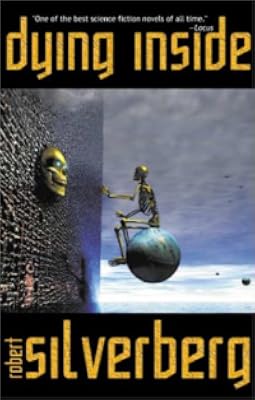
Dying Inside
by Robert Silverberg
On This Page
Description
Fiction. Science Fiction. HTML:David Selig was born with an awesome power -- the ability to look deep into the human heart, to probe the darkest truths hidden in the secret recesses of the soul. With reckless abandon, he used his talent in the pursuit of pleasure. Then, one day, his power began to die... Universally acclaimed as Robert Silverberg's masterwork, Dying Inside is a vivid, harrowing portrait of a man who squandered a remarkable gift, of a superman who had to learn what it was to show more be human. show lessTags
Recommendations




































Member Recommendations

Member Reviews
David Selig comes of age in the 1960s. He is a telepathic receiver who, even as a child, was smart enough to know that he should keep his ability a secret. He knows too much about people to respect them. His moral compass wavers a bit, and he is often depressed. He exploits his lovers and business colleagues. For a while, he makes his living writing term papers for desperate college students. Along the way, he meets only one other telepath, and he doesn’t like him.
Silverberg gives us the sex and drugs of the ‘60s without the rock ‘n’ roll. Dying Inside is probably his best book, and is so New Wave that one reviewer says it isn’t sci-fi. Selig is not a likable protagonist, nor is he meant to be, as you might expect for someone show more who identifies himself with Franz Kafka.
It is a good thing that David was not born in our era, because AI would undercut his prices in the fake-term-paper trade. show less
Silverberg gives us the sex and drugs of the ‘60s without the rock ‘n’ roll. Dying Inside is probably his best book, and is so New Wave that one reviewer says it isn’t sci-fi. Selig is not a likable protagonist, nor is he meant to be, as you might expect for someone show more who identifies himself with Franz Kafka.
It is a good thing that David was not born in our era, because AI would undercut his prices in the fake-term-paper trade. show less
Silverberg's speaker-protagonist David Selig is a freak telepath who has concealed his talent for his whole life and is now losing it, i.e. "dying inside." The book is framed as a memoir; it includes biographical reflection along with events more immediate to its writing. Selig ghostwrites academic papers for pay, and pieces of these appear embedded in the larger text. The narrative isn't very linear, and sometimes it indulges in stream of consciousness, but it didn't feel very experimental or avant-garde to me; these modes were suited to the subject matter.
I enjoyed this book, which seemed to me very vividly of its time, the exhausted post-countercultural moment of the beleaguered nineteen-seventies--letting go of anxious utopian and show more mystical aspirations. The story moved quickly, and while there was a fair amount of plot in retrospect, it felt very much like an exploration of character throughout, both Selig's own and his understanding of the people to whom he had been close. show less
I enjoyed this book, which seemed to me very vividly of its time, the exhausted post-countercultural moment of the beleaguered nineteen-seventies--letting go of anxious utopian and show more mystical aspirations. The story moved quickly, and while there was a fair amount of plot in retrospect, it felt very much like an exploration of character throughout, both Selig's own and his understanding of the people to whom he had been close. show less
4/5
Brilliantly clear, concise, and strong in voice, this is a stunning biopic of a man that has one-way telepathic power. David Selig spends his life receiving the thoughts and feelings of other, but nobody can either do the same for him, at least this way true during the early part of his life. The novel starts during his middle-aged years when his power is mysteriously on the decline, limiting his ability to connect with other people in the way that is most familiar to him.
It's a testament to Silverberg's strength as a storyteller that the central SF conceit of this novel is so rooted in reality that I hardly feels unreal at all. His prose is, as always, seemingly effortless. Witty and beautiful, the novel flies past your eyes with a show more sense of purpose unmatched by many authors. Silverberg's characterization of Selig is one of the best I've read in quite a while, and the heart of the novel. What we see is a flawed, unsympathetic, judgemental, and narcissistic person whose pain is relatable on so many levels. His inability to communicate with others alienates and isolates him, and when he uses his powers he feels like a peeping tom, a snake that pries into peoples brain without consent. There are many situations in which Selig is damned if he does and damned if he doesn't. It's a moldering, squandered life that he leads, and we feel that in every sense of the word. Of course, this is all through his perspective, how he feels about himself. Dying Inside is the story of one mans self-hatred as the only thing that separates him from his peers slowly slips through his fingers. All of this is a critique on the 'modern' life of single men, but I can't help but wonder how much of these experiences were personal to Silverberg himself.
There are unfortunately some downright dated characterizations too, specifically when it comes to the one black character, and the parade of female characters that David dates and subsequently has sex with. It's clear the year in which it was written played a heavy roll in these generalizations, and a contributing factor into why I don't give it higher score. I haven't read Portnoy's Complaint, so I really can't say how much inspiration Silverberg took from it, but I gather that it's quite a lot. show less
Brilliantly clear, concise, and strong in voice, this is a stunning biopic of a man that has one-way telepathic power. David Selig spends his life receiving the thoughts and feelings of other, but nobody can either do the same for him, at least this way true during the early part of his life. The novel starts during his middle-aged years when his power is mysteriously on the decline, limiting his ability to connect with other people in the way that is most familiar to him.
It's a testament to Silverberg's strength as a storyteller that the central SF conceit of this novel is so rooted in reality that I hardly feels unreal at all. His prose is, as always, seemingly effortless. Witty and beautiful, the novel flies past your eyes with a show more sense of purpose unmatched by many authors. Silverberg's characterization of Selig is one of the best I've read in quite a while, and the heart of the novel. What we see is a flawed, unsympathetic, judgemental, and narcissistic person whose pain is relatable on so many levels. His inability to communicate with others alienates and isolates him, and when he uses his powers he feels like a peeping tom, a snake that pries into peoples brain without consent. There are many situations in which Selig is damned if he does and damned if he doesn't. It's a moldering, squandered life that he leads, and we feel that in every sense of the word. Of course, this is all through his perspective, how he feels about himself. Dying Inside is the story of one mans self-hatred as the only thing that separates him from his peers slowly slips through his fingers. All of this is a critique on the 'modern' life of single men, but I can't help but wonder how much of these experiences were personal to Silverberg himself.
There are unfortunately some downright dated characterizations too, specifically when it comes to the one black character, and the parade of female characters that David dates and subsequently has sex with. It's clear the year in which it was written played a heavy roll in these generalizations, and a contributing factor into why I don't give it higher score. I haven't read Portnoy's Complaint, so I really can't say how much inspiration Silverberg took from it, but I gather that it's quite a lot. show less
Seems diminishing to describe this quite remarkable novel only in relation to its mainstream analogues. But they're there -- and they're far enough in distance, with their reputation firm and matured, to quite clearly be an influence upon and model for many aspects of what Silverberg's doing here. Namely, I would say, Roth [P's Complaint to be exact] and Bellow's Herzog. I mean, a substantial part of this is Selig dictating droves of unsent letters to acquaintances and famous people alike, alive and dead. Nonetheless, even given those non-sf antecedents, this is still quite the achievement -- achieving an aesthetic effect and emotional resonance quite unlike most any other sf [long or short] I've read. Even, I could say, achieving an show more effect I might have previously thought impossible in the medium [and not as a detriment, but solely as a function of how different genres operate]. AND, what is actually more impressive, the sf element here is NOT, as one might assume with a book doing what this book does, ancillary to that effect, but directly responsible for it! Basically, the criterion I require for exceptional speculative stuff. In some respects -- and again, this is one of the work's amazing elements [as it's more often than not the reverse, even in good speculative stuff] -- Dying Inside succeeds in discrete chunks more than it does cumulatively [one gets the sense that Silverberg understood what kind of work he was writing and thereby understood what kind of ending he needed to write, but still didn't exactly know how to tack on meaning nonetheless to a "meaningless" ending, as some litfic authors are more practiced at], meaning that the little section pieces work in and of themselves [I'm thinking of several early and middle scenes with his sister Jude (his immediate takedown of Guermantes in front of her ["He's a monster"]) and his breakup with Toni (reading her gay friend's mind, seeing them lying naked together and him trying his damndest to have sex with her as comfort and them failing but still feeling quite a bit of love and comfort between them -- really a moving scene, AND one in which the speculative element is required for its effect)]. Otherwise, I think I also felt especially predisposed to getting what this was giving after finishing A SEPARATION recently and really really souring on it even more in the meantime. Such a dead book. And to come to this immediately after -- something overflowing with life and experience, something so unapologetically itself, something so rudely of its time -- in which a smart reader understands the actual and tangible divisions between Selig's sexism [obsessive objectivisation, z.B.] and Silverberg's sexism [the inability to think of his female characters outside of his mind], Selig's racism [his inability to see the obvious bigotry in adopting jive talk for Yahya's paper] and Silverberg's racism [the announcing of every black entrance, the assumption of omnipresent Black Power and you-dumb-honky-ness], etc. etc. It all just works. show less
A beautiful book, as all books written by Silverberg usually turn out to be. It deals with David Selig, who was born with the ability to read minds, and the trouble he has when he realizes his gift is fading away. What we're dealing with is not the expected life of a superman, in fact he regards his gift as a curse due to the various difficulties it had put him through. And now that the power is dying inside him, he feels he's losing his identity with its passing away.
I loved everything about that novel. Characterization is top notch, the writing's fluid, and the story itself is a beauty, despite being a bit too dark and depressive most of the time. Which suited my current mood perfectly, I must add.
One thing that might irk readers show more unfamiliar with Silverberg's books is the open ending, as most of his books have no sharp ending event putting a neat close to the story line. More realistically though, he deals with the characters and the changing process they have to go through. Again, I had no problem with that.
There's not much I can say about the story itself. You have to drink it in yourself. Recommended. show less
I loved everything about that novel. Characterization is top notch, the writing's fluid, and the story itself is a beauty, despite being a bit too dark and depressive most of the time. Which suited my current mood perfectly, I must add.
One thing that might irk readers show more unfamiliar with Silverberg's books is the open ending, as most of his books have no sharp ending event putting a neat close to the story line. More realistically though, he deals with the characters and the changing process they have to go through. Again, I had no problem with that.
There's not much I can say about the story itself. You have to drink it in yourself. Recommended. show less
This is a book I might have enjoyed as an edgy teen. As an adult, I found myself embarrassed to read it - whether in public or alone. It is masturbatory and pretentious.
Tiresome name-dropping and referencing are used to give the illusion of intelligent narration, but have zero depth and offer nothing to the story. Chapter 4 is literally a high school essay on Kafka. These tangents very quickly become tedious and entirely skippable.
I only finished the book because it was mercifully short. I did enjoy the ending, but it was not worth reading the whole book for.
Having never read Silverberg's other works, I can't tell whether this style is particular to the protagonist or peculiar to Silverberg himself (...no Robert, I don't need another show more gratuitous characterisation of a woman by the size of her breasts and the quality of her thighs). Having been told this is the author's best work, I shall steer clear of him in the future. show less
Tiresome name-dropping and referencing are used to give the illusion of intelligent narration, but have zero depth and offer nothing to the story. Chapter 4 is literally a high school essay on Kafka. These tangents very quickly become tedious and entirely skippable.
I only finished the book because it was mercifully short. I did enjoy the ending, but it was not worth reading the whole book for.
Having never read Silverberg's other works, I can't tell whether this style is particular to the protagonist or peculiar to Silverberg himself (...no Robert, I don't need another show more gratuitous characterisation of a woman by the size of her breasts and the quality of her thighs). Having been told this is the author's best work, I shall steer clear of him in the future. show less
f you are a writer, there is a sadness in completing a masterful work. It is that surety, the cold knowledge that you will never write anything so important, or so simply. That is my unfiltered reaction to having completed Dying Inside. Silverberg filled his book with an absolutely miserable, self-pitying, abhorrent human being. He did little but wander through his current and dim past life, showing us his wallowing failures at holding normal relationships with people.
He has a “gift,” does David Selig, one that makes him — as he considers himself to be — a Superman. However, as we watch his life, and especially as his gift begins to fail him, and disappear, we become aware, as he never does, that it is not a gift. He can read show more minds, as only a few others can. But it does him no good. He squanders the gift, which oddly, isolates him from society. He doesn’t need to interact, he can “learn” them without their input. There are one or two others with the gift, and they fare slightly better, but it is still pointless.
So, I read about David, the whiny, wheedling, racist, protagonist, and secretly rooted for him to die. He does not, and I’m not certain he ever becomes likable, but I couldn’t help but enjoy the book. Silverberg’s prose is a masterful mix of simplicity and lyricism. And though we don’t like David or anyone in his world — there isn’t a single likable character in the book — we are drawn in by Silverberg’s storytelling enough not to care.
We read the book, not because we care about the character, but because we care about the book. And that, my friends, is a masterwork. show less
He has a “gift,” does David Selig, one that makes him — as he considers himself to be — a Superman. However, as we watch his life, and especially as his gift begins to fail him, and disappear, we become aware, as he never does, that it is not a gift. He can read show more minds, as only a few others can. But it does him no good. He squanders the gift, which oddly, isolates him from society. He doesn’t need to interact, he can “learn” them without their input. There are one or two others with the gift, and they fare slightly better, but it is still pointless.
So, I read about David, the whiny, wheedling, racist, protagonist, and secretly rooted for him to die. He does not, and I’m not certain he ever becomes likable, but I couldn’t help but enjoy the book. Silverberg’s prose is a masterful mix of simplicity and lyricism. And though we don’t like David or anyone in his world — there isn’t a single likable character in the book — we are drawn in by Silverberg’s storytelling enough not to care.
We read the book, not because we care about the character, but because we care about the book. And that, my friends, is a masterwork. show less
Members
- Recently Added By
Lists

Best Science Fiction Novels
816 works; 430 members
Survey of Classic Science Fiction
171 works; 48 members

Bibliography for Among Others
159 works; 15 members

S.F. Masterworks (Complete)
229 works; 15 members

SF Masterworks
193 works; 8 members
Unshelved Book Clubs
579 works; 5 members

Books Read in 2016
4,666 works; 199 members
Author Information

989+ Works 62,548 Members
Some Editions
Awards and Honors
Awards
Distinctions
Notable Lists
Series
Belongs to Publisher Series
Work Relationships
Common Knowledge
- Canonical title*
- Es stirbt in mir
- Original title
- Dying Inside
- Original publication date
- 1972-10
- People/Characters
- David Selig
- Important places
- New York, New York, USA
- Dedication
- For B and T and C and me - we sweated it out
- First words
- So, then, I have to go downtown to the University and forage for dollars again.
- Quotations
- David Selig is 41 and counting. Slightly above medium height, he has the lean figure of a bachelor accustomed to his own meager cooking, and his customary facial expression is a mild, puzzled frown. He blinks a lot. In his fa... (show all)ded blue denim jacket, heavy-duty boots, and 1969-vintage striped bells he presents a superficially youthful appearance, at least from the neck down; but in fact he looks like some sort of refugee from an illicit research laboratory where the balding, furrowed heads of anguished middle-aged men are grafted to the reluctant bodies of adolescent boys. How did this happen to him? At what point did his face and scalp begin to grow old?
Aldous Huxley thought that evolution has designed our brains to serve as filters, screening out a lot of stuff that’s of no real value to us in our daily struggle for bread. Visions, mystical experiences, psi phenomena such... (show all) as telepathic messages from other brains—all sorts of things along these lines would forever be flooding into us were it not for the action of what Huxley called, in a little book entitled Heaven and Hell, “the cerebral reducing valve.” Thank God for the cerebral reducing valve! If we hadn’t evolved it, we’d be distracted all the time by scenes of incredible beauty, by spiritual insights of overwhelming grandeur, and by searing, utterly honest mind-to-mind contact with our fellow human beings. Luckily, the workings of the valve protect us—most of us—from such things, and we are free to go about our daily lives, buying cheap and selling dear. - Last words
- (Click to show. Warning: May contain spoilers.)Until I die again, hello, hello, hello, hello.
- Blurbers
- Banks, Iain
- Original language
- English
- Canonical DDC/MDS
- 813.54
*Some information comes from Common Knowledge in other languages. Click "Edit" for more information.
Classifications
Statistics
- Members
- 1,749
- Popularity
- 12,638
- Reviews
- 58
- Rating
- (3.75)
- Languages
- 9 — Czech, English, French, German, Italian, Polish, Portuguese, Spanish, Turkish
- Media
- Paper, Audiobook, Ebook
- ISBNs
- 40
- ASINs
- 24