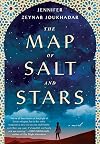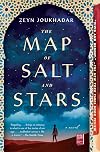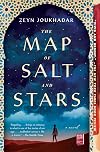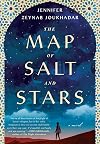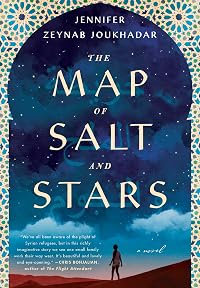
The Map of Salt and Stars
by Zeyn Joukhadar
On This Page
Description
"In the summer of 2011, just after Nour loses her father to cancer, her mother moves Nour and her sisters from New York City back to Syria to be closer to their family. In order to keep her father's spirit as she adjusts to her new home, Nour tells herself their favorite story--the tale of Rawiya, a twelfth-century girl who disguised herself as a boy in order to apprentice herself to a famous mapmaker. But the Syria Nour's parents knew is changing, and it isn't long before the war reaches show more their quiet Homs neighborhood. When a stray shell destroys Nour's house and almost takes her life, she and her family are forced to choose: stay and risk more violence or flee across seven countries of the Middle East and North Africa in search of safety--along the very route Rawiya and her mapmaker took eight hundred years before in their quest to chart the world"--Amazon.com. show lessTags
Recommendations





Member Reviews
After the death of her father, for reasons Nour doesn't understand, her mother moves them from New York back to Syria. The timing couldn't be more tragic: shortly after their arrival civil unrest commences, which leads swiftly to the Syrian Civil War, forcing Nour and her family to flee the conflict when their home is reduced to rubble. Throughout the hardships of their flight to safety, Nour compares her journey to that of 12th-century travelers Rawiya and al-Idrisi, who circumnavigated the Mediterranean in pursuit of creating the most detailed world map of its time.
This book is beautifully written and difficult to put down. Readers will immediately sense the trajectory of the dual timelines as Joukhadar deftly interweaves the show more fantastical past with the all-too-real present. I enjoyed detecting the similarities, though be forewarned that the contemporary plot is absolutely gut-wrenching. Highly recommended. show less
This book is beautifully written and difficult to put down. Readers will immediately sense the trajectory of the dual timelines as Joukhadar deftly interweaves the show more fantastical past with the all-too-real present. I enjoyed detecting the similarities, though be forewarned that the contemporary plot is absolutely gut-wrenching. Highly recommended. show less
In this beautifully written literary fiction, Nour, a girl of Syrian-American heritage, must relocate with her mother and two sisters to Syria after her father’s death. Upon settling into a new home in Syria, civil war breaks out. They begin a journey across the Middle East and North Africa in search of safe-haven. Nour’s father had often repeated a story to her, an ancient fable of a heroic girl and a mapmaker. This mystical story is interwoven into the primary narrative in alternating segments. I very much enjoyed the two intertwined stories, set hundreds of years apart, especially the way they parallel each other in geographic location as well as action sequences. Both stories contain mapmakers and strong young female show more protagonists that masquerade as boys. Both contain journeys, villains, and danger. The older mythical story sets the historic context for the contemporary story.
The author vividly portrays the various cultures of the region. Small portions of the story slip into the realm of magical realism in a way that adds to rather than detracts from the narrative. This novel brings the Syrian refugee crisis into sharp focus, and vividly conveys the impact on families, especially women and children. While the pacing seemed uneven in a few places, I found it extremely imaginative, lyrically written, and well-crafted.
Filled with visions of home, courage, and hope, the ancient and contemporary stories converge in a meaningful way at the end. This is a debut novel and I look forward to reading future works from this author. Highly recommended to readers of historical or literary fiction, or those interested in narratives featuring strong women, diverse cultures, or Syrian heritage. show less
The author vividly portrays the various cultures of the region. Small portions of the story slip into the realm of magical realism in a way that adds to rather than detracts from the narrative. This novel brings the Syrian refugee crisis into sharp focus, and vividly conveys the impact on families, especially women and children. While the pacing seemed uneven in a few places, I found it extremely imaginative, lyrically written, and well-crafted.
Filled with visions of home, courage, and hope, the ancient and contemporary stories converge in a meaningful way at the end. This is a debut novel and I look forward to reading future works from this author. Highly recommended to readers of historical or literary fiction, or those interested in narratives featuring strong women, diverse cultures, or Syrian heritage. show less
Beautiful, lyrically written parallel stories of a family's harrowing journey across the Middle East, which mirrors the journey of an ancient map maker and his young apprentices. Heavily infused with magical realism and almost crushing emotion, the story will overwhelm you but keep you turning pages. The writing is sophisticated, so you forget that the first person narration is coming from an 11-year old, until she does something or reacts in a way that could only come from a child. At the same time, the historical part of the story reads like a factual historical account, until something mystical happens. In both these ways the reader is constantly being pushed and pulled into different perceptions and understands of the reality the show more book creates. The young narrator is also a synesthete, which adds a depth of understanding to the character's physical context as well as her emotional connections to her family. The author herself is also a synesthete, so the reader can be confident that this is a real depiction of the way someone with synethesia understands the world. show less
It took me quite some time to totally become engrossed in A Map of Salt and Stars by Jennifer Joukhadar but once I did, this became a book that I couldn’t put down. There are two plot lines to follow in this book, one about a contemporary girl called Nour whose mother moves the family back to Syria from America after the death of her father. All too soon bombs are dropping on their city and their house is destroyed and the family is suddenly homeless, searching for a safe place. Nour comforts herself by remembering a story that her father used to tell her and this story becomes the second narrative. This story is about a girl called Rawiya in the twelfth century who disguises herself as a boy and becomes apprenticed to a mapmaker show more charting trade routes.
Nour’s and Rawiya’s stories become entwined as both girls travelled very similar trails through Jordan, Egypt, Libya and Algeria. Nour also disguises herself as a boy for safety’s sake, and both girls face cold, hunger and frequent bureaucracy. While Rawiya’s story is more of an adventure, Nour’s is the harrowing story of a refugee.
The Map of Salt and Stars is a remarkable debut novel. This coming of age story is enhanced by Nour’s synesthesia which brings an added richness to the descriptions. While both girls have to make hard choices and sacrifices, I was much more invested in the contemporary story but I do wish that the book had included a map that showed exactly where these girls travelled. show less
Nour’s and Rawiya’s stories become entwined as both girls travelled very similar trails through Jordan, Egypt, Libya and Algeria. Nour also disguises herself as a boy for safety’s sake, and both girls face cold, hunger and frequent bureaucracy. While Rawiya’s story is more of an adventure, Nour’s is the harrowing story of a refugee.
The Map of Salt and Stars is a remarkable debut novel. This coming of age story is enhanced by Nour’s synesthesia which brings an added richness to the descriptions. While both girls have to make hard choices and sacrifices, I was much more invested in the contemporary story but I do wish that the book had included a map that showed exactly where these girls travelled. show less
This was a beautifully written book. Nour's family moves back to Syria after her Baba's (father's) death in NYC. Nour is the only one born in the US, with her two older sisters having been born in Syria. When the Syrian Civil War comes close to their neighborhood, and eventually bombs their home, they consider themselves lucky to be able to follow a path that should lead them out of Syria. About 800 years earlier, Rawiya disguises herself as a young boy so she can join and apprentice with the premier map maker of the time, Al-Idrisi. His small caravan heads off to map the Northern African and Middle Eastern countries and routes, a definitive work for Norman King Roger. As with many dual timeline narratives, I started out liking one show more better than the other. But as I continued into the story, it was so interesting how Nour's refugee journey took them through the same parts of the Mid East that the map maker's party had taken years earlier. The story of Rawiya's journey was a favorite tale and memory that Nour has from her father. Both sections are filled with a lot of action and anxiety. The descriptions of the area are beautiful, Nour's synesthesia brings color to a lot of the descriptions. But the plight of these refugees isn't easy and many catastrophic things happen along the way. show less
I carried our memoires all this way, the story of what happened to us. It was heavy on my shoulders this whole time, but I didn’t fall down.
Joukhadar uses dual story lines and two young heroines to tell this story of family, loss, perseverance, grief, love and success. Nour’s story takes place in 2011; she has returned to Syria from Manhattan with her mother and sisters, after her father’s death. But it is not the safe haven her mother expected, because war is tearing the country apart. Rawiya, is a 12th-century girl who, legend has it, disguised herself as a boy to travel with renowned mapmaker al-Idrisi. Her story is the favorite one of Nour’s father’s tales and Nour recites it to herself as a way of keeping her father show more close. But there are parallels to the girls’ journeys, one as she explores new lands, the other as she flees across many countries to find safety once again.
I liked both Nour and Rawiya, and loved some of the supporting characters. Both girls must navigate through harsh territory and face numerous dangers from both the environment and the people they encounter. Both sometimes rely on being disguised or taken for a boy. Both find an unlikely champion / savior on more than one occasion. I was a little suspicious at first about Abu Sayeed, but came to love him and the gentle way he helped and protected Nour and her family. Like Nour, I relaxed in the safety he provided: I am covered with a thick rind of safety, like an orange.
I did find myself more drawn to Nour’s modern-day story, probably because I’m less inclined towards “fairytales” at this stage of my life. Dual timelines seems to be all the rage in novels these days, as well as dual narrators. But it’s a difficult style to pull off well. Joukhadar is a talented writer, but I felt tossed back and forth, getting invested in one story only to be yanked across centuries to a completely different scenario when I turned the page. I enjoyed the legendary tale but would have preferred to read a book that was set entirely in the present.
Still, Joukhadar gave me a compelling read with well-drawn characters and some interesting parallels. I also rather liked the opening of each part of the novel, where the author gave us a passage from a seemingly ancient text, printed, in each case, in the outline of that country. I checked the author notes but didn’t find any specific citation, so I assume that Joukhadar wrote these passages, rather than quote them. Though they fascinated me, they represented yet another style / storyline to try to get straight within the context of the entire book.
At one point Nour reflects on a scar left on her leg: Life draws blood and leaves its jewelry in our skin. This novel doesn’t draw any blood, but will definitely leave its mark on the reader.
NOTE: Author is a transgender male. The book was originally published with the author listed as Jennifer Zeynab Joukhadar. But the author now goes by Zeyn Joukhabar. show less
Joukhadar uses dual story lines and two young heroines to tell this story of family, loss, perseverance, grief, love and success. Nour’s story takes place in 2011; she has returned to Syria from Manhattan with her mother and sisters, after her father’s death. But it is not the safe haven her mother expected, because war is tearing the country apart. Rawiya, is a 12th-century girl who, legend has it, disguised herself as a boy to travel with renowned mapmaker al-Idrisi. Her story is the favorite one of Nour’s father’s tales and Nour recites it to herself as a way of keeping her father show more close. But there are parallels to the girls’ journeys, one as she explores new lands, the other as she flees across many countries to find safety once again.
I liked both Nour and Rawiya, and loved some of the supporting characters. Both girls must navigate through harsh territory and face numerous dangers from both the environment and the people they encounter. Both sometimes rely on being disguised or taken for a boy. Both find an unlikely champion / savior on more than one occasion. I was a little suspicious at first about Abu Sayeed, but came to love him and the gentle way he helped and protected Nour and her family. Like Nour, I relaxed in the safety he provided: I am covered with a thick rind of safety, like an orange.
I did find myself more drawn to Nour’s modern-day story, probably because I’m less inclined towards “fairytales” at this stage of my life. Dual timelines seems to be all the rage in novels these days, as well as dual narrators. But it’s a difficult style to pull off well. Joukhadar is a talented writer, but I felt tossed back and forth, getting invested in one story only to be yanked across centuries to a completely different scenario when I turned the page. I enjoyed the legendary tale but would have preferred to read a book that was set entirely in the present.
Still, Joukhadar gave me a compelling read with well-drawn characters and some interesting parallels. I also rather liked the opening of each part of the novel, where the author gave us a passage from a seemingly ancient text, printed, in each case, in the outline of that country. I checked the author notes but didn’t find any specific citation, so I assume that Joukhadar wrote these passages, rather than quote them. Though they fascinated me, they represented yet another style / storyline to try to get straight within the context of the entire book.
At one point Nour reflects on a scar left on her leg: Life draws blood and leaves its jewelry in our skin. This novel doesn’t draw any blood, but will definitely leave its mark on the reader.
NOTE: Author is a transgender male. The book was originally published with the author listed as Jennifer Zeynab Joukhadar. But the author now goes by Zeyn Joukhabar. show less
This is a physically and narratively beautiful book. With maps inside the covers, chapters marked by a shaped poem for each country the family visits, and a secret "message" hidden beneath the title, the book itself contributes to the story. Mostly it comes from the view point of Nour, a young 12 year old who has recently lost her father to cancer. Her mother, a creative mapmaker is bereft and lost in their adopted home of NYC, so she moves her daughters Nour, Zahra, and Huda back to Syria to be near family. It is 2011. To say that this is ill-timed is an understatement. Within months of their return, their family home is bombed and they become refugees. Their plight is harrowing, but Nour's understanding is a bit naive and she also show more filters things differently - she is a synthesthete, seeing the world in colors and emotions rather than stark reality. This gives her a small layer of protection. Her other "secret weapon" is the folk tale she shared with her father of Rawiya, a young girl in ancient times who seeks adventure and knowledge and is brave beyond compare, posing as a young boy so she can become an apprentice mapmaker. Her odyssey takes her around the ancient world, encountering mythical creatures and evil empires, but she triumphs just like Nour must. While her family faces every possible obstacle refugees might (corrupt border crossings/coyotes, a boat that sinks, being shelled by enemy gunfire, illness and injury) Nour follows her mother's map to "home." The child narrator works here as does the weaving of past fable and present reality to fully represent a culture, history and current global issue. show less
Members
- Recently Added By
Lists

Middle East Fiction
179 works; 16 members

Evan's Reading List 2020
12 works; 1 member

Middle Eastern Literature & Non-Fiction
99 works; 3 members

9 Mind-Bending Books About Parallel Universes
9 works; 1 member

Arab and Arab Diaspora Literature We Recommend
112 works; 53 members
Author Information

4+ Works 1,475 Members
Some Editions
Awards and Honors
Awards
Distinctions
Notable Lists
Common Knowledge
- Canonical title
- The Map of Salt and Stars
- Original title
- The Map of Salt and Stars
- Original publication date
- 2018-05-01
- People/Characters
- Muhammad al-Idrisi; Rawiya; Nour; Huda; Zahra; Khaldun
- Important places
- Syria; Middle East; Ceuta, Spain
- Important events
- Syrian Civil War
- Dedication
- For the Syrian people,
both in Syria and in diaspora,
and for all refugees - First words
- The island of Manhattan's got holes in it, and that's where Baba sleeps.
- Last words
- (Click to show. Warning: May contain spoilers.)Steadying my hand, I fill it in.
- Publisher's editor
- Todd, Trish
- Blurbers
- Alyan, Hala; Bohjalian, Chris; Chen, Kirstin
- Original language
- English US
Classifications
Statistics
- Members
- 1,000
- Popularity
- 26,226
- Reviews
- 40
- Rating
- (3.80)
- Languages
- 7 — Dutch, English, French, German, Italian, Spanish, Portuguese (Portugal)
- Media
- Paper, Audiobook, Ebook
- ISBNs
- 25
- ASINs
- 8