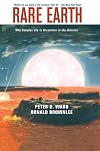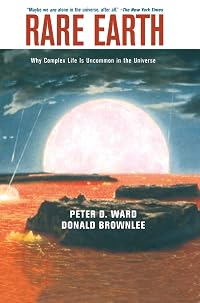
Rare Earth: Why Complex Life is Uncommon in the Universe
by Peter D. Ward, Donald Brownlee
On This Page
Description
n November 12, 2002, Dr. John Chambers of the NASA Ames - search Center gave a seminar to the Astrobiology Group at the OUniversity of Washington. The audience of about 100 listened with rapt attention as Chambers described results from a computer study of how planetary systems form. The goal of his research was to answer a dec- tively simple question: How often would newly forming planetary systems produce Earth-like planets, given a star the size of our own sun? By “Ear- like” Chambers show more meant a rocky planet with water on its surface, orbiting within a star’s “habitable zone. ” This not-too-hot and not-too-cold inner - gion, relatively close to the star, supports the presence of liquid water on a planet surface for hundreds of million of years—the time-span probably n- essary for the evolution of life. To answer the question of just how many Earth-like planets might be spawned in such a planetary system, Chambers had spent thousands of hours running highly sophisticated modeling p- grams through arrays of powerful computers. x Preface to the Paperback Edition The results presented at the meeting were startling. The simulations showed that rocky planets orbiting at the “right” distances from the central star are easily formed, but they can end up with a wide range of water c- tent. show lessTags
Recommendations















Member Reviews
I’m pretty proud of myself. I don’t generally read non-fiction, and the non-fiction I do read usually has some kind of flavor to it. However, I made an exception for Rare Earth, which is nothing but your usual general science condensed into a theory that Earth may be the only planet in the universe teeming with animal life, let alone intelligent life.
I heard of this book during Odyssey 2005 from guest lecturer Allen Steele. He gave a lecture on world-building, and passed out some of the references he had used while creating the solar system and planet for his Coyote series (I say series because at this lecture, he made a few comments that made me suspect a fourth volume is in the works). Rare Earth was one of his titles.
The reason I show more picked it up, aside from general curiosity about the various theories populating the chances of life outside our planet, was also for research material. Not that I had a particular project in mind at the time, but I thought that it would be a good idea to have this book under my belt for future stories (and one current one) that took place on extrasolar planets.
Rare Earth has a lot of interesting info. It goes into all kinds of reasons why animal life (the authors are quick to note that they do believe microbial life, like bacteria, is likely very common) is rare in the universe. The writers discuss the Cambrian Explosion, Snowball Earth, plate tectonics, impacts and extinctions, Jupiter, the moon, and the habitable zone of our solar system. All of which is divided into manageable chunks that lead from one section to the other. The writers also continuously repeat their points, just in case you missed them the first time.
Given the nature of the book (it’s more general science than theory), it’s hard to actually recommend. The hardcover edition was published in 2000, and the trade, which I read, in 2004. There’s a preface to the trade edition where the authors say that despite then-current observations and discoveries, they pretty much stand by their theories as presented in the book—indeed, the only corrections made were typos and such. But science has a way of jumping forward, and from recent articles in magazines like “New Scientist”, some of their then-current information is now wrong. The biggest two I noticed were the fact that there have been several terrestrial planets discovered, three of which posted in a 5/17/06 article on New Scientist’s website, all of them in the same system (and Neptune-sized!). There’s also a recent discovery that humanity did not originally migrate to North America from the Bering Strait—older remains, though currently disputed, have been found in South America.
Of course, all of this is very recent science. :) But given the fact that I’ve only recently begun to watch current scientific trends, I was constantly aware of what else could be considered wrong now that wasn’t when this book was published. Granted, it’s only been two years, but still, that’s a long time.
But I can’t fault the book in terms of interesting information, especially since it spawned a few vague story ideas and also gave me some interesting, supportive evidence for my own alien race in my novel. I am also glad to have read this now, before I tackle Darwin’s The Origin of Species.
Don’t get me wrong, though: for anyone convinced of intelligent life out there in the universe, this book is a total killjoy. The writers admit, at the very end, that they may lack imagination, that all of their evidence is based on what we know from our own planet, and that other worlds and other life may be creatively different. But they don’t think so. Personally, I think they rejoice in the idea that Earth and her people are not mediocre, that we aren’t one of many, that on a whole, we are a beautiful, unique, snowflake in the universe.
But at least they admit that astrobiology is clearly in its infancy, and that scientifically, we have a long way to go in terms of discovering the wonders of the universe. Who knows what such future science will reveal? Only time will tell.
Until then, it’s not a bad book to read, regardless of your beliefs. Especially if you write SF that involves other planets: this book at least gives solid facts as to what a planet would be like if tidally locked to the sun, or if the moon’s orbit around the earth were the exact opposite. So there’s fun facts, but in terms of research material, don’t let this be your only source. show less
I heard of this book during Odyssey 2005 from guest lecturer Allen Steele. He gave a lecture on world-building, and passed out some of the references he had used while creating the solar system and planet for his Coyote series (I say series because at this lecture, he made a few comments that made me suspect a fourth volume is in the works). Rare Earth was one of his titles.
The reason I show more picked it up, aside from general curiosity about the various theories populating the chances of life outside our planet, was also for research material. Not that I had a particular project in mind at the time, but I thought that it would be a good idea to have this book under my belt for future stories (and one current one) that took place on extrasolar planets.
Rare Earth has a lot of interesting info. It goes into all kinds of reasons why animal life (the authors are quick to note that they do believe microbial life, like bacteria, is likely very common) is rare in the universe. The writers discuss the Cambrian Explosion, Snowball Earth, plate tectonics, impacts and extinctions, Jupiter, the moon, and the habitable zone of our solar system. All of which is divided into manageable chunks that lead from one section to the other. The writers also continuously repeat their points, just in case you missed them the first time.
Given the nature of the book (it’s more general science than theory), it’s hard to actually recommend. The hardcover edition was published in 2000, and the trade, which I read, in 2004. There’s a preface to the trade edition where the authors say that despite then-current observations and discoveries, they pretty much stand by their theories as presented in the book—indeed, the only corrections made were typos and such. But science has a way of jumping forward, and from recent articles in magazines like “New Scientist”, some of their then-current information is now wrong. The biggest two I noticed were the fact that there have been several terrestrial planets discovered, three of which posted in a 5/17/06 article on New Scientist’s website, all of them in the same system (and Neptune-sized!). There’s also a recent discovery that humanity did not originally migrate to North America from the Bering Strait—older remains, though currently disputed, have been found in South America.
Of course, all of this is very recent science. :) But given the fact that I’ve only recently begun to watch current scientific trends, I was constantly aware of what else could be considered wrong now that wasn’t when this book was published. Granted, it’s only been two years, but still, that’s a long time.
But I can’t fault the book in terms of interesting information, especially since it spawned a few vague story ideas and also gave me some interesting, supportive evidence for my own alien race in my novel. I am also glad to have read this now, before I tackle Darwin’s The Origin of Species.
Don’t get me wrong, though: for anyone convinced of intelligent life out there in the universe, this book is a total killjoy. The writers admit, at the very end, that they may lack imagination, that all of their evidence is based on what we know from our own planet, and that other worlds and other life may be creatively different. But they don’t think so. Personally, I think they rejoice in the idea that Earth and her people are not mediocre, that we aren’t one of many, that on a whole, we are a beautiful, unique, snowflake in the universe.
But at least they admit that astrobiology is clearly in its infancy, and that scientifically, we have a long way to go in terms of discovering the wonders of the universe. Who knows what such future science will reveal? Only time will tell.
Until then, it’s not a bad book to read, regardless of your beliefs. Especially if you write SF that involves other planets: this book at least gives solid facts as to what a planet would be like if tidally locked to the sun, or if the moon’s orbit around the earth were the exact opposite. So there’s fun facts, but in terms of research material, don’t let this be your only source. show less
OK, I am in the obvious minority with this review, but it's how I see it.
This is a work filled with broad, sweeping suppositions, yet it seems that as always the devil is in the details and I was left unconvinced that the authors really had the details right to support their "Rare Earth" theory. It is an interesting, if ultimately unconvincing book. Interesting theory, lots of conjecture, and lots of "What if..." in every chapter.
To me it seems that in many places sweeping statements are made, but never supported. Take for instance the statement on page 110 "Changes in ocean chemistry caused by increased tectonic activity beginning a billion years ago facilitated the evolution of skeletons." But the section does not, to me, provide show more adequate support or explanation for this supposition.
Also take for example the Drake Equations which - while properly explained - is misstated in the details.
The equation is usually written: N = R* x fp x ne x fl x fi x fc x L where:
N = The number of civilizations in The Milky Way Galaxy whose electromagnetic emissions are detectable.
R* =The rate of formation of stars suitable for the development of intelligent life.
fp = The fraction of those stars with planetary systems.
Ne = The number of planets, per solar system, with an environment suitable for life.
fl = The fraction of suitable planets on which life actually appears.
fi = The fraction of life bearing planets on which intelligent life emerges
fc = The fraction of civilizations that develop a technology that releases detectable signs of their existence into space.
L = The length of time such civilizations release detectable signals into space.
(Source: Seti Institute, http://www.seti-inst.edu/science/drake-bg.html)
However, as given in the text of "Rare Earth" the formula is:
N* x fs x fp x ne x fi x fc x fl = N
This does not appear to be a big difference, however, the terms fi, fl, and fc are each mis-defined in the book. fi is defined as planets where life does arise, not intelligent life; fc as planets on which intelligent life emerges, not civilizations that develop a technology; and fl as percentage of lifetime of a planet that civilizations release detectable signals into space, not planets with life. This may seem nothing more then nit picking over details, but to me this is symptomatic of the entire work. If you can't even get a few simple 40 plus year old definitions right how accurate is the rest of the work? The belief that earth is the rarest of planets and then the selection of information to support that idea appears to be the main thrust here.
Good science uses data to take you to a logical, fact supported conclusion, you get the reverse when to select facts to support a preconceived conclusion.
In many ways I see this book as a thinnly disguised effort at Intelligent Design to explain why there is what there is on Earth.
Overall an unsatisfactory book. show less
This is a work filled with broad, sweeping suppositions, yet it seems that as always the devil is in the details and I was left unconvinced that the authors really had the details right to support their "Rare Earth" theory. It is an interesting, if ultimately unconvincing book. Interesting theory, lots of conjecture, and lots of "What if..." in every chapter.
To me it seems that in many places sweeping statements are made, but never supported. Take for instance the statement on page 110 "Changes in ocean chemistry caused by increased tectonic activity beginning a billion years ago facilitated the evolution of skeletons." But the section does not, to me, provide show more adequate support or explanation for this supposition.
Also take for example the Drake Equations which - while properly explained - is misstated in the details.
The equation is usually written: N = R* x fp x ne x fl x fi x fc x L where:
N = The number of civilizations in The Milky Way Galaxy whose electromagnetic emissions are detectable.
R* =The rate of formation of stars suitable for the development of intelligent life.
fp = The fraction of those stars with planetary systems.
Ne = The number of planets, per solar system, with an environment suitable for life.
fl = The fraction of suitable planets on which life actually appears.
fi = The fraction of life bearing planets on which intelligent life emerges
fc = The fraction of civilizations that develop a technology that releases detectable signs of their existence into space.
L = The length of time such civilizations release detectable signals into space.
(Source: Seti Institute, http://www.seti-inst.edu/science/drake-bg.html)
However, as given in the text of "Rare Earth" the formula is:
N* x fs x fp x ne x fi x fc x fl = N
This does not appear to be a big difference, however, the terms fi, fl, and fc are each mis-defined in the book. fi is defined as planets where life does arise, not intelligent life; fc as planets on which intelligent life emerges, not civilizations that develop a technology; and fl as percentage of lifetime of a planet that civilizations release detectable signals into space, not planets with life. This may seem nothing more then nit picking over details, but to me this is symptomatic of the entire work. If you can't even get a few simple 40 plus year old definitions right how accurate is the rest of the work? The belief that earth is the rarest of planets and then the selection of information to support that idea appears to be the main thrust here.
Good science uses data to take you to a logical, fact supported conclusion, you get the reverse when to select facts to support a preconceived conclusion.
In many ways I see this book as a thinnly disguised effort at Intelligent Design to explain why there is what there is on Earth.
Overall an unsatisfactory book. show less
This is a rare book, a book on science which is informative and inspiring without really trying to be. If we destroy 5% of species on earth, we may be doing a lot more than just that, we may be destroying 5% of the species in this sector of the galaxy.The authors explain a wide variety of different topics in several different disciplines in a non-dogmatic way, from astronomy and physics to biology and geography, just laying out what we think we know and how it relates to the formation of life on earth. This is a book in which I learned not just one new thing, but a whole bunch of different things that all relate to the question of the origin of complex life. (Simple life forms, they argue, may be quite common in the universe.) This book show more is sufficiently good so that it doesn't matter that much to me if the book is true (although it is quite convincing); I learned so much that the "refutation," if it comes, will have to build on what I learned in this book. A lot of the book is taken up with the single case of life that we know the best -- life on earth. There is a lot that goes into supporting intelligent life on earth besides just life itself. There's plate tectonics, the balance of water and continents, mass extinctions, a unique moon that stabilizes the tilt of the earth, Jupiter, and other things. And we don't really know what's really behind the Cambrian explosion, or the development of higher life forms (plants and animals, for example) from the microbes. So this really was a fascinating book. show less
Note the subtitle of the book is "Why COMPLEX Life Is Uncommon in the Universe". The authors conclude that simple life is likely widespread throughout the universe--and was very likely seeded here from space. The SETI-types rebutted Rare Earth with their own take, hilariously titled, "Life Everywhere." After all, if your funding was based on the belief that E.T. is out there just around the next sun, you'd be upset by this book too. But once you've read Rare Earth you'll understand why Newsday said, "…[a book that] has hit the world of astrobiologists like a killer asteriod…".
This is a very good book. But don´t expect much about extraterrestrial life and specifics about why life is uncommon in the universe. The book deals mostly on why life is common on Earth. It gives a much detailed account on the history of our planet and the history of life on Earth. Very well written and very nice to read.
There is some really decent science in here. It is a good book to realize the state of life on the Earth and how astrobiologists are investigating the origin of life.
Unfortunately, the whole issue is so largely speculative. The authors contradict themselves at times with their conclusions. They frequently make comments like, "since this is the way it happened on Earth we don't see how it could happen elsewhere differently." Conclusions based on a case study of one make accurate predicting possible.
Unfortunately, the whole issue is so largely speculative. The authors contradict themselves at times with their conclusions. They frequently make comments like, "since this is the way it happened on Earth we don't see how it could happen elsewhere differently." Conclusions based on a case study of one make accurate predicting possible.
This excellent book was reviewed in my "Alternate View" column published in the September-2000 issue of Analog Science Fiction/Fact Magazine. That review is available online at : https://www.npl.washington.edu/AV/altvw102.html (John G. Cramer)
Members
- Recently Added By
Lists

For Science!
39 works; 5 members

Physics
29 works; 3 members

Mind Expanding Books by hackerkid
581 works; 8 members
Author Information

20 Works 2,400 Members
Peter D. Ward is Professor of Geological Sciences at the University of Washington in Seattle.
2 Works 744 Members
Common Knowledge
- Original publication date
- 2000
Classifications
Statistics
- Members
- 550
- Popularity
- 53,681
- Reviews
- 10
- Rating
- (3.88)
- Languages
- English, German
- Media
- Paper, Ebook
- ISBNs
- 7
- ASINs
- 3