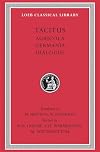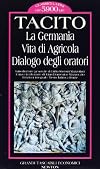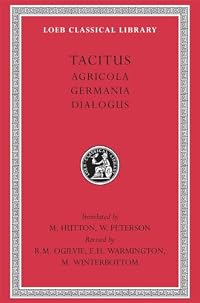
Agricola / Germania / Dialogus de Oratoribus
by P. Cornelius Tacitus
On This Page
Description
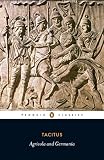
Cornelius Tacitus, Rome's greatest historian and the last great writer of classical Latin prose, produced his first two books in AD 98, after the assination of the Emperor Domitian ended fifteen years of enforced silence. Much of Agricola, which is the biography of Tacitus' late father-in-law Julius Agricola, is devoted to Britain and its people, since Agricola's claim to fame was that as governor for seven years he had completed the conquest of Britain, begun four decades earlier. Germany show more provides an account of Rome's most dangerous enemies, the Germans, and is the only surviving example of a show lessTags
Recommendations
Member Reviews
Edition: // Descr: v, 370 p. : maps 17 cm. // Series: The Loeb Classical Library Call No. { 878 T11-L 3 } Series Edited by T.E. Page Contains Latin and English Versions, Appendices, and Index. // //
Ratings
Members
- Recently Added By
Lists

Books in the Bibliography of Humans: A Monstrous History by Surekha Davies
346 works; 1 member
Author Information

Tacitus was a Roman senator who survived the terror launched among the Roman aristocracy by the emperor Domitian to rise to prominence and become first suffect consul and later proconsul of Asia. His historical works, which originally covered the first century of the empire from the accession of Tiberius to the assassination of Domitian, are an show more indictment of the emperors and of the senatorial aristocracy under imperial autocracy. They remain the fundamental sources of imperial history in this period. The embarrasing paradox of Tacitus's success under a "bad" emperor appears to have had an effect on his works, whose tone may have struck contemporaries as a defense of his prominence under a despot. Tacitus is thus often thought to have nursed a nostalgia for the Republic and the free nobility of its senatorial order. However, his attitude is less genuinely backward-looking than occupied with the contemporary moral and political problems of aristocratic honor. In The Annals, which survives only in part, he examines palace politics under the Julio-Claudians. The unspoken questions that occupy this examination are those of the possibilities of uncompromised and dignified service under despotism, and the opportunities therein to mitigate its evil. These themes emerge into daylight in The Agricola, his laudatory biography of his father-in-law, the Roman general who conquered Britain. The work portrays Agricola as a straightforward military man who preserved his integrity and the admiration of his contemporaries under the emperor Domitian, even though his greatest achievements went unrewarded. Tacitus was a trained advocate, and fundamental to his outlook is his prosecutorial purpose. He states the case against the emperors and others who attract his unfavorable judgment. This bias can be difficult for the reader to overcome. But Tacitus also played by the rules of advocacy. He appears to bring to light facts unfavorable to his case in order to interpret them according to the necessities of his argument. His lawyerly honesty thereby allows the historian to dissect the facts from their matrix in order to use them in reconstructing a historical account of the first century of the empire which is more balanced, if inevitably less committed, than that of Tacitus. (Bowker Author Biography) show less
Some Editions
Series
Belongs to Publisher Series
Work Relationships
Common Knowledge
- Canonical title
- Agricola / Germania / Dialogus de Oratoribus
- Original publication date
- 1914 (Loeb Classical Library translation) (Loeb Classical Library translation)
- People/Characters
- Augustus Caesar; Saleius Bassus; Marcus Junius Brutus; Marcus Caelius Rufus; Julius Caesar; Caius Licinius Macer Calvus (show all 16); Cato the Younger; Cicero, Marcus Tullius, 106-43 BC; Lucius Licinius Crassus; Demosthenes; T. Clodius Eprius Marcellus; Marcus Valerius Messalla Corvinus; Publius Vatinius; Vespasian; Gnaeus Julius Agricola; Gaius "Caligula" Caesar
- Important places
- Britannia, Roman Empire; Germania
- First words
- INTRODUCTION
Every one knows by what a slender thread of transmission some of the greatest of literary monuments of antiquity have come down to modern times.
1 Saepe ex me requiris, Iuste Fabi, cur, cum priora saecula tot eminentium oratorum ingeniis gloriaque floruerint, nostra potissimum aetas deserta et laude eloquentiae orbata vix nomen ipsum oratoris retineat;
P. CORNELIUS TACITUS
A DIALOGUE ON ORATORY
Dear Justus Fabius, -- There is a question that you often put to me. - Original language
- Latin
- Disambiguation notice
- The three "minor" works of Tacitus. Please do not combine with editions that also contain Histories and Annals.
Classifications
- Genres
- History, Nonfiction, Fiction and Literature
- DDC/MDS
- 878.0109 — Literature & rhetoric Latin & Italic literatures Latin miscellaneous writings –500
- LCC
- PA6707 .A7 .B4 — Language and Literature Greek language and literature. Latin language and literature Roman literature Individual authors Tacitus, Cornelius
- BISAC
Statistics
- Members
- 403
- Popularity
- 76,584
- Reviews
- 1
- Rating
- (3.67)
- Languages
- 9 — Catalan, Dutch, English, French, German, Italian, Latin, Spanish, Swedish
- Media
- Paper, Audiobook, Ebook
- ISBNs
- 25
- ASINs
- 10