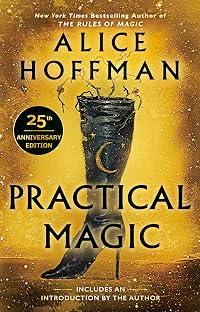
On This Page
Description
For more than two hundred years, the Owens women had been blamed for everything that went wrong in their Massachusetts town. And Gillian and Sally endured that fate as well; as children, the sisters were outsiders. Their elderly aunts almost seemed to encourage the whispers of witchery, but all Gillian and Sally wanted was to escape. One would do so by marrying, the other by running away. But the bonds they shared brought them back, almost as if by magic ...Tags
Recommendations


Member Recommendations


Member Reviews
[Review written by my high school self]
I used to love the movie for this book, and I didn’t even know until after I had seen it that it was originally in book form. After finally getting a copy of the book and reading it, something magical happened: I didn’t know which one I liked better. Usually, having to decide favorites between the book and the movie is very easy. Except in the case of Grisham's The Pelican Brief, I almost always prefer the book versions. In some cases (as with [b:Gone with the Wind|18405|Gone With The Wind|Margaret Mitchell|http://photo.goodreads.com/books/1166913011s/18405.jpg|3358283] and Scarlett), I simply refuse to see the movie, while in other cases (like The Great Gatsby and Jurassic Park) I prefer the show more book hands-down though the movie versions are certainly more than tolerable. With Hoffman’s Practical Magic, I just don’t know.
Part of the reason for this anomaly in my reading life may be the fact that the movie and book bear little resemblance to each other. Here is what is in the book that is also in the movie: the names of the characters (which in itself is a bit skewered), and the fact that this all has to do with witches, family, and magic. That’s about it. Other than that, even the basic plotline is very different. I can understand how the movie might need to condense the plotline to fit its regular two hours, but this plotline has been almost completely altered.
Unlike the movie, the book gives more equal attention to each of the sister protagonists, Sally and Gillian. This was both a good and a bad thing for me, due to my fascination with the characters and my partiality towards actress Sandra Bullock, who plays Sally in the movie version. The aunts, who are prominently figured in the movie as well, appear only as absent characters throughout most of the book. The children, Antonia and Kylie (their names are switched in the movie), are much older than their elementary school-age movie counterparts, and have very deep and intriguing characterizations that are lacking from the movie. Overall, the book does a better job of observing and presenting the importance, history, and closeness of sisterly relationships.
Hoffman’s writing has an utterly absorbing lyrical and poetic quality to it that I greatly admire. I ate this book up, partly because I was pushing for the protagonist Sally’s vindication (a point made in such a focused and concentrated manner in the movie), and partly because Hoffman’s writing is just superb and catching. I swallowed down pieces of this book for hours at a time, and would have to literally shake myself out of the mood of it all if I were so RUDELY interrupted. =)
The “magic” is of a different kind in the book, less magical in some senses, and focusing more on clairvoyance and intuition, a point much easier made and mystified in book form. Hoffman takes full charge of this, infusing this in every sentence of her text, and making the readers literary clairvoyants in their own sense. The predictability and unpredictability of this story makes it a book that can be read as I did in one gulp as I did or in a strolling leisurely fashion without losing anything of the book’s power or meaning.
Without a doubt, the movie has tainted, and at the same time, enhanced my reading of the book, so much so that I don’t even have a suggestion as to which medium persons should expose themselves to first. Should you read the book after seeing the movie, though, there are some things you should keep in mind. Certainly, one of the main things to remember is that Hoffman’s Gillian is no Nicole Kidman. Another thing to remember is that the movie, because of its required brevity, only touches upon the deep psychological implications and character insight of the book. Most importantly, the book characters don’t get wasted on midnight margaritas and dance around the dinner table to Harry Nillson’s “Coconut” song. show less
I used to love the movie for this book, and I didn’t even know until after I had seen it that it was originally in book form. After finally getting a copy of the book and reading it, something magical happened: I didn’t know which one I liked better. Usually, having to decide favorites between the book and the movie is very easy. Except in the case of Grisham's The Pelican Brief, I almost always prefer the book versions. In some cases (as with [b:Gone with the Wind|18405|Gone With The Wind|Margaret Mitchell|http://photo.goodreads.com/books/1166913011s/18405.jpg|3358283] and Scarlett), I simply refuse to see the movie, while in other cases (like The Great Gatsby and Jurassic Park) I prefer the show more book hands-down though the movie versions are certainly more than tolerable. With Hoffman’s Practical Magic, I just don’t know.
Part of the reason for this anomaly in my reading life may be the fact that the movie and book bear little resemblance to each other. Here is what is in the book that is also in the movie: the names of the characters (which in itself is a bit skewered), and the fact that this all has to do with witches, family, and magic. That’s about it. Other than that, even the basic plotline is very different. I can understand how the movie might need to condense the plotline to fit its regular two hours, but this plotline has been almost completely altered.
Unlike the movie, the book gives more equal attention to each of the sister protagonists, Sally and Gillian. This was both a good and a bad thing for me, due to my fascination with the characters and my partiality towards actress Sandra Bullock, who plays Sally in the movie version. The aunts, who are prominently figured in the movie as well, appear only as absent characters throughout most of the book. The children, Antonia and Kylie (their names are switched in the movie), are much older than their elementary school-age movie counterparts, and have very deep and intriguing characterizations that are lacking from the movie. Overall, the book does a better job of observing and presenting the importance, history, and closeness of sisterly relationships.
Hoffman’s writing has an utterly absorbing lyrical and poetic quality to it that I greatly admire. I ate this book up, partly because I was pushing for the protagonist Sally’s vindication (a point made in such a focused and concentrated manner in the movie), and partly because Hoffman’s writing is just superb and catching. I swallowed down pieces of this book for hours at a time, and would have to literally shake myself out of the mood of it all if I were so RUDELY interrupted. =)
The “magic” is of a different kind in the book, less magical in some senses, and focusing more on clairvoyance and intuition, a point much easier made and mystified in book form. Hoffman takes full charge of this, infusing this in every sentence of her text, and making the readers literary clairvoyants in their own sense. The predictability and unpredictability of this story makes it a book that can be read as I did in one gulp as I did or in a strolling leisurely fashion without losing anything of the book’s power or meaning.
Without a doubt, the movie has tainted, and at the same time, enhanced my reading of the book, so much so that I don’t even have a suggestion as to which medium persons should expose themselves to first. Should you read the book after seeing the movie, though, there are some things you should keep in mind. Certainly, one of the main things to remember is that Hoffman’s Gillian is no Nicole Kidman. Another thing to remember is that the movie, because of its required brevity, only touches upon the deep psychological implications and character insight of the book. Most importantly, the book characters don’t get wasted on midnight margaritas and dance around the dinner table to Harry Nillson’s “Coconut” song. show less
I haven't seen the movie in a minute, but I grew up LOVING it. I was way past due reading the book the film was actually based on and I''m so excited that I listened to the audiobook version of it, it was WONDERFUL! I couldn't have asked for a better narrator, she embodied the Owens sisters so completely! It's a witchy book that's not really about witches; it's about sisterhood, love, trust, and hope. It's beautiful and haunting and you really root for all the characters despite their faults. It's the perfect fall time read as the leaves change and the witching hour grows closer. The Owens sisters had a unique childhood; raised by their aunts, the girls were mercilessly teased and bullied for their aunts potions and love spells the show more villagers used in desperation. Sally just wants to be normal and settle down, whereas Gillian wants to paint the town red; jumping from man to man until she can get the hell out of town. Years pass and the sisters have moved on with their lives though they haven't seen each other much in two decades. Sally is living with her two daughters in a nice suburban town when Gillian shows up on her doorstep with a problem so big it threatens to tear everything apart. Wonderful. Such unique and vibrant characters! The writing is beautiful as well! Although the movie is quite different; it's a wonderful tribute to the book! show less
The Owens sisters, orphaned as girls, were raised by their eccentric aunts in a ramshackle house in Massachusetts and were shunned and scorned and feared by their peers, while the aunts greeted at the back door various townswomen seeking cures for heartbreak, unwanted pregnancies, and other hazards of being a woman and dealing with love. One sister left at 18 and never looked back. The other waited until her heart was crushed by widowhood until she took her own two daughters and fled looking for a more normal existence for them and for herself. But magic in one’s blood isn’t something you can escape, and despite a vow made as children, love and all its messes catch up to all Owens women eventually.
Magical realism is hit or miss in show more the extreme for me. If a book falls into that genre, I either throw it across the room in disgust or absolutely adore it. This one I loved. Such strong and strongly written women are found here, and their stories are a perfect blend of everyday and extraordinary. And I love that it’s a story filled with women and their relationships with one another, and although people of the male persuasion are key parts of the plot, they are certainly not in starring roles. They’re the celery of the recipe: background supporters but in no way a distraction from the main flavor of the tale. show less
Magical realism is hit or miss in show more the extreme for me. If a book falls into that genre, I either throw it across the room in disgust or absolutely adore it. This one I loved. Such strong and strongly written women are found here, and their stories are a perfect blend of everyday and extraordinary. And I love that it’s a story filled with women and their relationships with one another, and although people of the male persuasion are key parts of the plot, they are certainly not in starring roles. They’re the celery of the recipe: background supporters but in no way a distraction from the main flavor of the tale. show less
‘’Once a year, on midsummer’s eve, a sparrow would find its way into the Owens house. No matter how anyone tried to prevent it, the bird always managed to get inside. They could set out saucers of salt on the windowsills and hire a handyman to fix the gutters and the roof, but still the bird would appear. It would enter the house at twilight, the hour of sorrow, and it always came in silence, yet with a strange resolve, which defied both salt and bricks, as though the poor thing had no choice but to perch on the drapes and the dusty chandelier, from which glass drops spilled down like tears.’’
First things first. I have not seen the film adaptation. You couldn’t pay me enough to watch Kidman and Bullock. Their acting chops show more are worse than a scarecrow’s and I couldn’t care less whether the book is equal (!) to the film or not. And I can’t begin to imagine what the ‘readers’ who make this claim have inside their skulls. Because brains they have NOT.
This is a book of sisterhood and the contradictory sides of our souls, when we desire independence but our sense of duty wins. It is a book about flying away and if you crush, you crush. Life is full of crushes. In fact, life IS MADE of crushes. But you need to stand up and start again. Easier said than done…
‘’Never look back, that’s what she’s told herself. Don’t think about swans or being alone in the dark.’’
It is a book about womanhood and making mistakes. A book of looking back in anger, of looking forward in a fluttering hope, a book of being a mother and a book of being a daughter. A book of orange leaves dancing in the blowing wind, a book of fireflies playing in summer evenings. Of twilights, wisterias and lilacs, cats and toads. Of crickets, hazy afternoons, orange moons, evening silence, dangers in the dark. Of little dialogue which gives the chance for Hoffman’s prose to shine in a novel that is both a psychological study (if you are clever enough to understand it…) and an almanac of old wives’ tales.
If some of you think this is ‘mediocre’ writing, I dread to see what you consider ‘superior’.
Colleen Hoover and similar garbage have turned your brains into omelettes. Distasteful omelette…
‘’Trouble is like love, after all.’’
My reviews can also be found on https://theopinionatedreaderblog.wordpress.com/ show less
First things first. I have not seen the film adaptation. You couldn’t pay me enough to watch Kidman and Bullock. Their acting chops show more are worse than a scarecrow’s and I couldn’t care less whether the book is equal (!) to the film or not. And I can’t begin to imagine what the ‘readers’ who make this claim have inside their skulls. Because brains they have NOT.
This is a book of sisterhood and the contradictory sides of our souls, when we desire independence but our sense of duty wins. It is a book about flying away and if you crush, you crush. Life is full of crushes. In fact, life IS MADE of crushes. But you need to stand up and start again. Easier said than done…
‘’Never look back, that’s what she’s told herself. Don’t think about swans or being alone in the dark.’’
It is a book about womanhood and making mistakes. A book of looking back in anger, of looking forward in a fluttering hope, a book of being a mother and a book of being a daughter. A book of orange leaves dancing in the blowing wind, a book of fireflies playing in summer evenings. Of twilights, wisterias and lilacs, cats and toads. Of crickets, hazy afternoons, orange moons, evening silence, dangers in the dark. Of little dialogue which gives the chance for Hoffman’s prose to shine in a novel that is both a psychological study (if you are clever enough to understand it…) and an almanac of old wives’ tales.
If some of you think this is ‘mediocre’ writing, I dread to see what you consider ‘superior’.
Colleen Hoover and similar garbage have turned your brains into omelettes. Distasteful omelette…
‘’Trouble is like love, after all.’’
My reviews can also be found on https://theopinionatedreaderblog.wordpress.com/ show less
Magical realism novel that follows the lives of sisters Sally and Gillian Owens. Full of beautiful prose and a gentle but tightly woven plot that pulls the reader along (I devoured the book in two days). The magic element is fantastical and yet somehow treated as an everyday and in no way unusual thing in the lives of these women. With lovely explorations of what it means to be family, the power that love holds over people, and the importance of accepting yourself, this is a highly enjoyable novel. Recommended for fans of magical realism and family dramas.
Considering how much I adored the previous novels of Alice Hoffman's that I've read (especially the prequel to this novel), I fully expected to be swept away once again. I guess the old adage rings true once more: assumptions make an ass out of you and me (or however it goes), because I was just a touch disappointed by this book. Hoffman brings her signature intrigue and character-driven narrative to the table, but I just wasn't able to connect with sisters Sally and Gillian Owens. Her storytelling was a touch more removed (like we're being told the story, rather than being in the story as it unfolds), so I rarely, if ever, truely felt like we were getting inside the sisters' heads. It also doesn't help matters that we're automatically show more expecting the same story as in the film adaptation (even though this isn't realistic), so when the story skews a bit off kilter we're constantly left wondering why. That being said, the story was still softly magical (even for its occasional violence and cruelty) and was a decent opener for Halloween month. I'm very glad that Hoffman went back and wrote the prequel about the aunts, though, since she's bringing many more years of writing experience to the table when she delves into their deeply magical story. And now we have her latest novel (an even earlier prequel) to get into later on! show less
I love the film. The film is the perfect fairytale of strong women, true love and magic, and the scene where the circle join hands to save Gillian always gets to me. I never really thought about the book until I discovered that Alice Hoffman has recently written a prequel/sequel - and I honestly wish that was still the case. Stand alone, the book is fine, if a bit disjointed and lacking in unity, of both plot and characters. But, and I don't often say this, so I'll say it loud: THE FILM IS BETTER.
Like way, way better. The film is centred around the aunts' house, which only Gillian leaves and finally returns to, so there is a feeling of home and history at the heart of the story. There is also a definite emphasis on magic, with the show more aunts and Sally, although she fights her inheritance, practicing both the white and black sides of the craft. I also like the detail of the aunts interfering in Sally's love life - the first time around. When she finds her true love a second time, the magic is purely Sally's. All missing from the book. Sally leaves home with her much older daughters and moves to New York, so both the house and the aunts are removed from much of the story. The pacing is also very weak, and the final scene is an anticlimax compared to the film.
The book is trying to be 'gritty' and realistic, I think, despite the fairytale language, discussing sex and self-loathing and splintered families over love and magic and sisterhood. Sally is a depressed single mother of teenagers, Gillian is still Gillian, and none of the women can be happy until they meet 'the one'. Sally doesn't meet the perfect man of her conjuring but a lovesick fool conducting a half-assed investigation. Gillian is rewarded with a biology teacher instead of being 'possessed' by her dead lover's spirit. Even Antonia and Kylie go weak-kneed for the nearest boys. The happy ever after effect of the film is lost by the implied message that women just need a man in their lives to be happy.
The bones of the story are there, but the flesh is weak. Stick to the film. show less
Like way, way better. The film is centred around the aunts' house, which only Gillian leaves and finally returns to, so there is a feeling of home and history at the heart of the story. There is also a definite emphasis on magic, with the show more aunts and Sally, although she fights her inheritance, practicing both the white and black sides of the craft. I also like the detail of the aunts interfering in Sally's love life - the first time around. When she finds her true love a second time, the magic is purely Sally's. All missing from the book. Sally leaves home with her much older daughters and moves to New York, so both the house and the aunts are removed from much of the story. The pacing is also very weak, and the final scene is an anticlimax compared to the film.
The book is trying to be 'gritty' and realistic, I think, despite the fairytale language, discussing sex and self-loathing and splintered families over love and magic and sisterhood. Sally is a depressed single mother of teenagers, Gillian is still Gillian, and none of the women can be happy until they meet 'the one'. Sally doesn't meet the perfect man of her conjuring but a lovesick fool conducting a half-assed investigation. Gillian is rewarded with a biology teacher instead of being 'possessed' by her dead lover's spirit. Even Antonia and Kylie go weak-kneed for the nearest boys. The happy ever after effect of the film is lost by the implied message that women just need a man in their lives to be happy.
The bones of the story are there, but the flesh is weak. Stick to the film. show less
Members
- Recently Added By
Published Reviews
ThingScore 50
If there is an author north of the border who has managed to successfully translate the language of magic realism into the American idiom, it is Alice Hoffman.
added by stephmo
Indeed, the title of Ms. Hoffman's latest novel, "Practical Magic," says it all: if you are going to believe in magic, it had better have palpable and easily comprehensible results.
added by stephmo
Lists

Best Contemporary Literary Fiction (Around the Last 30 Years)
388 works; 122 members

Magic Realism
371 works; 52 members

Read the book and saw the movie
1,170 works; 192 members

Best Urban Fantasy
632 works; 78 members

Female Author
1,235 works; 67 members

Best Books With Sisters
130 works; 30 members
Female Protagonist
1,056 works; 57 members

100 New Classics
101 works; 13 members

Books Read in 2023
5,547 works; 145 members

READ in 2023
244 works; 1 member

Excellent Young Adult
12 works; 1 member

Witches and Wizards Oh My
135 works; 12 members

Books to read
8 works; 1 member

Gen X Library
245 works; 4 members

Reading Glasses Podcast
410 works; 3 members

Book of the Month Selections 2016 to Present
130 works; 5 members

Witchy Fiction
253 works; 126 members

The Worst Bestsellers Podcast
295 works; 5 members

Everand 2023
53 works; 1 member

Biggest Disappointments
606 works; 163 members

Read the Book, Hated the Movie
30 works; 25 members

Books by Jewish Authors
68 works; 5 members
Autumn books
31 works; 8 members
Our Favorite Comfort Reads
334 works; 200 members
Author Information

Alice Hoffman, an American novelist and screenwriter, was born in New York City on March 16, 1952. She earned a B.A. from Adelphi University in 1973 and an M.A. in creative writing from Stanford University in 1975 before publishing her first novel, Property Of, in 1977. Known for blending realism and fantasy in her fiction, she often creates show more richly detailed characters who live on society's margins and places them in extraordinary situations as she did with At Risk, her 1988 novel about the AIDS crisis. Her other works include The Drowning Season, Seventh Heaven, The River King, Blue Diary, The Probable Future, The Ice Queen, and The Dovekeepers. Her book, The Third Angel, won the 2008 New England Booksellers' Award for fiction. Two of her novels, Practical Magic and Aquamarine, were made into films. She has also written numerous screenplays, including adaptations of her own novels and the original screenplay, Independence Day. Her title's The Museum of Exteaordinary Things, The Marriage of Opposites, Seventh Heaven, and The Rules of Magic made The New York Times Best Seller List. (Bowker Author Biography) show less
Some Editions
Awards and Honors
Awards
Notable Lists
Series

Belongs to Publisher Series
Goldmann (43945)
Work Relationships
Common Knowledge
- Canonical title
- Practical Magic
- Original title
- Practical Magic
- Original publication date
- 1995-06-13
- People/Characters
- Sally Owens; Gillian Owens; Antonia Owens; Kylie Owens; Michael; James "Jimmy" Hawkins (show all 12); Gideon Barnes; Ben Frye; Scott Morrison; Gary Hallet; Aunt Frances Owens; Aunt Bridget "Jet" Owens
- Important places
- Massachusetts, USA; Long Island, New York, USA; Magnolia Street; Tucson, Arizona, USA
- Related movies
- Practical Magic (1998 | IMDb)
- Epigraph
- For every evil under the sun,
There is a remedy, or there is none.
If there be one, seek till you find it;
If there be none, never mind it.
MOTHER GOOSE - Dedication
- To Libby Hodges
To Carol DeKnight - First words
- For more than two hundred years, the Owens women have been blamed for everything that has gone wrong in town.
- Quotations
- Math plus desire equals who you are.
Grief is all around; it's just invisible to most people. - Last words
- (Click to show. Warning: May contain spoilers.)Fall in love whenever you can.
Classifications
Statistics
- Members
- 6,952
- Popularity
- 1,706
- Reviews
- 200
- Rating
- (3.73)
- Languages
- 16 — Danish, Dutch, English, Estonian, Finnish, French, German, Hungarian, Italian, Norwegian (Bokmål), Norwegian, Polish, Croatian, Spanish, Swedish, Portuguese (Portugal)
- Media
- Paper, Audiobook, Ebook
- ISBNs
- 79
- ASINs
- 13