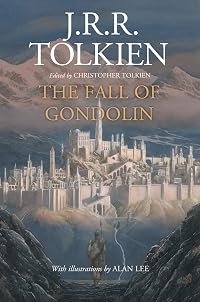
On This Page
Description
#1 NEW YORK TIMES BESTSELLERIn the Tale of The Fall of Gondolin are two of the greatest powers in the world. There is Morgoth of the uttermost evil, unseen in this story but ruling over a vast military power from his fortress of Angband. Deeply opposed to Morgoth is Ulmo, second in might only to Manwë, chief of the Valar: he is called the Lord of Waters, of all seas, lakes, and rivers under the sky. But he works in secret in Middle-earth to support the Noldor, the kindred of the Elves show more among whom were numbered Húrin and Túrin Turambar.
Central to this enmity of the gods is the city of Gondolin, beautiful but undiscoverable. It was built and peopled by Noldorin Elves who, when they dwelt in Valinor, the land of the gods, rebelled against their rule and fled to Middle-earth. Turgon King of Gondolin is hated and feared above all his enemies by Morgoth, who seeks in vain to discover the marvellously hidden city, while the gods in Valinor in heated debate largely refuse to intervene in support of Ulmo's desires and designs.
Into this world comes Tuor, cousin of Túrin, the instrument of Ulmo's designs. Guided unseen by him Tuor sets out from the land of his birth on the fearful journey to Gondolin, and in one of the most arresting moments in the history of Middle-earth the sea-god himself appears to him, rising out of the ocean in the midst of a storm. In Gondolin he becomes great; he is wedded to Idril, Turgon's daughter, and their son is Eärendel, whose birth and profound importance in days to come is foreseen by Ulmo.
At last comes the terrible ending. Morgoth learns through an act of supreme treachery all that he needs to mount a devastating attack on the city, with Balrogs and dragons and numberless Orcs. After a minutely observed account of the fall of Gondolin, the tale ends with the escape of Túrin and Idril, with the child Eärendel, looking back from a cleft in the mountains as they flee southward, at the blazing wreckage of their city. They were journeying into a new story, the Tale of Eärendel, which Tolkien never wrote, but which is sketched out in this book from other sources.
Following his presentation of Beren and Lúthien Christopher Tolkien has used the same 'history in sequence' mode in the writing of this edition of The Fall of Gondolin. In the words of J.R.R. Tolkien, it was 'the first real story of this imaginary world' and, together with Beren and Lúthien and The Children of Húrin, he regarded it as one of the three 'Great Tales' of the Elder Days.
. show less
Tags
Recommendations

Member Recommendations
Member Reviews
Fans of Tolkien and his Silmarillion will not be too disappointed in this book. It's not as recursive as Beren and Luthien and the strong descriptions of Gondolin's destruction are really quite fun.
I mean, who DOESN'T love balrogs and hosts of orcs descending upon and destroying the hidden city of elves in a grand bloody rout? Sure, there's mighty good sendoff and defense, but what we really wanted to see is all those stupid kinslaying elves get theirs.
Hmmm. I might be a bit bloodthirsty today. :) Rah, rah, Melkor?
My only complaint is not directed at Christopher but at J.R.R.
I really wanted not Tuon's story, although it was rather epic, but his son's story: Earendil, with the Silmaril on his brow. Am I asking too much? The way the show more later victors lose or use the recovered Silmarils? All of that stuff is more interesting to me than how the god of the waters set the first King of Men on a quest. :)
Still. Despite the repeats that show up in other books, I did have a good time with a lot more detail in certain areas. Only by reading ALL of them do we get the idea that big detailed tellings are portioned out for different areas despite getting a good feel in the primary publications. And I mean the Silmarillion. If you like the primary and always wanted to see the tales stretched out and also analyzed, then this is definitely for you.
I'm happy to have read it, although I am filled with a sense of loss. I wish Tolkien was back among us, getting not just credit, but support for more stories. show less
I mean, who DOESN'T love balrogs and hosts of orcs descending upon and destroying the hidden city of elves in a grand bloody rout? Sure, there's mighty good sendoff and defense, but what we really wanted to see is all those stupid kinslaying elves get theirs.
Hmmm. I might be a bit bloodthirsty today. :) Rah, rah, Melkor?
My only complaint is not directed at Christopher but at J.R.R.
I really wanted not Tuon's story, although it was rather epic, but his son's story: Earendil, with the Silmaril on his brow. Am I asking too much? The way the show more later victors lose or use the recovered Silmarils? All of that stuff is more interesting to me than how the god of the waters set the first King of Men on a quest. :)
Still. Despite the repeats that show up in other books, I did have a good time with a lot more detail in certain areas. Only by reading ALL of them do we get the idea that big detailed tellings are portioned out for different areas despite getting a good feel in the primary publications. And I mean the Silmarillion. If you like the primary and always wanted to see the tales stretched out and also analyzed, then this is definitely for you.
I'm happy to have read it, although I am filled with a sense of loss. I wish Tolkien was back among us, getting not just credit, but support for more stories. show less
On the scale of Silmarillion-chapters-turned-into-books this comes below Children Of Hurin but above Beren And Luthien, simply by dint of at least having a complete, if early, version of the story to kick off with. It isn't a bloody patch on the later, gorgeous, rich, vivid and witheringly incomplete version, and the frustration will literally make your eyes bleed, so I'm sorry about that, but be warned.
A narrativa principal da missão de Tuor, e a que começa renarrando com mais detalhes sua viagem são ambas notáveis e de fato, se costuradas, dariam um bom livro, que possivelmente poderia prosseguir narrando os infortunados aficcionados por Silmarilions, Maedhros e Maglor (embora isso fosse efetivamente entulhar a construção da saga). Então, diferentemente da fraca história de Lúthien e Beren, temos um bom material aqui. Mas o fato de Tolkien pai ter levado a sério demais seu próprio mundo ficcional a ponto de não terminar quase nada, combinado com um filho demasiado escrupuloso, que quer dar um tratamento quase-científico aos textos, torna de novo a leitura truncada, incompleta, e meramente para fãs. Como disse em outra show more ocasião, não que os fãs não gostem, mas talvez parte deles sejam como eu - que gostam fazendo cara feia. show less
This book will probably appeal mainly to serious Tolkien fans. It presents three different versions of the story The Fall Of Gondolin, one of which is complete but written in a very 'old world literary' style that I found hard going, and another of which is easier to read, more verbose, but incomplete. The book also includes a lot of commentary from Christopher Tolkien about the various versions, the reasons behind the final one being unfinished, as well as some other related works.
In The Fall of Gondolin, Christopher Tolkien continues his project of editing his father’s three great tales of the First Age of Middle Earth. He writes in his introduction, “When the time had come, as I supposed, to end at last this long series of editions it occurred to me to try out, as best as I could, a different mode: to follow, using previously published texts, one single particular narrative from its earliest existing form and throughout its later development” (pg. 13). In this, Tolkien follows the method he used in Beren and Lúthien (2017) rather than that of The Children of Húrin (2007), which told a more-or-less coherent story adapted from the various alterations (using the appendix to explain those changes).
The story show more focuses on the secret Elven city of Gondolin and the arrival of Tuor, one of Húrin’s kinsfolk, who comes to the city at the behest of Ulmo, the Vala who rules over the waters and the sea, in order to warn of Morgoth’s planned attack. Turgon, who built the city, refuses to abandon it and Tuor settles among the people. Tuor weds Idril Celebrindal and fathers with her Eärendel the Mariner. Their union is the second between Elves and Men following that of Beren and Lúthien (and thus also helps to foreshadow the union of Aragorn and Arwen). At the time of Morgoth’s sack of Gondolin, Tuor defends Idril and Eärendel as they flee the city under the onslaught of Morgoth’s Balrogs and fire drakes. Glorfindel defends them against a Balrog in the mountains, enabling them to flee to the sea.
In his conclusion, Tolkien refers to the Lost Tale of Eärendel, never written, before discussing how it relates to the Fall of Gondolin. Though he cautions, “To set out and discuss these often contradictory outlines in their clipped phrases would be contrary to the purpose of these two books [the present one and Beren and Lúthien]: the comparative histories of narratives as they evolved” (pg. 241). He does, however, focus on the two main variants of the conclusion in order to complete his story. As the final of the three tales of the First Age, The Fall of Gondolin more than measures up to expectations. J.R.R. Tolkien’s prose is as ever a delight to read and Alan Lee’s illustrations compliment the text as no other. A must-read for Tolkien fans. show less
The story show more focuses on the secret Elven city of Gondolin and the arrival of Tuor, one of Húrin’s kinsfolk, who comes to the city at the behest of Ulmo, the Vala who rules over the waters and the sea, in order to warn of Morgoth’s planned attack. Turgon, who built the city, refuses to abandon it and Tuor settles among the people. Tuor weds Idril Celebrindal and fathers with her Eärendel the Mariner. Their union is the second between Elves and Men following that of Beren and Lúthien (and thus also helps to foreshadow the union of Aragorn and Arwen). At the time of Morgoth’s sack of Gondolin, Tuor defends Idril and Eärendel as they flee the city under the onslaught of Morgoth’s Balrogs and fire drakes. Glorfindel defends them against a Balrog in the mountains, enabling them to flee to the sea.
In his conclusion, Tolkien refers to the Lost Tale of Eärendel, never written, before discussing how it relates to the Fall of Gondolin. Though he cautions, “To set out and discuss these often contradictory outlines in their clipped phrases would be contrary to the purpose of these two books [the present one and Beren and Lúthien]: the comparative histories of narratives as they evolved” (pg. 241). He does, however, focus on the two main variants of the conclusion in order to complete his story. As the final of the three tales of the First Age, The Fall of Gondolin more than measures up to expectations. J.R.R. Tolkien’s prose is as ever a delight to read and Alan Lee’s illustrations compliment the text as no other. A must-read for Tolkien fans. show less
I really likes this deep dive into the last of the Great Tales. Christopher Tolkien's research through what must surely be thousands of pages of written and re-written pieces of paper, to fit some hundred of them into this one narrative is truly impressive.
Giving the evolution of the story, since this tale was never truly finished, also gives a very interesting look into the life of Tolkien.
Alan Lee again delivers his very best work in the beautiful illustrations that are found inside the book.
Needless to say, really good book for any Tolkien fan.
Giving the evolution of the story, since this tale was never truly finished, also gives a very interesting look into the life of Tolkien.
Alan Lee again delivers his very best work in the beautiful illustrations that are found inside the book.
Needless to say, really good book for any Tolkien fan.
Years ago I tried reading The Simarillian after having consumed LOTR and The Hobbit. I failed miserably to enjoy the story, so I did not have a whole lot of hope when starting The Fall of Gondolin. Happily, I loved every minute of it. Almost 40 years of living gained me a greater appreciation of the detailed work that went into Tolkien's masterpiece, LOTR, and the extensive world that he created.
The Fall of Gondolin tells through 3 different tales written by JRR Tolkien during his lifetime of the decimation of the Noldor elves but ultimately where hope would be found 6500 years later. The main character is Tuor, grandfather of Elrond and how he made his way to Gondolin, partook in protecting the city as it fell and ultimately led the show more remaining elves out of the city.
Christopher Tolkien's commentary about his father and the construction of Middle Earth and the tales set it was also fascinating. show less
The Fall of Gondolin tells through 3 different tales written by JRR Tolkien during his lifetime of the decimation of the Noldor elves but ultimately where hope would be found 6500 years later. The main character is Tuor, grandfather of Elrond and how he made his way to Gondolin, partook in protecting the city as it fell and ultimately led the show more remaining elves out of the city.
Christopher Tolkien's commentary about his father and the construction of Middle Earth and the tales set it was also fascinating. show less
Members
- Recently Added By
Published Reviews
ThingScore 75
The story follows one of the Noldor, Tuor, who sets out to find Gondolin; during his journey, he experiences what the publisher described as "one of the most arresting moments in the history of Middle-earth": when Ulmo, the sea-god, rises out of the ocean during a storm.
When Tuor arrives in Gondolin, he becomes a great man and the father of Eärendel, an important character in Tolkien's The show more Silmarillion. But Morgoth attacks, with Balrogs, dragons and orcs, and as the city falls, Tuor, his wife Idril and the child Eärendel escape, "looking back from a cleft in the mountains as they flee southward, at the blazing wreckage of their city".
"They were journeying into a new story, the Tale of Eärendel, which Tolkien never wrote, but which is sketched out in this book from other sources," said HarperCollins.
[John] Garth said The Fall of Gondolin contains Tolkien's "biggest battle narrative outside of The Lord of the Rings", but he predicted the "capstone" of the book would be the "exquisite" piece of writing in which Tolkien attempted to tell the whole story again, in the novelistic style of The Lord of the Rings. "In the first (finished version) of the story, you feel like you’re reading The Iliad," he said. "This one (which is unfinished), is more naturalistic."
According to HarperCollins, Tolkien saw The Fall of Gondolin as one of his three "great tales" of the Elder Days, along with Beren and Lúthien and The Children of Húrin. The latter title was also a bestseller, after Christopher Tolkien completed the text left behind by his father and published it in 2007.
[Several below-the-line comments on the review point out that Tuor was not one of the Noldor, but a mortal man]. show less
When Tuor arrives in Gondolin, he becomes a great man and the father of Eärendel, an important character in Tolkien's The show more Silmarillion. But Morgoth attacks, with Balrogs, dragons and orcs, and as the city falls, Tuor, his wife Idril and the child Eärendel escape, "looking back from a cleft in the mountains as they flee southward, at the blazing wreckage of their city".
"They were journeying into a new story, the Tale of Eärendel, which Tolkien never wrote, but which is sketched out in this book from other sources," said HarperCollins.
[John] Garth said The Fall of Gondolin contains Tolkien's "biggest battle narrative outside of The Lord of the Rings", but he predicted the "capstone" of the book would be the "exquisite" piece of writing in which Tolkien attempted to tell the whole story again, in the novelistic style of The Lord of the Rings. "In the first (finished version) of the story, you feel like you’re reading The Iliad," he said. "This one (which is unfinished), is more naturalistic."
According to HarperCollins, Tolkien saw The Fall of Gondolin as one of his three "great tales" of the Elder Days, along with Beren and Lúthien and The Children of Húrin. The latter title was also a bestseller, after Christopher Tolkien completed the text left behind by his father and published it in 2007.
[Several below-the-line comments on the review point out that Tuor was not one of the Noldor, but a mortal man]. show less
added by Cynfelyn
Lists

Books Read in 2022
5,168 works; 114 members

Kirkus Starred Fiction Reviews of Books Published in 2018
330 works; 3 members

Amazon best fictional genre picks monthly for 2018
418 works; 9 members
Author Information

605+ Works 517,860 Members
A writer of fantasies, Tolkien, a professor of language and literature at Oxford University, was always intrigued by early English and the imaginative use of language. In his greatest story, the trilogy The Lord of the Rings (1954--56), Tolkien invented a language with vocabulary, grammar, syntax, even poetry of its own. Though readers have show more created various possible allegorical interpretations, Tolkien has said: "It is not about anything but itself. (Certainly it has no allegorical intentions, general, particular or topical, moral, religious or political.)" In The Adventures of Tom Bombadil (1962), Tolkien tells the story of the "master of wood, water, and hill," a jolly teller of tales and singer of songs, one of the multitude of characters in his romance, saga, epic, or fairy tales about his country of the Hobbits. Tolkien was also a formidable medieval scholar, as evidenced by his work, Beowulf: The Monster and the Critics (1936) and his edition of Anciene Wisse: English Text of the Anciene Riwle. Among his works published posthumously, are The Legend of Sigurd and Gudrún and The Fall of Arthur, which was edited by his son, Christopher. In 2013, his title, TheHobbit (Movie Tie-In) made The New York Times Best Seller List. (Bowker Author Biography) show less
All Editions
Some Editions
Series

Work Relationships
Is contained in
Lord of the Rings Collection:The Hobbit-The Fellowship of the Ring-The Two Towers-Return of the King-The Silmarillion-Unfinished Tales (Lord of the Rings) by J. R. R. Tolkien (indirect)
The Book of Lost Tales I; The Book of Lost Tales II; Unfinished Tales of Numenor and Middle-earth by J. R. R. Tolkien (indirect)
Inspired
Common Knowledge
- Canonical title
- The Fall of Gondolin
- Original title
- The Fall of Gondolin
- Original publication date
- 1917
- People/Characters
- Morgoth Bauglir; Idril; Tuor; Ulmo; Voronwë; Turgon
- Important places
- Middle-earth; Beleriand; Gondolin
- Dedication
- To My Family
- First words*
- In my preface to Beren and Lúthien I remarked that 'in my ninety-third year this is (presumptively) the last book in the long series of editions of my father's writings'. [preface]
I will begin this book by returning ... (show all)to the quotation that I used to open Beren and Lúthien: a letter written by my father in 1964, in which he said that 'out of my head' he wrote The Fall of Gondolin 'during sick-leave from the army in 1917', and the original version of Beren and Lúthien in the same year. [prologue] - Last words*
- (Click to show. Warning: May contain spoilers.)These last words refer to the rebellious Noldor who left Valinor and in Middle-earth became known as the Exiles.
- Original language
- English
- Canonical DDC/MDS
- 823.087661
*Some information comes from Common Knowledge in other languages. Click "Edit" for more information.
Classifications
- Genres
- Fantasy, Fiction and Literature, General Fiction
- DDC/MDS
- 823.087661 — Literature & rhetoric English & Old English literatures English fiction By type Genre fiction Adventure fiction Speculative fiction Fantasy fiction High fantasy
- LCC
- PR6039 .O32 .F354 — Language and Literature English English Literature 1900-1960
- BISAC
Statistics
- Members
- 2,640
- Popularity
- 7,115
- Reviews
- 25
- Rating
- (4.09)
- Languages
- 15 — Czech, Dutch, English, Finnish, French, German, Greek, Hungarian, Italian, Polish, Russian, Spanish, Turkish, Ukrainian, Portuguese (Brazil)
- Media
- Paper, Audiobook, Ebook
- ISBNs
- 51
- ASINs
- 11