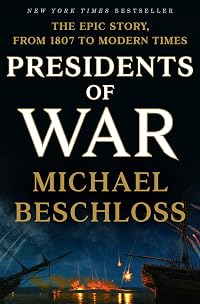
Presidents of War: The Epic Story, from 1807 to Modern Times
by Michael R. Beschloss
On This Page
Description
"From a preeminent presidential historian comes a groundbreaking and often surprising saga of America's wartime chief executives. Ten years in the research and writing, Presidents of Waris a fresh, magisterial, intimate look at a procession of American leaders as they took the nation into conflict and mobilized their country for victory. It brings us into the room as they make the most difficult decisions that face any President, at times sending hundreds of thousands of American men and show more women to their deaths. From James Madison and the War of 1812 to recent times, we see them struggling with Congress, the courts, the press, their own advisors and antiwar protesters; seeking comfort from their spouses, families and friends; and dropping to their knees in prayer. We come to understand how these Presidents were able to withstand the pressures of war--both physically and emotionally--or were broken by them. Beschloss's interviews with surviving participants in the drama and his findings in original letters, diaries, once-classified national security documents, and other sources help him to tell this story in a way it has not been told before.Presidents of Warcombines the sense of being there with the overarching context of two centuries of American history. This important book shows how far we have traveled from the time of our Founders, who tried to constrain presidential power, to our modern day, when a single leader has the potential to launch nuclear weapons that can destroy much of the human race"-- "From a preeminent presidential historian comes a groundbreaking and often surprising narrative of America's wartime chief executives"-- show lessTags
Recommendations






Member Reviews
When I studied the US Constitution for the first time in the late 1990s as a high-school student, I noticed that it gave Congress, not the Presidency, the responsibility of declaring war. This seemed contrary to my experience, in which the President led the nation into war. It is commonly said that the UN Charter, ratified by Congress, supersedes this earlier practice.
Beschloss seeks to tackle this inconsistency head-on. By providing detailed historical analysis, he describes the way our nation has drifted – for better or for worse – from an early view that only Congress could speak for a people entering war. Instead, Congress has willingly (that is, without much complaint) given up its responsibility to declare war to the Chief show more Executive. Despite extensive American engagements in Korea, Vietnam, Iraq (twice), and Afghanistan, Congress has not declared war on a country since World War II.
Beschloss details this trend’s beginnings under Founding Father James Madison in the War of 1812. Even Madison (who helped co-author the Constitution and defended it to the masses in The Federalist Papers) did not resist expanding Presidential powers in wartime. In the Mexican War, Polk defied Congress with a willingness to speak first and ask questions later. In a quest to save the American Union, Lincoln declared martial law and suspended the writ of habeas corpus. McKinley conducted the Spanish-American War based off of a false inciting narrative. Lyndon Johnson lied to lead America into Vietnam despite his strong disposition that the US would lose that war.
To his credit, Beschloss does not make a moral judgment on this American tendency to defy the Constitution; he only notes the historical trend. Congress has done little to reassert this power, either in the courts or in popular opinion. The start of wars has often begun with doubts about truths (the Mexican War, the Spanish-American War, the Vietnam War, and the second Iraq War).
As I write this in the era of Trump, I find it uncanny how the imbalance of a president’s mental stability mirrors those in prior times. Lyndon Johnson, Richard Nixon, and Donald Trump all seem relatively unsteady and disrespectful towards truth and facts. All three have used questionable means against the opposition in elections as well. Accounts of their private interactions in the White House present a common obsession of image over substance and a fixation on needing to win at all costs (even, in LBJ’s case, at the cost of losing).
I study American Presidents with regularity and find Beschloss’s contribution to the literature to be well-researched and relatively objective. (He relegates affairs after Vietnam to the Epilogue, but is very critical of Johnson.) Although the product of his labor is lengthy and the span of research is immense, Beschloss seems to pull this feat with ease. Anyone with an interest in the American Presidency would enjoy this tome. show less
Beschloss seeks to tackle this inconsistency head-on. By providing detailed historical analysis, he describes the way our nation has drifted – for better or for worse – from an early view that only Congress could speak for a people entering war. Instead, Congress has willingly (that is, without much complaint) given up its responsibility to declare war to the Chief show more Executive. Despite extensive American engagements in Korea, Vietnam, Iraq (twice), and Afghanistan, Congress has not declared war on a country since World War II.
Beschloss details this trend’s beginnings under Founding Father James Madison in the War of 1812. Even Madison (who helped co-author the Constitution and defended it to the masses in The Federalist Papers) did not resist expanding Presidential powers in wartime. In the Mexican War, Polk defied Congress with a willingness to speak first and ask questions later. In a quest to save the American Union, Lincoln declared martial law and suspended the writ of habeas corpus. McKinley conducted the Spanish-American War based off of a false inciting narrative. Lyndon Johnson lied to lead America into Vietnam despite his strong disposition that the US would lose that war.
To his credit, Beschloss does not make a moral judgment on this American tendency to defy the Constitution; he only notes the historical trend. Congress has done little to reassert this power, either in the courts or in popular opinion. The start of wars has often begun with doubts about truths (the Mexican War, the Spanish-American War, the Vietnam War, and the second Iraq War).
As I write this in the era of Trump, I find it uncanny how the imbalance of a president’s mental stability mirrors those in prior times. Lyndon Johnson, Richard Nixon, and Donald Trump all seem relatively unsteady and disrespectful towards truth and facts. All three have used questionable means against the opposition in elections as well. Accounts of their private interactions in the White House present a common obsession of image over substance and a fixation on needing to win at all costs (even, in LBJ’s case, at the cost of losing).
I study American Presidents with regularity and find Beschloss’s contribution to the literature to be well-researched and relatively objective. (He relegates affairs after Vietnam to the Epilogue, but is very critical of Johnson.) Although the product of his labor is lengthy and the span of research is immense, Beschloss seems to pull this feat with ease. Anyone with an interest in the American Presidency would enjoy this tome. show less
Summary: An account of eight American presidents who led the nation into war, how they coped with its stresses, and the consequences of their actions with regard to presidential power.
As recent tensions (I write in July 2019) with North Korea and Iran underscore, the potential and power of a U.S. president to lead the nation into war is great, and brings solemn consequences in terms of loss of life, ongoing entanglements, or the ultimate cataclysm of nuclear conflict. Michael Beschloss, in this work, studies eight American presidents who led the nation into war. The presidents are James Madison (War of 1812), James Polk (Mexican-American War), Abraham Lincoln (the Civil War), William McKinley (Spanish-American War), Woodrow Wilson show more (World War I), Franklin Roosevelt (World War II), Harry Truman (Korea) and Lyndon Johnson (Vietnam).
It is fascinating to see pretexts and concealed motives for conflicts. For example, Madison took a poorly equipped nation into conflict with Great Britain over impressments of American sailors and the high-handedness of George III, while entertaining ambitions to invade and seize Canadian territory. James Polk, similarly had territorial ambitions to annex territory in the southwest from Mexico and used clashes on the disputed Texas-Mexico border to seek a declaration of war. The fall of Fort Sumter was the flashpoint of the simmering conflict between North and South that both knew was about slavery. Yet until the summer of 1862, Lincoln spoke of the war as an effort to restore the Union. The sinking of the Maine, likely caused by a shipboard accident, served as the cause for the Spanish-American War, allowing the McKinley administration to seize the Philippines and achieve "regime change" in Cuba. Critical intelligence was not passed on to fleet commanders at Pearl Harbor, and the catastrophic Japanese attack gave Franklin Roosevelt the mandate he needed to lead a reluctant nation into war. Dubious attacks in the Tonkin Bay in response to covert US activity resulted in a congressional resolution that served as the basis for Lyndon Johnson's escalation of the Vietnam conflict.
Beschloss also chronicles a tension inherent in the U.S. Constitution. While Article I, Section 8 of the Constitution entrusts the sole power to declare war to Congress, Article II, Section 2 names the President the commander in chief of armed forces, entrusting to him the power to launch and direct military operations and deploy our forces, important in the event of attacks upon the country. In this work we see not only how presidents used various pretexts to argue for war declarations up through World War II, but also how Presidents avoided seeking such declarations in the case of Korea and Vietnam, actions that turned out to be unpopular with the American people. Beschloss notes that today's all-volunteer armies and the lack of a draft make this easier.
Presidents used war to push the limits of presidential power, whether in the suspension of habeas corpus, in executive orders, in harnessing civilian industry to war aims (such as Harry Truman's takeover of a strike-plagued steel industry), or even the Emancipation Proclamation, effecting an end of slavery without constitutional amendment. At the same time, failure in the exercise of these powers brought new curbs or temporarily weakened the presidency, such as the 1973 War Powers Act, after Vietnam, and the weakened administrations of Ford and Carter, post-Vietnam.
Beschloss also studies how different presidents coped with the pressures of war. Madison seemed not to cope well at all, offering indecisive leadership and being routed from Washington. Polk was the first president who paid a toll with his health for fighting a war, barely surviving his presidency in broken health. Lincoln admitted, "This war is eating my life out" and he had a strong impression that he would not live to see its end (he barely did before an assassin's bullet struck him down). McKinley turned to his Bible and justified the seizure of the Philippines as a trust to bring Christianity to the archipelago. His life was also ended by assassination while in office. Wilson suffered a stroke after fighting for his Fourteen Principles, the League of Nations, and the Treaty of Versailles. Roosevelt also suffered a fatal stroke on the eve of the allied victory and Johnson's health was seriously impaired with his death coming within five years of leaving office. Fate is not kind to most war presidents.
This work is an excellent survey of many of America's wars, and of presidential leadership, both in taking the nation into war and leading the country through them. It is disturbing how many times the country is deceived or deprived of critical information in being led into war, and how often fervor substitutes for a sound basis for war, perhaps most notably in 1812 and in Vietnam. Given the high stakes of modern warfare, Beschloss's work suggests that questions of character, demonstrated leadership, and the mental and physical fitness of the holders of the office of President should weigh heavily in our electoral processes. It also suggests the critical role of Congress in the exercise of its War Powers, and its role of requiring a President to make the case for war to the American people. The fate of a nation, or even the world, may rest on how our President, and our elected representatives act. show less
As recent tensions (I write in July 2019) with North Korea and Iran underscore, the potential and power of a U.S. president to lead the nation into war is great, and brings solemn consequences in terms of loss of life, ongoing entanglements, or the ultimate cataclysm of nuclear conflict. Michael Beschloss, in this work, studies eight American presidents who led the nation into war. The presidents are James Madison (War of 1812), James Polk (Mexican-American War), Abraham Lincoln (the Civil War), William McKinley (Spanish-American War), Woodrow Wilson show more (World War I), Franklin Roosevelt (World War II), Harry Truman (Korea) and Lyndon Johnson (Vietnam).
It is fascinating to see pretexts and concealed motives for conflicts. For example, Madison took a poorly equipped nation into conflict with Great Britain over impressments of American sailors and the high-handedness of George III, while entertaining ambitions to invade and seize Canadian territory. James Polk, similarly had territorial ambitions to annex territory in the southwest from Mexico and used clashes on the disputed Texas-Mexico border to seek a declaration of war. The fall of Fort Sumter was the flashpoint of the simmering conflict between North and South that both knew was about slavery. Yet until the summer of 1862, Lincoln spoke of the war as an effort to restore the Union. The sinking of the Maine, likely caused by a shipboard accident, served as the cause for the Spanish-American War, allowing the McKinley administration to seize the Philippines and achieve "regime change" in Cuba. Critical intelligence was not passed on to fleet commanders at Pearl Harbor, and the catastrophic Japanese attack gave Franklin Roosevelt the mandate he needed to lead a reluctant nation into war. Dubious attacks in the Tonkin Bay in response to covert US activity resulted in a congressional resolution that served as the basis for Lyndon Johnson's escalation of the Vietnam conflict.
Beschloss also chronicles a tension inherent in the U.S. Constitution. While Article I, Section 8 of the Constitution entrusts the sole power to declare war to Congress, Article II, Section 2 names the President the commander in chief of armed forces, entrusting to him the power to launch and direct military operations and deploy our forces, important in the event of attacks upon the country. In this work we see not only how presidents used various pretexts to argue for war declarations up through World War II, but also how Presidents avoided seeking such declarations in the case of Korea and Vietnam, actions that turned out to be unpopular with the American people. Beschloss notes that today's all-volunteer armies and the lack of a draft make this easier.
Presidents used war to push the limits of presidential power, whether in the suspension of habeas corpus, in executive orders, in harnessing civilian industry to war aims (such as Harry Truman's takeover of a strike-plagued steel industry), or even the Emancipation Proclamation, effecting an end of slavery without constitutional amendment. At the same time, failure in the exercise of these powers brought new curbs or temporarily weakened the presidency, such as the 1973 War Powers Act, after Vietnam, and the weakened administrations of Ford and Carter, post-Vietnam.
Beschloss also studies how different presidents coped with the pressures of war. Madison seemed not to cope well at all, offering indecisive leadership and being routed from Washington. Polk was the first president who paid a toll with his health for fighting a war, barely surviving his presidency in broken health. Lincoln admitted, "This war is eating my life out" and he had a strong impression that he would not live to see its end (he barely did before an assassin's bullet struck him down). McKinley turned to his Bible and justified the seizure of the Philippines as a trust to bring Christianity to the archipelago. His life was also ended by assassination while in office. Wilson suffered a stroke after fighting for his Fourteen Principles, the League of Nations, and the Treaty of Versailles. Roosevelt also suffered a fatal stroke on the eve of the allied victory and Johnson's health was seriously impaired with his death coming within five years of leaving office. Fate is not kind to most war presidents.
This work is an excellent survey of many of America's wars, and of presidential leadership, both in taking the nation into war and leading the country through them. It is disturbing how many times the country is deceived or deprived of critical information in being led into war, and how often fervor substitutes for a sound basis for war, perhaps most notably in 1812 and in Vietnam. Given the high stakes of modern warfare, Beschloss's work suggests that questions of character, demonstrated leadership, and the mental and physical fitness of the holders of the office of President should weigh heavily in our electoral processes. It also suggests the critical role of Congress in the exercise of its War Powers, and its role of requiring a President to make the case for war to the American people. The fate of a nation, or even the world, may rest on how our President, and our elected representatives act. show less
Americans have been writing America’s obituary since its birth. Whenever the cultural or political moment seems especially fraught, there’s no shortage of prophets to proclaim that this is the end, that now the free Republic dies only to rise as the tyrannical Empire.
I’m a cheery patriot with a lot of faith in this country’s ability to stagger in extraordinary ways and yet find its way home. But if your glasses are less rosy than mine, you’ll find nothing encouraging in historian Michael R. Beschloss’s book on America’s war presidents.
To be clear, I don’t think Beschloss doubts America’s capacity for goodness and greatness. However, as the son of a Jewish refugee from Nazi Germany, he is justifiably wary of show more presidential power. A leader strong enough to drag you into war abroad is strong enough to persecute you at home.
Beschloss studies America’s presidents of war, from the Chesapeake-Leopard Affair through Vietnam, within a helpful structure. First, he devotes a chapter to how and why each conflagration ignited. While describing both the leadup to war and the background of the presiding president, he also frames the conflict with the experiences of those who were there when sparks became flames.
I loved these stories of people whom we rush past in most history books. How conflicted was the Southern-born officer defending Fort Sumter in 1861? What happened to the military men responsible for Pearl Harbor’s security in 1941, or to the captain of the doomed USS Maine in 1898?
Second, after one chapter of stage-setting, Beschloss devotes a chapter to describing and critiquing the president’s skill and integrity in managing the war, his handling of Congress, and his approach to civil liberties. The only president who breaks this pattern with one chapter is Thomas Jefferson, who confronted an inciting incident but sidestepped outright war.
A picture thus emerges of presidential power growing ever greater and more imperious despite the justice or injustice of the war. The most appalling example is that of James K. Polk, whose utterly ruthless assault on Mexico won a vast territory for the maturing Republic at a deep cost to its supposed principles.
Each collision set precedents the next war president would use to justify his own measures, usually with little regard for a Congress riven by party and incapable of checking a determined executive. In time, the president’s will and skill in wooing the public became more important than what Congress wanted.
Beschloss is clear that each president was, in his own way, doing what he thought best for the people. But it’s hard to avoid the conclusion that the office has accumulated enough power through each national emergency that a leader disconnected from morality or respect for American ideals is nearly unstoppable.
This is why I say that, if you’re less optimistic than I, you may find this book depressing. I believe our founders created a self-healing system with deep potential to renew and recreate itself. However, it’s equally true that no system of government has yet survived time and eternity. If and when America falls, no doubt the powers gathered by our war presidents will play a key role in our national Armageddon. show less
I’m a cheery patriot with a lot of faith in this country’s ability to stagger in extraordinary ways and yet find its way home. But if your glasses are less rosy than mine, you’ll find nothing encouraging in historian Michael R. Beschloss’s book on America’s war presidents.
To be clear, I don’t think Beschloss doubts America’s capacity for goodness and greatness. However, as the son of a Jewish refugee from Nazi Germany, he is justifiably wary of show more presidential power. A leader strong enough to drag you into war abroad is strong enough to persecute you at home.
Beschloss studies America’s presidents of war, from the Chesapeake-Leopard Affair through Vietnam, within a helpful structure. First, he devotes a chapter to how and why each conflagration ignited. While describing both the leadup to war and the background of the presiding president, he also frames the conflict with the experiences of those who were there when sparks became flames.
I loved these stories of people whom we rush past in most history books. How conflicted was the Southern-born officer defending Fort Sumter in 1861? What happened to the military men responsible for Pearl Harbor’s security in 1941, or to the captain of the doomed USS Maine in 1898?
Second, after one chapter of stage-setting, Beschloss devotes a chapter to describing and critiquing the president’s skill and integrity in managing the war, his handling of Congress, and his approach to civil liberties. The only president who breaks this pattern with one chapter is Thomas Jefferson, who confronted an inciting incident but sidestepped outright war.
A picture thus emerges of presidential power growing ever greater and more imperious despite the justice or injustice of the war. The most appalling example is that of James K. Polk, whose utterly ruthless assault on Mexico won a vast territory for the maturing Republic at a deep cost to its supposed principles.
Each collision set precedents the next war president would use to justify his own measures, usually with little regard for a Congress riven by party and incapable of checking a determined executive. In time, the president’s will and skill in wooing the public became more important than what Congress wanted.
Beschloss is clear that each president was, in his own way, doing what he thought best for the people. But it’s hard to avoid the conclusion that the office has accumulated enough power through each national emergency that a leader disconnected from morality or respect for American ideals is nearly unstoppable.
This is why I say that, if you’re less optimistic than I, you may find this book depressing. I believe our founders created a self-healing system with deep potential to renew and recreate itself. However, it’s equally true that no system of government has yet survived time and eternity. If and when America falls, no doubt the powers gathered by our war presidents will play a key role in our national Armageddon. show less
Much gets made in the United States these days of the fact that the last 17 years of combat in Afghanistan (and 15 in Iraq) have been conducted without a formal declaration of war by Congress. Toss in the ongoing conflicts in Syria and Yemen (act-of-war declarations ditto) and that's a whole lot of U.S. troops in harm's way without anyone taking responsibility for putting them there (Congress did pass an Authorization for the Use of Military Force, or AUMF, shortly after 9/11 but it was meant to apply only against perpetrators of that particular attack).
Whenever it comes up in the news, it's easy to get the impression that this is a recent development. After all, Article I of the U.S. Constitution explicitly states that only Congress show more has the right to declare war. The value of historian Michael Beschloss's new book is to show that, in the words of Dickens, "'Twas ever thus." This is a very readable examination of the eight U.S. Presidents who presided during times of war — James Madison (War of 1812), Abraham Lincoln (Civil War), James Polk (Mexican-American War), William McKinley (Spanish-American War), Woodrow Wilson (World War I), Franklin D. Roosevelt (World War II), Harry Truman (Korea), and Lyndon B. Johnson (Vietnam) — with an eye toward how they did or did not comply with the Constitution's mandate.
What he found, predictably, was that presidents largely went to war with their own agendas and without asking Congress first, often manipulating events to create situations that "forced" the U.S. into war (see James Polk and the Mexican-American War in 1846) to accomplish goals that were kept secret from both Congress and the public (in Polk's case, the ostensible reason was to defend the recently annexed Republic of Texas; left unstated was his ambition to expand U.S. territory all the way to California). And all too often, presidents were aided and abetted by a weak Congress that shrank from making hard decisions that might prove unpopular with the general citizenry. (Boy, does that sound familiar!)
Beschloss isn't out to provide comprehensive histories of each conflict; he only briefly mentions what we now consider seminal events such as D-Day. But I learned a lot about the wars that we didn't cover much in school, such as the War of 1812 and the Mexican and Spanish conflicts. Beschloss's view seems to be that regardless of whether you view each of those war actions as justified or unjustified, the country would be stronger today if the Constitution's mandate had been more faithfully followed, allowing a vigorous, public debate about why war was necessary and what the end goals really were.
I'll add this, appropriately enough as footnote to my review: This is one book where following the footnotes rewards the diligent reader. Rather than functioning as simple listings of sources, Beschloss crams a lot of incidental, interesting information into those little asides. show less
Whenever it comes up in the news, it's easy to get the impression that this is a recent development. After all, Article I of the U.S. Constitution explicitly states that only Congress show more has the right to declare war. The value of historian Michael Beschloss's new book is to show that, in the words of Dickens, "'Twas ever thus." This is a very readable examination of the eight U.S. Presidents who presided during times of war — James Madison (War of 1812), Abraham Lincoln (Civil War), James Polk (Mexican-American War), William McKinley (Spanish-American War), Woodrow Wilson (World War I), Franklin D. Roosevelt (World War II), Harry Truman (Korea), and Lyndon B. Johnson (Vietnam) — with an eye toward how they did or did not comply with the Constitution's mandate.
What he found, predictably, was that presidents largely went to war with their own agendas and without asking Congress first, often manipulating events to create situations that "forced" the U.S. into war (see James Polk and the Mexican-American War in 1846) to accomplish goals that were kept secret from both Congress and the public (in Polk's case, the ostensible reason was to defend the recently annexed Republic of Texas; left unstated was his ambition to expand U.S. territory all the way to California). And all too often, presidents were aided and abetted by a weak Congress that shrank from making hard decisions that might prove unpopular with the general citizenry. (Boy, does that sound familiar!)
Beschloss isn't out to provide comprehensive histories of each conflict; he only briefly mentions what we now consider seminal events such as D-Day. But I learned a lot about the wars that we didn't cover much in school, such as the War of 1812 and the Mexican and Spanish conflicts. Beschloss's view seems to be that regardless of whether you view each of those war actions as justified or unjustified, the country would be stronger today if the Constitution's mandate had been more faithfully followed, allowing a vigorous, public debate about why war was necessary and what the end goals really were.
I'll add this, appropriately enough as footnote to my review: This is one book where following the footnotes rewards the diligent reader. Rather than functioning as simple listings of sources, Beschloss crams a lot of incidental, interesting information into those little asides. show less
Review of: Presidents of War, by Michael Beschloss
by Stan Prager (1-30-19)
The Founders sought a separation of powers in war-making, as in so much else of consequence to the new Republic, so the Constitution mandated that only Congress may declare war, while assigning to the President of the United States authority as commander in chief of the armed forces. A history of European monarchs engaging in war by fiat informed this caution in limiting the ability of the executive branch to act without the consent of the legislative. Yet, although the last time Congress issued a formal declaration of war was in 1942 (against Axis-allied Romania, Hungary and Bulgaria), the United States has waged a number of significant wars—in Korea, Vietnam, show more Iraq and Afghanistan—as well as dozens of other military interventions—like those in the Dominican Republic, Granada and Panama—with little more than vague and somewhat flimsy congressional authorizations, or no authorization at all. By October 2018, the War in Afghanistan had gone on for seventeen years, more than four times the length of the Civil War or U.S. involvement in World War II, making it not only our longest war, but—as characterized by historian and retired-colonel Andrew Bacevich—a kind of “endless war.” In Afghanistan, as in every other instance of the use of military force since World War II, war has had its origin in the White House, and a succession of presidents has conducted it with Congress as bystander.
How we ended up here, clearly at wide variance from the intentions of the Framers, is the subject of Presidents of War, an ambitious, uneven, and deeply flawed recent book by Michael Beschloss. The premise is simple. Starting with the War of 1812 and James Madison, a couple of chapters are devoted to each major conflict and the POTUS most closely associated with it, with an eye on precedents set as well as the unintended consequences that seem to have bolstered the confidence of successive chief executives to make war by misleading, bypassing or simply ignoring Congress. I have read Beschloss before. He is a leading historian of the modern American presidency, a gifted writer who has authored or edited a number of books in this milieu, and he often appears as media commentator. So, it is surprising that someone with his resume and talents would turn out a thick volume like this beset with a wordy and meandering narrative that falls so far short of its potential.
For one thing, there is a jarring lack of uniformity in the seventeen chapters in Presidents of War. Indeed, this is so striking that some of these chapters almost appear to have been penned by different authors. This may be because, as revealed in the “Acknowledgements,” the book was written over a ten-year span, begetting a distinct style and focus shift. The inconsistency might be less glaring if read as separate essays rather than assembled into a single work that purports to tell a cohesive story. It is also plagued by far-too-frequent asterisked footnotes populated with further clarification or “fun facts,” in the maddening tradition of a David Foster Wallace. The saving grace, if there is one, is that Beschloss has an engaging writing style that is appealing to a popular audience, and the narrative is heavy on anecdote, which frequently carries the reader along.
The first three chapters—centered around the War of 1812—are styled completely differently than the ones that follow. (We can only imagine that these were the first ones written, a decade prior.) More academic in orientation than the rest of the book and sometimes marred by dull passages that too often fall to quotation in the florid prose of the era—which unnecessarily interrupts the flow—this portion of the book is yet far more focused and coherent, as well as loyal to thesis and theme. The otherwise brilliant James Madison—who like his predecessor and frequent partner Thomas Jefferson proved a far more able Founder than president—along with a complicit Congress stumbled into a war against a much more powerful adversary, then bumbled its prosecution. Elected in 1800 as a Democratic-Republican, Jefferson—with Madison’s assistance—had vastly reduced the armed forces and begun dismantling the fiscal policies that were the legacy of Hamilton and the Federalists, so that by 1812 the United States was woefully unprepared both militarily and financially to take on the United Kingdom, itself engaged in an existential struggle against Napoleonic France. Grandiose plans to annex Canada ended with Washington D.C. in flames and Madison fleeing for his life. The nation survived largely because once Napoleon was vanquished, the Brits were weary of combat and eager to resume trade.
Beschloss covers the war competently, then—in a pattern repeated with subsequent conflicts—dedicates a few concluding pages to analysis that seeks to pass judgment on the achievements and shortcomings of the president who conducted it. This framework reveals the challenge of abridging the story of a consequential war to a couple of chapters, as the author is forced to be highly selective with what to include and what to omit. For instance, Beschloss devotes a number of pages to the Chesapeake–Leopard affair of 1807, which saw the humiliating capture of the American frigate Chesapeake by a British warship searching for deserters from the Royal Navy, spawning a lasting bitterness that poisoned Anglo-American relations and echoed down to the run-up of the War of 1812. Much color is added to the narrative with the backstory of the hapless captain of the Chesapeake, James Barron, who is unfairly held to account for the disaster. The multi-page tale of Barron’s disgrace adds flair, but nevertheless begs the question: how essential is it to the larger story? And what has been excised to make room for it? Unimportant to the casual reader, these questions will repeatedly nag those more widely read in the historiography in the chapters ahead.
Perhaps the best of these chapters is given to the Mexican War, launched and prosecuted by President James K. Polk on a deliberately manufactured pretext with a secret, nefarious scheme to annex a third of the territory of our southern neighbor, which succeeds all too well. The morally bankrupt Polk was nevertheless the most consequential one term president in American history. The aftermath of the Mexican War and the question of whether the newly acquired territories should be slave or free was the match that lit the secession crisis, although little is made of that in the narrative. The Civil War chapters that follow neatly summarize the latest scholarship, but there is nothing new here. More entertaining for the general reader is coverage of the Spanish-American War of 1898, sustained by much anecdote, especially with regard to another unlucky ship’s captain, this time in Havana harbor.
While Beschloss faithfully underscores how presidents looked to the wartime experiences of their predecessors in the Oval Office for both caution and guidance, what is most conspicuous in its absence is the connective tissue that binds one era to the next. The best example of this is his treatment of Wilson and World War I. The nation’s isolationism and Wilson’s reluctance to enter the war against Germany, even after the many American lives lost to the sinking of the Lusitania in 1915, did not occur in a vacuum, but was informed by relatively recent history. The Spanish-American War had achieved great territorial gains for a budding American imperialism in a very popular short war with limited loss of life, but sparked a long, bloody rebellion in the Philippines that by the time it was brutally suppressed had largely turned the nation against foreign adventures. And—almost exactly a year before the Lusitania went down—Wilson had blundered into military intervention in Mexico that went sideways, forcing him to pull back and reassess. These events are mentioned in passing, but Beschloss fails to emphasize the critical impact both the Philippine Insurrection and the incursion into Mexico had upon the nation and upon Wilson in contemplation of American involvement in an increasingly catastrophic European war.
The book’s approach to Franklin Roosevelt and World War II is quite curious. FDR is generally ranked as America’s third greatest president—after Lincoln and Washington—but that heroic figure is largely absent from the text of Presidents of War. Beschloss glosses over much of Roosevelt’s achievements in shepherding the nation through economic depression and world war, but instead devotes most of his ink to the president’s faults: his failure to anticipate Pearl Harbor, the internment of Japanese-Americans, the less-than-robust efforts to rescue European Jewry from Hitler’s executioners. While there is indeed some merit to the reproach, for this to dominate the emphasis is a distortion of the outsize role FDR played in American life. And, given that emphasis, it was no less than stunning to confront the stark incongruity of the author’s final analysis, that the “President deserves the verdict of the New York Times … that ‘men will thank God on their knees a hundred years from now that Franklin D. Roosevelt was in the White House,’” adding that: “It is difficult to imagine any other American leader of that generation guiding, with such success, a resistant nation toward intervention and ultimate victory in this most momentous of history’s wars, as well as taking Americans into a postwar assembly that would strive to enforce the peace.” [p432]
Beschloss wraps up WWII in just a few pages following FDR’s death, although the defeat of Japan remained uncertain and it was for the new president—Harry Truman—to face the critical atomic option that brought hostilities to the end, something only treated peripherally in the narrative. The next chapters concern Korea, but remarkably there is a complete lack of analysis of how Truman’s role as commander in chief in the final months of WWII and his decision to use the bomb may have informed his leadership in the Korean War.
Then it is on to Vietnam and Lyndon Johnson. Beschloss has studied LBJ closely, serving as editor to two volumes of Johnson’s White House Tapes (Taking Charge and Reaching for Glory, both of which I have read). And although he cites LBJ biographer Robert Caro (who has written four volumes on Johnson’s life to date, which I have also read), he ignores Caro’s thesis that the vast portion of Lyndon Johnson was given to political opportunism. Instead, the author seems to take every sentence privately uttered by LBJ about Vietnam at face value, even though these often smack of the height of calculation clearly designed to cultivate a specific audience. Eventually, Beschloss even goes so far as to conclude that: “To this day it is difficult to understand how this bighearted man could have brought himself to send young Americans to risk their lives in a conflict … he … seemed to have so little hope.” [p528] This analysis strikes the reader as the height of political naiveté. Strangely, although the war long outlasts Johnson, the next commander in chief—Richard Nixon—only gets a bit part in the narrative.
Then, except for a brief (six pages!) “Epilogue,” Presidents of War ends abruptly. Without explanation, there is no study of Bush, father or son, nor the Gulf War, Afghanistan, or Iraq. Maybe Beschloss was simply tired and ran out of steam. Perhaps his editor told him that at nearly six hundred pages enough was enough. Again, the informed reader cannot help but question the author’s decisions on what to include and what to discard. Can anyone really competently cover the Civil War in eighty-four pages, or World War II in seventy-five pages? In the end, there were many pages that seemed unnecessary, and yet so much that begged for further study. In addition to the absence of a strong concluding chapter, it might have been a welcome juxtaposition to have included a section on presidents who achieved foreign policy objectives without resorting to full-scale war, such as Eisenhower, and especially JFK—who during his crisis-driven tenure managed to circumvent pressures upon him to go to war over Laos, Berlin and the missiles in Cuba. Perhaps it was simply a mistake to imagine such a grand overview confined to a single book: adding a second volume may have resulted in a work more thorough and less unwieldy.
Michael Beschloss is an outstanding historian with credentials that far exceed my own, so I must admit discomfort in judging his book so harshly. Still, I have a master’s degree in history, and I have spent a lifetime studying American history and American presidents, so this is hardly unfamiliar territory for me. In the final analysis, Presidents of War may be an entertaining read for a popular audience, but as solid history it largely misses the mark.
Review of: Presidents of War, by Michael Beschloss https://regarp.com/2019/01/30/review-of-presidents-of-war-by-michael-beschloss/ show less
by Stan Prager (1-30-19)
The Founders sought a separation of powers in war-making, as in so much else of consequence to the new Republic, so the Constitution mandated that only Congress may declare war, while assigning to the President of the United States authority as commander in chief of the armed forces. A history of European monarchs engaging in war by fiat informed this caution in limiting the ability of the executive branch to act without the consent of the legislative. Yet, although the last time Congress issued a formal declaration of war was in 1942 (against Axis-allied Romania, Hungary and Bulgaria), the United States has waged a number of significant wars—in Korea, Vietnam, show more Iraq and Afghanistan—as well as dozens of other military interventions—like those in the Dominican Republic, Granada and Panama—with little more than vague and somewhat flimsy congressional authorizations, or no authorization at all. By October 2018, the War in Afghanistan had gone on for seventeen years, more than four times the length of the Civil War or U.S. involvement in World War II, making it not only our longest war, but—as characterized by historian and retired-colonel Andrew Bacevich—a kind of “endless war.” In Afghanistan, as in every other instance of the use of military force since World War II, war has had its origin in the White House, and a succession of presidents has conducted it with Congress as bystander.
How we ended up here, clearly at wide variance from the intentions of the Framers, is the subject of Presidents of War, an ambitious, uneven, and deeply flawed recent book by Michael Beschloss. The premise is simple. Starting with the War of 1812 and James Madison, a couple of chapters are devoted to each major conflict and the POTUS most closely associated with it, with an eye on precedents set as well as the unintended consequences that seem to have bolstered the confidence of successive chief executives to make war by misleading, bypassing or simply ignoring Congress. I have read Beschloss before. He is a leading historian of the modern American presidency, a gifted writer who has authored or edited a number of books in this milieu, and he often appears as media commentator. So, it is surprising that someone with his resume and talents would turn out a thick volume like this beset with a wordy and meandering narrative that falls so far short of its potential.
For one thing, there is a jarring lack of uniformity in the seventeen chapters in Presidents of War. Indeed, this is so striking that some of these chapters almost appear to have been penned by different authors. This may be because, as revealed in the “Acknowledgements,” the book was written over a ten-year span, begetting a distinct style and focus shift. The inconsistency might be less glaring if read as separate essays rather than assembled into a single work that purports to tell a cohesive story. It is also plagued by far-too-frequent asterisked footnotes populated with further clarification or “fun facts,” in the maddening tradition of a David Foster Wallace. The saving grace, if there is one, is that Beschloss has an engaging writing style that is appealing to a popular audience, and the narrative is heavy on anecdote, which frequently carries the reader along.
The first three chapters—centered around the War of 1812—are styled completely differently than the ones that follow. (We can only imagine that these were the first ones written, a decade prior.) More academic in orientation than the rest of the book and sometimes marred by dull passages that too often fall to quotation in the florid prose of the era—which unnecessarily interrupts the flow—this portion of the book is yet far more focused and coherent, as well as loyal to thesis and theme. The otherwise brilliant James Madison—who like his predecessor and frequent partner Thomas Jefferson proved a far more able Founder than president—along with a complicit Congress stumbled into a war against a much more powerful adversary, then bumbled its prosecution. Elected in 1800 as a Democratic-Republican, Jefferson—with Madison’s assistance—had vastly reduced the armed forces and begun dismantling the fiscal policies that were the legacy of Hamilton and the Federalists, so that by 1812 the United States was woefully unprepared both militarily and financially to take on the United Kingdom, itself engaged in an existential struggle against Napoleonic France. Grandiose plans to annex Canada ended with Washington D.C. in flames and Madison fleeing for his life. The nation survived largely because once Napoleon was vanquished, the Brits were weary of combat and eager to resume trade.
Beschloss covers the war competently, then—in a pattern repeated with subsequent conflicts—dedicates a few concluding pages to analysis that seeks to pass judgment on the achievements and shortcomings of the president who conducted it. This framework reveals the challenge of abridging the story of a consequential war to a couple of chapters, as the author is forced to be highly selective with what to include and what to omit. For instance, Beschloss devotes a number of pages to the Chesapeake–Leopard affair of 1807, which saw the humiliating capture of the American frigate Chesapeake by a British warship searching for deserters from the Royal Navy, spawning a lasting bitterness that poisoned Anglo-American relations and echoed down to the run-up of the War of 1812. Much color is added to the narrative with the backstory of the hapless captain of the Chesapeake, James Barron, who is unfairly held to account for the disaster. The multi-page tale of Barron’s disgrace adds flair, but nevertheless begs the question: how essential is it to the larger story? And what has been excised to make room for it? Unimportant to the casual reader, these questions will repeatedly nag those more widely read in the historiography in the chapters ahead.
Perhaps the best of these chapters is given to the Mexican War, launched and prosecuted by President James K. Polk on a deliberately manufactured pretext with a secret, nefarious scheme to annex a third of the territory of our southern neighbor, which succeeds all too well. The morally bankrupt Polk was nevertheless the most consequential one term president in American history. The aftermath of the Mexican War and the question of whether the newly acquired territories should be slave or free was the match that lit the secession crisis, although little is made of that in the narrative. The Civil War chapters that follow neatly summarize the latest scholarship, but there is nothing new here. More entertaining for the general reader is coverage of the Spanish-American War of 1898, sustained by much anecdote, especially with regard to another unlucky ship’s captain, this time in Havana harbor.
While Beschloss faithfully underscores how presidents looked to the wartime experiences of their predecessors in the Oval Office for both caution and guidance, what is most conspicuous in its absence is the connective tissue that binds one era to the next. The best example of this is his treatment of Wilson and World War I. The nation’s isolationism and Wilson’s reluctance to enter the war against Germany, even after the many American lives lost to the sinking of the Lusitania in 1915, did not occur in a vacuum, but was informed by relatively recent history. The Spanish-American War had achieved great territorial gains for a budding American imperialism in a very popular short war with limited loss of life, but sparked a long, bloody rebellion in the Philippines that by the time it was brutally suppressed had largely turned the nation against foreign adventures. And—almost exactly a year before the Lusitania went down—Wilson had blundered into military intervention in Mexico that went sideways, forcing him to pull back and reassess. These events are mentioned in passing, but Beschloss fails to emphasize the critical impact both the Philippine Insurrection and the incursion into Mexico had upon the nation and upon Wilson in contemplation of American involvement in an increasingly catastrophic European war.
The book’s approach to Franklin Roosevelt and World War II is quite curious. FDR is generally ranked as America’s third greatest president—after Lincoln and Washington—but that heroic figure is largely absent from the text of Presidents of War. Beschloss glosses over much of Roosevelt’s achievements in shepherding the nation through economic depression and world war, but instead devotes most of his ink to the president’s faults: his failure to anticipate Pearl Harbor, the internment of Japanese-Americans, the less-than-robust efforts to rescue European Jewry from Hitler’s executioners. While there is indeed some merit to the reproach, for this to dominate the emphasis is a distortion of the outsize role FDR played in American life. And, given that emphasis, it was no less than stunning to confront the stark incongruity of the author’s final analysis, that the “President deserves the verdict of the New York Times … that ‘men will thank God on their knees a hundred years from now that Franklin D. Roosevelt was in the White House,’” adding that: “It is difficult to imagine any other American leader of that generation guiding, with such success, a resistant nation toward intervention and ultimate victory in this most momentous of history’s wars, as well as taking Americans into a postwar assembly that would strive to enforce the peace.” [p432]
Beschloss wraps up WWII in just a few pages following FDR’s death, although the defeat of Japan remained uncertain and it was for the new president—Harry Truman—to face the critical atomic option that brought hostilities to the end, something only treated peripherally in the narrative. The next chapters concern Korea, but remarkably there is a complete lack of analysis of how Truman’s role as commander in chief in the final months of WWII and his decision to use the bomb may have informed his leadership in the Korean War.
Then it is on to Vietnam and Lyndon Johnson. Beschloss has studied LBJ closely, serving as editor to two volumes of Johnson’s White House Tapes (Taking Charge and Reaching for Glory, both of which I have read). And although he cites LBJ biographer Robert Caro (who has written four volumes on Johnson’s life to date, which I have also read), he ignores Caro’s thesis that the vast portion of Lyndon Johnson was given to political opportunism. Instead, the author seems to take every sentence privately uttered by LBJ about Vietnam at face value, even though these often smack of the height of calculation clearly designed to cultivate a specific audience. Eventually, Beschloss even goes so far as to conclude that: “To this day it is difficult to understand how this bighearted man could have brought himself to send young Americans to risk their lives in a conflict … he … seemed to have so little hope.” [p528] This analysis strikes the reader as the height of political naiveté. Strangely, although the war long outlasts Johnson, the next commander in chief—Richard Nixon—only gets a bit part in the narrative.
Then, except for a brief (six pages!) “Epilogue,” Presidents of War ends abruptly. Without explanation, there is no study of Bush, father or son, nor the Gulf War, Afghanistan, or Iraq. Maybe Beschloss was simply tired and ran out of steam. Perhaps his editor told him that at nearly six hundred pages enough was enough. Again, the informed reader cannot help but question the author’s decisions on what to include and what to discard. Can anyone really competently cover the Civil War in eighty-four pages, or World War II in seventy-five pages? In the end, there were many pages that seemed unnecessary, and yet so much that begged for further study. In addition to the absence of a strong concluding chapter, it might have been a welcome juxtaposition to have included a section on presidents who achieved foreign policy objectives without resorting to full-scale war, such as Eisenhower, and especially JFK—who during his crisis-driven tenure managed to circumvent pressures upon him to go to war over Laos, Berlin and the missiles in Cuba. Perhaps it was simply a mistake to imagine such a grand overview confined to a single book: adding a second volume may have resulted in a work more thorough and less unwieldy.
Michael Beschloss is an outstanding historian with credentials that far exceed my own, so I must admit discomfort in judging his book so harshly. Still, I have a master’s degree in history, and I have spent a lifetime studying American history and American presidents, so this is hardly unfamiliar territory for me. In the final analysis, Presidents of War may be an entertaining read for a popular audience, but as solid history it largely misses the mark.
Review of: Presidents of War, by Michael Beschloss https://regarp.com/2019/01/30/review-of-presidents-of-war-by-michael-beschloss/ show less
Mostly demonstrates the ineptitude of war presidents and how they have blundered and blustered their way into warfare. The Constitution seems clear enough, but presidents saw their war powers as expansive. It ends with Vietnam, so a hole exists for exploring the Gulf wars.
I typically read one history, government or politics book each month. Because they often exceed 500 pages of text, I tend to research them a bit more than my other reading because I am mindful of the commitment of time and energy I am about to make. Therefore, I am not often surprised nor disappointed with my selections and I usually rate these books five star, sometimes high 4’s. Beschloss’s “Presidents of War” (“PoW”) was three stars for me. I plowed through it; reading it was often a chore. Much of it was not new news, and often times the new bits were not all that interesting.
So, who were these “Presidents of War”? Well, in order they were:
Madison – War of 1812
Polk – Mexican War
Lincoln – Civil War
McKinley – show more Spanish-American Wat
Wilson – WWl
FDR – WWll
Truman – Korean War
LBJ – Viet Nam War
Bush 43 – Iraq, Afghanistan (6 page Epilogue)
I found the chapters on Truman and Johnson to be the most interesting (but they represent only 25% of the book). Until reading Beschloss, I was not totally aware of all the constant self-doubt, debate, and daily ruminations about short-term and long-term issues, about how history would view critical decisions, about China and Russia’s support of the other side, about the next election. Certainly, one of the critical issues from the author’s perspective was who makes the big decision, Congress or the President? What is the role of each? What is clear from “PoW” is that in many cases the Commander-in-Chief of the moment probably worried about it less than did the author. Yet on page 460: “Thus Truman became the first President to engage the country in a major foreign conflict - this one potentially risking war with China – without bothering to ask Congress for a war declaration….As a result, Truman had undermined his ability to wage the Korean War and established a dangerous example for future American Presidents.”
I have two comments about the Epilogue. First, I found it odd that U S wars post Viet Nam were summarized in only six pages. Secondly, the last two sentences in the book…..”They (founding fathers) anticipated that any Chief Executive would strain to avoid taking the nation into conflict, except to confront a genuine, immediate national danger. And they expected that in the absence of such a danger, all future Presidents would resist any temptation – which the Founders saw in the European despots they abhorred – to launch a major war out of lust to expand their own popularity and power.” show less
So, who were these “Presidents of War”? Well, in order they were:
Madison – War of 1812
Polk – Mexican War
Lincoln – Civil War
McKinley – show more Spanish-American Wat
Wilson – WWl
FDR – WWll
Truman – Korean War
LBJ – Viet Nam War
Bush 43 – Iraq, Afghanistan (6 page Epilogue)
I found the chapters on Truman and Johnson to be the most interesting (but they represent only 25% of the book). Until reading Beschloss, I was not totally aware of all the constant self-doubt, debate, and daily ruminations about short-term and long-term issues, about how history would view critical decisions, about China and Russia’s support of the other side, about the next election. Certainly, one of the critical issues from the author’s perspective was who makes the big decision, Congress or the President? What is the role of each? What is clear from “PoW” is that in many cases the Commander-in-Chief of the moment probably worried about it less than did the author. Yet on page 460: “Thus Truman became the first President to engage the country in a major foreign conflict - this one potentially risking war with China – without bothering to ask Congress for a war declaration….As a result, Truman had undermined his ability to wage the Korean War and established a dangerous example for future American Presidents.”
I have two comments about the Epilogue. First, I found it odd that U S wars post Viet Nam were summarized in only six pages. Secondly, the last two sentences in the book…..”They (founding fathers) anticipated that any Chief Executive would strain to avoid taking the nation into conflict, except to confront a genuine, immediate national danger. And they expected that in the absence of such a danger, all future Presidents would resist any temptation – which the Founders saw in the European despots they abhorred – to launch a major war out of lust to expand their own popularity and power.” show less
Members
- Recently Added By
Author Information

21+ Works 4,024 Members
Michael Beschloss is a historian specializing in the U.S. presidency. The author of five previous books on presidents and world affairs, he is also a commentator on PBS' NewsHour and NBC News Presidential Historian. He lives in Washington, D.C. (Bowker Author Biography)
Common Knowledge
- Original publication date
- 2018
- People/Characters
- James Madison; David Erskine, 2nd Baron Erskine; Thomas Jefferson; George Canning; God; Lot's Wife (show all 141); Dolley Madison; Paul Jennings; George Washington; Sukey; Frances Cadwalader; Theodore Roosevelt; John Armstrong, Secretary of War; Anna Payne Cutts; Lucy Washington; George Cockburn; George Mason; James Wilson; Elbridge Gerry; James Barron; Robert Smith; Samuel Smith; Edward Preble; Joshua Humphreys; John Rodgers; Charles Gordon; Albert Gallatin; Joseph Nicholson; Francis Scott Key; Dr. John Bullus; Charlotte Jefferson; Salusbury Pryce Humphreys; John Meade; George Berkeley; Thomas Americus Erskine; John Cadwalader; Henry Erskine; John Wilson; James Townshend; David Erskine, 2nd Baron Erskine; Jenkin Ratford; William Gordon; Robert Brent; John Jay; Napoleon Bonaparte; John Adams; Henry Dearborn; William Cabell; Robert Fulton; Thomas Paine; Alexander Murray; William Hook; John Rodgers; Stephen Decatur; Charlotte Bullus; Alexander Hanson; Eugene Carusi; Harry S. Truman; James Baron; George Rose; Timothy Pickering; Alexander Hamilton; John Lane Jones; Charles James Fox; John Cadwalader; Robert Smith; George III, King of the United Kingdom; Albert Gallatin; John G. Jackson; Nathaniel Macon; John Tyler Sr.; Henry Clay; John Marshall, 4th Chief Justice of the United States; Augustus Foster; William Henry Harrison; William Eustis; Anthony Wayne; Ojibway/Ojibwe Nation; Potawatomis; Mingos; Wyandot; Delawares; Miamis; Tecumseh; Tenskwatawa; Matthew Lyon; Robert Stewart, 2nd Marquess of Londonderry; John Randolph; Samuel Harrison; Henry Dearborn; Hugo Grotius; Edward Coles; Franklin D. Roosevelt; William Hull; Isaac Brock; Reverend David Jones; Caleb Strong; Roger Griswold; Alexander Hanson; Henry Lee; James Lingan; Creighton Abrams; Dean Acheson; Charles Francis Adams; John Quincy Adams; Spiro Agnew; Emilio Aguinaldo; U.S. Air Force; Alexander I, Emperor of Russia; Russell Alger; William Allen; William Henry Allen; Joseph Alsop; Pedro María de Anaya; Clinton Anderson; Eba Anderson Lawton; Eliza Clinch Anderson; Robert B. Anderson; Robert Anderson; John Andrews; William Anthony; American Anti-Imperialist League; Anti-Rent Party; John Armstrong; John Armstrong, Jr.; U.S. Army; Army Air Corps; Army Corps of Engineers; Army of the Patomic; Army of the West; James Ashley; George Ashmun; Henry Ashurst; Fred Astaire; John Jacob Astor; Alexander Atocha; Clement Attlee; Moses Austin; Stephen Austin; Stickton Axson; Eben Ayers
- Important places
- England, UK; Washington, D.C., USA; Alexandria, Virginia, USA; South Carolina, USA; Charleston, South Carolina, USA; HMS Liberty (show all 106); New York, New York, USA; Massachusetts, USA; Monticello, Virginia, USA; Philadelphia, Pennsylvania, USA; France; Potomac River; Washington City; Virginia, USA; Great Britain; White House, Washington, D.C., USA; Afghanistan; Iraq; Pennsylvania Ave., Washington, D.C., USA; Pennsylvania, USA; Philadelphia, Pennsylvania, USA; Massachusetts, USA; Malta; Boston, Massachusetts, USA; Savannah, Georgia, USA; North Africa; Lousiana, USA; Gibraltar; Norfolk, Virginia, USA; Mount Vernon, Virginia, USA; Richmond, Virginia, USA; London, England, UK; Northwest Territories, Canada; France; Kentucky, USA; Maine, USA; New York, USA; Virginia, USA; Elizabeth River, Virginia, USA; New York, New York, USA; New Orleans, Louisiana, USA; Italy; Normandy, France; Boston, Massachusetts, USA; South Carolina, USA; Lexington, Kentucky, USA; Virginia, USA; Richmond, Virginia, USA; Albany, New York, USA; North Carolina, USA; Montréal, Québec, Canada; Upper Canada; Indiana Territory, USA; Fort Malden, Ontario, Canada; Fort Washington, Ohio, USA; Maumee River; Fort Miami; Amherstburg, Ontario, Canada; Detroit, Michigan, USA; Chicago, Illinois, USA; Vincennes, Indiana, USA; Wabash River, USA; Lexington, Kentucky, USA; Great Lakes; Cincinnati, Ohio, USA; Lower Canada; Montréal, Québec, Canada; Capitol Hill, Washington, D.C., USA; Maryland, USA; Georgia, USA; Japanese Empire; Michigan Territory, USA; Fort Detrick, Maryland, USA; Strait of St. Clair; Newark, New Jersey, USA; Québec, Canada; Ohio, USA; Fort Malden, Ontario, Canada; Mackinac Island, Michigan, USA; Lake Superior; Lake Huron; Lake Michigan, USA; Dumfries, Virginia, USA; Monticello, Virginia, USA; Montpelier, Virginia, USA; New Hampshire, USA; New England, USA; Massachusetts, USA; Connecticut, USA; Georgetown, Washington, D.C., USA; Baltimore, Maryland, USA; Pennsylvania, USA; Alabama, USA; Alamo Mission, San Antonio, Texas, USA; Alaska, USA; American Federation of Labor; Annapurna; Appomattox Court House, Virginia, USA; Arizona, USA; Arkansas, USA; Arlington National Cemetery, Virginia, USA; Atlanta, Georgia, USA; Auschwitz concentration camp, Oświęcim, Lesser Poland, Poland; Australia; Austria; Austria-Hungary
- Important events
- April 1809; Revolutionary War; August 24, 1814; War of 1812; 1901; 1787 (show all 75); American Civil War; 2001; 1798; 1794; 1862; 1801; First Barbary War; 1790s; 1805; January 1807; May 1807; 1804; 1794; 1803; 1783; 1798; June 25, 1807; 1808; July 1, 1807; July 1807; 1807; October 1807; 1913; October 27, 1807; December 1807; Barbary War; January 1808; 1818; 1831; 1810; March 1820; World War II; D-Day; 1851; April 1809; November 1809; 1787; 1788; 1810; 1798; 1812; 1811; 1794; Battle of Fallen Timbers; 1795; Treaty of Greenville; 1788; August 1810; November 1811; Battle of Tippecanoe; November 7, 1811; 1840; January 1813; Elections of 1812; 1795; June 1, 1812; 1941; Attack on Pearl Harbor; July 1812; 1810; Adams–Onís Treaty; Afghanistan War; Battle of the Alamo; Alien and Sedition Acts of 1798; America First; American Expeditionary Force; Battle of Antietam; Battle of Argonne; Atlantic Charter
- Dedication
- For Afsaneh, Alex, and Cyrus
- First words
- (Preface) Since the start of the Republic, Presidents of the United States have taken the American people into major wars roughly once in a generation.
(Prologue) And so it had come to this.
The cascade of hostilities that led to the War of 1812 and the burning of Washington had begun half a decade earlier, under President Thomas Jefferson, when an unexpected naval confrontation brought the United States and its ... (show all)estranged British parent to the edge of full-scale war. - Last words
- (Click to show. Warning: May contain spoilers.)In a private congratulatory letter, Richard Nixon wrote Bush that he had "finally exorcised the Vietnam Syndrome from the American psyche."
(Click to show. Warning: May contain spoilers.)(Epilogue) And they expected that in the absence of such a danger, all future Presidents would resist any temptation - which the Founders saw in the European despots they abhorred - to launch a major war out of lust to expand their own popularity and power. - Blurbers
- Chernow, Ron; Meacham, Jon; Hanks, Tom; Faust, Drew Gilpin; Gordon-Reed, Annette
- Original language
- English US
Classifications
- Genres
- History, Nonfiction, General Nonfiction, Biography & Memoir
- DDC/MDS
- 355.00973 — Society, government, & culture Public administration & military science The Military - Land, Air & Sea / Warfare Biography And History North America United States
- LCC
- E176.1 .B475 — History of the United States United States History General
- BISAC
Statistics
- Members
- 687
- Popularity
- 41,629
- Reviews
- 10
- Rating
- (4.16)
- Languages
- English
- Media
- Paper, Audiobook, Ebook
- ISBNs
- 11
- ASINs
- 2