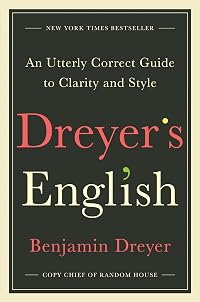
Dreyer's English: An Utterly Correct Guide to Clarity and Style
by Benjamin Dreyer
On This Page
Description
"Authoritative as it is amusing, this book distills everything Benjamin Dreyer has learned from the hundreds of books he has copyedited, including works by Elizabeth Strout, E. L. Doctorow, and Frank Rich, into a useful guide not just for writers but for everyone who wants to put their best foot forward in writing prose. Dreyer offers lessons on the ins and outs of punctuation and grammar, including how to navigate the words he calls 'the confusables,' like tricky homophones; the myriad ways show more to use (and misuse) a comma; and how to recognize--though not necessarily do away with--the passive voice. (Hint: If you can plausibly add 'by zombies' to the end of a sentence, it's passive.) People are sharing their writing more than ever--on blogs, on Twitter--and this book lays out, clearly and comprehensibly, everything writers can do to keep readers focused on the real reason writers write: to communicate their ideas clearly and effectively. Chock-full of advice, insider wisdom, and fun facts on the rules (and nonrules) of the English language, this book will prove invaluable to everyone who wants to shore up their writing skills, mandatory for people who spend their time editing and shaping other people's prose, and--perhaps best of all--an utter treat for anyone who simply revels in language"-- show lessTags
Recommendations











Member Reviews
This is the perfect companion to Lynn Truss's Eats Shoots & Leaves - and even wittier. It's overflowing with opportunities to learn about our American written communication (with a bunch of amusing comparisons to how Brits do it) and even about obscure parts of speech (retronym, contronym, cacography, reduplication) and words (Brundlefly). Everyone who loves to read should cherish it and keep it close. My only quibble: footnotes on almost every page - Dreyer's too fond of them - and the asterisks designating them in the text, in most cases, are too tiny to find. Or I need new reading glasses.
Quote: "First challenge is to go a week without writing these words: very, rather, really, quite, in fact, of course, surely, that said. And show more "actually"? Feel free to go the rest of your life without another "actually"". show less
Quote: "First challenge is to go a week without writing these words: very, rather, really, quite, in fact, of course, surely, that said. And show more "actually"? Feel free to go the rest of your life without another "actually"". show less
I was so relieved when Benjamin Dreyer confessed. "When I started out as a copy editor, I realized that most of what I knew about grammar I knew instinctively," I read with relief. I was not alone!
He won my heart by adding, "Even now I'd be hard-pressed to tell you what a nominative absolute is, I think that the word "genitive" sounds vaguely smutty, and I certainly don't know, or care to know, how to diagram a sentence. I hope I'm not shocking you."
We did diagram sentences in junior high....in 1965... Don't ask me how to do that now.
In school, I often got an A for content and a C for grammar and spelling. I never did learn to touch type with accuracy, and any proficiency I had gained in spelling has disappeared.
I often said that I show more came out of Temple University knowing how to read intelligently. I was quite unemployable and ended up in customer service and sales.
When I somehow got a job as a copywriter/copyeditor in promotion for a small publishing house (I had worked for a former employee and my new boss thought I had learned her skills through osmosis), I worked hard to correct my errors by reading grammar books. My coworker and I had many heated discussions about how to write; she was a grammar nerd.
Later in life, while schooling our son, my family all were writing and we would critique each other. I had become a member of the dreaded 'grammar police' and oversensitive to bad writing habits.
I took short-term editing jobs and people hated me. I edited a manuscript for a self-published author who appreciated my insight and gave me double our agreed on price.
Well, that was a long time ago. I had thrown out my ragged grammar books before a move. Now, I needed a refresher course. And hearing so many good things about Dreyer's English, bought an ebook.
What a treasure! So much useful information, shared in such an entertaining way! A joy to read!
I now understand why I never know if I should use gray or grey. My history of reading British writers had me totally confused.
I am very grateful. show less
He won my heart by adding, "Even now I'd be hard-pressed to tell you what a nominative absolute is, I think that the word "genitive" sounds vaguely smutty, and I certainly don't know, or care to know, how to diagram a sentence. I hope I'm not shocking you."
We did diagram sentences in junior high....in 1965... Don't ask me how to do that now.
In school, I often got an A for content and a C for grammar and spelling. I never did learn to touch type with accuracy, and any proficiency I had gained in spelling has disappeared.
I often said that I show more came out of Temple University knowing how to read intelligently. I was quite unemployable and ended up in customer service and sales.
When I somehow got a job as a copywriter/copyeditor in promotion for a small publishing house (I had worked for a former employee and my new boss thought I had learned her skills through osmosis), I worked hard to correct my errors by reading grammar books. My coworker and I had many heated discussions about how to write; she was a grammar nerd.
Later in life, while schooling our son, my family all were writing and we would critique each other. I had become a member of the dreaded 'grammar police' and oversensitive to bad writing habits.
I took short-term editing jobs and people hated me. I edited a manuscript for a self-published author who appreciated my insight and gave me double our agreed on price.
Well, that was a long time ago. I had thrown out my ragged grammar books before a move. Now, I needed a refresher course. And hearing so many good things about Dreyer's English, bought an ebook.
What a treasure! So much useful information, shared in such an entertaining way! A joy to read!
I now understand why I never know if I should use gray or grey. My history of reading British writers had me totally confused.
I am very grateful. show less
Benjamin Dreyer, the copy chief at Random House, "wandered into his job nearly three decades ago" when he started out as a freelance proofreader. He's worked his way up since then and, in "Dreyer's English," this gentle guru gives us valuable tips about the proper use of punctuation and capitalization, warns us to avoid mixing up words that sound alike but have different meanings, and urges us to proofread our copy for spelling mistakes and factual errors. Unless you are wild about this stuff--which I am--you might worry that a manual on how to write more clearly and elegantly might be nit-picky and/or sleep-inducing. Fear not. Mr. Dreyer is a clever fellow who entertains us with puns; allusions to popular culture; marvelous excerpts show more from such works as Dickens's "Bleak House" and Baum's "The Wonderful Wizard of Oz"; and witty footnotes and asides that add to the generally lighthearted tone.
I love the chapter heading, "The Life-Changing Magic of Tidying Up (Your Prose)." This pokes fun at those pompous decluttering books that are all the rage these days. Although Dreyer does not tell us how to get rid of the junk in our homes, he is a stickler for streamlining sentences. In addition, he suggests ways to convey one's meaning lucidly and succinctly while steering clear of dangling participles, mistakes in subject-verb agreement, misuse of quotation marks, misspellings, and redundancies. Dreyer also cautions us to give clichés a wide berth (I couldn't resist) and to avoid pretentiousness. He is a kinder version of my college English professor who commanded us to "cut and connect"—to trim our writing down to its essentials and ensure that each idea leads to the next seamlessly. "Dreyer's English" gives us the tools to improve our prose, and the author charms us with sassy and humorous anecdotes that demonstrate how much fun playing with language can be. show less
I love the chapter heading, "The Life-Changing Magic of Tidying Up (Your Prose)." This pokes fun at those pompous decluttering books that are all the rage these days. Although Dreyer does not tell us how to get rid of the junk in our homes, he is a stickler for streamlining sentences. In addition, he suggests ways to convey one's meaning lucidly and succinctly while steering clear of dangling participles, mistakes in subject-verb agreement, misuse of quotation marks, misspellings, and redundancies. Dreyer also cautions us to give clichés a wide berth (I couldn't resist) and to avoid pretentiousness. He is a kinder version of my college English professor who commanded us to "cut and connect"—to trim our writing down to its essentials and ensure that each idea leads to the next seamlessly. "Dreyer's English" gives us the tools to improve our prose, and the author charms us with sassy and humorous anecdotes that demonstrate how much fun playing with language can be. show less
Benjamin Dreyer is copy chief of Random House, and he wants to share with readers what he has learned over the years about good writing. Unlike a many books on usage and style, this one is not only informative but humorous. [It is killing me not to write quite humorous, but in his very first chapter, he lists words to eliminate in order to make your prose crisper, such as: very, rather, really, quite, in fact, inter alia.] He advises:
“If you can last a week without writing any of what I’ve come to think of as the Wan Intensifiers and Throat Clearers - I wouldn’t ask you to go a week without saying them; that would render most people, especially British people, mute - you will at the end of that week be a considerably better writer show more than you were at the beginning.”
He also attacks the modifier “literally,” calling it “the Intensifier from Hell.” “No,” he states, “you did not literally die laughing.”
He explains that prose rules “aid us in using our words to their preeminent purpose: to communicate clearly with our readers.” He avers, “I swear to you, a well-constructed sentence sounds better.” Still, he is much more flexible that one would suppose. Dreyer in his witty, breezy book tells us that most of the don’ts we learned in the last century were (or are now) maybes.
He notes, somewhat dispiritedly, that the English language is “not so easily ruled and regulated . . . [it] continues to evolve anarchically.”
In many cases Dreyer has the good grace to tell us what the old rule was. He proposes that the writer may observe them or not in his (or ‘her’ or sometimes ‘their’) discretion. (He doesn’t care for the use of the singular ‘their,’ but seems ready to bow to the inevitable if the gender of a single person is unknown.)
He does stress the importance of the serial comma (sometimes called the “Oxford comma”), providing funny examples of misunderstandings from omitting it. [That is the comma that precedes the final ‘and’ in an enumeration in most American books, but is typically absent (presumably to save space) in most American newspapers.]
He also is against using the passive voice, even while allowing that sometimes one needs to emphasize something other than the subject of a sentence. But he wants you at least to know what the passive voice is, writing:
“If you can append ‘by zombies’ to the end of a sentence (or, yes, ‘by the clown’), you’ve indeed written a sentence in the passive voice.”
He is not above taking opportunities to inject veiled political jabs into his rationales for his recommendations. For example, he bemoans the tendency of the President of the United States to misspell words, and has this to say on the importance of fact-checking quotes:
“In an era redolent to the high heavens with lies passed off as truths - often by career perjurers rabidly eager to condemn as fabrications facts they find inconvenient - I beg you not to continue to perpetrate and perpetuate these fortune-cookie hoaxes, which in their often insipid vapidity are as demeaning to the spirit as in the inauthenticity they are insulting to the history of the written word.”
He includes sections on, inter alia, “Peeves and Crotchets” (such as the use of aggravate versus irritate), “The Confusables” (affect versus effect, for example), and “Notes on Proper Nouns” which includes “Miscellaneous Facty Things” and “The Trimmables,” i.e., all those redundant phrases we use, from “blend together” to “exact same.”
Dreyer peppers the text with funny footnotes, sometimes all the more amusing for being digressive.
This book, like many of its genre, can be sampled a little at a time. I enjoyed it so much I read straight through, over to cover. show less
“If you can last a week without writing any of what I’ve come to think of as the Wan Intensifiers and Throat Clearers - I wouldn’t ask you to go a week without saying them; that would render most people, especially British people, mute - you will at the end of that week be a considerably better writer show more than you were at the beginning.”
He also attacks the modifier “literally,” calling it “the Intensifier from Hell.” “No,” he states, “you did not literally die laughing.”
He explains that prose rules “aid us in using our words to their preeminent purpose: to communicate clearly with our readers.” He avers, “I swear to you, a well-constructed sentence sounds better.” Still, he is much more flexible that one would suppose. Dreyer in his witty, breezy book tells us that most of the don’ts we learned in the last century were (or are now) maybes.
He notes, somewhat dispiritedly, that the English language is “not so easily ruled and regulated . . . [it] continues to evolve anarchically.”
In many cases Dreyer has the good grace to tell us what the old rule was. He proposes that the writer may observe them or not in his (or ‘her’ or sometimes ‘their’) discretion. (He doesn’t care for the use of the singular ‘their,’ but seems ready to bow to the inevitable if the gender of a single person is unknown.)
He does stress the importance of the serial comma (sometimes called the “Oxford comma”), providing funny examples of misunderstandings from omitting it. [That is the comma that precedes the final ‘and’ in an enumeration in most American books, but is typically absent (presumably to save space) in most American newspapers.]
He also is against using the passive voice, even while allowing that sometimes one needs to emphasize something other than the subject of a sentence. But he wants you at least to know what the passive voice is, writing:
“If you can append ‘by zombies’ to the end of a sentence (or, yes, ‘by the clown’), you’ve indeed written a sentence in the passive voice.”
He is not above taking opportunities to inject veiled political jabs into his rationales for his recommendations. For example, he bemoans the tendency of the President of the United States to misspell words, and has this to say on the importance of fact-checking quotes:
“In an era redolent to the high heavens with lies passed off as truths - often by career perjurers rabidly eager to condemn as fabrications facts they find inconvenient - I beg you not to continue to perpetrate and perpetuate these fortune-cookie hoaxes, which in their often insipid vapidity are as demeaning to the spirit as in the inauthenticity they are insulting to the history of the written word.”
He includes sections on, inter alia, “Peeves and Crotchets” (such as the use of aggravate versus irritate), “The Confusables” (affect versus effect, for example), and “Notes on Proper Nouns” which includes “Miscellaneous Facty Things” and “The Trimmables,” i.e., all those redundant phrases we use, from “blend together” to “exact same.”
Dreyer peppers the text with funny footnotes, sometimes all the more amusing for being digressive.
This book, like many of its genre, can be sampled a little at a time. I enjoyed it so much I read straight through, over to cover. show less
Is there a copyeditor who's read this who didn't love it? Even those weirdos who eschew the Oxford comma are bound to get some enjoyment (and valuable instruction, ahem) out of this. This guy gets it. He knows the types of dilemmas editors face every day, and he writes about these issues in a way that appeals not only to those experienced in the writing/editing realm, but those who are looking to get better at it, as well. You don't have to have all the same peeverisms to appreciate what he has to say, but prepare to feel extremely vindicated when you do. Plus he's funny. And he drops a lot of Lord of the Rings references (make sure you read all the footnotes). And the book is so dang handy. I'll be recommending this to every writer and show more editor I know for the next little while. show less
A recent opinion piece in the Washington Post by Copy Chief for Random House Benjamin Dreyer sent me in search of this book, and I was not disappointed. If you're someone who cringes at "comprised of," "I'm going to lay down," idiot apostrophes (see the footnote - and there are a lot of footnotes - on p. 36), "learnings" or "onboarding," you will find a kindred spirit in these pages. If you're a writer who needs any more cautions about what to resolutely avoid (but you have his permission to split an infinitive if you really want to) or watch out for in your own writing, Dreyer is your guy, because he has seen it all and then some. He is also funny, snarky, and cheerfully violates his own dicta (after inveighing against "Throat show more Clearers" like "That said...", you will find him saying exactly that quite a few times throughout).
The first chapters are the best, as he reviews general principles of correct and strong writing: rules of grammar, punctuation (be warned: he takes the Oxford comma seriously), conventions of spacing, foreign words, parenthetical statements, and so on. I'm going to scan the section on hyphens (includes em and en dashes for extra credit) and put it on my bulletin board. The section on editing fiction writing is illuminating, and is clearly a special professional niche, since it may involve authorial replies to your edits along the lines of "WRITE YOUR OWN F***ING BOOK!" The later chapters are more or less compendia of random tips, trick, preferences, and what I think must be extracts from his daily notebooks: "Peeves and Crotchets," "Assorted Things," "Confusables," words people just use wrong all the time, celebrity names to be sure to spell right, words he can never spell right.... The main takeaway would be - and he says it repeatedly: Look it up. Keep a dictionary, consult any of a number of recommended grammar / writing websites, or google it (when referring to the website, it's Google; if it's a verb, it's google).
Not necessarily a book to be read cover to cover, though I did, with enjoyment. But I will definitely stick this on the shelf next to my own "big fat style manuals" to refer to. A breezy, drily funny (thought sometimes he tries a little bit too hard) companion for those of us who really truly want to know where the word "only" properly should go in a sentence (answer: it depends). show less
The first chapters are the best, as he reviews general principles of correct and strong writing: rules of grammar, punctuation (be warned: he takes the Oxford comma seriously), conventions of spacing, foreign words, parenthetical statements, and so on. I'm going to scan the section on hyphens (includes em and en dashes for extra credit) and put it on my bulletin board. The section on editing fiction writing is illuminating, and is clearly a special professional niche, since it may involve authorial replies to your edits along the lines of "WRITE YOUR OWN F***ING BOOK!" The later chapters are more or less compendia of random tips, trick, preferences, and what I think must be extracts from his daily notebooks: "Peeves and Crotchets," "Assorted Things," "Confusables," words people just use wrong all the time, celebrity names to be sure to spell right, words he can never spell right.... The main takeaway would be - and he says it repeatedly: Look it up. Keep a dictionary, consult any of a number of recommended grammar / writing websites, or google it (when referring to the website, it's Google; if it's a verb, it's google).
Not necessarily a book to be read cover to cover, though I did, with enjoyment. But I will definitely stick this on the shelf next to my own "big fat style manuals" to refer to. A breezy, drily funny (thought sometimes he tries a little bit too hard) companion for those of us who really truly want to know where the word "only" properly should go in a sentence (answer: it depends). show less
Can you imagine laughing while reading a style book, an "utterly correct guide to clarity and style"? I really enjoyed this book, which was full of personality, great examples, and sometimes surprisingly flexible rules. I learned so much about commas, dashes, words like "actually" and "very." And also was relieved to find out I often am writing correctly (word choice, punctuation, spelling). My only complaint was the too small asterisks, which led to footnotes on many pages and further explained things quite humorously (can I use "quite"?). They needed to be larger. I totally agree with the book jacket: ". . .an utter treat for anyone who simply revels in language."
Members
- Recently Added By
Lists

Top Five Books of 2019
387 works; 111 members

Writing
81 works; 1 member
Author Information

5+ Works 1,640 Members
Awards and Honors
Common Knowledge
- Original title
- Dreyer's English
- Original publication date
- 2019
- Epigraph
- MARTHA. So? He’s a biologist. Good for him. Biology’s even better. It’s less…abstruse. GEORGE. Abstract. MARTHA. ABSTRUSE! In the sense of recondite. (Sticks her tongue out at GEORGE) Don’t you tell me words. —Edw... (show all)ard Albee, Who’s Afraid of Virginia Woolf?
- Dedication
- For my parents, Diana and Stanley
For Robert - First words
- I am a copy editor.
- Last words
- (Click to show. Warning: May contain spoilers.)There's no last word, only the next word.
- Blurbers
- Strout, Elizabeth; Saunders, George; Meacham, Jon
- Original language
- English US
- Canonical DDC/MDS
- 808.02
- Canonical LCC
- PN145
Classifications
- Genres
- Reference, Nonfiction
- DDC/MDS
- 808.02 — Literature & rhetoric Literature, rhetoric & criticism Rhetoric and collections of literary texts from more than two literatures Rhetoric and anthologies Authorship techniques, plagiarism, editorial techniques
- LCC
- PN145 — Language and Literature Literature (General) Literature (General) Authorship
- BISAC
Statistics
- Members
- 1,596
- Popularity
- 14,256
- Reviews
- 51
- Rating
- (4.18)
- Languages
- English
- Media
- Paper, Audiobook, Ebook
- ISBNs
- 13
- ASINs
- 6