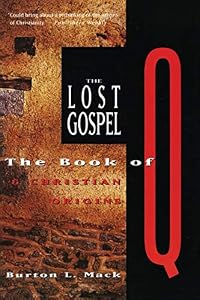
The Lost Gospel: The Book of Q & Christian Origins
by Burton L. Mack
On This Page
Description
The first book to give the full account of the lost gospel of Jesus' original followers, revealing him to be a Jewish Socrates who was mythologized into the New Testament Christ.Tags
Recommendations















Member Reviews
A text that literally exists within the text of two other books..
A text that portrays Jesus as a wise sage. No miracles. No godhood.
A text that will not be referenced at the pulpit.
This is the invisible book called Q, and another reason why biblical history is just so fascinating.
A text that portrays Jesus as a wise sage. No miracles. No godhood.
A text that will not be referenced at the pulpit.
This is the invisible book called Q, and another reason why biblical history is just so fascinating.
I had no idea so many decades, centuries really, of scholarship have research the "Q" root as a kernel of New Testament gospel writing with Q1-3 later revisions by others with their own intents. It urges considerations of the earliest "Jesus people" beliefs and aims.
Some modern scholars suggest Jesus shared similarities with ancient Greek Cynic philosophers due to his itinerant lifestyle, rejection of material wealth, and radical social critiques. However, this is a debated topic, as Jesus's apocalyptic, communal, and Jewish-focused message differed significantly from the individualistic, ascetic nature of Greek Cynicism. Similarities to Cynicism include:
Lifestyle: Jesus lived without456 many possessions and advocated a simple life, similar to Cynic "hardihood".
Rhetoric: Jesus’s direct, challenging teachings and parables sometimes mirrored the witty, biting, and confrontational style of Cynic philosophers.
Social Critique: Jesus critiqued the power structures of his society, promoting a "brokerless" kingdom in opposition to Roman imperialism and temple elites, note The Contemplative Life.
Distinctions from Cynicism:
Context: Jesus was deeply rooted in Jewish tradition and apocalyptic expectations, whereas Cynics belonged to the Hellenistic, Greco-Roman tradition, according to The University of Chicago Press: Journals.
Community: Cynics were often solitary, radical individualists, while Jesus gathered a community and taught about community, love, and the "Kingdom of God" rather than just individual virtue, note Reddit.
Mission: Jesus's actions were driven by a mission from his Father, rather than the rejection of conventionality for the sake of defying convention itself.
While scholars like John Dominic Crossan and Burton Mack have explored the "Jesus as Cynic" hypothesis, it is generally not accepted that Jesus was a "card-carrying" Cynic, but rather that his methods of communication and social critique in Galilee may have resembled those of popular Cynic preachers. This connection is explored here as well as the Hellenic, unique mixture of Galilee at the time. show less
As for Christian origins, it suddenly became clear that the conventional scenario was deeply indebted to the apocalyptic hypothesis. If Jesus had not been an eschatological prophet, the presence of apocalyptic language in the early traditions of the Jesus movements would have to be explained some other way. The conventional view of Christian origins assumed an apocalyptic imagination at the beginning and a gradual shift to the language of wisdom when the world did not end asshow more
expected. Now the sequence worked the other way around. The shift was not from apocalyptic announcement to instruction in wisdom, but from wisdom to apocalyptic. This switch forced a total reconsideration of Christian origins and of the way in which apocalyptic language had been understood to function. The assumption had been that preaching an apocalyptic message of judgment could attract people to a movement that promised salvation from that judgment. It now appeared that an apocalyptic imagination worked only in sup-port of social values and commitments that were generated by other attractions and persuasions already at work within the group.
.....
As interest grew in knowing more about the community of Q, however, studies began to appear that bumped up against features of the text that did not seem to fit the standard scenario etched in the Christian imagination. Not only was there no reference to the death and resurrection of Jesus, no mention of Jesus as the Christ, and no instruction to Peter and the other disciples about continuing Jesus' mission and baptizing converts into the church, the instructions in Q were couched in curious aphoristic discourse, addressed to individuals, and recommended strange public behavior. So the first attempts at describing the community of Q aimed at understanding how these odd features of the text could be made to fit the traditional picture of Christian origins.
Some modern scholars suggest Jesus shared similarities with ancient Greek Cynic philosophers due to his itinerant lifestyle, rejection of material wealth, and radical social critiques. However, this is a debated topic, as Jesus's apocalyptic, communal, and Jewish-focused message differed significantly from the individualistic, ascetic nature of Greek Cynicism. Similarities to Cynicism include:
Lifestyle: Jesus lived without456 many possessions and advocated a simple life, similar to Cynic "hardihood".
Rhetoric: Jesus’s direct, challenging teachings and parables sometimes mirrored the witty, biting, and confrontational style of Cynic philosophers.
Social Critique: Jesus critiqued the power structures of his society, promoting a "brokerless" kingdom in opposition to Roman imperialism and temple elites, note The Contemplative Life.
Distinctions from Cynicism:
Context: Jesus was deeply rooted in Jewish tradition and apocalyptic expectations, whereas Cynics belonged to the Hellenistic, Greco-Roman tradition, according to The University of Chicago Press: Journals.
Community: Cynics were often solitary, radical individualists, while Jesus gathered a community and taught about community, love, and the "Kingdom of God" rather than just individual virtue, note Reddit.
Mission: Jesus's actions were driven by a mission from his Father, rather than the rejection of conventionality for the sake of defying convention itself.
While scholars like John Dominic Crossan and Burton Mack have explored the "Jesus as Cynic" hypothesis, it is generally not accepted that Jesus was a "card-carrying" Cynic, but rather that his methods of communication and social critique in Galilee may have resembled those of popular Cynic preachers. This connection is explored here as well as the Hellenic, unique mixture of Galilee at the time. show less
Overlook reviews for readers unfamiliar with exegesis of the synoptic gospels for the last 150 years.
The presentation here is generally within the mainstream of scholarly Biblical study. It is the best explication of the genesis of Christianity that I have read, and the earliest progression of Christianity is incongruous without reference to the Q document or a parallel.
The book is written well. Anyone who doubts the author's sources and methods need only consult the bibliography. He has done that work for you.
My copy did not have an epilogue. At archiv.org the book is free (but no epilogue).
The presentation here is generally within the mainstream of scholarly Biblical study. It is the best explication of the genesis of Christianity that I have read, and the earliest progression of Christianity is incongruous without reference to the Q document or a parallel.
The book is written well. Anyone who doubts the author's sources and methods need only consult the bibliography. He has done that work for you.
My copy did not have an epilogue. At archiv.org the book is free (but no epilogue).
Well argued. Will read Kloppenberg next.
The first book to give the full account of the lost gospel of Jesus' original followers, revealing him to be a Jewish Socrates who was mythologized into the New Testament Christ.
NBB-4
May 12, 2021Catalan
Ratings
Members
- Recently Added By
Author Information

13+ Works 1,342 Members
Burton L. Mack, now retired, was formerly John Wesley professor in Early Christianity at the Claremont School of Theology and Graduate University in California. He is the author of numerous publications on Hellenistic Judaism, ritual theory, classical rhetoric and Christian origins from the viewpoint of cultural anthropology and history of show more religions. show less
Common Knowledge
- Canonical title
- The Lost Gospel: The Book of Q & Christian Origins
- Original publication date
- 1993
- People/Characters
- Jesus Christ
- Dedication
- In Memory of Hans Conzelmann a teacher of grace and truth.
- First words
- In modern times adventurers, seekers of treasure, and archeologists have discovered many ancient writings in ruins, caves and old monastery libraries.
- Last words
- (Click to show. Warning: May contain spoilers.)Godspeed.
- Blurbers
- Bloom, Harold; Smith, Jonathan Z.; Mills, Jack; Crossan, John Dominic
Classifications
Statistics
- Members
- 647
- Popularity
- 44,545
- Reviews
- 6
- Rating
- (3.75)
- Languages
- 5 — Dutch, English, Norwegian (Bokmål), Portuguese, Spanish
- Media
- Paper, Ebook
- ISBNs
- 12
- ASINs
- 5