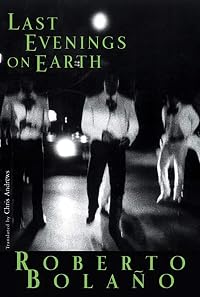
Last Evenings On Earth
by Roberto Bolaño
On This Page
Description
"The melancholy folklore of exile," as Roberto Bolano once put it, pervades these fourteen haunting stories. Bolano's narrators are usually writers grappling with private (and generally unlucky) quests, who typically speak in the first person, as if giving a deposition, like witnesses to a crime. These protagonists tend to take detours and to narrate unresolved efforts. They are characters living in the margins, often coming to pieces, and sometimes, as in a nightmare, in constant flight show more from something horrid. In the short story "Silva the Eye," Bolano writes in the opening sentence: "It's strange how things happen, Mauricio Silva, known as The Eye, always tried to escape violence, even at the risk of being considered a coward, but the violence, the real violence, can't be escaped, at least not by us, born in Latin America in the 1950s, those of us who were around 20 years old when Salvador Allende died." Set in the Chilean exile diaspora of Latin America and Europe, and peopled by Bolano's beloved "failed generation," the stories ofLast Evenings on Earth have appeared inThe New Yorker andGrand Street. show lessTags
Recommendations
















Member Recommendations
parrishlantern Whilst reading this, a certain song refrain kept intruding into my thoughts, after a while I paid closer attention to it, and realised that it not only fitted this books subject matter, it sounded like some thing from a Bolano novel.
Repent, Repent I wonder what they meant.
“All your lousy little poets coming round,
trying to sound like Charley Manson,
see the white girl dancin”
L.Cohen.
Member Reviews
4.5 stars
What ties the fourteen stories in this collection together is melancholy. Obscure poets and writers, and exiles make up most of the people in this book, and Bolaño renders moments of transience with great delicacy. Events are narrated plainly, but in all of them there’s the great veil of sadness enshrouding everything. Parting: from people, from the places we know and love, from the times that are familiar, is at most times sad. It can also be the kind of sadness that bears longing; the kind of sadness that is spontaneous and innocuous enough to dwell in. Going for a drive with the windows pulled down and the breeze on our face or looking at the starry sky. English words don’t seem to fit into the shape of these feelings show more of yearning and so we look for those of other languages: the Amharic tizita; the Welsh hiraeth; the German sehnsucht; the Portuguese saudade. The indefiniteness itself being a part of the experience, and this collection of stories dredges up this feeling exquisitely. This was my first Bolaño and it turned out to be a very good book. show less
What ties the fourteen stories in this collection together is melancholy. Obscure poets and writers, and exiles make up most of the people in this book, and Bolaño renders moments of transience with great delicacy. Events are narrated plainly, but in all of them there’s the great veil of sadness enshrouding everything. Parting: from people, from the places we know and love, from the times that are familiar, is at most times sad. It can also be the kind of sadness that bears longing; the kind of sadness that is spontaneous and innocuous enough to dwell in. Going for a drive with the windows pulled down and the breeze on our face or looking at the starry sky. English words don’t seem to fit into the shape of these feelings show more of yearning and so we look for those of other languages: the Amharic tizita; the Welsh hiraeth; the German sehnsucht; the Portuguese saudade. The indefiniteness itself being a part of the experience, and this collection of stories dredges up this feeling exquisitely. This was my first Bolaño and it turned out to be a very good book. show less
Exile on dead-end street
"A minor poet disappears without leaving a trace, hopelessly stranded in some town on the Mediterranean coast of France. There is no investigation. There is no corpse. By the time B turns to Daumal, night has fallen on the beach; he shuts the book & slowly makes his way back to the hotel."
The last evenings on earth, shouldn't make sense, it's a book about failure, not the usual fireworks & all guns blazing failure I've come to expect from Bolano's work (The savage detectives, 2666). No this is wretched, abject - from the Latin "abjectus" meaning, cast away, this is the flotsam & jetsam of Latin- America, exiled from their own past. Individuals washed up on the shores of Europe, some having escaped torture & show more violence under General Pinochet's regime, yet having not really escaped, still wearing the chains, still bearing the scars, still living haunted lives of utter anonymity. Bolano also writes about the writers, poets and artists that history forgot, the ones who regardless of talent, pursued a life of dedication to their muse, the ones who sacrificed themselves upon its altar & left not a blood stain.
"Have you found Henri Lefebvre? asks M. She must be still half asleep, thinks B. Then he says no. She has a pretty laugh. Why are you so interested in him? she asks, still laughing. Because nobody else is, says B. And because he was good."
These characters work as dishwashers, send poems to obscure magazines, enter competitions for a pittance of a prize, for the one chance that a light may illuminate their genius, that some voice will sing out & proclaim their worth. Lives are spent travelling from A to B, but B's never different, it's the same cheap hotel, the same bar filled with the same shades, just a different costume on the same whore .
These stories fall into two categories, they are either 1st person recollections, where the narrator recounts an episode from his past - a chance encounter, meeting old friends or enemies - or 3rd person accounts of a writer named B, (Belano/Bolano). Exiled from his homeland & subsisting on the margins of his adopted country, of time spent travelling in search of something long lost & settling for some short lived comfort, some transient shelter. Yet at the heart of these tales, this is just one story, that is not a criticism of the book. This is the story of artists, writers & poets exiled from all that could be called home. Individuals caught in their own private quests, hunted by nightmares, always on the edge. These are chased shadows no longer relevant.
Despite all this, the book is addictive. By the time you've started the third story, you will belong to these characters, it will matter what happens to them. The French poet who shone in the resistance only to fadeout as a teacher in some remote village, the exiled writer who goes home to recover his sons body then languishes & dies, or just following Ann Moore's life from the age of 20 - 40. It will matter, fold the corner on the page, put the book down, leave the room & it will be there, just behind your eyes, in between your thought processes, it will be the beat that paces your journeys, it's shadow will dog your footsteps & your sleeping self, will continue to turn the pages.
"There's nothing for me to do here, says B. This sentence will pursue him throughout the return journey like the headlights of a phantom car"
Although last evenings on earth is compiled from 2 previous collections (Llamadas Telefonicas & Putas Asesinas) of Bolano's, it doesn't feel bolted together, if there are joins, if in places it doesn't quite match, I couldn't find them. Yes it's fragmented, but the fault lines are those of the characters, the fractures are the human lives that he writes about.
"The secret story is the one we'll never know, although we're living it from day to day, thinking we're alive, thinking we've got it all under control and the stuff we overlook doesn't matter. But every single damn thing matters! Only we don't realize. We just tell ourselves that art runs on one track and life, our lives, on another, and we don't realize that's a lie." show less
"A minor poet disappears without leaving a trace, hopelessly stranded in some town on the Mediterranean coast of France. There is no investigation. There is no corpse. By the time B turns to Daumal, night has fallen on the beach; he shuts the book & slowly makes his way back to the hotel."
The last evenings on earth, shouldn't make sense, it's a book about failure, not the usual fireworks & all guns blazing failure I've come to expect from Bolano's work (The savage detectives, 2666). No this is wretched, abject - from the Latin "abjectus" meaning, cast away, this is the flotsam & jetsam of Latin- America, exiled from their own past. Individuals washed up on the shores of Europe, some having escaped torture & show more violence under General Pinochet's regime, yet having not really escaped, still wearing the chains, still bearing the scars, still living haunted lives of utter anonymity. Bolano also writes about the writers, poets and artists that history forgot, the ones who regardless of talent, pursued a life of dedication to their muse, the ones who sacrificed themselves upon its altar & left not a blood stain.
"Have you found Henri Lefebvre? asks M. She must be still half asleep, thinks B. Then he says no. She has a pretty laugh. Why are you so interested in him? she asks, still laughing. Because nobody else is, says B. And because he was good."
These characters work as dishwashers, send poems to obscure magazines, enter competitions for a pittance of a prize, for the one chance that a light may illuminate their genius, that some voice will sing out & proclaim their worth. Lives are spent travelling from A to B, but B's never different, it's the same cheap hotel, the same bar filled with the same shades, just a different costume on the same whore .
These stories fall into two categories, they are either 1st person recollections, where the narrator recounts an episode from his past - a chance encounter, meeting old friends or enemies - or 3rd person accounts of a writer named B, (Belano/Bolano). Exiled from his homeland & subsisting on the margins of his adopted country, of time spent travelling in search of something long lost & settling for some short lived comfort, some transient shelter. Yet at the heart of these tales, this is just one story, that is not a criticism of the book. This is the story of artists, writers & poets exiled from all that could be called home. Individuals caught in their own private quests, hunted by nightmares, always on the edge. These are chased shadows no longer relevant.
Despite all this, the book is addictive. By the time you've started the third story, you will belong to these characters, it will matter what happens to them. The French poet who shone in the resistance only to fadeout as a teacher in some remote village, the exiled writer who goes home to recover his sons body then languishes & dies, or just following Ann Moore's life from the age of 20 - 40. It will matter, fold the corner on the page, put the book down, leave the room & it will be there, just behind your eyes, in between your thought processes, it will be the beat that paces your journeys, it's shadow will dog your footsteps & your sleeping self, will continue to turn the pages.
"There's nothing for me to do here, says B. This sentence will pursue him throughout the return journey like the headlights of a phantom car"
Although last evenings on earth is compiled from 2 previous collections (Llamadas Telefonicas & Putas Asesinas) of Bolano's, it doesn't feel bolted together, if there are joins, if in places it doesn't quite match, I couldn't find them. Yes it's fragmented, but the fault lines are those of the characters, the fractures are the human lives that he writes about.
"The secret story is the one we'll never know, although we're living it from day to day, thinking we're alive, thinking we've got it all under control and the stuff we overlook doesn't matter. But every single damn thing matters! Only we don't realize. We just tell ourselves that art runs on one track and life, our lives, on another, and we don't realize that's a lie." show less
When I think of literature coming out of Chile I think of Nicanor Parra and I think of Roberto Bolano. There have been other great Chilean writers--Neruda, Donoso, Mistral and Lihn but Parra and Bolano IMO are its two brightest stars. Bolano is just a wonderful writer. Last evenings on earth does not have even one dud--one story approaching a dud out of its 14 stories. Maybe not quite the masterpiece that the Savage Detectives is or has become--nonetheless it is a gem. Starting with 'Sensini' about an Argentine exile writer from the 70's-80's military dictatorship eking out a living in Spain doing translations and entering and sometimes winning literary contests for prize money--Bolano in his clear, lucid and unsentimental prose shows show more the sorry existence of an artist forced to live outside his milieu. The stories sometimes narrated by his alter-ego Belano or at other times just B can be described as a kind of living history of coping with exile--not unknown to many Latin American writers of his era. B is often itinerant--almost always a wanderer-a man without a home often connecting with the disastrous effects of his displacement and the displacement of other South American refugees. They are left mostly with their dreams of what could have been and what will never be. Beyond that the prose is remarkable--a living current--that carries the reader along effortlessly--a kind of morning after lucidity that has you wishing at the end there were even just one more story to go. A masterful writer. show less
G. sits at his desk to write a review of the first Bolaño he's ever read. He thinks he liked it just fine, though it wasn't the best thing he's read. He wouldn't call Bolaño a "good writer" per se, but then again, G. isn't in a position to call anyone a "good" or a "bad" writer.
Okay, let's stop it with the imitation: I was surprised that Bolaño's style seemed so simple, like a summary of someone's life (one of the stories, Anne Moore's Life actually, is functionally a summary of a woman's life), unadorned, perhaps even--dare I say it--boring, with only rare glimmers of what I would call exciting writing.
So I don't know why I ended up being so engrossed in almost all the stories. Maybe it's because Bolaño writes great characters, show more all of them believable because, let's face it, almost all the stories seem like they were taken out of B's autobiof and were, therefore, real. Maybe it's because I got some voyeuristic rush out of the characters. In the end, I think it's both of those, combined with the fact that I didn't have to slog through excess verbiage and description to get to what I really look for in literature: the essence of relationships between human beings.
B really gets to the bone of such relationships. His main character interacts with a peripheral friend or someone close, and then the story ends, and the message I got out of most stories is that we really only have ourselves in the end. Nothing else. show less
Okay, let's stop it with the imitation: I was surprised that Bolaño's style seemed so simple, like a summary of someone's life (one of the stories, Anne Moore's Life actually, is functionally a summary of a woman's life), unadorned, perhaps even--dare I say it--boring, with only rare glimmers of what I would call exciting writing.
So I don't know why I ended up being so engrossed in almost all the stories. Maybe it's because Bolaño writes great characters, show more all of them believable because, let's face it, almost all the stories seem like they were taken out of B's autobiof and were, therefore, real. Maybe it's because I got some voyeuristic rush out of the characters. In the end, I think it's both of those, combined with the fact that I didn't have to slog through excess verbiage and description to get to what I really look for in literature: the essence of relationships between human beings.
B really gets to the bone of such relationships. His main character interacts with a peripheral friend or someone close, and then the story ends, and the message I got out of most stories is that we really only have ourselves in the end. Nothing else. show less
Last Evenings on Earth is the first book by Roberto Bolano that I've ever read, and I am deeply impressed. Even in translation, Bolano comes across as a sort of poet laureate of vaguely dissatisfied intellectuals, delivering these wonderful short stories with a wry humor and an eye for detail. Most impressive is Bolano's skillful use of fast-flowing language that really does sweep the reader along in a journey that is simultaneously thrilling, confusing, and never subject to obvious interpretation. And that's the strength of Bolano's gift - he seems to accept the world as it is, without the endless re-invention found in so much contemporary fiction that can reduce it to mere fantasy. After this first sampling of his art, I'm sure I'll show more be reading much more of Bolano's output in the coming years. show less
This is my first trip into Bolaño; I wasn't really prepared for this, what happened to me upon reading this book, but it was a mixed bag: a bit of ADHD, a bit of yanking my chain, but mainly, this was some exciting reading from a very talented writer.
It's a very good book at times, and at others, e.g. when Bolaño endlessly name-drops authors and books, it gets tedious as hell. At that point I wish he'd had an editor to rein him in a lot.
Some sentences, though, are just great:
A lot goes on in very little time:
In total: a very worthy read. show less
When Paul was gone, Anne and Rubén shut themselves in the bungalow and spent three days in a row making love. Anne's money soon ran out and Rubén went back to selling drugs outside The Frog. Anne left the bungalow and went to live at Ruben's house in a suburb from which you couldn't see the ocean. The house belonged to Rubéns grandmother, who lived there with her eldest son, Ruben's uncle, an unmarried fisherman, about forty years old. Things soon took a turn for the worse. Ruben'sshow more
grandmother didn't like the way Anne walked around the house half-naked. One afternoon, when Anne was in the bathroom, Ruben's uncle came in and propositioned her. He offered her money. Anne, of course, refused the offer, but not firmly enough (she didn't want to offend him, she remembers) and the next day Ruben's uncle offered her money again in return for her favors. Without realizing what she was about to unleash, Anne told Rubén. That night Rubén took a knife from the kitchen and tried to kill his uncle. The shouting was loud enough to wake the whole neighborhood, Anne remembers, but strangely nobody seemed to hear. Luckily, Ruben's uncle, who was a stronger and more experienced fighter, soon disarmed him. But Rubén wasn't about to give in, and threw a vase at his uncle's head. As bad luck would have it, just at that moment his grandmother was coming out of her room, wearing a very bright red nightgown, the likes of which Anne had never seen. Ruben's uncle dodged the vase and it struck his grandmother on the chest. The uncle gave Rubén a beating, then took his mother to hospital. When they returned, the uncle and the grandmother marched straight into the room where Anne and Rubén were sleeping and gave them two hours to get out of the house. Rubén had bruises all over his body and could hardly move, but he was so scared of his uncle that before the two hours were up, they had packed all their gear into the car.
It's a very good book at times, and at others, e.g. when Bolaño endlessly name-drops authors and books, it gets tedious as hell. At that point I wish he'd had an editor to rein him in a lot.
Some sentences, though, are just great:
One day Anne's love for Tony ran out and she left Seattle.
A lot goes on in very little time:
One night, while they were making love, Bill suggested they have a child. Anne's reply was brief and calm, she simply said no, she was still too young, but inside she could feel herself starting to scream, or rather, she could feel, and see, the dividing line between not screaming and screaming. It was like opening your eyes in a cave bigger than the Earth, Anne remembers. It was around then that she had a relapse and the doctors decided to operate again.
In total: a very worthy read. show less
there are a few low-points in here, one of which is the character of anne moore in "anne moore's life" -- maybe she seemed to familiar to me, or too without a heart, or too ... american. i don't know. i wasn't interested. i also get frustrated when bolano lists poets and authors in torrential lists that it would take me days to get through. but aside from these points, which possibly only bothered me, this book is heartbreak and hope and despair and sunshine wrapped up in some vignettes that, if you ask me, could have gone on forever.
Members
- Recently Added By
Lists

Tonikat reading completed on Librarything journals
329 works; 2 members
Author Information

96+ Works 28,118 Members
Some Editions
Awards and Honors
Work Relationships
Is contained in
Common Knowledge
- Canonical title
- Last Evenings On Earth
- Original publication date
- 1997 (Llamadas Telefonicas) (Llamadas Telefonicas); 2001 (Putas Asesinas) (Putas Asesinas); 2006 (English collection) (English collection)
- Important places
- Gerona; Mexico City, Mexico; Acapulco, Guerrero, Mexico; Chile
- Blurbers
- Lytal, Benjamin; Sontag, Susan; Stavans, Ilan; Estrada, Aura; Goldman, Francisco; Elder, Richard
- Original language
- Spanish
- Disambiguation notice
- Selected stories from other two collections: Llamadas telefónicas (Telephone calls) and Putas asesinas (Murdering whores). It should not be combined with either of those collections, or with The return, which consists of a d... (show all)ifferent selection of stories from those same collections.
Classifications
- Genres
- General Fiction, Fiction and Literature
- DDC/MDS
- 813 — Literature & rhetoric American literature in English American fiction in English
- LCC
- PQ8098.12 .O38 .A2 — Language and Literature French, Italian, Spanish and Portuguese literatures Spanish literature Provincial, local, colonial, etc. Spanish America
- BISAC
Statistics
- Members
- 936
- Popularity
- 28,513
- Reviews
- 22
- Rating
- (3.94)
- Languages
- Chinese, English, Farsi/Persian, Spanish
- Media
- Paper, Audiobook, Ebook
- ISBNs
- 11
- ASINs
- 6