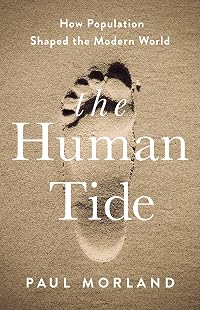
The Human Tide: How Population Shaped the Modern World
by Paul Morland
On This Page
Description
"A dazzling new history of the irrepressible demographic changes and mass migrations that have made and unmade nations, continents, and empires The rise and fall of the British Empire; the emergence of America as a superpower; the ebb and flow of global challenges from Nazi Germany, Imperial Japan, and Soviet Russia. These are the headlines of history, but they cannot be properly grasped without understanding the role that population has played. The Human Tide shows how periods of rapid show more population transition--a phenomenon that first emerged in the British Isles but gradually spread across the globe--shaped the course of world history. Demography--the study of population--is the key to unlocking an understanding of the world we live in and how we got here."--Dust jacket flap. show lessTags
Recommendations





































Member Reviews
The Human Tide is a fascinating look at how demography impacts history. The central idea is that the UK was the first country to experience a rapid rise in population due to technological and other social innovations that occurred in the 18th and 19th centuries. As a result the UK exported its population around the globe to colonies and likewise used this same toolset to dominate larger populations. This is called a "first mover advantage". However population rise has a natural cycle, which is still unfolding, over time women choose to have fewer children and the boom begins to bust. And during this period, other regions discover how to use the same toolsets and they go through a similar cycle of boom to bust. But these waves have not show more occurred simultaneously and the interactions between them is a driver of historical events. So for example Brexit is largely a rebellion by a shrinking native population against a large influx of immigrants from countries experiencing population booms, and the same can be said for the Trump phenomenon whose main emphasis is on a [demographic] wall. Morland also looks at WWI and WWII and wars of the 19th century through the lens of demographic tides occurring at different rates and places. Demography is not destiny in the sense a rising population will cause a war, but without demography the event would be hard to explain - a Nazi Germany with half the population would likely not have attacked Russia; likewise a Russia with a quarter the population would have lost the war. These "human tides" go a long way to understanding historical events. And understanding what causes the tides and their natural cycles is useful to understanding past, present and future. Morland sees most of the world shrinking in size through the 21st century except for sub-Sahara Africa which has the potential to meet or exceed the current population of east Asia and thus will be a great driver of historical events as the human tide rises and falls. show less
Fascinating. Really gives a new angle on the whole of modern history and human existence in general, while based on hard facts (I presume) and simple statistics. Some points we learn: simple population size, if not determinant, is a major factor in war; but even the loss of millions may be just a blip in a growing population. How Malthus was right for his time but missed that the world was changing even as he wrote. Japan's economic freeze is no accident, and still not a good long-term investment. Africa might well be, but South Africa (Africa's most developed country by far) is a victim of one of the modern Four Horsemen (AIDS), with serious consequences. Education and literacy, especially for women, brings down fertility rates show more dramatically, as does city living. So the world population explosion is set to cool down.
Britain as the first to industrialise could dominate the world for a while. She showed a pattern which more or less repeats around the world. Population rise - emigration and military victories - flattening out and eventual shrinkage. show less
Britain as the first to industrialise could dominate the world for a while. She showed a pattern which more or less repeats around the world. Population rise - emigration and military victories - flattening out and eventual shrinkage. show less
Interesting coverage of how populations (and in particular, differential demographic transitions, both from malthusian to industrial ("first") and from industrial to post-industrial ("second") have caused issues, both between countries and due to ethnic and religious subgroups within countries.
Lots of interesting facts (USSR had such an unstoppable demographic wave that the population went up even during WW1 to WW2 despite massive losses from civil war, famine, Stalin, and Hitler). The "abortion as primary birth control" in USSR was also new to me (the average Soviet woman had ~7 abortions in her lifetime).
The core themes of demographic transitions, groups not having an "innate" growth rate but varying by circumstance (e.g. Germans used show more to be massively fertile and are now sub-replacement), etc. were all well presented. It was a bit less engaging of presentation than it could have been, but I think part of that is to avoid being inflammatory. show less
Lots of interesting facts (USSR had such an unstoppable demographic wave that the population went up even during WW1 to WW2 despite massive losses from civil war, famine, Stalin, and Hitler). The "abortion as primary birth control" in USSR was also new to me (the average Soviet woman had ~7 abortions in her lifetime).
The core themes of demographic transitions, groups not having an "innate" growth rate but varying by circumstance (e.g. Germans used show more to be massively fertile and are now sub-replacement), etc. were all well presented. It was a bit less engaging of presentation than it could have been, but I think part of that is to avoid being inflammatory. show less
This book argues very convincingly that demographics are a major factor in history, and that demographic patterns started to change radically around 1800. Since then, they have shown -- in one country or area after another -- a characteristic pattern: the author's "human tide". First, death rates plunged, in response to the emergence of modern technology -- technology as basic as sewage systems and basic cleanliness. That allowed a precipitous drop in death rates, particularly for babies in the first year of life. For a while, birth rates remained very high and populations surged. Finally, birth rates fell sharply, and populations moved towards stability. This has had massive effects on history and on the health of our climate. This show more book examines the process, shows how it has interacted with history, and provides lots of fascinating information. A good read for anyone interested in history, politics, or, indeed, our world. show less
Important reading to understand why some countries have higher rates of violence and war (younger and poorer cohorts of men - say, Yemen - are not insignificant), and many other influences from demography on the world today. Read it while occasionally going onto the Dollar Street website set up by Gap Minder ( https://www.gapminder.org/dollar-street ). Dollar Street allows you to contemplate the details of particular people's lives and living circumstances through images and words, and thereby gives you flesh on the abstract bones of statistical demography. Read the book and look at the website together and you will have done important work in enlarging and deepening your understanding of the world beyond your nation's boundaries.
Ratings
Members
- Recently Added By
Lists

Books That Changed Me
158 works; 46 members
Author Information
11 Works 203 Members
Classifications
- Genres
- Anthropology, History, Nonfiction, General Nonfiction, Science & Nature
- DDC/MDS
- 304.6 — Society, government, & culture Social sciences, sociology & anthropology Factors affecting social behavior Population
- LCC
- HB871 .M85 — Social sciences Economic theory. Demography Economic theory. Demography Demography. Population. Vital events
- BISAC
Statistics
- Members
- 146
- Popularity
- 224,113
- Reviews
- 5
- Rating
- (4.07)
- Languages
- English
- Media
- Paper, Audiobook, Ebook
- ISBNs
- 9
- ASINs
- 4