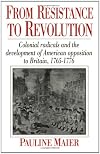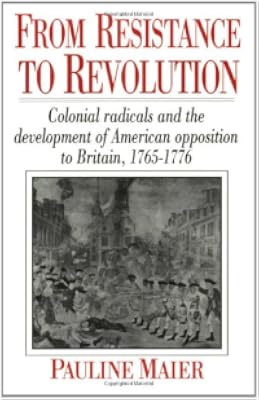
From Resistance to Revolution: Colonial Radicals and the Development of American Opposition to Britain, 1765-1776
by Pauline Maier
On This Page
Description
Details major events which shaped an organized resistance movement against the British and brought about the American Revolution. Maintaining that the outbreak of revolution in 1775 was not the result of secret planning by radicals but rather the end product of years of painful evolution, Pauline Maier brilliantly traces the American colonists' road to independence from 1765 to 1776 and examines the role of popular violence as political allegiances corroded and once-loyal subjects were show more gradually transformed into revolutionaries. Mrs. Maier presents a view of the American leaders different from that which prevailed a generation ago, when historians saw them as lawless demagogues who, already set upon independence at the outset of the conflict with England, manipulated the public toward their goal through propaganda and mob violence. She shows that none of the men in the forefront of American opposition to British policies favored independence when the colonies blocked England's efforts to impose a Stamp Tax upon them in 1765. Their love of British institutions was undermined gradually and for reasons beyond their opposition to legislation affecting American interest. Developments in England itself, in Ireland, Corsica, and the West Indies also fed American disillusionment with imperial rule, until leading colonists came to believe that just government required casting loose from Britain and monarchy. Indeed, Mrs. Maier demonstrates that participants saw the American Revolution as part of an international struggle between freedom and despotism. Like independence, violence was a last resort. Arguing that colonial leaders, like many present-day "revolutionaries," quickly learned that popular violence was counterproductive, Mrs. Maier makes it clear that they organized resistance in part to contain disorder. Building association to discipline opposition, they gradually made self-rule founded upon carefully designed "social compacts" a reality. Out of the struggle with Britain emerged not merely separation, but the beginnings of American republican government. show lessTags
Recommendations




Member Reviews
Members
- Recently Added By
Lists

Best U.S. History Books (1754-1828)
363 works; 18 members

Bibliography of How the Old World Ended by Jonathan Scott
308 works; 1 member
Author Information

7+ Works 2,051 Members
Pauline Maier was born on April 27, 1938 in St. Paul, Minnesota. She received an undergraduate degree in American history and literature from Radcliffe College in 1960, studied at the London School of Economics and Political Science on a Fulbright scholarship, and received a Ph.D. in history from Harvard University. She was a history professor at show more the Massachusetts Institute of Technology for three decades. She wrote several books including From Resistance to Revolution: Colonial Radicals and the Development of American Opposition to Britain, 1765-1776, The Old Revolutionaries: Political Lives in the Age of Samuel Adams, and American Sculpture: Making the Declaration of Independence. She won the George Washington Book Prize for Ratification: The People Debate the Constitution, 1787-1788. She died of lung cancer on August 12, 2013 at the age of 75. (Bowker Author Biography) show less
Awards and Honors
Common Knowledge
- Canonical title
- From Resistance to Revolution: Colonial Radicals and the Development of American Opposition to Britain, 1765-1776
- Original publication date
- 1972
- People/Characters
- Sons of Liberty; John Adams; Samuel Adams
- Important places
- British North America; USA; Boston, Massachusetts, USA; Massachusetts, USA; New York, USA; New York, New York, USA (show all 8); Pennsylvania, USA; Philadelphia, Pennsylvania, USA
- Important events
- American Revolution (1775 | 1783); Stamp Act; Continental Congress
- Epigraph
- The Revolution of the United States was the result of a mature and reflecting preference for freedom, not of a vague or ill-defined craving for independence. It contracted no alliance with the turbulent passions of anarchy, ... (show all)but its course was marked, on the contrary, by a love of order and law.
- Dedication
- For my parents
- First words
- eighteenth century Americans accepted the existence of popular uprisings with remarkable ease.
- Last words
- (Click to show. Warning: May contain spoilers.)They were republicans by conviction and by choice.
- Blurbers
- Wood, Gordon ; Kammen, Michael ; Segall, Barrie
Classifications
Statistics
- Members
- 344
- Popularity
- 91,838
- Rating
- (3.71)
- Languages
- English
- Media
- Paper, Ebook
- ISBNs
- 5
- ASINs
- 8