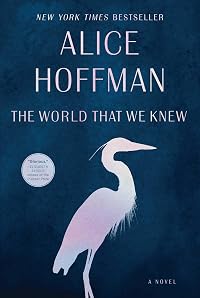
The World That We Knew
by Alice Hoffman
On This Page
Description
In Berlin, at the time when the world changed, Hanni Kohn knows she must send her twelve-year-old daughter away to save her from the Nazi regime. She finds her way to a renowned rabbi, but it's his daughter, Ettie, who offers hope of salvation when she creates a mystical Jewish creature, a rare and unusual golem, who is sworn to protect Lea. Once Ava is brought to life, she and Lea and Ettie become eternally entwined, their paths fated to cross, their fortunes linked. Lea and Ava travel from show more Paris, where Lea meets her soulmate, to a convent in western France known for its silver roses; from a school in a mountaintop village where three thousand Jews were saved. Meanwhile, Ettie is in hiding, waiting to become the fighter she's destined to be. show lessTags
Recommendations




Member Reviews
Although I read a lot of Holocaust history, biography, and memoirs, I’m picky about Holocaust fiction. Unlike in real life, the author can choose the ending for the characters, with some Holocaust fiction feeling manipulative. I was leery about this book because of the element of magical realism in the form of a golem created to protect a young German Jewish girl, Lea. I’m so glad that I gave this book a chance. The subject is handled sensitively, and the cruelty and hardships that the characters endure is in keeping with the many histories and memoirs that I’ve read. Judith Light’s narration is outstanding in parts, which makes the quirks of her narration all the more irritating (such as her penchant for running sentences show more together.) The audio version includes a bonus conversation between author Alice Hoffman and narrator Judith Light in which Hoffman reveals that the novel was inspired by a story shared with her by a Holocaust survivor who had been a “hidden child” in a French convent. show less
This story begins in Berlin in 1941 during the Holocaust. A bit of magical realism overlying the plot doesn’t change the the historical events that occurred, but adds a metaphorical dimension to several themes: the inevitability of evil in the world; the transformational power of love and hope; and all the blessings that can occur in spite of the first and with the help of the second, even in the worst of circumstances.
Hanni Kohn knew that evil was all around her, and closing in.
“Demons were on the streets. They wore brown uniforms, they took whatever they wanted, they were cold-blooded, even though they looked like young men.”
Hanni also understood how evil worked - the same way, in fact it has always worked, even in the 21st show more Century:
“It made its own corrupt sense; it swore that the good were evil, and that evil had come to save mankind. It brought up ancient fears and scattered them on the street like pearls.”
Hanni’s husband Simon, a doctor, had already been murdered by the Nazis. Thus she was all the more desperate that her 12-year-old daughter Lea should live:
“Her husband had saved so many people she refused to believe his life had meant nothing. It would mean, she had decided, that no matter what, their daughter would live. Lea would live and she would save more souls, and so it would go, on and on, until there was more good in the world than there was evil.”
Somehow, she had to help her daughter get to (relative) safety in France. She herself couldn’t leave; her own mother was bedridden and Hanni owed it to her to stay with her and care for her.
Desperate for a miracle, Hanni sought help from an old woman, Tante Ruth, who was the daughter of a rabbi known as “The Magician.” Ruth told Hanni the only possibility she could think of to get Lea out was a golem.
In Jewish folklore, a golem is a human-like figure made out of clay and brought to life by esoteric magic known only to a select few adept at Jewish mysticism, or Kabbalah. Golems – unnaturally strong and unquestionably obedient to their creators - were said to have been created from time to time in olden days to help defend Jews from antisemitic attacks. It would take a golem for Lea to escape from Berlin. Ruth gave Hanni the address of a rabbi who was famous for his knowledge of spirits and magic.
Neither the rabbi nor his wife would help Hanni, but their daughter, 17-year-old Ettie, agreed to try. Ettie had eavesdropped on her father for years, and knew how to create a golem. She would not only make one for Lea, but she and her 15-year-old sister Marta would go with them to France.
Hanni, Ettie, and Marta collected mud from the banks of the Spree River, adding Hanni’s tears and Marta’s menstrual blood to the mix, and together shaped a female golem they named Ava. Ava was charged with protecting Hanni’s daughter at all costs: “You cannot abandon her or leave her on her own. She is the only one who matters to you.”
Ava understood she was created to love Lea as if she were her own, but love was a mystery to Ava, one that could not be fully understood even by mortals. Nevertheless, Ava was determined to fulfill the sole purpose with which she had been charged.
As the story goes on, and Ava, Lea, Ettie, and Marta proceed on their journey, all of them come to learn more about the mystery of love.
In Paris, Lea and Ava go to stay with the Levi family, distant cousins of Hanni, where they meet Julien, 14, and Victor, 17 - two boys whose fates will become entwined with theirs.
Ettie ends up in Vienne, France, a region outside of Lyon, where she lives a life in disguise as a gentile. She no longer has faith in any event. She felt God had forsaken her, “and in turn she had forsaken His ways and His word.” All she wished for was a way to fight back against the Germans.
The Nazi occupation becomes more entrenched and dangerous over time. The group suffer losses, but they also learn this about love: “If you are loved, you never lose the person who loved you. You carry them with you all your life.”
Lea had been given instructions by her mother for what to do about Ava when Lea was finally safe, but Ava, who also knew about the instructions, wanted to change her fate. Yes, she had fulfilled the original purpose of her creation, but Ava felt her maker was wrong; she was no longer just an automaton made of clay. She believed that if you love someone, you do in fact possess a soul. And if someone loves you, you have been made flesh. You can ache and bleed and feel joy, because of that love.
As for Lea, she wanted to honor her mother’s guidance about Ava, but also came to see that “fate might not be set out before them in a straight, unwavering path, but might instead be a curving line marked by chance and choice, infinite in its possible destinations.”
Discussion: One is reminded of Isaac Asimov’s series of books about robots, which explore the idea of the creation of beings who come to feel alive and who cherish that feeling. This book might also be considered a Holocaust retelling of The Velveteen Rabbit. In that classic story, the Nursery Magic Fairy explains to the much-loved and eventual raggedy plush bunny toy that it has became “Real” because of the love of the boy who owned him. In The World That We Knew, we are asked to ponder how, after all, is one to define “humanity”? Are the murderous and evil demons in brown shirts to be considered “alive” while a being like Ava is not?
While the theme of defining humanity is explored in this story, it never takes the focus away from the horrors of the Holocaust. Hoffman takes great pains to make an accurate presentation of exactly what happened and how many lives were affected by the Nazi reign of terror. The magical elements add a metaphorical aspect to understanding it, but cannot change it.
Through the different characters, readers are also able to examine different reactions to the problem of theodicy, the question of how the idea of an all-knowing, all-powerful and benevolent God is consistent with the existence of evil or suffering in the world. The Holocaust gave a unique dimension to the issue, and put each character's response in sharp relief.
Evaluation: This profoundly affecting book has redemptive aspects to it, but ultimately is informed by the crushing reality of what actually happened during the Holocaust. It raises so many philosophical issues that it would make an excellent choice for book clubs. show less
Hanni Kohn knew that evil was all around her, and closing in.
“Demons were on the streets. They wore brown uniforms, they took whatever they wanted, they were cold-blooded, even though they looked like young men.”
Hanni also understood how evil worked - the same way, in fact it has always worked, even in the 21st show more Century:
“It made its own corrupt sense; it swore that the good were evil, and that evil had come to save mankind. It brought up ancient fears and scattered them on the street like pearls.”
Hanni’s husband Simon, a doctor, had already been murdered by the Nazis. Thus she was all the more desperate that her 12-year-old daughter Lea should live:
“Her husband had saved so many people she refused to believe his life had meant nothing. It would mean, she had decided, that no matter what, their daughter would live. Lea would live and she would save more souls, and so it would go, on and on, until there was more good in the world than there was evil.”
Somehow, she had to help her daughter get to (relative) safety in France. She herself couldn’t leave; her own mother was bedridden and Hanni owed it to her to stay with her and care for her.
Desperate for a miracle, Hanni sought help from an old woman, Tante Ruth, who was the daughter of a rabbi known as “The Magician.” Ruth told Hanni the only possibility she could think of to get Lea out was a golem.
In Jewish folklore, a golem is a human-like figure made out of clay and brought to life by esoteric magic known only to a select few adept at Jewish mysticism, or Kabbalah. Golems – unnaturally strong and unquestionably obedient to their creators - were said to have been created from time to time in olden days to help defend Jews from antisemitic attacks. It would take a golem for Lea to escape from Berlin. Ruth gave Hanni the address of a rabbi who was famous for his knowledge of spirits and magic.
Neither the rabbi nor his wife would help Hanni, but their daughter, 17-year-old Ettie, agreed to try. Ettie had eavesdropped on her father for years, and knew how to create a golem. She would not only make one for Lea, but she and her 15-year-old sister Marta would go with them to France.
Hanni, Ettie, and Marta collected mud from the banks of the Spree River, adding Hanni’s tears and Marta’s menstrual blood to the mix, and together shaped a female golem they named Ava. Ava was charged with protecting Hanni’s daughter at all costs: “You cannot abandon her or leave her on her own. She is the only one who matters to you.”
Ava understood she was created to love Lea as if she were her own, but love was a mystery to Ava, one that could not be fully understood even by mortals. Nevertheless, Ava was determined to fulfill the sole purpose with which she had been charged.
As the story goes on, and Ava, Lea, Ettie, and Marta proceed on their journey, all of them come to learn more about the mystery of love.
In Paris, Lea and Ava go to stay with the Levi family, distant cousins of Hanni, where they meet Julien, 14, and Victor, 17 - two boys whose fates will become entwined with theirs.
Ettie ends up in Vienne, France, a region outside of Lyon, where she lives a life in disguise as a gentile. She no longer has faith in any event. She felt God had forsaken her, “and in turn she had forsaken His ways and His word.” All she wished for was a way to fight back against the Germans.
The Nazi occupation becomes more entrenched and dangerous over time. The group suffer losses, but they also learn this about love: “If you are loved, you never lose the person who loved you. You carry them with you all your life.”
Lea had been given instructions by her mother for what to do about Ava when Lea was finally safe, but Ava, who also knew about the instructions, wanted to change her fate. Yes, she had fulfilled the original purpose of her creation, but Ava felt her maker was wrong; she was no longer just an automaton made of clay. She believed that if you love someone, you do in fact possess a soul. And if someone loves you, you have been made flesh. You can ache and bleed and feel joy, because of that love.
As for Lea, she wanted to honor her mother’s guidance about Ava, but also came to see that “fate might not be set out before them in a straight, unwavering path, but might instead be a curving line marked by chance and choice, infinite in its possible destinations.”
Discussion: One is reminded of Isaac Asimov’s series of books about robots, which explore the idea of the creation of beings who come to feel alive and who cherish that feeling. This book might also be considered a Holocaust retelling of The Velveteen Rabbit. In that classic story, the Nursery Magic Fairy explains to the much-loved and eventual raggedy plush bunny toy that it has became “Real” because of the love of the boy who owned him. In The World That We Knew, we are asked to ponder how, after all, is one to define “humanity”? Are the murderous and evil demons in brown shirts to be considered “alive” while a being like Ava is not?
While the theme of defining humanity is explored in this story, it never takes the focus away from the horrors of the Holocaust. Hoffman takes great pains to make an accurate presentation of exactly what happened and how many lives were affected by the Nazi reign of terror. The magical elements add a metaphorical aspect to understanding it, but cannot change it.
Through the different characters, readers are also able to examine different reactions to the problem of theodicy, the question of how the idea of an all-knowing, all-powerful and benevolent God is consistent with the existence of evil or suffering in the world. The Holocaust gave a unique dimension to the issue, and put each character's response in sharp relief.
Evaluation: This profoundly affecting book has redemptive aspects to it, but ultimately is informed by the crushing reality of what actually happened during the Holocaust. It raises so many philosophical issues that it would make an excellent choice for book clubs. show less
Alice Hoffman and I have a love-hate relationship. I want to love her books, but most of the time I either do not finish them or finish them under duress. However, with The World That We Knew, I found an Alice Hoffman novel I love. Even though it occurs during World War II, her exploration of what makes us human resonates in today’s fractious environment.
While World War II is the backdrop of the story, The World That We Knew is not a World War II novel. Rather, it is a novel that explores love and sacrifice as key aspects of one’s humanity. Told through various narrators, we get an understanding of what it feels like to be prey among a country of predators, always watchful, always anxious. We also get a glimpse of how people survive show more in such impossible situations, fighting through action, survival, and love. Never pontific, Ms. Hoffman allows her characters to show the integrity and fortitude required to keep going after horrific losses and the love that binds past to present.
The World That We Knew is an unassuming story with a quiet message. That message, however, loudly resonates within a world in which overt displays of hatred and bigotry become more commonplace and society becomes increasingly ideologically and politically divided. As we enter a new presidential era, The World That We Knew brings a reminder that hope and love will always win. show less
While World War II is the backdrop of the story, The World That We Knew is not a World War II novel. Rather, it is a novel that explores love and sacrifice as key aspects of one’s humanity. Told through various narrators, we get an understanding of what it feels like to be prey among a country of predators, always watchful, always anxious. We also get a glimpse of how people survive show more in such impossible situations, fighting through action, survival, and love. Never pontific, Ms. Hoffman allows her characters to show the integrity and fortitude required to keep going after horrific losses and the love that binds past to present.
The World That We Knew is an unassuming story with a quiet message. That message, however, loudly resonates within a world in which overt displays of hatred and bigotry become more commonplace and society becomes increasingly ideologically and politically divided. As we enter a new presidential era, The World That We Knew brings a reminder that hope and love will always win. show less
Alice Hoffman is one of those authors that never disappoints. Yes, she is a talented storyteller who is able to make even magic and mysticism believable. But her real gift is creating characters with souls. In this novel, Hoffman explores how war impacts and changes a small group of fictional people. And by doing so, she makes so much of the complexity of World War II more digestible and understandable.
As soon as I started reading, I was immediately absorbed by the lives of the people I met. In one Berlin family of successful and cultured Jews, I worried at their failure to recognize the danger of the mounting government restrictions. In another, I identified with the intense fear of one mother who flaunts deep religious tradition in show more order to save her child. In a third, I met a rabbi's teenage daughter who believes she is the only one who can protect her younger sister and sees the war will give her the opportunity to finally do what she was born to do -- fight.
There is also young Lea, hiding out with distant relatives or in remote schools, and her unfolding love-hate relationship with her fierce protectress, Ava. The two spoiled sons of a prominent mathematician, lazy Victor and star-student Julian, who find their paths diverge sharply when the war comes. And a quiet country doctor, hiding his own private sadness, while trying to keep villagers alive. Even a heron that acts as a homing pigeon.
As the book progressed, each of these characters came to represent so much more than that one person's story. Instead, Hoffman skillfully used each one to illuminate many of the deepest themes of wartime. Like the universal sacrifices parents willingly make to save their children. Or the blasé arrogance and brutality of the Nazi regime. The risks so many non-Jews took to protect strangers. The randomness of loss and death. How survival can depend on having someone to live for. And how some individuals seize the opportunity of war to become stronger and braver people, while others simply give up. And even, what it ultimately means to be human.
This is a powerful, suspenseful, disturbing, and unpredictable read. And it's going to stay with me for a long time. show less
As soon as I started reading, I was immediately absorbed by the lives of the people I met. In one Berlin family of successful and cultured Jews, I worried at their failure to recognize the danger of the mounting government restrictions. In another, I identified with the intense fear of one mother who flaunts deep religious tradition in show more order to save her child. In a third, I met a rabbi's teenage daughter who believes she is the only one who can protect her younger sister and sees the war will give her the opportunity to finally do what she was born to do -- fight.
There is also young Lea, hiding out with distant relatives or in remote schools, and her unfolding love-hate relationship with her fierce protectress, Ava. The two spoiled sons of a prominent mathematician, lazy Victor and star-student Julian, who find their paths diverge sharply when the war comes. And a quiet country doctor, hiding his own private sadness, while trying to keep villagers alive. Even a heron that acts as a homing pigeon.
As the book progressed, each of these characters came to represent so much more than that one person's story. Instead, Hoffman skillfully used each one to illuminate many of the deepest themes of wartime. Like the universal sacrifices parents willingly make to save their children. Or the blasé arrogance and brutality of the Nazi regime. The risks so many non-Jews took to protect strangers. The randomness of loss and death. How survival can depend on having someone to live for. And how some individuals seize the opportunity of war to become stronger and braver people, while others simply give up. And even, what it ultimately means to be human.
This is a powerful, suspenseful, disturbing, and unpredictable read. And it's going to stay with me for a long time. show less
Alice Hoffman is one of those authors that never disappoints. Yes, she is a talented storyteller who is able to make even magic and mysticism believable. But her real gift is creating characters with souls. In this novel, Hoffman explores how war impacts and changes a small group of fictional people. And by doing so, she makes so much of the complexity of World War II more digestible and understandable.
As soon as I started reading, I was immediately absorbed by the lives of the people I met. In one Berlin family of successful and cultured Jews, I worried at their failure to recognize the danger of the mounting government restrictions. In another, I identified with the intense fear of one mother who flaunts deep religious tradition in show more order to save her child. In a third, I met a rabbi's teenage daughter who believes she is the only one who can protect her younger sister and sees the war will give her the opportunity to finally do what she was born to do -- fight.
There is also young Lea, hiding out with distant relatives or in remote schools, and her unfolding love-hate relationship with her fierce protectress, Ava. The two spoiled sons of a prominent mathematician, lazy Victor and star-student Julian, who find their paths diverge sharply when the war comes. And a quiet country doctor, hiding his own private sadness, while trying to keep villagers alive. Even a heron that acts as a homing pigeon.
As the book progressed, each of these characters came to represent so much more than that one person's story. Instead, Hoffman skillfully used each one to illuminate many of the deepest themes of wartime. Like the universal sacrifices parents willingly make to save their children. Or the blasé arrogance and brutality of the Nazi regime. The risks so many non-Jews took to protect strangers. The randomness of loss and death. How survival can depend on having someone to live for. And how some individuals seize the opportunity of war to become stronger and braver people, while others simply give up. And even, what it ultimately means to be human.
This is a powerful, suspenseful, disturbing, and unpredictable read. And it's going to stay with me for a long time. show less
As soon as I started reading, I was immediately absorbed by the lives of the people I met. In one Berlin family of successful and cultured Jews, I worried at their failure to recognize the danger of the mounting government restrictions. In another, I identified with the intense fear of one mother who flaunts deep religious tradition in show more order to save her child. In a third, I met a rabbi's teenage daughter who believes she is the only one who can protect her younger sister and sees the war will give her the opportunity to finally do what she was born to do -- fight.
There is also young Lea, hiding out with distant relatives or in remote schools, and her unfolding love-hate relationship with her fierce protectress, Ava. The two spoiled sons of a prominent mathematician, lazy Victor and star-student Julian, who find their paths diverge sharply when the war comes. And a quiet country doctor, hiding his own private sadness, while trying to keep villagers alive. Even a heron that acts as a homing pigeon.
As the book progressed, each of these characters came to represent so much more than that one person's story. Instead, Hoffman skillfully used each one to illuminate many of the deepest themes of wartime. Like the universal sacrifices parents willingly make to save their children. Or the blasé arrogance and brutality of the Nazi regime. The risks so many non-Jews took to protect strangers. The randomness of loss and death. How survival can depend on having someone to live for. And how some individuals seize the opportunity of war to become stronger and braver people, while others simply give up. And even, what it ultimately means to be human.
This is a powerful, suspenseful, disturbing, and unpredictable read. And it's going to stay with me for a long time. show less
Book on CD performed by Judith Light
A slightly different take on the usual WW2 stories. Hanni Kohn recognizes the imminent danger the Nazi’s pose, so she goes to a rabbi for help. But it is the rabbi’s daughter, Ettie, who offers to make the mystical golem who will protect Hanni’s daughter, Lea. Once Ava is brought to life, she will join with Lea and Ettie to escape to France. Although separated their paths are fated to intersect.
I was skeptical about reading another WW2 story, but Hoffman’s writing captured my attention and kept me interested and engaged throughout. I grew to love Ava in particular. What an interesting character! Not truly human, and not intended to “feel,” nevertheless, she has been charged by her show more creators to act as a mother to Lea, and so she begins to feel for this child/teen/young woman. Her devotion is no less than that of a mother, and she suffers many of the same heartaches a mother would feel as her daughter grows up and away from her.
Ettie is a marvelous young woman. Strong, independent, determined to make a difference. She will not accept the role that has been prescribed for her by her strictly orthodox parents. She will fight against tyranny with every fiber of her being.
Lea is a bit of an enigma. A child at the outset she grows into a sullen teenager and then a strong-willed young woman. There were several times I wanted to just throttle her! But by the end of the book I was cheering her on.
While the focus of the story is really on Ava, Ettie and Lea, there are a number of supporting characters who help them throughout, from the Mother Superior at the convent where Ava and Lea hide for a time, to the French resistance group Ettie works with, to a kind doctor and the farmer and his daughter who keep bees and a charming goat, Bluebell.
Judith Light is an accomplished actress and voice artist. She does a marvelous job of performing the audiobook. She really brings these characters to life. show less
A slightly different take on the usual WW2 stories. Hanni Kohn recognizes the imminent danger the Nazi’s pose, so she goes to a rabbi for help. But it is the rabbi’s daughter, Ettie, who offers to make the mystical golem who will protect Hanni’s daughter, Lea. Once Ava is brought to life, she will join with Lea and Ettie to escape to France. Although separated their paths are fated to intersect.
I was skeptical about reading another WW2 story, but Hoffman’s writing captured my attention and kept me interested and engaged throughout. I grew to love Ava in particular. What an interesting character! Not truly human, and not intended to “feel,” nevertheless, she has been charged by her show more creators to act as a mother to Lea, and so she begins to feel for this child/teen/young woman. Her devotion is no less than that of a mother, and she suffers many of the same heartaches a mother would feel as her daughter grows up and away from her.
Ettie is a marvelous young woman. Strong, independent, determined to make a difference. She will not accept the role that has been prescribed for her by her strictly orthodox parents. She will fight against tyranny with every fiber of her being.
Lea is a bit of an enigma. A child at the outset she grows into a sullen teenager and then a strong-willed young woman. There were several times I wanted to just throttle her! But by the end of the book I was cheering her on.
While the focus of the story is really on Ava, Ettie and Lea, there are a number of supporting characters who help them throughout, from the Mother Superior at the convent where Ava and Lea hide for a time, to the French resistance group Ettie works with, to a kind doctor and the farmer and his daughter who keep bees and a charming goat, Bluebell.
Judith Light is an accomplished actress and voice artist. She does a marvelous job of performing the audiobook. She really brings these characters to life. show less
I finished reading this book yesterday and absolutely sped-read throughout it because it was so good, but now that I’ve come to write the review I find myself at a loss for words. I’ve never read any of Hoffman’s books before, which is surprising because a lot of her subject matter seems to involve themes around feminism, magic, and history - all topics which I generally enjoy - but I guess it’s better late than never to discover a new author! The story Hoffman presents here revolves around the intertwined stories of three young women and a golem as they struggle to survive during the Jewish genocide of World War II. Historical events are woven into a story bound by Jewish mysticism and magic at its core to give us a tale that show more brings readers straight into the harsh reality of war-torn France but lifts us up with a message that community and love can persevere with the right ingredients and determination. At times I felt like Hoffman was giving us a bit of a facts list with her continually recounted numbers relating how many people were saved by the efforts of resistance groups and the change in tone when she recalled with an almost medical precision how many people were lost to the war, but these small doses of reality served to keep the story realistic. It would be far too easy to be swept up in the young friendship and romance of Lea and Julien, the strange development of Ava towards a more human nature, and the picturesque descriptions of the Bee House farm, but we must remember that while these events are lovely in and of themselves they came about because of the chaos that Europe was thrown into from the advances of the Nazis. As the story comes to its conclusion during the final days of the war we see the deaths of many of our favourite characters, and few get quite what they want, so Hoffman deftly steers clear of this book being labeled a simple romance. And yet, the feeling we are left with as we close the covers is distinctly hopeful, as many of the characters have persevered despite their hardships and their individual transformations are nothing less than magical. show less
Members
- Recently Added By
Lists

Top Five Books of 2019
387 works; 111 members

Kirkus Starred Fiction Reviews of Books Published in 2019
411 works; 12 members

Books Read in 2020
4,379 works; 124 members

History: Holocaust
106 works; 1 member
Author Information

74+ Works 61,358 Members
Alice Hoffman, an American novelist and screenwriter, was born in New York City on March 16, 1952. She earned a B.A. from Adelphi University in 1973 and an M.A. in creative writing from Stanford University in 1975 before publishing her first novel, Property Of, in 1977. Known for blending realism and fantasy in her fiction, she often creates show more richly detailed characters who live on society's margins and places them in extraordinary situations as she did with At Risk, her 1988 novel about the AIDS crisis. Her other works include The Drowning Season, Seventh Heaven, The River King, Blue Diary, The Probable Future, The Ice Queen, and The Dovekeepers. Her book, The Third Angel, won the 2008 New England Booksellers' Award for fiction. Two of her novels, Practical Magic and Aquamarine, were made into films. She has also written numerous screenplays, including adaptations of her own novels and the original screenplay, Independence Day. Her title's The Museum of Exteaordinary Things, The Marriage of Opposites, Seventh Heaven, and The Rules of Magic made The New York Times Best Seller List. (Bowker Author Biography) show less
Awards and Honors
Awards
Distinctions
Common Knowledge
- Canonical title
- The World That We Knew
- Original publication date
- 2019-09-24
- People/Characters
- Hanni Kohn; Lea Kohn (Lillie Perrin); Ettie (Karin Beck | Nicole Duval); Ava Perrin; Marta (Margrit Beck); Bobeshi (show all 22); André Lévi; Claire Lévi; Julien Lévi; Victor Lévi; Father Varnier; Marianne Félix; Monsieur Félix; Pastor Durand; Madeleine Salomon Hasson (Madeleine de Masson | Sister Marie); Rachel (Renée); Claude Gotlib; Raoul Salomon; Monsieur Favre; Dr. Henri Girard; Sarah Girard; Ahron Weitz
- Important places
- Berlin, Germany; Paris, France; Vienne, France; Haute-Loire, France; Ardéche, France; Rhône Valley, France (show all 9); Izieu, France; Le Chambon-sur-Lignon, France; The Wolf's Plain, France
- Important events
- Vélodrome d'Hiver / Operation Spring Breeze; Holocaust; World War II
- Epigraph
- "Can you tell me the way then, and I will seek you..."
"Yes, you may do that," said he; "but there is no thither.
It lies east of the sun, and west of the moon, and never would you find your way there."
&n... (show all)bsp; "East of the Sun, West of the Moon"
The strangers in your midst shall be to you as the native born, for you know the stranger's heart, for you were strangers in the land of Egypt.
&nb... (show all)sp; Exodus 23:9 - Dedication
- To my mother, Sherry Hoffman, I will miss you forever.
- First words
- If you do not believe in evil, you are doomed to live in a world you will never understand.
- Quotations
- If you are loved, you never lose the person who loved you. You carry them with you all your life.
Trust no one, make your own future, love with all your heart. - Last words
- (Click to show. Warning: May contain spoilers.)She arose from the grass in the first light if day, alive.
- Blurbers
- Strout, Elizabeth; Picoult, Jodi
- Canonical DDC/MDS
- 813.6
- Canonical LCC
- PS3558.O3447
Classifications
Statistics
- Members
- 1,363
- Popularity
- 17,546
- Reviews
- 56
- Rating
- (4.19)
- Languages
- Dutch, English, English (Middle), Portuguese
- Media
- Paper, Audiobook, Ebook
- ISBNs
- 26
- ASINs
- 5