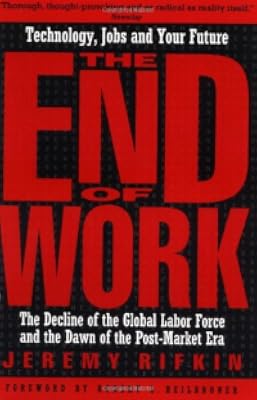
The End of Work: The Decline of the Global Labor Force and the Dawn of the Post-Market Era
by Jeremy Rifkin
On This Page
Description
Rifkin argues that we are entering a new phase in history characterized by the steady and inevitable decline of jobs, as sophisticated computers, robotics, telecommunications, and other cutting-edge technologies replace human beings in virtually every sector and industry -- from manufacturing, retail, and financial services, to transportation, agriculture, and government. He suggests that it is time to prepare ourselves and our institutions for a world that is phasing out mass employment in show more the production and marketing of goods and services. We will need to find alternatives to formal work and new ways of providing income and purchasing power in this post-market era. show lessTags
Recommendations





































Member Reviews
A more intelligent argument than most I have heard for something other than a market economy (for which I remain an advocate). Rifkin argues that the advances in technology are quickly taking us to a state in which few workers are needed. The resulting unemployment and free time should lead to increased participation in the third sector of volunteerism and community service. He also makes a decent case for a negative income tax for certain low incomes, which in my opinion, beats the alternatives he and others propose. The history he provides around the basis of the New Deal (moving the 65+ crowd out to avoid having idle youth) and the trends of the 50's and 60's is very interesting.
This book is must read. The amount of information in this book is phenominal. It must have taken the author his entire lifetime to compile it all. The book reflects on the history of work and how the nature of work has been effected along the way until the present time in which the technology and information age has overtaken the majority of work related activities. Automation has reduced the number of private and public sector jobs to the point of massive unemployment and desperation for millions across the globe. While it was written about 10 years ago I have seen the events in the book unfold before my eyes exactly as the author has written them and the worst, yet to come, will probably occur as proposed if governments do not start show more trying to build the third sector to accomodate the needs of the people who no longer will have any work or any prospects for work in the new age. show less
Libro del 1995. Leggerlo oggi significa anche testarne anche la capacità di lettura del "futuro" e l'influenza sul pensiero manageriale di questi ultimi 20 anni. Riferimento importante, anche al di là della direzione poi presa dallo stesso Rifkin nel corso del tempo.
"Finally, by the mid-1970s more than 19 percent of all U.S. workers had jobs in the public sector, making the government the largest employer in the United States." (Page 33)
I found a lot to quote in this book, but the above is the only thing that I copied into my notes.
I found a lot to quote in this book, but the above is the only thing that I copied into my notes.
Un libro imprescindible. Es un brillante análisis que explica el malestr existente a propósito del trabajo, su ausencia, la marginalidad creciente, ... Como dice Rifkin vivimos en el cambio de un modo de vida en el que tu trabajo reflejaba lo que valías a otro que aún no sabemos qué valorará.
Aug 4, 2011Spanish
Testo fondamentale e ancora di grande attualità nell'analizzare le dinamiche del mercato mondiale del lavoro.
Impressionante vedere come molte osservazioni fatte più di vent'anni fa si sono rivelate esatte.
Rifkin scrive in modo molto facile e comprensivo, anche affrontando temi economici complessi.
Secondo me è un saggio che tutti (soprattutto i giovani) dovrebbero leggere:
Impressionante vedere come molte osservazioni fatte più di vent'anni fa si sono rivelate esatte.
Rifkin scrive in modo molto facile e comprensivo, anche affrontando temi economici complessi.
Secondo me è un saggio che tutti (soprattutto i giovani) dovrebbero leggere:
Apr 25, 2017Italian
(Come inizia:) " Fin dai suoi albori, la civiltà umana si è strutturata in gran parte intorno al concetto di lavoro. Dai cacciatori-raccoglitori paleolitici agli agricoltori del Neolitico, all'artigiano medievale, all'addetto alla catena di montaggio dell'età contemporanea, il lavoro è stato una parte integrante della vita quotidiana. Oggi, per la prima volta il lavoro umano viene sistematicamente eliminato ..."
Oct 15, 2013 (Edited)Italian
Members
- Recently Added By
Author Information

51+ Works 4,489 Members
Jeremy Rifkin is president of the Foundation on Economic Trends and the author of 19 bestselling books that have been translated into, more than 35 languages. Rifkin serves as an adviser to the European Union and to heads of state around the world. He is chairman of the Third Industrial Revolution Global CEO Business Roundtable, which includes show more many of the world's leading Fortune 500 companies. Rifkin is also a senior lecturer at the Wharton Schools Executive Education Program at the University or Pennsylvania. show less
Common Knowledge
- Canonical title
- The End of Work: The Decline of the Global Labor Force and the Dawn of the Post-Market Era
- Original title
- The end of work : the decline of the global labor force and the dawn of the post-market era
- Original publication date
- 1995
- First words
- Introduction -- Global unemployment has now reached its highest level since the great depression of the 1930s. More than 800 million human beings are now unemployed or underemployed in the world. That figure is likely to rise... (show all) sharply between now and the turn of the century as millions of new entrants into the workforce find themselves without jobs, many victims of a technology revolution that is fast replacing human beings with machines in virtually every sector and industry of the global economy.
- Last words
- (Click to show. Warning: May contain spoilers.)In the new world that's emerging, government is likely to play a much reduced role in the affairs of commerce and a far greater role in civil society. Together, these two geographically bound sectors can begin to exert tremendous political pressure on corporations, forcing some of the gains of the new commerce into the communities.
- Blurbers
- Heilbroner, Robert L.; Leontief, Wassily; Urban, Glen L.; Goldsmith, Sir James; Price, Hugh B.
Classifications
- Genres
- Economics, Sociology, Nonfiction, General Nonfiction
- DDC/MDS
- 331.137042 — Society, government, & culture Economics Labor economics Labor force and market Discrimination on the labor market, unemployment Unemployment Kinds of unemployment Technological unemployment
- LCC
- HD6331 .R533 — Social sciences Industries. Land use. Labor Industries. Land use. Labor Labor. Work. Working class
- BISAC
Statistics
- Members
- 653
- Popularity
- 44,480
- Reviews
- 7
- Rating
- (3.35)
- Languages
- 8 — English, Estonian, Finnish, French, German, Italian, Portuguese, Spanish
- Media
- Paper, Ebook
- ISBNs
- 30
- ASINs
- 6