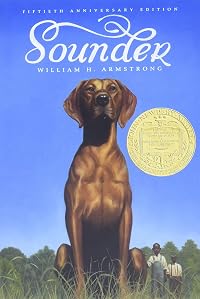
Sounder
by William H. Armstrong
On This Page
Description
Angry and humiliated when his sharecropper father is jailed for stealing food for his family, a young black boy grows in courage and understanding by learning to read and with the help of the devoted dog Sounder.Tags
Recommendations




Member Recommendations
Member Reviews
Sounder isn't so much a story about a dog as it is the coming of age story of an African American boy in the depression era South. There is a beauty in the simplicity of the author's writing which imparts a great deal of meaning in a minimum of words. William H. Armstrong was definitely an author who understood the meaning of the saying, “Less is more” and put it to good use. I never thought a book in which the characters have no names could be so powerful, yet even though I didn't know what they were called and very little of what they looked like, the author made me really care about them. Though spare and unembellished, his narrative managed to convey the hardships of life for a sharecropping family during that time. Loneliness show more seems to be a running theme throughout a large part of the book, and I could sense the boy's feelings of isolation very deeply. It is also a story about searching for meaning in life. As the boy travels around the countryside looking for his father, he discovers his heart's desire. It is also about the unbreakable bond between a man and his dog that often transcends our mortal understanding. The way this connection was depicted near the end of the book was both joyful and heartbreaking at the same time, bringing tears to my eyes.
From a parental standpoint, I think this book has some wonderful messages to convey to kids. All of the main characters, the boy, his mother, his father, and Sounder, all showed a great deal of determination in the face of adversity. The family exhibits a strong religious faith that was rendered in a very gentle way that I enjoyed. There is also the idea that if we search long enough and work hard enough, we can accomplish what we set out to do. Although I didn't feel that there was anything particularly unsuitable for kids in the book, sensitive readers, especially animal lovers, should be aware that there are a couple of descriptive scenes involving cruelty to animals and details of injuries received by both a human character and an animal. The boy also thought about what it might be like to watch two men die, one in the way that he'd seen a bull strangled and the other in the way that he'd seen a scarecrow torn apart by the wind. It was only his thoughts though, and he never outwardly exhibited any violent tendencies. Not to mention, both men had treated him very poorly, so it was rather understandable. Lastly, there is one use of the “n” word as a racial slur, and two characters die, but of course, dying is simply a part of life.
Sounder, like many other children's classics, may be more easily appreciated by adults, but in my opinion, there is much for children to glean from it's pages, lessons that kids in our modern world need to learn but often don't. Sounder is a beautiful story that has earned a spot on my keeper shelf. I can understand why it won the Newberry Medal. It is a wonderful tale that is truly powerful in its simplicity. Although it isn't really marketed a such, Sounder is the first in a trilogy of books followed by Sour Land and The MacLeod Place. It was also made into a motion picture that received several Academy Award nominations. I'm really looking forward to reading the other books in the series and seeing the movie as well. show less
From a parental standpoint, I think this book has some wonderful messages to convey to kids. All of the main characters, the boy, his mother, his father, and Sounder, all showed a great deal of determination in the face of adversity. The family exhibits a strong religious faith that was rendered in a very gentle way that I enjoyed. There is also the idea that if we search long enough and work hard enough, we can accomplish what we set out to do. Although I didn't feel that there was anything particularly unsuitable for kids in the book, sensitive readers, especially animal lovers, should be aware that there are a couple of descriptive scenes involving cruelty to animals and details of injuries received by both a human character and an animal. The boy also thought about what it might be like to watch two men die, one in the way that he'd seen a bull strangled and the other in the way that he'd seen a scarecrow torn apart by the wind. It was only his thoughts though, and he never outwardly exhibited any violent tendencies. Not to mention, both men had treated him very poorly, so it was rather understandable. Lastly, there is one use of the “n” word as a racial slur, and two characters die, but of course, dying is simply a part of life.
Sounder, like many other children's classics, may be more easily appreciated by adults, but in my opinion, there is much for children to glean from it's pages, lessons that kids in our modern world need to learn but often don't. Sounder is a beautiful story that has earned a spot on my keeper shelf. I can understand why it won the Newberry Medal. It is a wonderful tale that is truly powerful in its simplicity. Although it isn't really marketed a such, Sounder is the first in a trilogy of books followed by Sour Land and The MacLeod Place. It was also made into a motion picture that received several Academy Award nominations. I'm really looking forward to reading the other books in the series and seeing the movie as well. show less
Newbery Medal award winning classic novel about the courage and faith, and the love of a dog, that give a family strength in the face of inhumanity.
Life as a 19th century African American sharecropper in the South is hard. Food was scarce, and money was even more scarce. Every day is a struggle. One day, the father comes home with a large ham. Maybe life is going to be a little bit better.... that is until the sheriff and his deputies show up and take the father away for stealing.
It explores the racial tensions that divided the north and the south after the Civil War. The main character, a boy whose name we never knew, is the son of black sharecroppers who struggle to earn enough to eat. After a particularly unsuccessful hunt, the show more father steals a ham from a white man’s smokehouse, and this one desperate act changes his life and his family forever.
The book includes the usual topics: the hard life of the poor, both black and white... the sharecropping system that kept families in virtual slavery, the mistreatment and unimaginable attitude of the white folks holding on to old ideas of supremacy, and the prejudice of the era, but it tells it much gentler than it probably was as we hear it through the voice of a bewildered child searching for his father.
While several characters, though unnamed, lend depth and power to the story, it is this boy we grow to love. For a mere 118 pages, we see the world through eyes that do their best to comprehend injustice. His simple insights, the profound comparisons he makes to characters from the Bible, the hope he draws from family and his endless determination make us not only like him but also admire him. The boy also takes us on a journey. Through personal tragedy, endless seeking, and the love of one big lovable dog, the boy gains an understanding of his world. I couldn’t help but cheer when he determines to rise above circumstances through the power of literacy.
This book is sure to encourage meaningful discussions about poverty and racial injustice. It's also an excellent tale of perseverance, hope and courage. Parents of sensitive children may wish to either pre-read this story or read it withyour children. The book ends, with a strong quote “Only the unwise think that what has changed is dead.” I grew up in the south and my best friend was a little black girl whose parents and 5 older brothers worked in the fields in exchange for the house they lived in and to put food on their table. I didn't understand why my best friend, Cordelia couldn't use my bathroom or drink from my water fountain, and if we rode a bus she had to sit in the back. She was my best friend. She and I played together and spent most nights sleeping in the same bed at either her house or mine. My poor grandmother didn't have the words to explain it to 5-year-old me...I don't think she understood it herself. I do believe and hope that such active prejudice and racial contention is, for the greater part, a thing of the American past in most parts of America. Still, it's a past that must be taught to each new generation so it will not be repeated toward any race or culture ever again in the United Staes of America. show less
Life as a 19th century African American sharecropper in the South is hard. Food was scarce, and money was even more scarce. Every day is a struggle. One day, the father comes home with a large ham. Maybe life is going to be a little bit better.... that is until the sheriff and his deputies show up and take the father away for stealing.
It explores the racial tensions that divided the north and the south after the Civil War. The main character, a boy whose name we never knew, is the son of black sharecroppers who struggle to earn enough to eat. After a particularly unsuccessful hunt, the show more father steals a ham from a white man’s smokehouse, and this one desperate act changes his life and his family forever.
The book includes the usual topics: the hard life of the poor, both black and white... the sharecropping system that kept families in virtual slavery, the mistreatment and unimaginable attitude of the white folks holding on to old ideas of supremacy, and the prejudice of the era, but it tells it much gentler than it probably was as we hear it through the voice of a bewildered child searching for his father.
While several characters, though unnamed, lend depth and power to the story, it is this boy we grow to love. For a mere 118 pages, we see the world through eyes that do their best to comprehend injustice. His simple insights, the profound comparisons he makes to characters from the Bible, the hope he draws from family and his endless determination make us not only like him but also admire him. The boy also takes us on a journey. Through personal tragedy, endless seeking, and the love of one big lovable dog, the boy gains an understanding of his world. I couldn’t help but cheer when he determines to rise above circumstances through the power of literacy.
This book is sure to encourage meaningful discussions about poverty and racial injustice. It's also an excellent tale of perseverance, hope and courage. Parents of sensitive children may wish to either pre-read this story or read it withyour children. The book ends, with a strong quote “Only the unwise think that what has changed is dead.” I grew up in the south and my best friend was a little black girl whose parents and 5 older brothers worked in the fields in exchange for the house they lived in and to put food on their table. I didn't understand why my best friend, Cordelia couldn't use my bathroom or drink from my water fountain, and if we rode a bus she had to sit in the back. She was my best friend. She and I played together and spent most nights sleeping in the same bed at either her house or mine. My poor grandmother didn't have the words to explain it to 5-year-old me...I don't think she understood it herself. I do believe and hope that such active prejudice and racial contention is, for the greater part, a thing of the American past in most parts of America. Still, it's a past that must be taught to each new generation so it will not be repeated toward any race or culture ever again in the United Staes of America. show less
I'm going to buy 10 copies.
Sounder is part of the many books I did not read as a kid but I probably checked out from the school library, and instead my mother read it.
That often happened with books I brought home. I had good intentions but there was also so much playing to do, Barbies alone in my room, riding bikes with the neighbor kids, chasing games in the yard with my brothers. Ultimately I read perhaps only a quarter of those I brought home. My mother always read them. She would even recommend a specific one to me, saying I would like it, but never insisted. On Saturdays, Mom would clean house, grocery shop, put away the the groceries, and prepare a meal to cook slow on the stove. Then she would lie down, it was her weekly treat show more to read for a couple of hours by herself. I learned that if I would ask if I could read with her, usually one of titles she recommended, she would allow fidgety, noisy me to read my book beside her during her special reading time.
That likely accounts for the quarter of the books I brought home that I actually read.
Sounder is beautiful. Tragic. Serious. Loving. Had I read it at age 10, when it was highly popular at our school library, I would have thought even then that it was beautiful, tragic, serious, and loving.
But of course every thing is different now. Some parents consider aspects controversial in Sounder (and Lot's daughters in the cave isn't?) and challenge it for banning. Seems to me, if my working mother could do all that she did, and read and monitor my books too, that's what parents should do, instead of trying to remove a book from a school library in order that their children and your children cannot read them.
Me, I believe I'll buy 10 copies and divide them in the Little Free Libraries closest to me. available for the many of those for whom it would be beautiful and meaningful.
Listened via Hoopla, read by Avery Brooks who gave the most sensitive and yet not saccharine narration of this book. I'd love to listen to anything by him. show less
Sounder is part of the many books I did not read as a kid but I probably checked out from the school library, and instead my mother read it.
That often happened with books I brought home. I had good intentions but there was also so much playing to do, Barbies alone in my room, riding bikes with the neighbor kids, chasing games in the yard with my brothers. Ultimately I read perhaps only a quarter of those I brought home. My mother always read them. She would even recommend a specific one to me, saying I would like it, but never insisted. On Saturdays, Mom would clean house, grocery shop, put away the the groceries, and prepare a meal to cook slow on the stove. Then she would lie down, it was her weekly treat show more to read for a couple of hours by herself. I learned that if I would ask if I could read with her, usually one of titles she recommended, she would allow fidgety, noisy me to read my book beside her during her special reading time.
That likely accounts for the quarter of the books I brought home that I actually read.
Sounder is beautiful. Tragic. Serious. Loving. Had I read it at age 10, when it was highly popular at our school library, I would have thought even then that it was beautiful, tragic, serious, and loving.
But of course every thing is different now. Some parents consider aspects controversial in Sounder (and Lot's daughters in the cave isn't?) and challenge it for banning. Seems to me, if my working mother could do all that she did, and read and monitor my books too, that's what parents should do, instead of trying to remove a book from a school library in order that their children and your children cannot read them.
Me, I believe I'll buy 10 copies and divide them in the Little Free Libraries closest to me. available for the many of those for whom it would be beautiful and meaningful.
Listened via Hoopla, read by Avery Brooks who gave the most sensitive and yet not saccharine narration of this book. I'd love to listen to anything by him. show less
This 1970 Newbery winner, about a family of black sharecroppers and their dog, Sounder, is very sad. It is bitter cold, hunting is poor, so the father steals a ham and pork sausage to feed his wife and four children. When he is arrested and hauled away in a wagon, Sounder breaks free from the oldest son to chase it and is shot, but survives. The father is sentenced to many years of hard labor on a chain gang. His oldest son takes over his work in the fields, providing for the family and even learning to read. He looks for his father when he is not working, encountering more prejudice and cruel treatment. Both Sounder and the father return but are badly maimed and die before the end of the book.
Sounder has earned some criticism in the show more ensuing years, primarily because a white author is writing about a black experience. Armstrong says in an author’s note at the beginning of Sounder that it is the story of an African American teacher (Charles Jones) who worked for Armstrong’s father after school and in the summer, and who taught Armstrong to read.
In an interview in the March 1978 Writer's Digest, Armstrong said race was not a factor when writing the book. "I was writing about people's hearts and feelings. There's no color to feeling. There's no color to heart. There are a lot of white people who have suffered indignities, but they strangely hold out against it and save themselves. And there's a lot of black people who have done the same thing."
Many of these same critics take Armstrong to task for not naming any of the characters other than the dog. For example, Albert Schwartz (in MacCann and Woodard’s The Black American in Books for Children: Readings in Racism, 1972) says leaving them unnamed “raises the issue of white supremacy” and “deep-seated prejudice has long denied human individualization to the Black person.”
In the Writer’s Digest interview, Armstrong states, "If the boy's age was not given the reader could become a part of the story: 'The boy must be about my age.' Place and time kept vague, no name or description of the boy. . . . And no names for the family. With names they would have represented one family; without names they became universal-- representing all people who suffer privation and injustice, but through love, self-respect, devotion, and desire for improvement, make it in the world." Indeed, the setting is vague enough that it could be anytime between the end of the Civil War and the Great Depression, and anywhere walnuts grow (which is most of the eastern half of the United States, not just the South).
According to Lois Kuznets (in the Spring 1978 Illinois English Bulletin), the original manuscript of Sounder was much longer. Armstrong's publishers split it into two novels; the second is Sour Land (1971) and tells the story of the boy (now named Moses Waters) as an adult.
Well-known actor Avery Brooks (Star Trek DS9’s Captain Sisko) did a marvelous job narrating the audiobook, even singing some of the hymns in the story. His bass voice was perfect for that and for everyone but the mother. He gives the white characters deep southern accents, not necessarily reflected in their words in the book.
Although Sounder is written at about a grade 4.9-5.3 reading level, its subject matter is more appropriate for middle grades (6-8) and up. It is hard to fathom such a harsh punishment for stealing a ham and sausages, and the cruelties the black family and the dog endure. There is also some scenes (on pages 59-61) where the boy imagines, in grisly detail, what he would do to the deputy who shot Sounder (drag him behind a wagon) and the jailer who destroys a homemade cake the boy brings his father, awaiting trial (choke him with a chain). show less
Sounder has earned some criticism in the show more ensuing years, primarily because a white author is writing about a black experience. Armstrong says in an author’s note at the beginning of Sounder that it is the story of an African American teacher (Charles Jones) who worked for Armstrong’s father after school and in the summer, and who taught Armstrong to read.
In an interview in the March 1978 Writer's Digest, Armstrong said race was not a factor when writing the book. "I was writing about people's hearts and feelings. There's no color to feeling. There's no color to heart. There are a lot of white people who have suffered indignities, but they strangely hold out against it and save themselves. And there's a lot of black people who have done the same thing."
Many of these same critics take Armstrong to task for not naming any of the characters other than the dog. For example, Albert Schwartz (in MacCann and Woodard’s The Black American in Books for Children: Readings in Racism, 1972) says leaving them unnamed “raises the issue of white supremacy” and “deep-seated prejudice has long denied human individualization to the Black person.”
In the Writer’s Digest interview, Armstrong states, "If the boy's age was not given the reader could become a part of the story: 'The boy must be about my age.' Place and time kept vague, no name or description of the boy. . . . And no names for the family. With names they would have represented one family; without names they became universal-- representing all people who suffer privation and injustice, but through love, self-respect, devotion, and desire for improvement, make it in the world." Indeed, the setting is vague enough that it could be anytime between the end of the Civil War and the Great Depression, and anywhere walnuts grow (which is most of the eastern half of the United States, not just the South).
According to Lois Kuznets (in the Spring 1978 Illinois English Bulletin), the original manuscript of Sounder was much longer. Armstrong's publishers split it into two novels; the second is Sour Land (1971) and tells the story of the boy (now named Moses Waters) as an adult.
Well-known actor Avery Brooks (Star Trek DS9’s Captain Sisko) did a marvelous job narrating the audiobook, even singing some of the hymns in the story. His bass voice was perfect for that and for everyone but the mother. He gives the white characters deep southern accents, not necessarily reflected in their words in the book.
Although Sounder is written at about a grade 4.9-5.3 reading level, its subject matter is more appropriate for middle grades (6-8) and up. It is hard to fathom such a harsh punishment for stealing a ham and sausages, and the cruelties the black family and the dog endure. There is also some scenes (on pages 59-61) where the boy imagines, in grisly detail, what he would do to the deputy who shot Sounder (drag him behind a wagon) and the jailer who destroys a homemade cake the boy brings his father, awaiting trial (choke him with a chain). show less
I have no idea how this book slipped by me, during my early reading years. Once I decided I enjoyed reading, I read everything I could get my hands on. Everything from Where the Red Fern Grows to Roll of Thunder, Hear My Cry, to Tales of a Fourth Grade Nothing. I wish I'd started keeping track of everything back then!
But this one really hit hard! It's one of those stories I couldn't put down once I picked it up.
I found it interesting that the only names used throughout the story are that of the dog (Sounder) and that of a characters in stories (David, Joseph, Cyrus, etc). I found myself wanting to know what each of these people's names are. It's hard for me, because I become emotionally invested.... I understand the reason for doing show more this (or at least I think I do--to underscore how "inconsequential" these people were to their community), but it filled me with longing to know that one, special thing about each of them. Names, I believe, hold a lot of power. I feel like the main characters in this story weren't given names because they had little-to-no power at all. Pretty intense. show less
But this one really hit hard! It's one of those stories I couldn't put down once I picked it up.
I found it interesting that the only names used throughout the story are that of the dog (Sounder) and that of a characters in stories (David, Joseph, Cyrus, etc). I found myself wanting to know what each of these people's names are. It's hard for me, because I become emotionally invested.... I understand the reason for doing show more this (or at least I think I do--to underscore how "inconsequential" these people were to their community), but it filled me with longing to know that one, special thing about each of them. Names, I believe, hold a lot of power. I feel like the main characters in this story weren't given names because they had little-to-no power at all. Pretty intense. show less
I worried that my book club kids wouldn't like this one, but they surprised me. Not only did they like it, but I think they really got it. We talked about the boy's anger and loneliness, the similarities between Sounder and the father, and what it's like to love and lose a pet. I tried to explain what sharecropping was, but the kids were far more interested in the emotional aspects of the book than the historical context. The only negative comments were about the ending (dismay over Sounder's ultimate demise) and about the characters not having names (they would've preferred names).
Personally, this book was tough for me. So gut wrenching. The part where the boy is getting all scraped up crawling under his house looking for a dog he show more thinks is dead just killed me. The part where the jailer destroys the carefully prepared cake killed me. The part where the father comes home terribly wounded killed me. Nearly everything the mother said, with its undertone of numbness, killed me. show less
Personally, this book was tough for me. So gut wrenching. The part where the boy is getting all scraped up crawling under his house looking for a dog he show more thinks is dead just killed me. The part where the jailer destroys the carefully prepared cake killed me. The part where the father comes home terribly wounded killed me. Nearly everything the mother said, with its undertone of numbness, killed me. show less
Reading this as an adult, I realize that this is one of those "a dog and his boy" books that is not really about the dog at all. If I had read it as a child, I think I would have fallen into despair, because even in other books where -- SPOILER ALERT -- the dog dies, there is at least some redemptive, hopeful moment, as with the fern in Where the Red Fern Grows (which still makes me cry). The matter-of-fact realism of Armstrong's window into the situation of black sharecroppers in our not-so-distant past provides no light of hope; the reader, looking back, must bring her own to the book, and that is a difficult task. This is a short book, ostensibly for children, and it has beautiful moments, but read it only when you are prepared to show more feel real sadness. show less
Members
- Recently Added By
Lists

Best Newbery Medal Winners
94 works; 54 members

Sonlight Books
1,487 works; 25 members

Honey For a Child's Heart
1,152 works; 25 members

Newbery Medal Winners - By Year
105 works; 7 members

CCE 1000 Good Books List
1,033 works; 12 members

Books You Read During High School (For School)
301 works; 53 members

Dogs -- children's/young adult fiction
1,317 works; 9 members

Books Read in 2021
5,361 works; 114 members

1970s
657 works; 23 members

Recommended Reading List
219 works; 1 member

HMS: Make Your Child a Lover of Books, Ages 9 & up
111 works; 2 members

The Playful Pioneers
166 works; 1 member
Talk Discussions
Past Discussions
Children's Historical Fiction - Jim Crow South, dog in Name that Book (November 2010)
Author Information

Some Editions
Awards and Honors
Awards
Work Relationships
Is contained in
Has the adaptation
Has as a student's study guide
Has as a teacher's guide
Common Knowledge
- Canonical title
- Sounder
- Original title
- Sounder
- Original publication date
- 1969-10-08
- People/Characters
- The Boy; The Man; The Woman; Sounder (dog)
- Related movies
- Sounder (1972 | IMDb)
- Epigraph
- "A man keeps, like his love, his courage dark."
—Antoine de Saint Exupéry - Dedication
- To Kip, Dave, and Mary
- First words
- Fifty years ago I learned to read at a round table in the center of a large, sweet-smelling, steam-softened kitchen.
--Author's Note
The tall man stood at the edge of the porch.
--Body text - Last words
- (Click to show. Warning: May contain spoilers.)And the quiet of the night would fill and echo again with the deep voice of Sounder, the great coon dog.
- Blurbers
- Morris, Effie Lee; Fuller, Edmund
- Original language
- English US
Classifications
Statistics
- Members
- 9,504
- Popularity
- 1,092
- Reviews
- 110
- Rating
- (3.74)
- Languages
- 9 — Danish, Dutch, English, Finnish, German, Italian, Spanish, Swedish, Turkish
- Media
- Paper, Audiobook, Ebook
- ISBNs
- 75
- UPCs
- 5
- ASINs
- 49