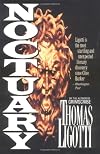
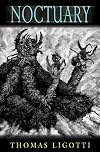
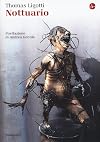
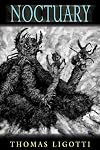
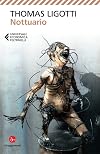
Noctuary
by Thomas Ligotti
On This Page
Description
Noctuary is the third volume of Thomas Ligotti's horror stories to appear in a revised, definitive edition from Subterranean Press. The first two collections in this series, Songs of a Dead Dreamer (2010; 1986; expanded edition, 1989) and Grimscribe: His Lives and Works (2011; originally published 1991), are now collector's items. Like its predecessors, Noctuary received numerous plaudits from reviewers upon its initial appearance. As Booklist observed, "The most disturbing terror comes from show more within, springs unexpectedly from bland or half-formed memories of the past. This is the terror that Ligotti cultivates in the rich evocative tales of Noctuary For those willing to immerse themselves in Ligotti's world, the rewards are great." When an interviewer asked Ligotti the derivation of the word "noctuary," he replied that it was the nocturnal counterpart of "diary," that is, a journal of what occurs on a nightly timetable rather than during the light of day. Echoing the tenebrous tone of the book's name are the section titles into which Noctuary is divided Studies in Shadow, Discourse on Blackness, Notebook of the Night. Shadow, Blackness, Night: these are substance and signification of the themes of Ligotti's works and the signature of gloom in which they are signed. New to Noctuary are the terse pieces of the volumes' third section. Composed of nineteen dreamy entries, Notebook of the Night is a journal or perhaps only excerpts of a greater work of insidious exploits, delirious freaks, hymns to the void, esoteric rituals, and carnivals of the abyss. As an introduction to this and the other segments of Noctuary is "In the Night, in the Dark: A Note on the Appreciation of Weird Fiction." Perhaps the reader will fight guidance in the words of this meditation on what separates the aberrant from the norm, the diseased from the wholesome, and the night from the day. show lessTags
Recommendations















Member Reviews
Nethescurial appears to be Ligotti's most obvious homage to Lovecraft almost to the point of pastiche in terms of structure and mood although it is clearly very much a Ligotti production.
It is as if Ligotti decided to see how he could take as many Lovecraftian tropes about ancient cultic lore and the dark occult, refine them to their basics and come up with a definitive layered narrative oozing unease rather than outright horror.
Ligotti is at his best not in trying to present something visceral, disgusting or terrible but in presenting something that unnerves us with the sense that the world is not as it seems - something closer to Sartre's 'nausea' than to most horror fare.
In this story he possibly over-reaches himself. The attempt show more to create unease through an adroit use of formulae that we recognise is skilled and will please those with a post-modern and ironic sensibility but it is perhaps all a little too clever and neatly structured.
There is unease here certainly but also a hysteria towards the end that implies a literary concoction rather than an honest attempt to create an emotion or a sense of things not being as they should. Highly skilled, always part of the Ligotti canon, but a story to be admired rather than loved. show less
It is as if Ligotti decided to see how he could take as many Lovecraftian tropes about ancient cultic lore and the dark occult, refine them to their basics and come up with a definitive layered narrative oozing unease rather than outright horror.
Ligotti is at his best not in trying to present something visceral, disgusting or terrible but in presenting something that unnerves us with the sense that the world is not as it seems - something closer to Sartre's 'nausea' than to most horror fare.
In this story he possibly over-reaches himself. The attempt show more to create unease through an adroit use of formulae that we recognise is skilled and will please those with a post-modern and ironic sensibility but it is perhaps all a little too clever and neatly structured.
There is unease here certainly but also a hysteria towards the end that implies a literary concoction rather than an honest attempt to create an emotion or a sense of things not being as they should. Highly skilled, always part of the Ligotti canon, but a story to be admired rather than loved. show less
While Noctuary features some strikingly powerful stories, it's not an entirely successful collection and would seem to be a small let down from Ligotti's previous collection, Grimscribe. This may be because Noctuary, like Ligotti's debut Songs of a Dead Dreamer, is a transitional work. With Songs, it's clear that Ligotti was working to combine his literary influences with his own original voice and ideas to create something strikingly original yet very much within the tradition of weird fiction. This project would find it's full articulation in Grimscribe. Seen from the perspective of Songs and Grimscribe, Noctuary would seem to represent a step backwards or a sort of exhaustion. Ligotti has, of course, always trafficked in exhaustion show more whether Alice's weary adulthood as she faces her last adventures or the narrator's dismissal of horror stories in Nethescurial; yet realms of exhaustion often prove to be rather fertile for the generation of new horrors.
Among it's horrors are the death god of "The Prodigy of Dreams," the supernatural vengeance of "Conversations in a Dead Language," and the Lovecraftian dreams of "Mrs. Rinaldi's Angel," all quite strong stories that feel somehow slight in this collection, as if Ligotti is spinning his wheels. One story, "The Tsalal," while arguably along the same lines as much of the stories in Grimscribe, stands out because it is so powerfully crafted, perfectly structured and with the sort of shockingly inevitable ending that marks Ligotti's best work.
Other tales, such as "The Medusa," in which an eccentric scholar seeks out the fabled monster whom he believes to be lurking in the every day world, or "Mad Night of Atonement," in which a Nyarlathotep-like showman reveals the true will of God, feel markedly transitional, attempting to go a step beyond the previous confines of weird fiction, yet never quite making the leap. These stories, despite moments of brilliance, are somewhat disappointing, lacking the powerful build and surprise of Ligotti's previous works. Ligotti has, I believe, started to chafe against the bonds of his own chosen idiom, though this can be seen only from the perspective of his later work. With such collections as Teatro Grottesco, Ligotti would dispense with much of the Lovecraftian baroqueness of his earlier style, leaving behind the dark gods and forbidden texts, as well as stylistic flourishes, for a more banal and bleaker world. If stories such as "Medusa" and "Mad Night" disappoint, it is probably because Ligotti has already begun the process of trying to break free of his earlier style.
The final section of the novel is the Notebook of Night, a collection of brief vignette, rich in language and imagery but often nearly plotless. These also reveal Ligotti experimenting with how best to express his own dark concepts. This is my favorite section of the collection, since even those that don't quite work as tales still are full of wonderfully sinister atmosphere. show less
Among it's horrors are the death god of "The Prodigy of Dreams," the supernatural vengeance of "Conversations in a Dead Language," and the Lovecraftian dreams of "Mrs. Rinaldi's Angel," all quite strong stories that feel somehow slight in this collection, as if Ligotti is spinning his wheels. One story, "The Tsalal," while arguably along the same lines as much of the stories in Grimscribe, stands out because it is so powerfully crafted, perfectly structured and with the sort of shockingly inevitable ending that marks Ligotti's best work.
Other tales, such as "The Medusa," in which an eccentric scholar seeks out the fabled monster whom he believes to be lurking in the every day world, or "Mad Night of Atonement," in which a Nyarlathotep-like showman reveals the true will of God, feel markedly transitional, attempting to go a step beyond the previous confines of weird fiction, yet never quite making the leap. These stories, despite moments of brilliance, are somewhat disappointing, lacking the powerful build and surprise of Ligotti's previous works. Ligotti has, I believe, started to chafe against the bonds of his own chosen idiom, though this can be seen only from the perspective of his later work. With such collections as Teatro Grottesco, Ligotti would dispense with much of the Lovecraftian baroqueness of his earlier style, leaving behind the dark gods and forbidden texts, as well as stylistic flourishes, for a more banal and bleaker world. If stories such as "Medusa" and "Mad Night" disappoint, it is probably because Ligotti has already begun the process of trying to break free of his earlier style.
The final section of the novel is the Notebook of Night, a collection of brief vignette, rich in language and imagery but often nearly plotless. These also reveal Ligotti experimenting with how best to express his own dark concepts. This is my favorite section of the collection, since even those that don't quite work as tales still are full of wonderfully sinister atmosphere. show less
Thomas Ligotti is a truly unusual author. He has a fascination with “weird fiction,” with the unknowable, the macabre. This is paired with a knack for eloquent word-poetry, intelligence and complexity, and a sense of the chillingly unusual. When I finish reading several Ligotti stories, I find that the world looks different. The colors aren’t quite right any more, or the angles, or maybe people seem a little darker, a little stranger. The world has changed.
That is how effective Ligotti can be.
Ligotti is a master of madness. He makes use of the short story format to show us things and then leave again, without ever having to truly explain them to us. He doesn’t wrap things up in a neat little package; he doesn’t tie a ribbon show more around them. Oftentimes you’ll be left wondering just what on earth really happened.
I have several books of Ligotti stories, and “Noctuary” is my favorite. I have often wondered why, and the answer I eventually came to is this: most of the stories in here are shorter than those in other books. The longest one is less than 40 pages, and many are only two or three pages long. As much as I love Ligotti’s writing, he’s at his best when he writes in short chunks. Otherwise I find his writing occasionally drags a little.
Ligotti’s work is not for everyone. If you don’t like the weird or the macabre, you won’t enjoy his work. If you prefer your stories to be normal, with a beginning, middle and end, all wrapped up in a neat little ribbon, then this is definitely not for you. If you prefer your world to be its same, comfortable self when you close your books - don’t read a word of Ligotti. Ligotti’s style is definitely not for everyone.
But for those of us who enjoy it, it is a dread and harrowing pleasure - one that I would not in a million years give up.
Full review at ErrantDreams show less
That is how effective Ligotti can be.
Ligotti is a master of madness. He makes use of the short story format to show us things and then leave again, without ever having to truly explain them to us. He doesn’t wrap things up in a neat little package; he doesn’t tie a ribbon show more around them. Oftentimes you’ll be left wondering just what on earth really happened.
I have several books of Ligotti stories, and “Noctuary” is my favorite. I have often wondered why, and the answer I eventually came to is this: most of the stories in here are shorter than those in other books. The longest one is less than 40 pages, and many are only two or three pages long. As much as I love Ligotti’s writing, he’s at his best when he writes in short chunks. Otherwise I find his writing occasionally drags a little.
Ligotti’s work is not for everyone. If you don’t like the weird or the macabre, you won’t enjoy his work. If you prefer your stories to be normal, with a beginning, middle and end, all wrapped up in a neat little ribbon, then this is definitely not for you. If you prefer your world to be its same, comfortable self when you close your books - don’t read a word of Ligotti. Ligotti’s style is definitely not for everyone.
But for those of us who enjoy it, it is a dread and harrowing pleasure - one that I would not in a million years give up.
Full review at ErrantDreams show less
Loved Studies in Shadow. Loved 2/3 of Discourse on Blackness: Tsalal, Mad Night of Atonement, The Strange Design of Master Rignolo. Liked the other one just okay, certainly still well above the average "weird" story. I didn't care at all for Notebook of the Night, not that the pieces were bad, sort of prose poems, but I'm just not a big flash fiction fan and that's what it kind of seemed like to me. I found I just couldn't concentrate on these. I read them all through twice, some a third time because I didn't think I was doing them justice. They didn't stick with me like the rest of the book and they were a big part of the contents.
Prose was exquisite as always.
I gave it four stars but I'm really more like 3.5. Benefit of the doubt. I show more just don't think I like Ligotti as much as say, Laird Barron. Probably just a personal preference and not really a reflection on his importance to the genre. show less
Prose was exquisite as always.
I gave it four stars but I'm really more like 3.5. Benefit of the doubt. I show more just don't think I like Ligotti as much as say, Laird Barron. Probably just a personal preference and not really a reflection on his importance to the genre. show less
One more disappointment. In my quest to find writers reminiscent of T. E. D. Klein I have so far met with nothing but disappointment. I should just get over it and realize that I am never, ever going to find another book as good as either "The Ceremonies" or "Dark Gods" and just be grateful that Klein wrote them at all.
Why do I obsess so about Klein? Because he could be subtle and tell a story at the same time. So far, all the writers I have checked out who have been compared to him are way too subtle and tell about 25% of the story and leave the reader to fill in the rest. Can anyone out there just make me happy and write a book like T. E. D. Klein would write? Several dozen of them, please and thank you.
Why do I obsess so about Klein? Because he could be subtle and tell a story at the same time. So far, all the writers I have checked out who have been compared to him are way too subtle and tell about 25% of the story and leave the reader to fill in the rest. Can anyone out there just make me happy and write a book like T. E. D. Klein would write? Several dozen of them, please and thank you.
Thomas Ligotti, autor de culto, cultiva ese difícil y escaso género que es el terror filosófico. Comparado con escritores de la talla de Poe, con sus casas decadentes, y Lovecraft, con su horror cósmico y sus libros malditos, Ligotti, engendra un terror imbuido de oscuridad y horror del vacío. Ligotti nos acerca a la soledad existencial del ser humano y a la extrañeza del otro. Sus historias, elusivas y enigmáticas, se alejan del terror estandarizado, aquel en el que todo queda explicado para confort del lector, optando en su lugar por un relato fantástico rodeado de misterio en el que la puerta a mundos extraños queda entreabierta. Mundos inexplicables, barrocos y bizarros, en los que un clima inquietante y de pesadilla nos show more arroja de la realidad. Su lectura no es fácil y más de una vez vuelví atrás para releer un párrafo. No estamos ante un libro de sustos y espantos, lo que no está mal y diferencia a Ligotti de otros autores de terror.
’Noctuario [relatos extraños y terroríficos]’ está dividido en tres partes: Estudios de sombra, Discurso sobre la negrura y Cuaderno de la noche, esta última compuesta por pequeñas piezas de dos a cuatro páginas. En estos relatos nos encontramos con un extraño ritual (‘El Tsalal’); un encuentro con una sórdida entidad (‘El prodigio de los sueños’); un asesino en serie que actúa en Halloween (‘Conversaciones en una lengua muerta’), etc, todos ellos deudores de los ya mencionados Poe y Lovecraft, pero también de M.R. James, Clive Barker, Robert W. Chambers, Kafka o Borges.
Mi primer acercamiento a la obra de Thomas Ligotti me ha supuesto una cierta decepción. Me han gustado sus historias, pero no todo lo que pensaba que lo iban a hacer. Estupendamente escritas (o traducidas), he echado de menos más narración y menos lirismo, ya que a veces las historias quedan un tanto abstractas y difíciles de desentrañar. No es fácil acceder al mundo personal de Ligotti, pero esto no es óbice para poder "disfrutar" de su obra y sus sugerentes imágenes. show less
’Noctuario [relatos extraños y terroríficos]’ está dividido en tres partes: Estudios de sombra, Discurso sobre la negrura y Cuaderno de la noche, esta última compuesta por pequeñas piezas de dos a cuatro páginas. En estos relatos nos encontramos con un extraño ritual (‘El Tsalal’); un encuentro con una sórdida entidad (‘El prodigio de los sueños’); un asesino en serie que actúa en Halloween (‘Conversaciones en una lengua muerta’), etc, todos ellos deudores de los ya mencionados Poe y Lovecraft, pero también de M.R. James, Clive Barker, Robert W. Chambers, Kafka o Borges.
Mi primer acercamiento a la obra de Thomas Ligotti me ha supuesto una cierta decepción. Me han gustado sus historias, pero no todo lo que pensaba que lo iban a hacer. Estupendamente escritas (o traducidas), he echado de menos más narración y menos lirismo, ya que a veces las historias quedan un tanto abstractas y difíciles de desentrañar. No es fácil acceder al mundo personal de Ligotti, pero esto no es óbice para poder "disfrutar" de su obra y sus sugerentes imágenes. show less
Mar 18, 2026 (Edited)Spanish
Ratings
Members
- Recently Added By
Lists

Weird and Weirder Fiction
270 works; 35 members
Author Information

82+ Works 6,292 Members
Work Relationships
Contains
Has as a commentary on the text
Common Knowledge
- Original publication date
- 2017
- People/Characters
- Andrew Mannes; Mrs. Rinaldi
- Important places
- Moxton
- Quotations
- Oh, blessed puppets, receive My prayer, and teach Me to make Myself in thy image.
Classifications
Statistics
- Members
- 399
- Popularity
- 78,397
- Reviews
- 6
- Rating
- (3.95)
- Languages
- English, Italian, Spanish
- Media
- Paper, Ebook
- ISBNs
- 10
- ASINs
- 2