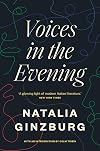
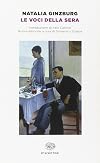
Voices in the Evening
by Natalia Ginzburg
On This Page
Description
"In a quiet Italian town after World War Two, Elsa lives with her parents in the house where she was born. Twenty-seven and unmarried, she is a constant concern to her obsessive, hypochondriac mother. But her mother does not know that Elsa has fallen in love with Tommasino, the elusive youngest son of the De Francisci family, who own the textile factory that dominates the town. Over the course of their secret meetings, Elsa begins to imagine a future with Tommasino, free from the constraints show more of expectations and burdensome history. But this is all threatened by exposure. An elegant and beautifully re-strained novel that scratches at the fragility of postwar consciousness, Voices in the Evening is an unforgettable story about first love and lost chances"-- show lessTags
Recommendations

















Member Reviews
Elsa's mother is worried that at 29 Elsa isn't married, but she doesn't stop talking long enough to listen to anything Elsa says. The mother is comically self-absorbed, a gossip and a hypochondriac, and leavens this sad novella with humour. The young people are haunted by WWII and decades of Fascism and seem trapped in their little village, surrounded by the people they've known since childhood. Village life revolves around the wealthy DiFrancisci family, which owns the textile mill.
Nearly everyone, including most of the members of the DiFrancisci family, is a Socialist. They disdain the Fascist thugs but are at risk, and people are killed. But Ginzburg doesn't dwell. Her tone is factual, detached and unemotional, but the unembellished show more details accumulate to show the devastating impact of Fascism and WWII on the lives of a generation of Italians. show less
Nearly everyone, including most of the members of the DiFrancisci family, is a Socialist. They disdain the Fascist thugs but are at risk, and people are killed. But Ginzburg doesn't dwell. Her tone is factual, detached and unemotional, but the unembellished show more details accumulate to show the devastating impact of Fascism and WWII on the lives of a generation of Italians. show less
🇮🇹 Italian village recovering from fascism
👨👩👧👦 Family dynamics
😢 Mother is Mrs. Bennet w/ less scheming
✍🏼 Ginzburg's straightforward style
😭 "Why has everything been ruined?"
It is no secret that I love Natalia Ginzburg. One of my favorite authors that I have #WITMonth to thank for, and who I have tried to read 1-2 books a year from ever since.
Like Tove Jansson, she has a deceptively simple style. He sentences are straightforward and unadorned. Yet while Jansson's writing manages to feel warm even when she is writing about icebergs, Ginzburg's feels more stark, as if she is presenting just the facts of these little families, even as you suspect that as well as she understands them, she must love them, show more too.
Ostensibly about one woman, living with her parents and aunt in a small village in Italy after WWII, in attempting to explain her relationships with her neighbors, the book zooms out and tells the story of the whole village, but especially Balotta's family, who own the factory. There is very little about the war itself, mostly describing how people were before the war, briefly mentioning what they did during the war, and then picking up again after. But even as the book treats the war as a terrible pause on normal life, it is clear that it haunts everything that happens after. A refrain repeated by multiple characters with slightly different wording is "Why has everything been ruined?"
No one in this book means to do harm, even as they of course hurt each other day after day. Even Purillo, a member of the Fascist party, when he hears the party is coming for Balotta, who has raised him, smuggles Balotta and his wife out of the village and has to spend the war in hiding. When two characters are talking about happiness, one says, "It is the same with the evil we do; it seems nothing, just seems foolishness, cold water, while we are doing it. Otherwise people would not do it; they would be more careful."
I wondered if a book about fascist Italy was the best choice for this week of suspense before the election, but I think it was just right. show less
👨👩👧👦 Family dynamics
😢 Mother is Mrs. Bennet w/ less scheming
✍🏼 Ginzburg's straightforward style
😭 "Why has everything been ruined?"
It is no secret that I love Natalia Ginzburg. One of my favorite authors that I have #WITMonth to thank for, and who I have tried to read 1-2 books a year from ever since.
Like Tove Jansson, she has a deceptively simple style. He sentences are straightforward and unadorned. Yet while Jansson's writing manages to feel warm even when she is writing about icebergs, Ginzburg's feels more stark, as if she is presenting just the facts of these little families, even as you suspect that as well as she understands them, she must love them, show more too.
Ostensibly about one woman, living with her parents and aunt in a small village in Italy after WWII, in attempting to explain her relationships with her neighbors, the book zooms out and tells the story of the whole village, but especially Balotta's family, who own the factory. There is very little about the war itself, mostly describing how people were before the war, briefly mentioning what they did during the war, and then picking up again after. But even as the book treats the war as a terrible pause on normal life, it is clear that it haunts everything that happens after. A refrain repeated by multiple characters with slightly different wording is "Why has everything been ruined?"
No one in this book means to do harm, even as they of course hurt each other day after day. Even Purillo, a member of the Fascist party, when he hears the party is coming for Balotta, who has raised him, smuggles Balotta and his wife out of the village and has to spend the war in hiding. When two characters are talking about happiness, one says, "It is the same with the evil we do; it seems nothing, just seems foolishness, cold water, while we are doing it. Otherwise people would not do it; they would be more careful."
I wondered if a book about fascist Italy was the best choice for this week of suspense before the election, but I think it was just right. show less
In small town post-World-War-2 Italy, Elsa tells about various people in the town--focused largely on Balotta's family, the local factory owners. The book discusses the family and children, their friends, pastimes, and important employees. The real story, though never discusses as such, is what was lost and changed because of the war. Politics (black shirts, socialists, communists, partisans) disrupted families and friendships. Men left to fight and largely came back--one was killed right in town. Marriages didn't happen or unlikely marriages did happen. The war might have ended, but the effects of the war are still there.
Ratings
Members
- Recently Added By
Lists

Italian Literature
558 works; 42 members

Canon de la narrativa universal del siglo XX
254 works; 6 members

Anticipated 2021 Reads
231 works; 7 members
Author Information

71+ Works 5,898 Members
Some Editions
Awards and Honors
Series
Belongs to Publisher Series
Work Relationships
Is contained in
Common Knowledge
- Canonical title
- Voices in the Evening
- Original title
- Le voci della sera
- Original publication date
- 1961
- Important places
- Italy
- Dedication*
- A Gabriele
- Original language*
- Italiano
*Some information comes from Common Knowledge in other languages. Click "Edit" for more information.
Classifications
- Genres
- Fiction and Literature, General Fiction
- DDC/MDS
- 853.914 — Literature & rhetoric Italian, Romanian & related literatures Italian fiction 1900- 20th Century 1945-1999
- LCC
- PQ4817 .I5 .V613 — Language and Literature French, Italian, Spanish and Portuguese literatures Italian literature Individual authors, 1900-1960
- BISAC
Statistics
- Members
- 331
- Popularity
- 96,950
- Reviews
- 3
- Rating
- (3.70)
- Languages
- 10 — Catalan, Dutch, English, French, German, Hebrew, Italian, Spanish, Swedish, Turkish
- Media
- Paper, Audiobook, Ebook
- ISBNs
- 35
- ASINs
- 10