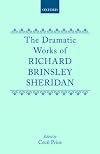
The Plays of Richard Brinsley Sheridan
by Richard Brinsley Sheridan
On This Page
Description
Contents:The Rivals: A ComedySt. Patrick's Day; or, The Schmeing Lieutenant, A FarceThe Duenna: A Comic OperaThe School for Scandal: A ComedyThe Critic; or, A Tragedy RehearsedA Trip to Scarboroguh: A ComedyPizarro: A TragedyVerses to the Memory or GarrickTags
Recommendations
























Member Reviews
Prof. Cecil Price, head of English at Swansea University, edited Sheridan's letters and his complete dramatic works for Oxford before producing this scholarly paperback edition of the plays for advanced students. It features impeccable scholarship, minimal notes, a useful 20-page introduction and a helpful one-page chronology of Sheridan's life. Included with Sheridan's lesser known works are his three best and most popular plays: The Rivals (1775), The School for Scandal (1777), and The Critic (1979). These comedies of manners deserve their place between Moliere and Wilde and alongside Goldsmith's She Stoops to Conquer as among the best of the genre.
Sheridan's first dramatic accomplishment, The Rivals was "not well received" when first show more enacted. But after a quick revision in which the author shortened it and toned it down, it has been a notable success for centuries, not only for its familiar plot of a high-born lover (Capt. Jack Absolute) pretending baseness to woo his beloved (the sentimental Lydia Languish), but for the marvelously misspeaking Mrs. Malaprop, the most delightful misuser of language since Shakespeare's Dogberry. Despite other Shakespearean echoes from Lear, Macbeth, Falstaff, and Hamlet, in the end the titular rivals avoid tragic bloodshed from dueling just as in Much Ado and Twelfth Night to allow the appropriate heteronormative romantic couplings to flourish. Making the play more difficult for a modern audience are its story's class-ist, sexist and racist foundations. show less
Sheridan's first dramatic accomplishment, The Rivals was "not well received" when first show more enacted. But after a quick revision in which the author shortened it and toned it down, it has been a notable success for centuries, not only for its familiar plot of a high-born lover (Capt. Jack Absolute) pretending baseness to woo his beloved (the sentimental Lydia Languish), but for the marvelously misspeaking Mrs. Malaprop, the most delightful misuser of language since Shakespeare's Dogberry. Despite other Shakespearean echoes from Lear, Macbeth, Falstaff, and Hamlet, in the end the titular rivals avoid tragic bloodshed from dueling just as in Much Ado and Twelfth Night to allow the appropriate heteronormative romantic couplings to flourish. Making the play more difficult for a modern audience are its story's class-ist, sexist and racist foundations. show less
The origin of Mrs. Malaprop.
Ratings
Members
- Recently Added By
Lists

Philip Ward's Lifetime Reading Plan
592 works; 22 members
Author Information

64+ Works 3,201 Members
The son of Thomas Sheridan, the Irish actor and theater manager, Richard Brinsley Sheridan began writing plays as a youngster in Bath. He went on to become one of the most successful playwrights of the later eighteenth century, manager of the Drury Lane Theater, and also a politician and orator of some note in the House of Commons. Along with his show more friends David Garrick (seeVol. 3) and Oliver Goldsmith, Sheridan was a member of the Literary Club of Samuel Johnson, having been proposed for membership by Johnson himself. Like Goldsmith, Sheridan also attacks "The Sentimental Muse" of weeping comedy. In his best-known play, The School for Scandal (1777), Sheridan revives the Restoration comedy of manners with its portrait of the beau monde and its deflation of hypocrisy. The play is indebted to William Congreve as well as to Moliere (see Vol. 2), and the picture of society is based on Bath and London. In The Rivals (1775), Sheridan amuses himself with the language games of Mrs. Malaprop and her "nice derangement of epitaphs." The allusions are consistently literary, as in her simile "as headstrong as an allegory on the banks of the Nile." Sheridan's acute ear for banalities and truisms is best seen in The Critic (1779), a burlesque of sentimental and inflated plays as well as self-important criticism. The play ridicules "false Taste and brilliant Follies of modern dramatic Composition." Sheridan's sparking dialogue, lively scenes, and masterful dramatic construction have proved to be enduringly popular. (Bowker Author Biography) show less
Some Editions
Awards and Honors
Notable Lists
Series
Belongs to Publisher Series
Everyman's Library (95)
Work Relationships
Contains
Common Knowledge
- Disambiguation notice
- This Blackie & Son Red Letter Library edition contains ONLY The Rivals, The School for Scandal and The Critic. Do not combine with other editions containing the full works of Sheridan.
Classifications
Statistics
- Members
- 266
- Popularity
- 121,904
- Reviews
- 2
- Rating
- (4.03)
- Languages
- English, French, Russian
- Media
- Paper, Ebook
- ISBNs
- 11
- ASINs
- 44