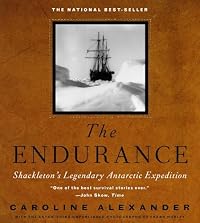
The Endurance: Shackleton's Legendary Antarctic Expedition
by Caroline Alexander, Frank Hurley (Photographer)
On This Page
Description
Provides an account of the Shackleton expedition of 1914, during which explorer Ernest Shackleton and his crew of twenty-seven set out to cross the Antarctic continent on foot, only to have their ship, Endurance, break up eighty-five miles short of their destination, leaving them stranded for close to two years. Includes a photographic record of the adventure.Tags
Recommendations




















Member Recommendations


Member Reviews
I read Caroline Alexander’s The Endurance, an account of the legendary 1914-1916 expedition accomplished by Ernest Shackleton and his men, while sampling a gift I’d received: “Shackleton Blended Malt Scotch Whisky…The Spirit Supplied to the 1907 British Antarctic Expedition.”
The 1907 expedition isn’t the one described in Alexander’s book, of course. Also, better whiskeys than Shackleton exist. Sipping it, though, can create a sensation that the man’s spirit has been infused into your own. Such accompaniment enhances time spent with him and his men at sea and on ice and seems to fortify the diary entries Alexander quotes extensively. The most diligent diarists inevitably get more attention than other crew members, not show more necessarily for the best. No matter. More than any other, the paramount contributor to this book is expedition photographer Frank Hurley. His pictures are many and breathtaking and do much to show the physical character of an enterprise in which men survived an experience that lies well near unfathomable. show less
The 1907 expedition isn’t the one described in Alexander’s book, of course. Also, better whiskeys than Shackleton exist. Sipping it, though, can create a sensation that the man’s spirit has been infused into your own. Such accompaniment enhances time spent with him and his men at sea and on ice and seems to fortify the diary entries Alexander quotes extensively. The most diligent diarists inevitably get more attention than other crew members, not show more necessarily for the best. No matter. More than any other, the paramount contributor to this book is expedition photographer Frank Hurley. His pictures are many and breathtaking and do much to show the physical character of an enterprise in which men survived an experience that lies well near unfathomable. show less
COMPELLING TALE OF HEROISM AND PRIVATION
The great majority of us would never agree to join an expedition such as the one described in Caroline Alexander’s account of the Shakelton-led party to cross Antarctica by land. Yet we are mesmerized by the feats of human endurance and courage we encounter in books such as this one. Not since reading John Krakauer’s “Into Thin Air” have I been brought to witness deeds and events such as these. If it wasn’t for Ms. Alexander’s obviously exhaustive research and Frank Hurley’s amazing photographs, a reader would be inclined to think that this was fiction.
Ms. Alexander, presents the story in such a way as to involve us in the lives of the men of this expedition by including details show more from original documents that serve to make each of them truly human and interesting. She blends these personalities into the fabric of the account, as they encounter one horrendous obstacle to survival after another. This is a story that you will think about for a long time after you’ve finished reading the book.
Recommended: Yes show less
The great majority of us would never agree to join an expedition such as the one described in Caroline Alexander’s account of the Shakelton-led party to cross Antarctica by land. Yet we are mesmerized by the feats of human endurance and courage we encounter in books such as this one. Not since reading John Krakauer’s “Into Thin Air” have I been brought to witness deeds and events such as these. If it wasn’t for Ms. Alexander’s obviously exhaustive research and Frank Hurley’s amazing photographs, a reader would be inclined to think that this was fiction.
Ms. Alexander, presents the story in such a way as to involve us in the lives of the men of this expedition by including details show more from original documents that serve to make each of them truly human and interesting. She blends these personalities into the fabric of the account, as they encounter one horrendous obstacle to survival after another. This is a story that you will think about for a long time after you’ve finished reading the book.
Recommended: Yes show less
I recommend this book for anyone in the midst of a very trying time in their life. It delivers perspective at its finest. The fact that every member of the crew survived this nightmare is unarguably a testament to Shackleton's commitment to leadership, life and his ability to inspire faith. These were not all men who were amiable social butterflies by nature, not by any stretch. No one is uplifted in the destruction of innocent animals or watching their ship, their shelter, their ticket home and all its contents, crushed and devoured by ice. Yet, he so gracefully convinced them to remain positive in the face of their cold stark circumstances and focused on their common goal - getting home. Whatever you are facing, this story will give show more you strength, albeit through tears and a bit of laughter. show less
This is what good nonfiction is all about. Author Alexander shows rather than tells the incredible story of Edward Shackelton's voyage on the Endurance. After being entrapped in ice, the crew live on the ship, the ship breaks up and sinks so the men move to ice floes, then set out in small boats, land at Elephant Island, in time, a smaller crew (incl. Shackleton) then sail to So. Georgia Island, march across the Island to the whaling villages on its opposite shore... after several attempts, a rescue ship is able to land at Elephant Island and the remaining crew are rescued. Through blizzards, rains, starvation, deprivations, and more: not a single life was lost The book is enhanced with superb pictures. A true tale of perseverance, show more tenacity, and courage. show less
Shackleton set out on an Antarctic exploration mission just at the time of the outbreak of WWI. In fact he telegraphed the Admiralty shortly after departure to ask whether he should proceed, or return with his crew for the war effort. To his great relief the reply was that he should continue. But the planned trek to the South Pole was not to be. Instead, Shackleton's ship, The Endurance, was frozen into the ice before he could get to the point where the seamen would have left him and the other explorers and returned on their own to the last staging point. From that time through months of drifting with the icepack, and then living on ice floes after the ship was crushed by the ice, and then finally making a run it for it in three open show more boats, the crew of The Endurance survived 497 days before they touched land. And what a land: Elephant Island (named after elephant seals): uninhabited desolate in the extreme, and so far off the shipping lines that no one would ever look for survivors in such a place, assuming of course that they even would be looking for Shackleton and his crew after over a year's absence. Shackleton and a small crew of six, in a re-fitted, very small boat, set out from Elephant Island for the nearest point of help: a Norwegian whaling station that took them 16 days to reach in a feat of seafaring and navigation that is still widely recognized as nothing short of incredible. Even when they eventually arrived at South Georgia Island, they were not at the whaling station itself, and Shackleton and two others had to walk for 36 hours through snow, ice, and storms, through steep passes, to reach the station. The rescue of the men left on Elephant Island proved much more difficult than could have been thought. Shackleton tried two or three times but was turned back each time by the ice, and he had incredible difficulty in finding the loan of ships to undertake the operation. In the end he succeeded, and returned with what he regarded as his greatest triumph: that through all of the incredible hardships, he did not lose a single man.
This seems to be largely attributable to Shackleton's leadership style. He was always optimistic, did not allow negative or pessimistic conjectures; he was very solicitous of the well-being of the men, and he seems to have not been infected by the class snobbishness so characteristic of his time; he had an excellent eye for those who might cause trouble, and he acted quickly and decisively when necessary to deal with problems and to isolate difficult personalities.
The story is woven together through the diaries of various members of the expedition, and in this edition it is beautifully illustrated with photographs taken by Hurley, the expedition's official photographer. The clarity, the composition, and the sheer beauty of many of these photographs is astonishing and they add wonderfully to the description of the ordeal. They are all the more impressive when one considers the conditions under which they were taken, the state of photographic technology in 1914, and the harsh conditions under which the negatives had to be stored and treated.
Shackleton pulled together an incredibly disparate group of men, most of whom dispersed around the globe when it was all over, and who, with few exceptions, had little or no interest in staying in touch afterwards. The experience was unique; the incredible physical closeness and the fact that the men depended so much on each other for their survival was special to that time and place and did not translate, for most, into any lasting friendships or even acquaintances.
In the aftermath of WWI, Shackleton could not really take advantage of his story; after the carnage of the Ypres and the Somme, there was not much appetite for adventure stories, and the Brits already had the doomed hero of Scott to hang on to. Shackleton survived by touring and giving some lectures, and a stint as an arctic advisor, or some such thing, in a British Mission in Russia post-war, but he never really settled down or found his niche. Even the royalties of a book he wrote on the adventure had to go to creditors of the expedition who hounded him for payment. He ended up recruiting a few of the Endurance crew for a trip to the southern points, in particular South Georgia, where he was known and recognized for what he had achieved. He died there of a heart attack, in 1922 at 47 years of age; his wife instructed that he should be buried there rather than be returned to Britain. A poignant end for a man who was never successful in the "civilian" world, but who had a reputation as an arctic explorer, and who showed greatness in one great trail of life. show less
This seems to be largely attributable to Shackleton's leadership style. He was always optimistic, did not allow negative or pessimistic conjectures; he was very solicitous of the well-being of the men, and he seems to have not been infected by the class snobbishness so characteristic of his time; he had an excellent eye for those who might cause trouble, and he acted quickly and decisively when necessary to deal with problems and to isolate difficult personalities.
The story is woven together through the diaries of various members of the expedition, and in this edition it is beautifully illustrated with photographs taken by Hurley, the expedition's official photographer. The clarity, the composition, and the sheer beauty of many of these photographs is astonishing and they add wonderfully to the description of the ordeal. They are all the more impressive when one considers the conditions under which they were taken, the state of photographic technology in 1914, and the harsh conditions under which the negatives had to be stored and treated.
Shackleton pulled together an incredibly disparate group of men, most of whom dispersed around the globe when it was all over, and who, with few exceptions, had little or no interest in staying in touch afterwards. The experience was unique; the incredible physical closeness and the fact that the men depended so much on each other for their survival was special to that time and place and did not translate, for most, into any lasting friendships or even acquaintances.
In the aftermath of WWI, Shackleton could not really take advantage of his story; after the carnage of the Ypres and the Somme, there was not much appetite for adventure stories, and the Brits already had the doomed hero of Scott to hang on to. Shackleton survived by touring and giving some lectures, and a stint as an arctic advisor, or some such thing, in a British Mission in Russia post-war, but he never really settled down or found his niche. Even the royalties of a book he wrote on the adventure had to go to creditors of the expedition who hounded him for payment. He ended up recruiting a few of the Endurance crew for a trip to the southern points, in particular South Georgia, where he was known and recognized for what he had achieved. He died there of a heart attack, in 1922 at 47 years of age; his wife instructed that he should be buried there rather than be returned to Britain. A poignant end for a man who was never successful in the "civilian" world, but who had a reputation as an arctic explorer, and who showed greatness in one great trail of life. show less
I read this book over the course of about 3 days. It was fascinating reading, and I read quickly so as to actually finish it. I considered how their travails compared to those endured by those who are successful in any endeavor. They were not successful in their goal of traversing Antarctica, but were successful in coming back without loss of life. I suppose that is because of the perseverance of their leadership.
The contrast in tenacity between their leader, and some who gave up is a striking lesson in how to fail. After giving up, chances of success diminish dramatically. But Shackleton did not give up. That he brought back all of the men alive is rare and extremely impressive.
The contrast in tenacity between their leader, and some who gave up is a striking lesson in how to fail. After giving up, chances of success diminish dramatically. But Shackleton did not give up. That he brought back all of the men alive is rare and extremely impressive.
The heroics of the expedition chronicled in [The Endurance] extended from the expedition leader, Sir Ernest Shackleton, to its lowest-ranking team member (who surely would be Perce Blackborow, a stowaway). Twenty-eight men sailed aboard a wooden-hulled, three-masted steamship, named the Endurance, from the southernmost outpost of civilization--a whaling station on South Georgia Island--toward Antarctica. The intention was to land members of an expeditionary team that would traverse the continent and be picked up by a second ship.
Ah, but the Endurance never made landfall. Two days after leaving port, 7 Dec 1914, near the southern hemisphere's summer solstice, the ship encountered the Antarctic ice pack. Of course, once the Endurance show more sailed it lost all contact with civilization: no radio communication, no homing pigeons, no semaphore, no smoke signals. No one would be looking for the Endurance, either. The expedition was on its own.
For a month, the ship struggled through the ice, working its way south, closer to its intended landfall. But on 18 Jan 1915 the ice seized the Endurance, never to let her go. For ten months, the Endurance drifted with the ice pack. On 27 Oct 1915, pressure of the ice crushed the ship's hull, forcing all aboard onto the ice. The team did have almost a month to unload and salvage whatever they could; 21 Nov 1915, the ship sank. The next four months were spent on the ice, still drifting. And drifting to an extent that the team, on Shackleton's order, destroyed all the sledge dogs, fit everything they could into the three lifeboats salvaged from the Endurance and sailed to tiny Elephant Island. For the first time in more than a year, the men set their feet on solid ground. But they were far from safe. It would be another four months until they were rescued and returned to civilization.
The remarkable thing was that all 28 men survived. Stuck in perpetual winter from January 1915 through August 1916, sheltering in tents in the open during blizzards with high winds and negative double-digit temps. Everything wet—sleeping bags, clothing, boots. Shackleton selected his team members astutely and kept all hands occupied every day. He earned the respect and admiration of every man. And just as important, the men trusted and respected each other, followed orders, worked to the best of their abilities. Yes, personalities clashed; some guys were difficult, irritable and Shackleton managed to single these fellows out and minimize their contact with their principal antagonists (a tough job in such a confined environment). Together, they survived.
A feature of the book I read was the collection of photos taken during the expedition by Frank Hurley, an Australian hired primarily to capture the voyage on film. A view camera taking glass plates was Hurley's primary camera, but he also used a Kodak box camera and a motion picture camera. While on the ship, he developed his photos and soldered them into tin containers to preserve them.
The book includes more than 150 photos of the expedition taken by Frank Hurley. I've posted a few of them, with the book's captions, here: https://www.librarything.com/topic/250357#5992309 show less
Ah, but the Endurance never made landfall. Two days after leaving port, 7 Dec 1914, near the southern hemisphere's summer solstice, the ship encountered the Antarctic ice pack. Of course, once the Endurance show more sailed it lost all contact with civilization: no radio communication, no homing pigeons, no semaphore, no smoke signals. No one would be looking for the Endurance, either. The expedition was on its own.
For a month, the ship struggled through the ice, working its way south, closer to its intended landfall. But on 18 Jan 1915 the ice seized the Endurance, never to let her go. For ten months, the Endurance drifted with the ice pack. On 27 Oct 1915, pressure of the ice crushed the ship's hull, forcing all aboard onto the ice. The team did have almost a month to unload and salvage whatever they could; 21 Nov 1915, the ship sank. The next four months were spent on the ice, still drifting. And drifting to an extent that the team, on Shackleton's order, destroyed all the sledge dogs, fit everything they could into the three lifeboats salvaged from the Endurance and sailed to tiny Elephant Island. For the first time in more than a year, the men set their feet on solid ground. But they were far from safe. It would be another four months until they were rescued and returned to civilization.
The remarkable thing was that all 28 men survived. Stuck in perpetual winter from January 1915 through August 1916, sheltering in tents in the open during blizzards with high winds and negative double-digit temps. Everything wet—sleeping bags, clothing, boots. Shackleton selected his team members astutely and kept all hands occupied every day. He earned the respect and admiration of every man. And just as important, the men trusted and respected each other, followed orders, worked to the best of their abilities. Yes, personalities clashed; some guys were difficult, irritable and Shackleton managed to single these fellows out and minimize their contact with their principal antagonists (a tough job in such a confined environment). Together, they survived.
A feature of the book I read was the collection of photos taken during the expedition by Frank Hurley, an Australian hired primarily to capture the voyage on film. A view camera taking glass plates was Hurley's primary camera, but he also used a Kodak box camera and a motion picture camera. While on the ship, he developed his photos and soldered them into tin containers to preserve them.
The book includes more than 150 photos of the expedition taken by Frank Hurley. I've posted a few of them, with the book's captions, here: https://www.librarything.com/topic/250357#5992309 show less
Members
- Recently Added By
Lists

Recommend the 20 best books you've read in the last five years
2,167 works; 599 members

Polar exploration
54 works; 4 members

Adult Books for YA Readers
194 works; 6 members

Sea, Mariners, or Otherwise Wet
10 works; 1 member

Club Read's Recommended Nonfiction Written by Women
618 works; 30 members
Author Information

12+ Works 5,129 Members

Awards and Honors
Awards
Distinctions
Work Relationships
Common Knowledge
- Canonical title
- The Endurance: Shackleton's Legendary Antarctic Expedition
- Original title
- The Endurance: Shackleton's Legendary Antarctic Expedition
- Original publication date
- 1998-11-08
- People/Characters
- Ernest Shackleton; Frank Hurley; Mrs Chippy (cat)
- Important places
- Antarctica; Atlantic Ocean; Elephant Island; South Atlantic Ocean; South Georgia Island
- Important events
- Endurance Expedition (1914-1917)
- Related movies
- The Endurance: Shackleton's Legendary Antarctic Expedition (2000 | IMDb)
- Epigraph
- Never for me the lowered banner, never the last endeavour. - Sir Ernest Shackleton
- Dedication
- To Mrs. Chippy who pioneered the way
- First words
- The captain of the ship, Frank Worsley, would remember the day vividly ever afterward.
- Quotations*
- La exploración del Antártico, a comienzos del siglo XX, no se parecía a ninguna otra exploración en cualquier otro punto de la Tierra. No había feroces animales ni indígenas salvajes que cerraran el paso al explorador. ... (show all)El obstáculo esencial era puro y simple: vientos de hasta trescientos kilómetros por hora y temperaturas de hasta cincuenta grados centígrados bajo cero. La lucha se establecía entre el hombre y las fuerzas desatadas de la naturaleza, entre el hombre y los límites de la resistencia.
- Last words
- (Click to show. Warning: May contain spoilers.)In it, he captured both sides of this impossible story, the razor's edge of its endeavor - success and failure in the balance, the momentous departure and the patient bravery of those left behind to wait, their hands raised boldly in a determined, resigned, and courageous farewell.
- Canonical DDC/MDS
- 919.8904092
*Some information comes from Common Knowledge in other languages. Click "Edit" for more information.
Classifications
- Genres
- Nonfiction, Travel, General Nonfiction, History, Biography & Memoir
- DDC/MDS
- 919.8904092 — History & geography Geography & travel Geography of and travel in Australasia, Pacific Ocean islands, Atlantic Ocean islands, Arctic islands, Antarctica and on extraterrestrial worlds Polar regions Antarctica
- LCC
- G850 — Geography, Anthropology and Recreation Geography (General) Arctic and Antarctic regions
- BISAC
Statistics
- Members
- 2,006
- Popularity
- 10,361
- Reviews
- 43
- Rating
- (4.24)
- Languages
- 13 — Catalan, Danish, Dutch, English, Finnish, French, German, Greek, Italian, Norwegian (Bokmål), Portuguese, Spanish, Swedish
- Media
- Paper, Audiobook, Ebook
- ISBNs
- 43
- UPCs
- 1
- ASINs
- 8