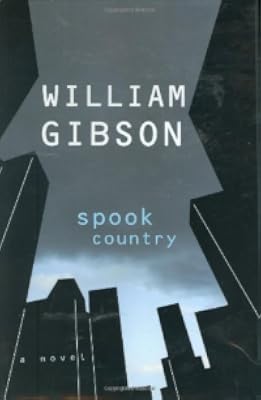
On This Page
Description
Multilingual Tito engages in sensitive information transfers from his single-room apartment, while journalist Hollis frets over her start-up magazine's censure of its own promotions, and prescription drug addict Milgrim wonders about the military connections of an enigmatic benefactor.Tags
Recommendations





Member Recommendations

themulhern They both have one human being who manipulates human beings in the aggregate, more or less denying their humanity.
Member Reviews
This is the book with which Gibson has finally, definitively fallen behind the curve. Some of his previous books have been bad -- Idoru, anyone? -- and in general, he's been writing the same book over and over, with the same stock characters. But this is the first one in which he no longer seems to understand the zeitgeist.
His stock characters are all social marginals. The Finder of Art -- not an artist, but someone with a mystical ability to track it down. The Rogue Corporate Boss. The Streetwise Muscle. The Tapped-In Insider Exiled. All of them make an appearance in this book, more or less. But the book isn't about social marginality. It's about the evil done by the Bush administration to America. And Gibson has no way of confronting show more that -- comically, futilely, he has a junkie ventriloquize a lecture, but patently can't go anywhere from there.
No one in the book is really a government employee, working on government time. So Gibson can't confront the fact that the post-9/11 social problems that he depicts have a cause, because he doesn't do governments, he doesn't do personalities. But he can't even really depict what's gone wrong as a structure. Even when he was writing about corporations, he never could bring himself to write an actual one -- they were always rogue individuals, caricatures with more or less unknowable motives, but really nothing like how an actual, impersonal corporate structure operates.
That was fine, back in the days when everyone was dislocated and everyone imagined a face that they could hate. He caught something of that time. But now that there is an actual face -- now that the agenda involves people becoming all too located -- he's lost track. show less
His stock characters are all social marginals. The Finder of Art -- not an artist, but someone with a mystical ability to track it down. The Rogue Corporate Boss. The Streetwise Muscle. The Tapped-In Insider Exiled. All of them make an appearance in this book, more or less. But the book isn't about social marginality. It's about the evil done by the Bush administration to America. And Gibson has no way of confronting show more that -- comically, futilely, he has a junkie ventriloquize a lecture, but patently can't go anywhere from there.
No one in the book is really a government employee, working on government time. So Gibson can't confront the fact that the post-9/11 social problems that he depicts have a cause, because he doesn't do governments, he doesn't do personalities. But he can't even really depict what's gone wrong as a structure. Even when he was writing about corporations, he never could bring himself to write an actual one -- they were always rogue individuals, caricatures with more or less unknowable motives, but really nothing like how an actual, impersonal corporate structure operates.
That was fine, back in the days when everyone was dislocated and everyone imagined a face that they could hate. He caught something of that time. But now that there is an actual face -- now that the agenda involves people becoming all too located -- he's lost track. show less
William Gibson has stopped writing science fiction.
That's not to say that his style or content has changed. Rather, it shows that our world has now caught up to his vision. I thought that when I read his previous book. 'Pattern recognition'; now, with 'Spook country', it becomes all the plainer. There is a feature in the novel that we don't have in our world (as far as I know); I'm not aware of locative art, virtual sculptures located in the real world that you need to be online at their presumed location to see, but with smartphones and iPads, that can only be just around the corner.
My early impression of this book was "So far, so Gibson", and others have commented that he writes the same book over and over. I soon began to move away show more from this view. 'Spook country' is set in a very specific political territory: the human landscape of those who the end of the Cold War left beached, without a direction or a purpose. One of his characters is a teenager of a Chinese-Cuban expatriate family, whose "family firm" turns out to have been the KGB, but who have been deserted in the political upheavals of the end of the 20th century when allegiances and political viewpoints changed almost overnight.
Given that the plot quickly begins to involve people for whom sudden death is part of their daily grind, this novel quickly acquired, for me, a clearer focus than previous Gibson offerings. Perhaps this is why others have compared it more to 'Neuromancer' than some of his later intervening works. Certainly, I found it becoming a page-turner as I got closer to the end; I was getting quite excited by the outcome!
The characters, though typically Gibson, are also an interesting bunch. Milgrim, for example; addicted to anti-anxiety drugs, he is held hostage by the one-time (or wannabe?) US agent Brown for his translation skills; does his name, though, possibly reference the originator of the Milgram experiment, the one that showed that ordinary people can turn into sadistic monsters if ordered to do a nasty thing by a sufficiently powerful authority figure? And once more we meet Hubertus Bigend, a character whose name is probably the only deliberate joke that Gibson has ever given us, and a character looking increasingly shady - there now appears to be more to Bigend's agency, Blue Ant, than we previously thought, with its penchant for concealed offices with power-operated drive-in garages, beloved of 1960s spy thrillers, its global reach, and Bigend's sudden interest in potentially dangerous people and acts. Given that in my mind's eye, Bigend has always been played by John Malkovich, perhaps I'm making him more sinister than I ought - or am I?
So: a book which turned out to be more interesting than I expected; or is it just that Gibson is turning into the sort of cultural phenomenon that his characters obsess over? show less
That's not to say that his style or content has changed. Rather, it shows that our world has now caught up to his vision. I thought that when I read his previous book. 'Pattern recognition'; now, with 'Spook country', it becomes all the plainer. There is a feature in the novel that we don't have in our world (as far as I know); I'm not aware of locative art, virtual sculptures located in the real world that you need to be online at their presumed location to see, but with smartphones and iPads, that can only be just around the corner.
My early impression of this book was "So far, so Gibson", and others have commented that he writes the same book over and over. I soon began to move away show more from this view. 'Spook country' is set in a very specific political territory: the human landscape of those who the end of the Cold War left beached, without a direction or a purpose. One of his characters is a teenager of a Chinese-Cuban expatriate family, whose "family firm" turns out to have been the KGB, but who have been deserted in the political upheavals of the end of the 20th century when allegiances and political viewpoints changed almost overnight.
Given that the plot quickly begins to involve people for whom sudden death is part of their daily grind, this novel quickly acquired, for me, a clearer focus than previous Gibson offerings. Perhaps this is why others have compared it more to 'Neuromancer' than some of his later intervening works. Certainly, I found it becoming a page-turner as I got closer to the end; I was getting quite excited by the outcome!
The characters, though typically Gibson, are also an interesting bunch. Milgrim, for example; addicted to anti-anxiety drugs, he is held hostage by the one-time (or wannabe?) US agent Brown for his translation skills; does his name, though, possibly reference the originator of the Milgram experiment, the one that showed that ordinary people can turn into sadistic monsters if ordered to do a nasty thing by a sufficiently powerful authority figure? And once more we meet Hubertus Bigend, a character whose name is probably the only deliberate joke that Gibson has ever given us, and a character looking increasingly shady - there now appears to be more to Bigend's agency, Blue Ant, than we previously thought, with its penchant for concealed offices with power-operated drive-in garages, beloved of 1960s spy thrillers, its global reach, and Bigend's sudden interest in potentially dangerous people and acts. Given that in my mind's eye, Bigend has always been played by John Malkovich, perhaps I'm making him more sinister than I ought - or am I?
So: a book which turned out to be more interesting than I expected; or is it just that Gibson is turning into the sort of cultural phenomenon that his characters obsess over? show less
No matter when or where it is set, all the best science fiction is really about the present day. William Gibson takes this idea to its logical conclusion and writes about the present day as if it were science fiction.
Gibson seems mostly concerned with how our (real) technologies are transforming us. His main character, Hollis Henry (love the strong female characters that are always present in Gibson's work), the lead singer of a defunct band from the '90s, who is now trying to make it as a journalist. The start-up magazine for which she works has given her an assignment that's really little more than a cover. They hope that as she investigates locative technology in art, she'll also uncover the where-abouts of a mysterious cargo show more container. Without her knowledge, of course. There are two other characters we follow in the course of the narrative, neither of whom know the whole story either.
By keeping the characters and the readers in the dark about the narrative thread, Gibson creates a paranoid feeling that mimics that of the world we find ourselves living in. A world where, as one of the characters says, "America had developed Stockholm syndrome toward its own government, post 9/11."
This is the second novel set in the "real world" by Gibson; a sort of follow up to Pattern Recognition. These two novels share one character between them: Advertising magnate, Hubertus Bigend. While not a huge presence in either book, he is the force that motivates both narratives. Again, Gibson is telling us something about the world we live in.
Gibson's writing here is bare-bones spare, but beautiful. He has the ability to turn a phrase that can stop the reader dead for a moment, but that then compels you to continue. To race to the completely satisfying conclusion. show less
Gibson seems mostly concerned with how our (real) technologies are transforming us. His main character, Hollis Henry (love the strong female characters that are always present in Gibson's work), the lead singer of a defunct band from the '90s, who is now trying to make it as a journalist. The start-up magazine for which she works has given her an assignment that's really little more than a cover. They hope that as she investigates locative technology in art, she'll also uncover the where-abouts of a mysterious cargo show more container. Without her knowledge, of course. There are two other characters we follow in the course of the narrative, neither of whom know the whole story either.
By keeping the characters and the readers in the dark about the narrative thread, Gibson creates a paranoid feeling that mimics that of the world we find ourselves living in. A world where, as one of the characters says, "America had developed Stockholm syndrome toward its own government, post 9/11."
This is the second novel set in the "real world" by Gibson; a sort of follow up to Pattern Recognition. These two novels share one character between them: Advertising magnate, Hubertus Bigend. While not a huge presence in either book, he is the force that motivates both narratives. Again, Gibson is telling us something about the world we live in.
Gibson's writing here is bare-bones spare, but beautiful. He has the ability to turn a phrase that can stop the reader dead for a moment, but that then compels you to continue. To race to the completely satisfying conclusion. show less
Spooky Country by William Gibson is the second book in his Blue Ant series, so you know Hubertus Bigend is a character, but much like in Pattern Recognition he's the invisible hand the alters the narrative, not a obvious actor. This novel focuses instead on Hollis Henry, an aspiring journalist that Bigend hires to find the elusive Bobby Chombo.
As always, I'm blown away by how much Gibson gets right. It's so nice to read a book about someone who can talk about current technology without sounding like a completely idiot. It's similarly pleasing to read a book where the author is also quite good at predicting future technology trends.
I very much enjoyed this book, particularly the changing of POV for each chapter. It stacked up well in show more comparison to Pattern Recognition, having a similarly mysterious plot, and a cast of fascinating characters. I thought the payoff was a little bit less impressive, but that could just be because this plot was similarly structured, even if the way it was written wasn't. Maybe Bigend is just less fun the second time you meet him? show less
As always, I'm blown away by how much Gibson gets right. It's so nice to read a book about someone who can talk about current technology without sounding like a completely idiot. It's similarly pleasing to read a book where the author is also quite good at predicting future technology trends.
I very much enjoyed this book, particularly the changing of POV for each chapter. It stacked up well in show more comparison to Pattern Recognition, having a similarly mysterious plot, and a cast of fascinating characters. I thought the payoff was a little bit less impressive, but that could just be because this plot was similarly structured, even if the way it was written wasn't. Maybe Bigend is just less fun the second time you meet him? show less
Way back before music went digital, John Prine wrote this:
We are living in the future, tell you how I know:
I read it in the paper - Fifteen years ago
When William Gibson starts using the word "cyberspace" as a plot point, you sit up and take notice. And when he starts talking about virtual reality, dont' start shaking your head. Yeah, that stuff with the plastic helmets and the boxy graphics has seemed like a very old and useless party trick since back in the 90s. But what Gibson is aiming for here is not so much a virtual reality novel as a post-VR novel - in the same sense that "post-modern" doesn't mean "non-modern" or "post-9/11" doesn't mean "we've forgotten 9/11". It's about what happens when something has become so embedded in show more reality that it IS reality; it's, funnily enough, a novel about borders. Or perhaps, the absence of them.
"See-bare-espace," Odile pronounced, gnomically, "it is everting."
"'Everything'? What is?"
"See-bare-espace," Odile confimed, "everts." She made a gesture with her hands that reminded Hollis, in some dimly unsettling way, of the crocheted model uterus her Family Life Education teacher had used as an instructional aid.
"Turns itself inside out," offered Alberto, by way of clarification. "'Cyberspace'."
Spook Country takes place in a world where cyberspace has indeed everted, become just another aspect of the world; just as the world has shrunk to the place where geographical borders, however well-guarded, can be easily crossed if you know how (after all, what is an illegal immigrant but a real-life hacker penetrating a system with lots of black ICE?). Any reality which involves GPS locators, WiFi networks everywhere, and entire lives being carried in little memory sticks is to some extent virtual. Reality is tagged like a wiki; street artists in Gibson's now don't use spray cans, they use laptops and 3D renderings that only make sense to those in the know to make their mark on the world. The characters, as well-drawn and as human as they are, to some extent come off as avatars – each with their own title, picture and online persona in a world that's always online.
The phrase "trusted networks" briefly made her feel like crying. She wasn't feeling as though she had any.
Now, this obviously addresses some timely issues - and surprisingly enough, by the last 100 pages as the plot becomes clearer, I'm reminded very strongly of Thomas Pynchon's Against the Day. I'm not in any way suggesting that Gibson ripped Pynchon off, just that they do seem to have tapped into some of the same concerns. The informal secret-by-default societies and underground movements, the fractured narrative, the promise of a brave new world around the corner, the "resistance"... it's all vintage Pynchon themes, but Gibson being Gibson, he takes it to different (and considerably less opinionated) places. I'm also reminded of something Umberto Eco wrote in Turning Back the Clock, which I've unfortunately lent to a friend, but which goes something along the lines of how the "Big Brother is watching you" theme is hopelessly antiquated; it can be much scarier to live in a world with 6 billion big brothers all watching each other with no way of knowing who is working for whom.
"The pop star, as we knew her" – and here he bowed slightly, in her direction – "was actually an artefact of preubiquitous media."
"Of -?"
"Of a state in which 'mass' media existed, if you will, within the world."
"As opposed to?"
"Comprising it."
Spook Country is a very multifaceted novel, touching upon technology, religion, politics, art, war, capitalism... One of those facets is a thriller, and much like with Pattern Recognition, I find myself intrigued more by the setup than with the actual plot resolution. Not so much because some of it's been done before (been watching Goldfinger, William?) but because it feels like there's something disjointed here; as if he hasn't quite thought the plot through all the way, and drops some of the interesting observations on the world in favour of a more plot-driven approach and a somewhat unsatisfactory ending about 2/3 in. It's still very intriguing – hell, I read the last 130 pages or so in one sitting – but some part of me still feels like it's a great exhibition followed by a slightly flawed dismount. His repeating some of the plot devices from Pattern Recognition probably adds to that. That's probably the reason I find myself thinking it could have been better, and I'm only going to give it a strong . But on a whole, it's a fascinating and more than slightly spooky novel. It feels like Gibson has come full circle, catching up to his younger self as the world has caught up to what, back then, sounded like science fiction, only now with much more meat on his bones. We are living in the future,
We're all driving rocket ships and talkin' with our minds
Wearin' turquoise jewelry and standing in soup lines. show less
We are living in the future, tell you how I know:
I read it in the paper - Fifteen years ago
When William Gibson starts using the word "cyberspace" as a plot point, you sit up and take notice. And when he starts talking about virtual reality, dont' start shaking your head. Yeah, that stuff with the plastic helmets and the boxy graphics has seemed like a very old and useless party trick since back in the 90s. But what Gibson is aiming for here is not so much a virtual reality novel as a post-VR novel - in the same sense that "post-modern" doesn't mean "non-modern" or "post-9/11" doesn't mean "we've forgotten 9/11". It's about what happens when something has become so embedded in show more reality that it IS reality; it's, funnily enough, a novel about borders. Or perhaps, the absence of them.
"See-bare-espace," Odile pronounced, gnomically, "it is everting."
"'Everything'? What is?"
"See-bare-espace," Odile confimed, "everts." She made a gesture with her hands that reminded Hollis, in some dimly unsettling way, of the crocheted model uterus her Family Life Education teacher had used as an instructional aid.
"Turns itself inside out," offered Alberto, by way of clarification. "'Cyberspace'."
Spook Country takes place in a world where cyberspace has indeed everted, become just another aspect of the world; just as the world has shrunk to the place where geographical borders, however well-guarded, can be easily crossed if you know how (after all, what is an illegal immigrant but a real-life hacker penetrating a system with lots of black ICE?). Any reality which involves GPS locators, WiFi networks everywhere, and entire lives being carried in little memory sticks is to some extent virtual. Reality is tagged like a wiki; street artists in Gibson's now don't use spray cans, they use laptops and 3D renderings that only make sense to those in the know to make their mark on the world. The characters, as well-drawn and as human as they are, to some extent come off as avatars – each with their own title, picture and online persona in a world that's always online.
The phrase "trusted networks" briefly made her feel like crying. She wasn't feeling as though she had any.
Now, this obviously addresses some timely issues - and surprisingly enough, by the last 100 pages as the plot becomes clearer, I'm reminded very strongly of Thomas Pynchon's Against the Day. I'm not in any way suggesting that Gibson ripped Pynchon off, just that they do seem to have tapped into some of the same concerns. The informal secret-by-default societies and underground movements, the fractured narrative, the promise of a brave new world around the corner, the "resistance"... it's all vintage Pynchon themes, but Gibson being Gibson, he takes it to different (and considerably less opinionated) places. I'm also reminded of something Umberto Eco wrote in Turning Back the Clock, which I've unfortunately lent to a friend, but which goes something along the lines of how the "Big Brother is watching you" theme is hopelessly antiquated; it can be much scarier to live in a world with 6 billion big brothers all watching each other with no way of knowing who is working for whom.
"The pop star, as we knew her" – and here he bowed slightly, in her direction – "was actually an artefact of preubiquitous media."
"Of -?"
"Of a state in which 'mass' media existed, if you will, within the world."
"As opposed to?"
"Comprising it."
Spook Country is a very multifaceted novel, touching upon technology, religion, politics, art, war, capitalism... One of those facets is a thriller, and much like with Pattern Recognition, I find myself intrigued more by the setup than with the actual plot resolution. Not so much because some of it's been done before (been watching Goldfinger, William?) but because it feels like there's something disjointed here; as if he hasn't quite thought the plot through all the way, and drops some of the interesting observations on the world in favour of a more plot-driven approach and a somewhat unsatisfactory ending about 2/3 in. It's still very intriguing – hell, I read the last 130 pages or so in one sitting – but some part of me still feels like it's a great exhibition followed by a slightly flawed dismount. His repeating some of the plot devices from Pattern Recognition probably adds to that. That's probably the reason I find myself thinking it could have been better, and I'm only going to give it a strong . But on a whole, it's a fascinating and more than slightly spooky novel. It feels like Gibson has come full circle, catching up to his younger self as the world has caught up to what, back then, sounded like science fiction, only now with much more meat on his bones. We are living in the future,
We're all driving rocket ships and talkin' with our minds
Wearin' turquoise jewelry and standing in soup lines. show less
I still adore Gibson's voice, his use of language and dialogue, his take on culture and technology. They hooked me in the so-called Sprawl trilogy, and though there are frequent references in reviews (LT or elsewhere) to his "working backward" from a science-fiction future to a barely-ahead-of-us contemporary setting, I think he's simply working through whatever vision he had originally. And I like it.
"Spook Country" is notable for its integration of music (not on-your-sleeve like Iain Banks, perhaps), and continues Gibson's interest in information as power / currency. Technology is inevitably involved. He also continues his use of name brands (designer wear, customised gear such as aftermarket car offerings, and marketing boutiques show more being most emblematic) as a means of looking at aesthetics, in the sense of "truth" or "beauty" as much as about style or fashion.
All that said, "Spook Country" reads fast. I almost welcome the interruptions in reading as they afford me an opportunity to reflect on what I've read rather than simply process it sufficiently to pursue the plot to the end. The plot's not the thing, here, it's merely a frame on which to hang the various ideas. But it's easy to forget that, and I write that with admiration.
Conceit: found three distinct usages of the concept of "spook" in the first three chapters, and thought I might be onto something. I can see Gibson making an exercise of fitting variations on the theme into each chapter. At around chapter 19, I must admit I was forcing it a bit. Thereafter I decided to "find" one only if compelling, and several subsequent chapters had quite striking examples. So maybe it's more than just my conceit, Gibson may actually have made a game of it. Given his books read like screenplays (loads of dialogue and very short chapters), with little space for a digression in some of the briefer examples, it would be suitable to skip the exercise for those chapters in which it would simply intrude. Regardless of authorial intent, it was fun to seek them out.
About the ending: I disagree with others who seemed disappointed or wrote that everything wrapped up too neatly. The actual "secret" (what's in the container, who's after it, and why) actually is sensible, and the letdown is more a function of secrets in general (and human psychology) than anything here, in my view. As for all the characters wrapping up their individual quests / issues / concerns: sure, maybe a bit neat, but if it had been angst-ridden or elsewise unhappy, I'd say that would have been a bit overwrought on Gibson's part. I say again, I don't think the plot's the thing here, it's a scaffold, and in that sense I like it being spare & neat.
Finally: Gibson never uses the term 'intermodal' which seems strange given that it's what he's discussing, and he certainly tends to research and deploy precise terminologies, so the omission is glaring. Unless I missed it, he only used the terms 'shipping container' or 'box'. Interesting. show less
"Spook Country" is notable for its integration of music (not on-your-sleeve like Iain Banks, perhaps), and continues Gibson's interest in information as power / currency. Technology is inevitably involved. He also continues his use of name brands (designer wear, customised gear such as aftermarket car offerings, and marketing boutiques show more being most emblematic) as a means of looking at aesthetics, in the sense of "truth" or "beauty" as much as about style or fashion.
All that said, "Spook Country" reads fast. I almost welcome the interruptions in reading as they afford me an opportunity to reflect on what I've read rather than simply process it sufficiently to pursue the plot to the end. The plot's not the thing, here, it's merely a frame on which to hang the various ideas. But it's easy to forget that, and I write that with admiration.
Conceit: found three distinct usages of the concept of "spook" in the first three chapters, and thought I might be onto something. I can see Gibson making an exercise of fitting variations on the theme into each chapter. At around chapter 19, I must admit I was forcing it a bit. Thereafter I decided to "find" one only if compelling, and several subsequent chapters had quite striking examples. So maybe it's more than just my conceit, Gibson may actually have made a game of it. Given his books read like screenplays (loads of dialogue and very short chapters), with little space for a digression in some of the briefer examples, it would be suitable to skip the exercise for those chapters in which it would simply intrude. Regardless of authorial intent, it was fun to seek them out.
About the ending: I disagree with others who seemed disappointed or wrote that everything wrapped up too neatly. The actual "secret" (what's in the container, who's after it, and why) actually is sensible, and the letdown is more a function of secrets in general (and human psychology) than anything here, in my view. As for all the characters wrapping up their individual quests / issues / concerns: sure, maybe a bit neat, but if it had been angst-ridden or elsewise unhappy, I'd say that would have been a bit overwrought on Gibson's part. I say again, I don't think the plot's the thing here, it's a scaffold, and in that sense I like it being spare & neat.
Finally: Gibson never uses the term 'intermodal' which seems strange given that it's what he's discussing, and he certainly tends to research and deploy precise terminologies, so the omission is glaring. Unless I missed it, he only used the terms 'shipping container' or 'box'. Interesting. show less
Spook Country is the second book in a trilogy that began with the terrific Pattern Recognition, but the connection is slight and you don't need to have read the first - although you should.
Here the plot is less complex than usual for Gibson. We have three threads that spiral together: a journalist covering hi-tech art, on assignment for a magazine that doesn't quite exist yet, the scion of a very peculiar family whose trade is the spy business, and a drug addict drawn into that trade involuntarily. Gibson's trademark insightful observations and humor are present. For example, as two characters walk into a very expensive condominium: "...they stepped into a space that might have been the central concourse in the national airport of some show more tiny, hyperwealthy European nation, a pocket Liechtenstein founded on the manufacture of the most expensive minimalist light fixtures ever made." You either love this sort of thing or you don't, I suppose.
Set securely in 2006, Spook Country is sf in feel and approach, even though without technological or scientific extrapolation. This is a decidedly post-9-11 novel - but actually, it could be called a post-post-9-11 novel, in the sense that its characters have learned to live with the 9-11 horrors and some of them, at least, are finding new ways to deal with the world. For a book dealing with the results of decades of covert actions carried out by and in our spooky country - as in Kathleen Ann Goonan's In War Times, the war never really ended - Spook Country is positively cheerful. show less
Here the plot is less complex than usual for Gibson. We have three threads that spiral together: a journalist covering hi-tech art, on assignment for a magazine that doesn't quite exist yet, the scion of a very peculiar family whose trade is the spy business, and a drug addict drawn into that trade involuntarily. Gibson's trademark insightful observations and humor are present. For example, as two characters walk into a very expensive condominium: "...they stepped into a space that might have been the central concourse in the national airport of some show more tiny, hyperwealthy European nation, a pocket Liechtenstein founded on the manufacture of the most expensive minimalist light fixtures ever made." You either love this sort of thing or you don't, I suppose.
Set securely in 2006, Spook Country is sf in feel and approach, even though without technological or scientific extrapolation. This is a decidedly post-9-11 novel - but actually, it could be called a post-post-9-11 novel, in the sense that its characters have learned to live with the 9-11 horrors and some of them, at least, are finding new ways to deal with the world. For a book dealing with the results of decades of covert actions carried out by and in our spooky country - as in Kathleen Ann Goonan's In War Times, the war never really ended - Spook Country is positively cheerful. show less
Members
- Recently Added By
Published Reviews
ThingScore 88
"This novel is a political thriller that is also a satire on advertising, music and the geekocracy, a finely machined mystery whose main pleasures lie in its rich store of miniature aesthetic jolts and unexpected textures."
added by bookfitz
"Despite its thriller trappings, "Spook Country" is a puzzle palace of bewitching proportions and stubborn echoes."
added by bookfitz
"If Gibson’s vision has got bleaker, his eye for the eerie in the everyday still lends events an otherworldly sheen."
added by bookfitz
Lists

Best 21st Century Books (So Far)
670 works; 85 members

Speculative Fiction to Read
706 works; 32 members

Books Read 2024
23 works; 1 member
Author Information

82+ Works 95,912 Members
William Gibson was born on March 17, 1948 in Conway, South Carolina. He dropped out of high school and moved to Canada, where he eventually graduated from the University of British Columbia in 1977. He is the author of Mona Lisa Overdrive, The Peripheral, and Neuromancer, which won the Phillip K. Dick Award, the Hugo Award, and the Nebula Award. show more He also wrote the screenplay for the film Johnny Mnemonic. (Bowker Author Biography) show less
Some Editions
Awards and Honors
Awards
Distinctions
Series

Belongs to Publisher Series
Work Relationships
Is contained in
Common Knowledge
- Canonical title
- Spook Country
- Original title
- Spook Country
- Original publication date
- 2007 (G. P. Putnam's Sons) (G. P. Putnam's Sons)
- People/Characters
- Hollis Henry; Tito; Milgrim; Reginald Inchmale; Bobby Chombo; Hubertus Bigend (show all 13); Odile Richard; Pamela Mainwaring; Vianca; Brown; Garreth Wilson; Laura "Heidi" Hyde; Oliver Sleight
- Important places
- Vancouver, British Columbia, Canada; British Columbia, Canada; New York, USA; New York, New York, USA; Los Angeles, California, USA
- Dedication
- For Deborah
- First words
- 'Rausch,' said the voice in Hollis Henry's cell. 'Node,' it said.
- Quotations
- The strength of Juana's magic had faded, Tito knew, amid new technologies and an increasing governmental stress on "security", by which was meant control. [13]
The Curfew's fans were virtually the only people who knew the band had existed, today, aside from radio programmers, pop historians critics, and collectors. With the increasingly atemporal nature of music, though, the b... (show all)and had continued to acquire new fans. Those it did acquire, like Alberto, were often formidably serious. [25]
Cyberspace is everting. [22] And once it everts, then there isn't any cyberspace, is there? [66]
But what if, asked the upwardly burrowing voice, Brown was not really a government agent? ... what if Brown was just an asshole with a gun? [80]
Intelligence, Hollis, is advertising turned inside out. [108]
Organized religion, he saw, back in the day, had been purely a signal-to-noise proposition, at once the medium and the message, a one-channel universe. For Europe, that channel was Christian, and broadcasting from Rome,... (show all) but nothing could be broadcast faster than a man could travel on horseback. There was a hierarchy in place, and a highly organized methodology of top-down signal dissemination, but the time lag enforced by tech-lack imposed a near-disastrous ratio, the noise of heresy constantly threatening to overwhelm the signal. [119]
Cities, in Milgrim's experience, had a way of revealing themselves in the faces of their inhabitants, and particularly on their way to work in the morning. There was a sort of basic fuckedness index to be read, then, in... (show all) faces that hadn't yet encountered the reality of whatever they were on their way to do. [262]
Inchmale thought that America had developed Stockholm syndrome toward its own government, post 9/11. [312] - Last words
- (Click to show. Warning: May contain spoilers.)She put the helmet on, turned it on, and looked up, to where Alberto's giant cartoon rendition of the Mongolian Death Worm, its tail wound through the various windows of Bigend's pyramidal aerie like an eel through the skull of a cow, waved imperially, tall and scarlet, in the night.
- Original language
- English
Classifications
Statistics
- Members
- 5,186
- Popularity
- 2,636
- Reviews
- 135
- Rating
- (3.53)
- Languages
- 10 — Czech, English, French, German, Hungarian, Italian, Polish, Portuguese, Russian, Spanish
- Media
- Paper, Audiobook, Ebook
- ISBNs
- 40
- ASINs
- 29