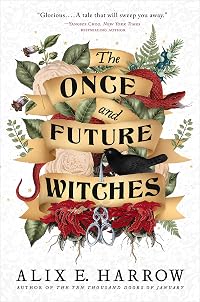
The Once and Future Witches
by Alix E. Harrow
On This Page
Description
In 1893, there's no such thing as witches. There used to be, in the wild, dark days before the burnings began, but now witching is nothing but tidy charms and nursery rhymes. If the modern woman wants any measure of power, she must find it at the ballot box.But when the three Eastwood sisters join the suffragists of New Salem, they begin to pursue the forgotten ways that might turn the women's movement into the witch's movement. Stalked by shadows and sickness, hunted by forces who will not show more suffer a witch to vote - and perhaps not even to live - the sisters must delve into the oldest magics, draw new alliances, and heal the bond between them if they want to survive. There's no such thing as witches. But there will be. show lessTags
Recommendations




Member Reviews
I can't imagine finding a more unique take on women fighting for their rights. Although the novel has quite a slow start, it eventually builds toward a compelling and suspenseful conclusion.
It's the 1800s. Three sisters are born into less than ideal circumstances. A mother who dies after the birth of the youngest. A drunken and abusive father. Fortunately, the girls have a strange but loving grandmother who shares her knowledge of herbs and "spells."
• Belle, the oldest, leaves home after someone exposes her darkest secret to her father.
• Agnes, becomes a librarian, navigating a hostile environment while struggling to protect her own secret.
• Juniper, the wildest of the three, has been deeply hurt and can't understand why her older show more sisters abandoned her to live alone with their father.
But even when separated, each sister still feels a strong, almost mystical, personal connection with the other two, innately sensing when one is in trouble. When the sisters finally reunite, they become involved with the budding Suffragette movement, fight against the political establishment -- all the while seeking to learn more about the lost world of Avalon.
The plot is much more creative and ingenious than my description but I don't want to give away any spoilers. Alix Harrow is an inventive writer and not afraid to struggle with her craft, as she readily admits in the book's ending Acknowledgments.
I greatly enjoyed and was impressed by Harrow's first book, The Ten Thousand Doors of January. But this one surpasses the first. show less
It's the 1800s. Three sisters are born into less than ideal circumstances. A mother who dies after the birth of the youngest. A drunken and abusive father. Fortunately, the girls have a strange but loving grandmother who shares her knowledge of herbs and "spells."
• Belle, the oldest, leaves home after someone exposes her darkest secret to her father.
• Agnes, becomes a librarian, navigating a hostile environment while struggling to protect her own secret.
• Juniper, the wildest of the three, has been deeply hurt and can't understand why her older show more sisters abandoned her to live alone with their father.
But even when separated, each sister still feels a strong, almost mystical, personal connection with the other two, innately sensing when one is in trouble. When the sisters finally reunite, they become involved with the budding Suffragette movement, fight against the political establishment -- all the while seeking to learn more about the lost world of Avalon.
The plot is much more creative and ingenious than my description but I don't want to give away any spoilers. Alix Harrow is an inventive writer and not afraid to struggle with her craft, as she readily admits in the book's ending Acknowledgments.
I greatly enjoyed and was impressed by Harrow's first book, The Ten Thousand Doors of January. But this one surpasses the first. show less
It’s hard to pin down the genre of this book, which at first just seems like a fantasy about witches. But it is so much more than that, including historical fiction, magical realism, a story of relationships between family, friends, and lovers, and perhaps most interestingly, a manifesto on feminist sociology and politics.
The central characters are three sisters, Agnes, Bella, and Juniper, who grew up with a cruel abusive father - “a mean drunk with hard knuckles who never loved anything or anyone as much as he loved corn liquor.” Their mother died during Juniper’s birth. Their grandmother, called Mama Mags, was a healer who taught the girls about herbs and spells. Back home, Juniper explained, “every mama teaches her show more daughters a few little charms to keep the soup-pot from boiling over or make the peonies bloom out of season.”
Mama Megs used to tell the girls fairytales of all kinds, and the girls remembered them as “doors to someplace else, someplace better” (harkening back to Harrow’s first book, The Ten Thousand Doors of January.) She told them that magic would never be totally eliminated “because it beats like a great red heartbeat on the other side of everything.” She also said that proper witching was “just a conversation with that red heartbeat, which only ever takes three things: the will to listen to it, the words to speak with it, and the way to let it into the world. The will, the words, and the way.”
But the words - how to find them? The sisters discover the words are hidden in plain sight, in places like children’s verses and stories, and in sewing samplers: “power passed in secret from mother to daughter, like swords disguised as sewing needles.”
James Juniper Eastwood, at age 17, was the youngest and wildest of the three sisters. She somehow survived alone with her father for seven years after her older sisters left without a word and with no further communications. It hurt her, the way “they’d just walked off the edge of the page and vanished, a pair of unfinished sentences….”
At least she had Mama Mags. When Mama Mags died in the winter of 1891 though, there was nothing to hold Juniper back from doing what she thought she had to do and leaving town, arriving in New Salem by train on the the spring equinox of 1893. Upon disembarking, Juniper was surprised to see her picture on wanted posters all over the train platform. She was accused of murder and suspected witchcraft. She thought: “Hell. They must have found him.” She also saw posters for a women’s enfranchisement meeting at St. George’s Square, and was drawn to it.
At the suffrage meeting, Juniper heard the women talk about equality and she understood immediately what they were really asking: Aren’t you tired yet? Of being cast down and cast aside? Of making do with crumbs when once we wore crowns? Aren’t you angry yet? Indeed, Juniper certainly was.
Agnes Amaranth Eastwood was the middle sister, five years older than Juniper and the strongest of the three. Agnes worked hard in a New Salem sweatshop where woman were exploited for their labor, tied there by their desperation for money.
Beatrice Belladonna Eastwood, called Bella, was the oldest sister, and the wisest of the three. She had been a librarian in New Salem for the past five years.
Agnes and Bella hadn't known they lived so close to one another. But once all three sisters were in the same place, the older two simultaneously experienced what Juniper did: “an invisible kite-string stretched tight between her and her sisters, thrumming with unsaid things and unfinished business. It feels like a beckoning finger, a hand shoving between her shoulder blades, a voice whispering a witch-tale about three sisters lost and found.” Thus, Agnes and Bella also felt the pull to go to St. George's Square.
When the three came together, they, along with the rest of the town, saw a vision of the tower of the Lost Way of Avalon, fronted by three circles woven together. Bella had seen this interlocking shape before, and knew to whom it belonged: the Last Three Witches of the West.
Bella was able to identify the vision because she spent her free time in the library searching for “the words and ways to call back the Lost Way of Avalon.” According to Mama Mags, the Lost Way of Avalon was “some great construct of stone and time and magic that preserved the wicked heart of women’s magic like seeds saved after winnowing.” She would ask Bella with a wink: what is lost, that can’t be found, Belladonna?”
The three started to work with the suffragettes, and in the process not only reconnected to each other but formed new relationships with others in the town.
Juniper discovered there were other women who wanted to tap into women's magic again and gain strength through it. This subgroup began to meet in secret, calling themselves The Sisters of Avalon, and strategizing about how to bring back the words and ways. They performed little public demonstrations of magic and left “The Sign of the Three” behind - the three interlocking circles.
Bella developed a relationship with Cleo Quinn, a black woman who shared her interests in both suffrage and witchcraft. But Cleo mostly worked with a society of black women, “The Daughters of Tituba,” that the women had formed out of necessity, [Indeed, there is a historical basis for racist attitudes by white women in the suffrage movement. On one occasion Susan B. Anthony even asked Frederick Douglass not to attend a gathering for women’s suffrage in Atlanta, Georgia because, as she later recalled: “I did not want anything to get in the way of bringing the Southern white women into our suffrage association.” In this book, one of the characters explained, “some worry that the inclusion of colored women might tarnish their respectable reputation; others feel they ought to spend a few more decades being grateful for their freedom before they agitate for anything so radical as rights. Most of them agree it would far more convenient if colored women remained in the Colored Women’s League.”]
Agnes had a new entanglement as well, and hers would change the lives of all the sisters.
Over time, the sister's quest to understand and realize their potential as women received an unexpected boost not by "witch-blood," which they concluded wasn't a thing, but by what many might claim was the greatest magic and source of strength: the power of love. Love came to each of them in different ways, conferring “teeth and talons” while also opening them up to an altogether new sort of risk.
Discussion: Women have always needed words and ways to survive in what has for so long been a man’s world, in which men have power not only through physical strength but because of their political, social, and economic advantages they have worked hard to maintain. The author's creation of a women's movement in New Salem allowed her to explore issues relevant to women (many of which remain problematic), even down to the lack of pockets in women’s clothes and the ideological tyranny behind that convention. She exposes not only the racial divide in the feminist movement, but the way oppressive gender and sexual norms affected (and continue to affect) women. She tackles the hypocrisy and co-optation (false consciousness, we say now) of those (both men and women) opposed to more freedom for women, and the way language - like the accusation of witchcraft - was and is still used to manipulate the populace to resist any change, particularly in women’s status.
As for the matter of witchcraft and magic, certainly there is at the very least magical realism in the book, but readers might also understand it metaphorically. The labeling of women who want their rights as "witches," and the methods resorted to by women trying to undermine and overturn that tyrannical suppression, has always been real, and this story just adds depth and color to the conceit.
Evaluation: Alix Harrow is certainly one of our most creative contemporary writers. Her stories give readers so much to think about, and her facility with language is impressive. She isn’t afraid to transgress the boundaries between reality and fantasy while always leaving readers with the option to look past the magic and find the truths about power, relationships, and society underneath. show less
The central characters are three sisters, Agnes, Bella, and Juniper, who grew up with a cruel abusive father - “a mean drunk with hard knuckles who never loved anything or anyone as much as he loved corn liquor.” Their mother died during Juniper’s birth. Their grandmother, called Mama Mags, was a healer who taught the girls about herbs and spells. Back home, Juniper explained, “every mama teaches her show more daughters a few little charms to keep the soup-pot from boiling over or make the peonies bloom out of season.”
Mama Megs used to tell the girls fairytales of all kinds, and the girls remembered them as “doors to someplace else, someplace better” (harkening back to Harrow’s first book, The Ten Thousand Doors of January.) She told them that magic would never be totally eliminated “because it beats like a great red heartbeat on the other side of everything.” She also said that proper witching was “just a conversation with that red heartbeat, which only ever takes three things: the will to listen to it, the words to speak with it, and the way to let it into the world. The will, the words, and the way.”
But the words - how to find them? The sisters discover the words are hidden in plain sight, in places like children’s verses and stories, and in sewing samplers: “power passed in secret from mother to daughter, like swords disguised as sewing needles.”
James Juniper Eastwood, at age 17, was the youngest and wildest of the three sisters. She somehow survived alone with her father for seven years after her older sisters left without a word and with no further communications. It hurt her, the way “they’d just walked off the edge of the page and vanished, a pair of unfinished sentences….”
At least she had Mama Mags. When Mama Mags died in the winter of 1891 though, there was nothing to hold Juniper back from doing what she thought she had to do and leaving town, arriving in New Salem by train on the the spring equinox of 1893. Upon disembarking, Juniper was surprised to see her picture on wanted posters all over the train platform. She was accused of murder and suspected witchcraft. She thought: “Hell. They must have found him.” She also saw posters for a women’s enfranchisement meeting at St. George’s Square, and was drawn to it.
At the suffrage meeting, Juniper heard the women talk about equality and she understood immediately what they were really asking: Aren’t you tired yet? Of being cast down and cast aside? Of making do with crumbs when once we wore crowns? Aren’t you angry yet? Indeed, Juniper certainly was.
Agnes Amaranth Eastwood was the middle sister, five years older than Juniper and the strongest of the three. Agnes worked hard in a New Salem sweatshop where woman were exploited for their labor, tied there by their desperation for money.
Beatrice Belladonna Eastwood, called Bella, was the oldest sister, and the wisest of the three. She had been a librarian in New Salem for the past five years.
Agnes and Bella hadn't known they lived so close to one another. But once all three sisters were in the same place, the older two simultaneously experienced what Juniper did: “an invisible kite-string stretched tight between her and her sisters, thrumming with unsaid things and unfinished business. It feels like a beckoning finger, a hand shoving between her shoulder blades, a voice whispering a witch-tale about three sisters lost and found.” Thus, Agnes and Bella also felt the pull to go to St. George's Square.
When the three came together, they, along with the rest of the town, saw a vision of the tower of the Lost Way of Avalon, fronted by three circles woven together. Bella had seen this interlocking shape before, and knew to whom it belonged: the Last Three Witches of the West.
Bella was able to identify the vision because she spent her free time in the library searching for “the words and ways to call back the Lost Way of Avalon.” According to Mama Mags, the Lost Way of Avalon was “some great construct of stone and time and magic that preserved the wicked heart of women’s magic like seeds saved after winnowing.” She would ask Bella with a wink: what is lost, that can’t be found, Belladonna?”
The three started to work with the suffragettes, and in the process not only reconnected to each other but formed new relationships with others in the town.
Juniper discovered there were other women who wanted to tap into women's magic again and gain strength through it. This subgroup began to meet in secret, calling themselves The Sisters of Avalon, and strategizing about how to bring back the words and ways. They performed little public demonstrations of magic and left “The Sign of the Three” behind - the three interlocking circles.
Bella developed a relationship with Cleo Quinn, a black woman who shared her interests in both suffrage and witchcraft. But Cleo mostly worked with a society of black women, “The Daughters of Tituba,” that the women had formed out of necessity, [Indeed, there is a historical basis for racist attitudes by white women in the suffrage movement. On one occasion Susan B. Anthony even asked Frederick Douglass not to attend a gathering for women’s suffrage in Atlanta, Georgia because, as she later recalled: “I did not want anything to get in the way of bringing the Southern white women into our suffrage association.” In this book, one of the characters explained, “some worry that the inclusion of colored women might tarnish their respectable reputation; others feel they ought to spend a few more decades being grateful for their freedom before they agitate for anything so radical as rights. Most of them agree it would far more convenient if colored women remained in the Colored Women’s League.”]
Agnes had a new entanglement as well, and hers would change the lives of all the sisters.
Over time, the sister's quest to understand and realize their potential as women received an unexpected boost not by "witch-blood," which they concluded wasn't a thing, but by what many might claim was the greatest magic and source of strength: the power of love. Love came to each of them in different ways, conferring “teeth and talons” while also opening them up to an altogether new sort of risk.
Discussion: Women have always needed words and ways to survive in what has for so long been a man’s world, in which men have power not only through physical strength but because of their political, social, and economic advantages they have worked hard to maintain. The author's creation of a women's movement in New Salem allowed her to explore issues relevant to women (many of which remain problematic), even down to the lack of pockets in women’s clothes and the ideological tyranny behind that convention. She exposes not only the racial divide in the feminist movement, but the way oppressive gender and sexual norms affected (and continue to affect) women. She tackles the hypocrisy and co-optation (false consciousness, we say now) of those (both men and women) opposed to more freedom for women, and the way language - like the accusation of witchcraft - was and is still used to manipulate the populace to resist any change, particularly in women’s status.
As for the matter of witchcraft and magic, certainly there is at the very least magical realism in the book, but readers might also understand it metaphorically. The labeling of women who want their rights as "witches," and the methods resorted to by women trying to undermine and overturn that tyrannical suppression, has always been real, and this story just adds depth and color to the conceit.
Evaluation: Alix Harrow is certainly one of our most creative contemporary writers. Her stories give readers so much to think about, and her facility with language is impressive. She isn’t afraid to transgress the boundaries between reality and fantasy while always leaving readers with the option to look past the magic and find the truths about power, relationships, and society underneath. show less
At about the 70% mark of this book, I sent a note to the author via Twitter, saying “I have never wanted a more visceral & violent end to an antagonist or villain as I wish upon Gideon Hill in your book.”
Reader, I was not disappointed.
Phenomenal book that takes a bit of time to get rolling, but once it does, it becomes a juggernaut of characters and plots so well woven and crafted that its end is both a surprise and inevitable.
E-ARC provided via Edelweiss & the publisher
Reader, I was not disappointed.
Phenomenal book that takes a bit of time to get rolling, but once it does, it becomes a juggernaut of characters and plots so well woven and crafted that its end is both a surprise and inevitable.
E-ARC provided via Edelweiss & the publisher
"The Once and Future Witches" intrigued me from the beginning. The way it is written was captivating. I love the little nursery rhymes at the beginning of each chapter. They spoke to my love for fairytales and myths. The whole story referenced pieces of fairytales and of some things that really happened, like the Salem witch trials, adapted of course to fit in this story, but it contributes to the "feels reals to me" feelings I felt while reading this book.
There are some great characters in this book, but I will stick to the sisters:
James Juniper Eastwood: She is the youngest sister. A loose cannon, dangerous and with a deranged moral compass. All of that because of the abuse she endured. I really liked her from the beginning because of show more her passion and "go for it" mentality even as I simultaniously got exhausted from shouting at her to do things differently.
Agnes Amaranth Eastwood: The middle sister and the one that I really couldn't bond with. Don't know exactly why, but some of it has to do with how calculating and cold she is, far too busy saving her own hide instead of helping others, especially at the first half of the book. Later on I started to feel some sympathy for her, after she gets feelings for Mr. Lee. It took me quite a while though.
Beatrice Belladonna Eastwood: The eldest sister and the one I liked the most. A librarian, silent and shy, old spinster-type and with a massive crush on Mrs. Quint. The way she handled things and the way she thought were very endearing to me and also a bit humourous. Not the laughing-out-loud kind, but the smile-on-the-inside-of-my-mind kind. Like in this part:
It's not earthshattering funny, but I enjoyed these bits of Bella's thoughts very much.
There were other characters very interesting, but they don't compare to the sisters, who combined have lived through almost all aspects of being a woman and went through almost all the different kind of trauma a woman can experience.
What I hated about them was the way they did not communicate with each other. It took a very long time before the misunderstandings that kept them apart were solved by talking to each other. It probably makes some sense it was written this way, but I really think it would have benefitted my involvement in the story if the sisters had figured this out a lot earlier on in this story. It made me almost not give 5 stars, but the writing and the plot have too much going for them to deny that last star.
The struggle for equality is the biggest theme in this book. Not only equality between men and women, but also between races, classes and between straight and LGBTQ . You feel the struggle for just being accepted for who you are and what you do throughout this story and it get's tough, scary, traumatic and sad. It makes it painful to read at times because these struggles exists even today and are far too real. Painful to read about, but necessary as well. What makes this a very good read is that it never get's too preaching, it felt very realistic to me and it remains within the narrative of the story.
The discrimination, the abuse, the mistrust between the sisters, all of this made for a heavy read. However, throughout the story you feel the hope for a better world, for better understanding, for equality. So for me it is more a grim story with a bit of hope here and there instead of a sad depressing one. And above all else this is a very well written story of three witch sisters who find each other through struggle and hardship. And that is a story well worth reading. show less
There are some great characters in this book, but I will stick to the sisters:
James Juniper Eastwood: She is the youngest sister. A loose cannon, dangerous and with a deranged moral compass. All of that because of the abuse she endured. I really liked her from the beginning because of show more her passion and "go for it" mentality even as I simultaniously got exhausted from shouting at her to do things differently.
Agnes Amaranth Eastwood: The middle sister and the one that I really couldn't bond with. Don't know exactly why, but some of it has to do with how calculating and cold she is, far too busy saving her own hide instead of helping others, especially at the first half of the book. Later on I started to feel some sympathy for her, after she gets feelings for Mr. Lee. It took me quite a while though.
Beatrice Belladonna Eastwood: The eldest sister and the one I liked the most. A librarian, silent and shy, old spinster-type and with a massive crush on Mrs. Quint. The way she handled things and the way she thought were very endearing to me and also a bit humourous. Not the laughing-out-loud kind, but the smile-on-the-inside-of-my-mind kind. Like in this part:
A “modern-day coven,” he calls them, seeking to bewitch young maidens and seduce God-fearing husbands. (Just the reverse, Beatrice thinks, and then spends several minutes shocked at her own wickedness.)
It's not earthshattering funny, but I enjoyed these bits of Bella's thoughts very much.
There were other characters very interesting, but they don't compare to the sisters, who combined have lived through almost all aspects of being a woman and went through almost all the different kind of trauma a woman can experience.
What I hated about them was the way they did not communicate with each other. It took a very long time before the misunderstandings that kept them apart were solved by talking to each other. It probably makes some sense it was written this way, but I really think it would have benefitted my involvement in the story if the sisters had figured this out a lot earlier on in this story. It made me almost not give 5 stars, but the writing and the plot have too much going for them to deny that last star.
The struggle for equality is the biggest theme in this book. Not only equality between men and women, but also between races, classes and between straight and LGBTQ . You feel the struggle for just being accepted for who you are and what you do throughout this story and it get's tough, scary, traumatic and sad. It makes it painful to read at times because these struggles exists even today and are far too real. Painful to read about, but necessary as well. What makes this a very good read is that it never get's too preaching, it felt very realistic to me and it remains within the narrative of the story.
The discrimination, the abuse, the mistrust between the sisters, all of this made for a heavy read. However, throughout the story you feel the hope for a better world, for better understanding, for equality. So for me it is more a grim story with a bit of hope here and there instead of a sad depressing one. And above all else this is a very well written story of three witch sisters who find each other through struggle and hardship. And that is a story well worth reading. show less
"There's no such thing as witches, but there used to be."
The three Eastwood sisters - Beatrice Belladonna, Agnes Amaranth, and James Juniper - are sent away or flee their father's home in Crow County. All three, separately, end up in New Salem in 1893, and together, somewhat accidentally, they call the Lost Way of Avalon, a tower inhabited by the Last Three (the Crone, the Mother, the Maiden) to appear in the center of St. George's square during a suffragists' event. A witch hunt ensues, led by the dangerous Gideon Hill, a candidate for mayor who brings a black dog with him everywhere and whose shadow doesn't behave in the usual way. Hounded, Wise Beatrice/Bella, beautiful, strong, pregnant Agnes, and wild, wayward Juniper find their show more way to each other, uncover past misunderstandings and hurts, and begin to gather and share knowledge with other women in New Salem, including African-American reporter Cleopatra Quinn, who turns out to be one of the Daughters of Tituba. Gideon is a formidable, insidious enemy, and every character suffers and sacrifices immensely, even ultimately; but there is hope in the end, and witchcraft - the will, the words, and the way - woven throughout.
"There's still no such thing as witches.
But there will be."
See also: The Future of Another Timeline by Annalee Newitz, The Power by Naomi Alderman, Carry On by Rainbow Rowell, The Ten Thousand Doors of January by Alix Harrow
Quotes
Mama Mags said...proper witching...only ever takes three things: the will to listen to it, the worlds to speak with it, and the way to let it into the world. The will, the words, and the way. (viii)
Beatrice remembers listening to her grandmother's stories as if they were doors to someplace else, someplace better. (19)
Juniper never thought much about her sisters' lives after they left Crow County - they'd just walked off the edge of the page and vanished, a pair of unfinished sentences... (29)
"Seems to me they're the same thing, more or less...Witching and women's rights. Suffrage and spells. They're both a kind of power, aren't they? The kind we're not allowed to have....They're better than the story we were given." (Juniper, 47)
"We may be either beloved or burned, but never trusted with any degree of power." (Miss Stone, 55)
She's been all of those things herself; she knows the black alchemy that transmutes hurt into hate. (Agnes, 110)
"Not every word and way belongs to you." (Gertrude to Juniper, 174)
[Beatrice] wonders if trust, once lost, can ever truly be found again...She decides she doesn't care, that maybe trust is neither lost nor found, broken nor mended, but merely given. Decided, despite the risk. (199)
"Must a thing be bound and shelved in order to matter? Some stories were never written down. Some stories were passed by whisper and song, mother to daughter to sister." (Cleo Quinn to Bella, 219)
"I may not be a witch, Miss Eastwood, but I'm quite a tolerable librarian." (Henry Blackwell to Beatrice, 221)
"Behind every witch is a woman wronged." (Mr. Blackwell to Beatrice, 222)
"What my mother taught me is this: you hide the most important things in the places that matter least....Places a man would never look." (Cleo Quinn to Beatrice, 241)
...he can feel the rules of the real shifting beneath his feet... (245)
"What if they didn't start as witch-burnings? What if they were book-burnings, in the beginning?" (Bella to Juniper, 277)
"Sometimes you can't fight. Sometimes you can only survive." (Agnes to August Lee, 291)
...full of unwieldy, fresh-hatched love. (Juniper for Eve, 333)
"If you want to blame someone for a fire, look for the men holding matches." (Quinn to Beatrice, 334)
Of the terrible risk of loving someone more than yourself and the secret strength it grants you. (Agnes, 346)
...her growing suspicion that witchcraft isn't one thing but many things, all the ways and words women have found to wreak their wills on the world. (Bella to Blackwell, 353)
...she thinks of the ways people make for themselves when there are none, the impossible things they render possible. (Bella, 394)
"That's all magic is, really: the space between what you have and what you need." (The Crone to Bella, 404)
Bella's fingertips fizz with the need to write it all down, to decant the marvels and curiosities of the last hour into the safety of ink and paper. (416)
She begins to believe that the words and ways are whichever ones a woman has, and that a witch is merely a woman who needs more than she has. (Bella, 507) show less
The three Eastwood sisters - Beatrice Belladonna, Agnes Amaranth, and James Juniper - are sent away or flee their father's home in Crow County. All three, separately, end up in New Salem in 1893, and together, somewhat accidentally, they call the Lost Way of Avalon, a tower inhabited by the Last Three (the Crone, the Mother, the Maiden) to appear in the center of St. George's square during a suffragists' event. A witch hunt ensues, led by the dangerous Gideon Hill, a candidate for mayor who brings a black dog with him everywhere and whose shadow doesn't behave in the usual way. Hounded, Wise Beatrice/Bella, beautiful, strong, pregnant Agnes, and wild, wayward Juniper find their show more way to each other, uncover past misunderstandings and hurts, and begin to gather and share knowledge with other women in New Salem, including African-American reporter Cleopatra Quinn, who turns out to be one of the Daughters of Tituba. Gideon is a formidable, insidious enemy, and every character suffers and sacrifices immensely, even ultimately; but there is hope in the end, and witchcraft - the will, the words, and the way - woven throughout.
"There's still no such thing as witches.
But there will be."
See also: The Future of Another Timeline by Annalee Newitz, The Power by Naomi Alderman, Carry On by Rainbow Rowell, The Ten Thousand Doors of January by Alix Harrow
Quotes
Mama Mags said...proper witching...only ever takes three things: the will to listen to it, the worlds to speak with it, and the way to let it into the world. The will, the words, and the way. (viii)
Beatrice remembers listening to her grandmother's stories as if they were doors to someplace else, someplace better. (19)
Juniper never thought much about her sisters' lives after they left Crow County - they'd just walked off the edge of the page and vanished, a pair of unfinished sentences... (29)
"Seems to me they're the same thing, more or less...Witching and women's rights. Suffrage and spells. They're both a kind of power, aren't they? The kind we're not allowed to have....They're better than the story we were given." (Juniper, 47)
"We may be either beloved or burned, but never trusted with any degree of power." (Miss Stone, 55)
She's been all of those things herself; she knows the black alchemy that transmutes hurt into hate. (Agnes, 110)
"Not every word and way belongs to you." (Gertrude to Juniper, 174)
[Beatrice] wonders if trust, once lost, can ever truly be found again...She decides she doesn't care, that maybe trust is neither lost nor found, broken nor mended, but merely given. Decided, despite the risk. (199)
"Must a thing be bound and shelved in order to matter? Some stories were never written down. Some stories were passed by whisper and song, mother to daughter to sister." (Cleo Quinn to Bella, 219)
"I may not be a witch, Miss Eastwood, but I'm quite a tolerable librarian." (Henry Blackwell to Beatrice, 221)
"Behind every witch is a woman wronged." (Mr. Blackwell to Beatrice, 222)
"What my mother taught me is this: you hide the most important things in the places that matter least....Places a man would never look." (Cleo Quinn to Beatrice, 241)
...he can feel the rules of the real shifting beneath his feet... (245)
"What if they didn't start as witch-burnings? What if they were book-burnings, in the beginning?" (Bella to Juniper, 277)
"Sometimes you can't fight. Sometimes you can only survive." (Agnes to August Lee, 291)
...full of unwieldy, fresh-hatched love. (Juniper for Eve, 333)
"If you want to blame someone for a fire, look for the men holding matches." (Quinn to Beatrice, 334)
Of the terrible risk of loving someone more than yourself and the secret strength it grants you. (Agnes, 346)
...her growing suspicion that witchcraft isn't one thing but many things, all the ways and words women have found to wreak their wills on the world. (Bella to Blackwell, 353)
...she thinks of the ways people make for themselves when there are none, the impossible things they render possible. (Bella, 394)
"That's all magic is, really: the space between what you have and what you need." (The Crone to Bella, 404)
Bella's fingertips fizz with the need to write it all down, to decant the marvels and curiosities of the last hour into the safety of ink and paper. (416)
She begins to believe that the words and ways are whichever ones a woman has, and that a witch is merely a woman who needs more than she has. (Bella, 507) show less
I love this book! It’s original, and beautifully crafted, with moments of sassy humor and heartbreaking tragedy. It’s set in a universe not quite just around the corner from ours – a universe that had its Seneca Falls Conference and 1890s Suffragette Movement, its own Chicago Pullman strike and its own Eugene Debs, but it's also a universe where the Sisters Grimm and Charlene Parreau collect fairy tales for children that may hold the ancient witchways hidden in their nursery stories and pat-a-cake rhymes. It’s a universe in which three sisters (it’s always three, you know) reunite after crimes and betrayals too dark to reveal, driven by righteous anger to try to revive the ancient arts. They are attracted at first to the show more independent spirit and feeling of sisterhood rising in the Suffragette movement, surely a match made in neither heaven nor hell, but possibly in some little pocket of reality that can be reached only through the rabbit hole.
Harrow is deft and sure-footed as she weaves a tale as compelling as any fairy-tale enchantment, uncovering layer after layer of the sisters’ characters as they move deeper and deeper into the battle to take charge of their own lives and their own destinies. They are helped, eventually, by other women (and A Few Good Men) who live in the New Salem of this universe – a city of rigidly gridded streets and determinedly upright citizens, who are nevertheless haunted by the heritage of their Old Salem, a city burned to ashes to rid itself of the stain of witchcraft. And yet there is something nasty and evil creeping around the edges of all this self-righteous purity, and the nascent coven, which names itself the Sisters of Avalon, quickly attract both its attention and its enmity.
Drawing both on the classic precepts of witchcraft and on the richly symbolic fabric of fairy tales and children’s rhymes, Harrow creates a tapestry both complex and compelling, with characters the reader can’t help rooting for. There are all sorts of surprises lurking in the corners, some great fun (who are those two sisters, Victoria and Tennessee, who show up from time to time?), some deeply hidden under two or three layers of deception, and some that present themselves as obvious to anyone familiar with what is popularly accepted as the lore of The Craft.
This is an ambitious and polished work, and not one that can be whizzed through over a long weekend. The reader will find total immersion here, and an unwillingness to put the book down to return to the mundane world. One might even say it’s almost as if the book were … well, enchanted might not be too strong a term. show less
Harrow is deft and sure-footed as she weaves a tale as compelling as any fairy-tale enchantment, uncovering layer after layer of the sisters’ characters as they move deeper and deeper into the battle to take charge of their own lives and their own destinies. They are helped, eventually, by other women (and A Few Good Men) who live in the New Salem of this universe – a city of rigidly gridded streets and determinedly upright citizens, who are nevertheless haunted by the heritage of their Old Salem, a city burned to ashes to rid itself of the stain of witchcraft. And yet there is something nasty and evil creeping around the edges of all this self-righteous purity, and the nascent coven, which names itself the Sisters of Avalon, quickly attract both its attention and its enmity.
Drawing both on the classic precepts of witchcraft and on the richly symbolic fabric of fairy tales and children’s rhymes, Harrow creates a tapestry both complex and compelling, with characters the reader can’t help rooting for. There are all sorts of surprises lurking in the corners, some great fun (who are those two sisters, Victoria and Tennessee, who show up from time to time?), some deeply hidden under two or three layers of deception, and some that present themselves as obvious to anyone familiar with what is popularly accepted as the lore of The Craft.
This is an ambitious and polished work, and not one that can be whizzed through over a long weekend. The reader will find total immersion here, and an unwillingness to put the book down to return to the mundane world. One might even say it’s almost as if the book were … well, enchanted might not be too strong a term. show less
What an extraordinary book. It was gifted/loaned by a friend, who had read it along with her daughter. Which gives me hope for the future!
This book takes the past of the Inquisition and focuses it on witch burnings. And how, in the created world, the result was a complete elimination of Women's Ways and magick. An example is the stories collected called "The Sisters Grimm" that contain variations on the familiar stories of childhood that are more instructional in magic and in this world's different history. That history includes the malevolence of spirit that ruthlessly hunts down and kills women throughout many generations. It also includes magick of thread and feather and chanted words, recognizing the overlooked items women keep in show more their pockets. A central focus is on the (in)famous town of Salem and asks, What if the Salem Witch Trials had culminated in burning all the inhabitants of that town? And what happens when the lust for power and the desire to punish combine to create a malevolent Spirit made of shadows?
The result is a well-crafted, deeply written, full book of three sisters who grow up without a mother, with an abusive father, and how his tearing them apart when they are young women preys on their minds and hearts. And yet, they find themselves drawn together at long last with the thread that binds them together. And because their grandmother continued to teach them spells and rhymes, they are able to track down the ways in which Witchcraft and Healing and Women's Ways have survived in stories and samplers and symbols carved on gateposts.
It is sometimes not an easy read, but it is timely and well worth the effort. show less
This book takes the past of the Inquisition and focuses it on witch burnings. And how, in the created world, the result was a complete elimination of Women's Ways and magick. An example is the stories collected called "The Sisters Grimm" that contain variations on the familiar stories of childhood that are more instructional in magic and in this world's different history. That history includes the malevolence of spirit that ruthlessly hunts down and kills women throughout many generations. It also includes magick of thread and feather and chanted words, recognizing the overlooked items women keep in show more their pockets. A central focus is on the (in)famous town of Salem and asks, What if the Salem Witch Trials had culminated in burning all the inhabitants of that town? And what happens when the lust for power and the desire to punish combine to create a malevolent Spirit made of shadows?
The result is a well-crafted, deeply written, full book of three sisters who grow up without a mother, with an abusive father, and how his tearing them apart when they are young women preys on their minds and hearts. And yet, they find themselves drawn together at long last with the thread that binds them together. And because their grandmother continued to teach them spells and rhymes, they are able to track down the ways in which Witchcraft and Healing and Women's Ways have survived in stories and samplers and symbols carved on gateposts.
It is sometimes not an easy read, but it is timely and well worth the effort. show less
Members
- Recently Added By
Published Reviews
ThingScore 100
Bella, Agnes, and Juniper Eastwood are nobodies. They are estranged from one another, broken, impotent, and invisible, all having suffered at the brutal hands of an abusive father. They are witches without the craft of witches, wayward women in a world that “binds and bridles” wayward women....Over the course of the novel, the sisters must overcome their past grievances and heal their show more fractures, build a sisterhood with other women, and rediscover and master the spells half-hidden by the witches of yore in fairy tales, nursery rhymes, lullabies, and children’s stories....Harrow’s story lies firmly within the feminist tradition, reflective of the social commentaries of modern feminist thinkers like Kate Manne and Rebecca Traister and reminiscent of women’s recent and growing exercise of their political power show less
added by Lemeritus
Combining an imaginative and fully realized system of magic, stellar worldbuilding and characters who grow, expand and subvert readers’ expectations on every page, THE ONCE AND FUTURE WITCHES is the perfect brew of magic and power. With themes of intersectional feminism, motherhood and the deep scars of trauma, Harrow provides readers with an intoxicating mix of fantasy and reality that will show more speak to both the powerless and the empowered, igniting a new fury within all who read it. show less
added by Lemeritus
If spells ("witch-ways" in the novel) are truly hidden in stories, then I know what spell is in The Once and Future Witches. It's the spell to claim a heart and dwell there, ever after. I unabashedly, unreservedly adore The Once and Future Witches. I adore it with the kind of passion that prickles at my eyes and wavers my voice. I adore it in a way that requires purchase of a giving copy, for show more friends in need. show less
added by melmore
Lists

Top Five Books of 2020
982 works; 348 members

Top Five Books of 2021
604 works; 181 members

2021 Hugo Eligible Novels
37 works; 14 members

Staff Picks
11 works; 1 member

LGBTQ+ Speculative Fiction
821 works; 51 members

Books Read in 2022
5,226 works; 115 members

Netgalley Reads
468 works; 3 members

Feminism
167 works; 4 members

Books Read in 2021
5,361 works; 114 members

Novels About Witchcraft
8 works; 1 member

READ IN 2022
206 works; 2 members

Books Mentioned in the A+ Autostraddle Pop Up Discords Nov 2022 & Dec 2022
223 works; 3 members

Witchy Fiction
253 works; 126 members

Queer Fiction (Owned TBR)
142 works; 1 member
Author Information

25+ Works 15,666 Members
Some Editions
Awards and Honors
Awards
Distinctions
Work Relationships
Common Knowledge
- Canonical title
- The Once and Future Witches
- Original title
- The Once and Future Witches
- Original publication date
- 2020-10
- People/Characters
- James Juniper Eastwood; Agnes Amaranth Eastwood; Beatrice Belladonna Eastwood; Cleopatra Quinn
- Dedication
- To my mother and grandmother and
all the women they burned before us - First words
- There's no such thing as witches, but there used to be.
- Quotations
- Maybe magic is just the space between what you have and what you need.
“Maybe you're right, and they didn't have anything to do with it. Still. Seems to me they're the same thing, more or less.” “What are?” Juniper's eyes reflect the bronze shine of Saint George's standing in the square.... (show all) “Witching and women's rights. Suffrage and spells. They're both…” She gestures in midair again. “They're both a kind of power, aren't they? The kind we aren't allowed to have.” The kind I want, says the hungry shine of her eyes.
He comes from broad-minded Quaker stock, but there are rules about people like Miss Quinn lingering too long in the Salem College Library. The rules aren't written down anywhere, but the important rules rarely are.
an endless stream of committees and subcommittees to keep her busy. She didn't think throwing down the tyranny of man would take so many meetings, but apparently it does.
Things always come in sevens in witch-tales (swans, dwarves, days to create the world), so Juniper figures they'll do fine.
The sky is such an unblemished blue it looks strangely unfinished, as if a careless painter has forgotten to add clouds and birds and slight variations in hue.
she supposes a person doesn't have to love their home in order to miss it.
The trick to being nothing is to want nothing.
“The doctor said the baby wasn't coming, that she would have to be extracted.” Bella tuts, setting glass jars in a neat line on the bedside table and clutching her black leather notebook. “I'm sure he did. But I remind ... (show all)you that he was merely a man. Whereas we”—she looks over her spectacles at Agnes and gives her a very small smile—“are witches.”
The trick to doing something stupid is to do it very quickly, before anyone can shout wait!
The previous week the City Council issued a statement that the suffrage question could not possibly be entertained in the current climate. “And frankly,” Mr. Hill had told the papers, “if this is what happens when women... (show all) gain some measure of power, we have grave doubts about the advisability of granting them more.”
“The Constitution? What, exactly, do you think the Constitution is? A magic spell? A dragon, perhaps, that will swoop down to defend you in your most desperate hour?” Cleo straightens in her seat. Juniper doesn't think sh... (show all)e's ever seen a face so full of scorn. “I assure you it has only ever been a piece of paper, and it has only ever applied to a very few persons.”
She thinks how very tiresome it is to love and be loved. She can't even risk her life properly, because it no longer belongs solely to her.
“In the stories, it's generally best to do whatever the hell the talking animal tells you.”
If you three were chosen, it was by circumstance. By your own need. That's all magic is, really: the space between what you have and what you need.”
August touches his bitten lips with the expression of a person who has suffered a religious revelation or a recent head injury. - Last words
- (Click to show. Warning: May contain spoilers.)Once upon a time there were three witches.
- Blurbers
- Choo, Yanhsze; Womack, Gwendolyn; Gailey, Sarah
- Original language*
- English
- Canonical DDC/MDS
- 813.6
- Canonical LCC
- PS3608.A783854
*Some information comes from Common Knowledge in other languages. Click "Edit" for more information.
Classifications
Statistics
- Members
- 3,782
- Popularity
- 4,213
- Reviews
- 105
- Rating
- (4.09)
- Languages
- 8 — Dutch, English, French, German, Italian, Polish, Portuguese, Spanish
- Media
- Paper, Audiobook, Ebook
- ISBNs
- 26
- ASINs
- 9